IN THIS ARTICLE:
- Introduction: The Freedom of the Road, Delivered by Professionals
- Understanding the Fleet: Classes and Types of RVs
- Methods of Transport: How We Get Your RV Home
- Measuring for Success: Why Every Inch Counts
- The Mechanics of the Move: Planning and Execution
- 5 Critical Steps to Preparing Your RV for Transport
- Navigating the Legal Road: DOT Regulations for RV Transport
- The Financial Landscape: Understanding RV Shipping Rates
- The Role of Technology: RV Transport Load Boards
- Special Cases: Moving the “Immovable” and Broken Down Units
- Why Every Owner Should Read Travel Trailer Blogs
- Protection and Security: Camper on a Flatbed Trailer
- Conclusion
- FAQ
Introduction: The Freedom of the Road, Delivered by Professionals
There is nothing quite like the American dream of hitting the open road in a recreational vehicle. It’s about the national parks, the family campfires, and the absolute freedom to change your backyard every single morning. But let’s be honest: sometimes the “road” part of that dream is a bit much to handle on your own. Maybe you’ve just invested in a beautiful new unit across the country and don’t have the time to drive it back yourself. Perhaps you are a “snowbird” heading south for the winter, or worse, you’re stranded on the shoulder with a broken-downtrailer that needs a professional tow.
In 2026, the logistics of moving these massive homes-on-wheels have evolved. It’s no longer just about finding a guy with a hitch; it’s about navigating complex safety standards and ensuring your investment is handled with expert care. At Monarch Transport Group, we’ve seen every scenario imaginable. We know that whether you need to move RV units for a cross-country relocation or a seasonal change, the process should be transparent and stress-free. This guide is designed to give you the straight answers you need for a successful journey.
Understanding the Fleet: Classes and Types of RVs
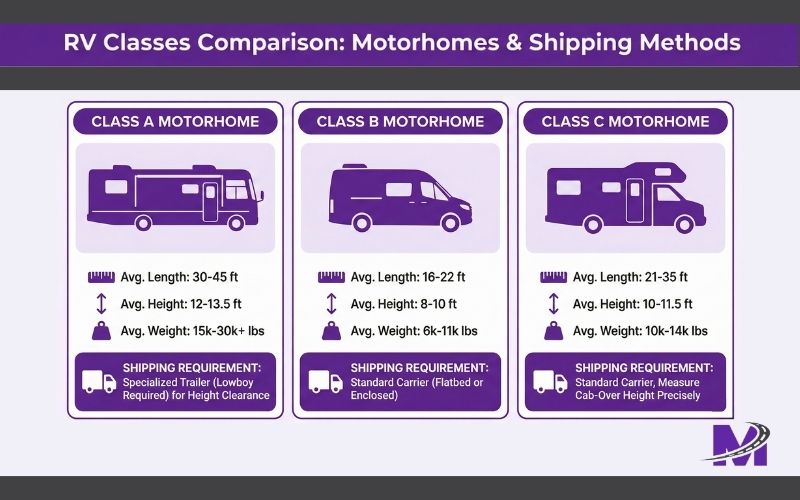
Before you start looking at any digital boards or calling for quotes, you need to understand that in our industry, the type of vehicle dictates the entire strategy. In the world of specialized RV transport services, size, weight, and aerodynamics change every aspect of the mission.
When we talk about motorhome shipping, we are usually dealing with self-propelled units.
Travel Trailers and Campers
If you are looking to ship travel trailer units, you are dealing with what we call “towables.” It’s a huge category, you’ve got everything from those massive, luxury Fifth Wheels that feel like rolling apartments to tiny teardrop campers for quick weekend trips. You have to realize that hauling RV trailers is a completely different beast compared to just driving a motorhome. Since these units don’t move on their own, their stability on the highway comes down to two things: the gear being used and the driver’s experience. Whether you choose a flatbed trailer or a standard tow-away, getting the weight distribution right is everything. Even a small mistake there can cause the trailer to sway at high speeds, so we take the time to make sure every hitch and connection is spot-on for a smooth trip to your next campsite.
Methods of Transport: How We Get Your RV Home
At Monarch Transport Group, we offer three primary ways to move your vehicle. The “best” way isn’t just about price; it’s about what is safest for your specific model and its current mechanical condition.
1. Drive-Away Service
This is a popular choice for motorhome shipping. We assign a professional, CDL-certified driver to get behind the wheel of your RV and drive it directly to your destination. It’s efficient and doesn’t require extra equipment. However, keep in mind that this adds mileage and general wear to your vehicle. It’s often the fastest way to get your motorhome from point A to point B without worrying about trailer heights.
2. Flatbed and Lowboy Transport
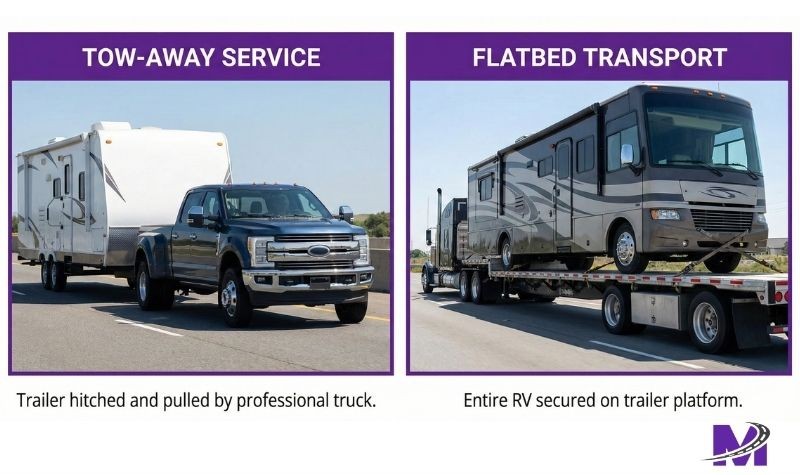
If you’re the kind of owner who hates the idea of adding extra miles to your tires, putting a travel trailer on a flatbed or a specialized lowboy is really the gold standard. We often suggest a camper with a flatbed trailer setup for those long-distance hauls where you want to keep the chassis completely off the pavement. It just saves so much wear and tear in the long run. Now, if you’re moving one of those massive Class A units, lowboy trailers are pretty much a necessity. They sit much lower to the ground, which is the only way to keep those taller rigs under the legal height limits and away from low-hanging highway overpasses.
3. Tow-Away Service
This is probably the most common way to haul campers that we see every day. Essentially, a professional heavy-duty truck hitches up to your trailer and pulls it, much like you’d do with your own pickup, only with a lot more stability and constant monitoring. It’s a solid, cost-effective solution that works with just about any towable RV. It’s simple, it’s reliable, and it’s usually the first choice for people who want their trailer delivered quickly without the extra complexity of loading it onto another platform.
Measuring for Success: Why Every Inch Counts
When you call us to ship RV units across state lines, the very first thing we will ask for is precise dimensions. We don’t just mean the specs you found in the original owner’s manual; those often don’t account for the “extras” that make an RV a home. You need to measure the vehicle in its current, road-ready state.
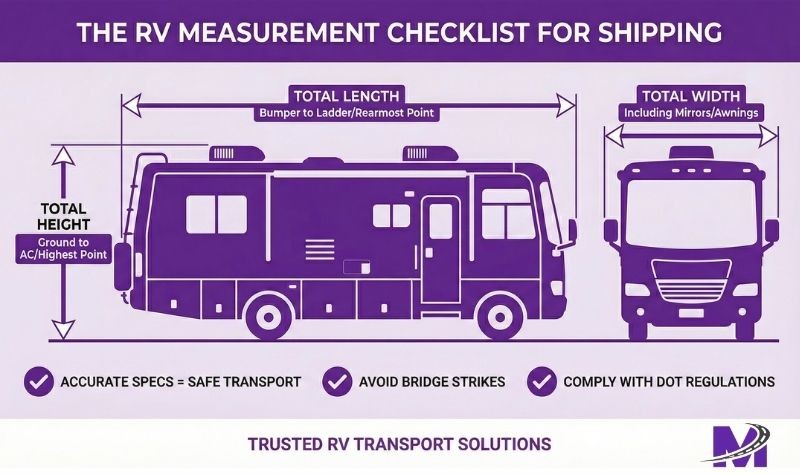
Providing these details correctly ensures that the RV-hauling trailers assigned to your shipment are the correct size and that we remain in full compliance with all safety regulations regarding “oversize loads.”
The Mechanics of the Move: Planning and Execution
You might have heard of an RV transport load board during your research. These are digital marketplaces where shipments are listed. While some owners try to navigate these boards themselves, it is a high-risk move. Without a professional broker like Monarch Transport Group, you have no way to verify if a driver actually meets the necessary RV transport truck requirements.
Shipping an RV cross-country is a massive logistical puzzle. It involves planning fuel stops at stations that can accommodate 80-foot rigs, finding safe overnight parking, and navigating through unpredictable mountain weather. Whether we are hauling travel trailers through a summer heatwave or moving a unit during the winter, we manage the “behind the scenes” details so you can focus on your move.
5 Critical Steps to Preparing Your RV for Transport
Preparing your RV for transport is the most important responsibility an owner has. Think of it like prepping for an earthquake that lasts for three days. If you don’t secure the interior, the contents of your cabinets will be destroyed by the time the driver arrives at the destination.
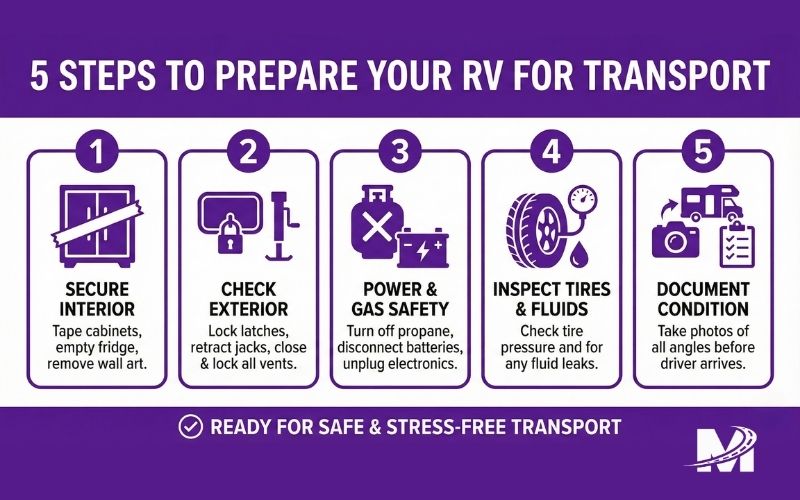
1. Interior Security
Anything that can move will move. Use painter’s tape to secure cabinet doors, empty the fridge, and take down any wall art or mirrors. When shipping an RV, the constant road vibrations act like a slow-motion blender on your belongings.
2. Exterior Security Check
Walk around your RV and make sure every exterior storage-compartment latch is secure. If you’re hauling a travel trailer, double-check that the stabilizer jacks are fully retracted. Take a quick look at the roof to ensure all vents are not only closed but locked. Any vent catching the wind at highway speed can get torn off in seconds.
3. Power and Propane Safety
Safety comes first. Turn off the propane at the main tank and release any remaining pressure in the lines. Disconnect the house batteries and unplug all sensitive electronics. For travel trailers, also make sure the tongue jack and safety chains are in good working order before the driver takes off.
4. Tire and Chassis Inspection
If your RV is being towed or driven, make sure the tires are inflated to the manufacturer’s recommended pressure. A tire blowout on a heavy RV during a long trip is a serious hazard. Check for any fluid leaks that could cause a fire or damage the transport equipment.
5. Document Everything
Before the driver pulls away, take photos and videos from all angles. Capture any scratches, dents, or other imperfections. Having a clear record of your RV’s condition before transport makes it much easier to verify its condition upon arrival and gives you peace of mind.
Navigating the Legal Road: DOT Regulations for RV Transport
When it comes to cross-country RV transport, it isn’t just about having a strong truck and a steady hand. The Department of Transportation (DOT) has strict rules that every professional RV transport service must follow to the letter. These regulations are designed to keep the driver, your vehicle, and Federal Motor motorists safe on the highway. If you are shipping an RV that exceeds standard road dimensions, usually anything wider than 8.5 feet or taller than 13.5 feet, it enters the complex territory of “oversize loads.”
DOT regulations for RV transport require specific permits for every state the vehicle passes through. In some cases, depending on the route and the unit’s size, you might even need escort vehicles (pilot cars) to lead the way. At Monarch Transport Group, we handle all this red tape for you. We ensure that the RV hauling trailers we use are fully compliant with federal weight limits and that our drivers strictly adhere to “Hours of Service” rules to prevent fatigue-related accidents. Whether you are hauling travel trailers or a massive Class A motorhome, staying within the law is the only way to ensure a delivery without legal delays or fines.
The Financial Landscape: Understanding RV Shipping Rates
One thing people often overlook is “Air Drag.” A massive, boxy trailer isn’t just heavy; it’s basically a giant sail against the wind. This resistance forces the transport truck to burn significantly more fuel, which is a big reason why travel trailer transportation usually carries a higher price tag per mile than, say, a sleek camper van.
Then there’s the timing. The cost to ship travel trailer units isn’t static; it breathes with the market. Diesel prices play a huge role, but so does the calendar. If you’re planning to move RV units right when the “snowbirds” start flocking to Arizona or Florida, you’re going to run into peak-demand pricing. At Monarch Transport Group, we don’t believe in hiding these facts. We provide transparent quotes that break down the math upfront, so you aren’t left staring at “surprise” surcharges once the driver reaches your driveway.
The Role of Technology: RV Transport Load Boards
If you’ve spent any time researching how to move your rig, you’ve likely stumbled upon an RV transport load board. Think of these as digital marketplaces where anybody can post a job and any driver can bid on it. On the surface, it looks simple, but for an owner without logistical experience, it can be a real gamble. The problem with a public RV transport load board is the lack of accountability. You’re essentially handing your keys to someone whose insurance status or safety record you can’t truly verify.
At Monarch Transport Group, we do use these platforms, but only as one small part of a much larger network. Our real work happens behind the scenes. We don’t just hunt for the lowest price; we filter for the driver who actually meets our specific RV transport truck requirements. This means we’re digging into their active DOT authority, checking their cargo insurance limits, and looking at their history with heavy loads. When we haul campers for our clients in 2026, we prioritize security over a “cheap deal.” We believe transparency is the only way to ensure the person behind the wheel is a true professional, not just someone with a hitch and a spare afternoon.
Special Cases: Moving the “Immovable” and Broken Down Units
Sometimes, the need for transport isn’t part of a planned vacation. We often assist clients who are facing a stressful emergency, such as a broken-down trailer on the side of a highway or a unit that has sat in storage for years and is no longer roadworthy. In these situations, a standard tow-away service isn’t an option because the tires or axles might not be safe for the road.
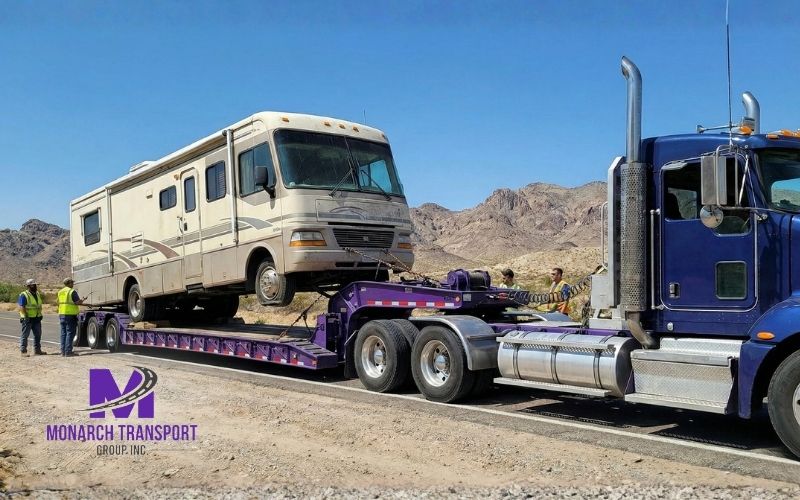
This is where a specialized camper hauling trailer or a lowboy becomes essential. We provide a professional RV haul that utilizes winches and specialized ramps to get your non-running unit off the ground and onto a secure platform. If you have a heavy RV that needs a “rescue,” it’s vital to communicate the vehicle’s exact mechanical condition when booking. This allows us to send the correct RV hauling trailers equipped with the power and tools needed to load and secure an inoperable vehicle safely.
Why Every Owner Should Read Travel Trailer Blogs
If you are new to RV ownership, we highly recommend immersing yourself in the community. Travel trailer blogs are an incredible resource for “real-world” advice that you won’t find in a manufacturer’s manual. These enthusiasts share their personal stories about shipping travel trailer units, giving you a glimpse into the practical challenges of life on the road.
At Monarch Transport Group, we love it when our customers stay informed. Reading travel trailer blogs can help you pick up on small but crucial details, such as how to properly winterize your plumbing before shipping an RV cross-country during the colder months. These blogs also offer insights into the best types of RV transport trailers for specific terrain, helping you feel more confident when discussing your options with our team. The more you know about the RV’s maintenance and prep, the smoother your transport experience will be.
Protection and Security: Camper on a Flatbed Trailer
A common debate among owners is whether it’s better to tow a unit or carry it. While towing is efficient, putting a camper on a flatbed trailer is the ultimate way to protect your investment. When you choose a travel trailer with a flatbed setup, your RV is treated as high-value cargo rather than a vehicle in use. This means there is zero tire wear, no risk of a blowout, and no strain on the suspension system over long distances.
For many of our clients, a camper with a flatbed trailer configuration provides the peace of mind they need when moving a brand-new or vintage unit. It keeps the vehicle high off the road, away from kicked-up rocks and debris. While the cost to ship travel trailer units this way is typically higher than a standard tow, the savings in long-term maintenance and the preservation of the unit’s value often make it the smartest choice for serious enthusiasts.
Conclusion
Choosing someone to handle your RV is, more than anything, a matter of trust. You’re not just moving a piece of equipment; you’re handing over a major investment, and often a second home, to someone you’ve likely never met. At Monarch Transport Group, we’ve built our reputation on being the reliable middleman who ensures trust isn’t misplaced. We don’t look at these as just “loads” to be moved from point A to point B. Whether you need to haul campers to a nearby state or you’re looking for a massive cross-country RV transport solution, our focus is the same: getting your vehicle there in the exact same condition it left in. In this industry, being on time and being safe isn’t just a goal; it’s the only way we do business.
FAQ
Many people ask how to get into hauling campers as a career path. It requires a heavy-duty truck (usually 1-ton or larger), a clean driving record, and a solid understanding of DOT safety standards. Most independent drivers start by partnering with a broker like Monarch Transport Group to gain access to a steady stream of shipments and to ensure they are operating within federal regulations. It’s a demanding job that requires great attention to detail and a commitment to vehicle safety.
The total cost to ship travel trailer or motorhome units varies significantly based on distance and size. On average, for a cross-country RV transport, you might look at rates ranging from $1.50 to $3.50 per mile. Shorter trips typically have a higher per-mile rate due to the fixed costs of loading and unloading. Always request a detailed quote from Monarch Transport Group to get the most accurate pricing for your specific route and vehicle type.
Absolutely. We specialize in moving vehicles that are no longer roadworthy. However, a broken-down trailer requires a camper hauling trailer equipped with a winch or a “roll-back” mechanism. It is crucial to inform your agent of the mechanical condition upfront so we can provide the appropriate RV-haul equipment and avoid delays at the pickup site.
For tow-away services, the truck must have a towing capacity that exceeds the weight of the heavy RV, along with proper hitching equipment (like a 5th-wheel or gooseneck plate) and integrated trailer brake controllers. For hauling, we utilize various RV transport trailers such as step-decks or lowboys to ensure the total height of the load remains within the legal limit of 13’6″ to avoid bridge strikes.
Honestly, the best thing you can do is make sure everything inside and out is completely “static.” Since preparing your RV for transport is the owner’s responsibility, you really want to focus on the details that might fail at 65 mph. This means double-checking that every cabinet is taped or latched shut and that no loose items are left to slide around the floor. On the outside, you’ve got to be sure all vents are locked down, and the tires are aired up properly. Taking an hour to go over these small things yourself is the best way to avoid a headache later and ensure your cross-country RV transport goes off without a single scratch.
We strongly recommend against it. Per DOT regulations for RV transport, carriers aren’t licensed to move household goods inside a vehicle, and, more importantly, the carrier’s insurance won’t cover them if they’re damaged or stolen. Items also tend to shift during cross-country RV transport, which can cause mirrors or cabinets to break. To keep things simple and safe, it’s best to clear out your personal gear and leave only what’s permanently attached to the rig.