
IN THIS ARTICLE:
- How Does Boat Beam Width Affect Shipping Cost?
- Transport Methods: Tow-Away Service vs. Specialized Hauling
- Average Boat Shipping Costs in 2026: What to Expect
- Preparing Your Vessel for Overland Transport
- Understanding Marine Transport Insurance
- Navigating Marine Brokers, Carriers, and DOT Compliance
- Conclusion
- FAQ: Boat Transport
Professional boat transport is the logistical process of moving a watercraft overland via specialized marine carriers. In 2026, standard domestic boat shipping costs range from $1.50 to $3.50 per mile, depending heavily on the vessel’s beam width, overall length, and routing requirements. Primary transport methods include tow-away service (using the owner’s roadworthy trailer) and flatbed or lowboy hauling for untrailered vessels and larger yachts requiring commercial Department of Transportation (DOT) permits.
Moving a car is relatively simple because cars are predictable. They have standardized wheelbases, known curb weights, and generally fit inside a neat rectangular box. Moving a boat is a completely different beast. You are essentially paying a logistics company to haul a fragile, awkwardly shaped fiberglass bathtub down an interstate highway at 70 miles per hour.
The marine transport industry doesn’t play guessing games. When a dispatcher looks at your quote request, they aren’t just looking at the mileage; they are looking at bridge clearances, weigh station regulations, and the exact dimensional footprint of your hull. If you buy a center console in Florida and need it shipped up to Michigan, treating the logistics like a standard auto transport will result in blown-out tires, delayed shipments, or a massive surprise bill at the marina.
Let’s break down exactly how professional boat haulers calculate their rates, what physical methods they use to get your vessel across state lines, and why a few inches of fiberglass can instantly double your shipping costs.
How Does Boat Beam Width Affect Shipping Cost?
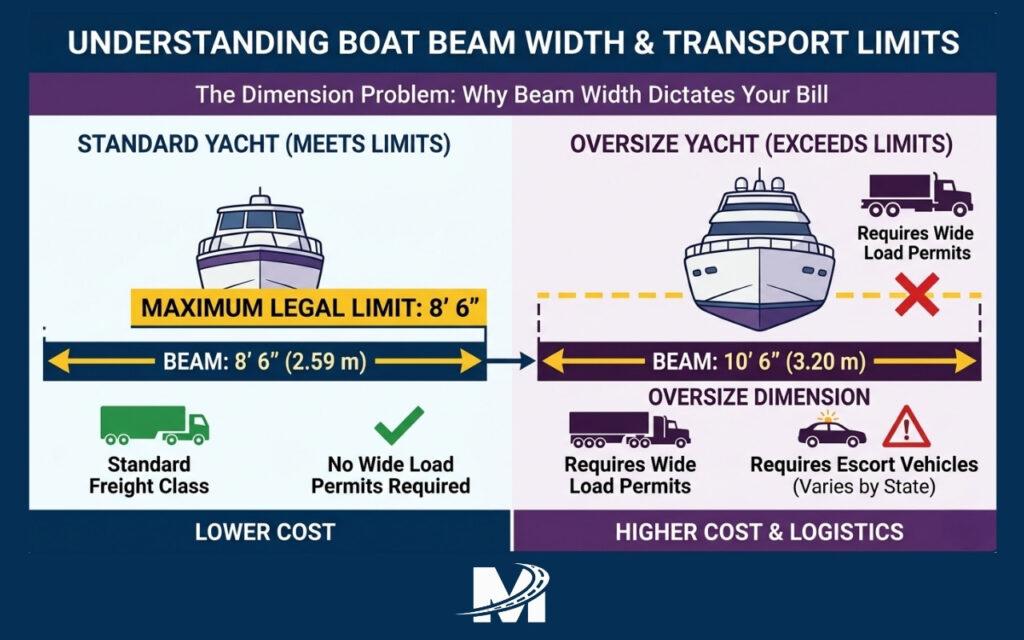
In the world of overland freight, height and width are everything. Your boat’s length determines the size of the trailer, but the beam (the widest point of the boat) dictates the legality of the transport itself.
| Beam Width | Load Status | Permits Required | Escort Vehicles |
| Under 8’6″ | Standard | None | No |
| 8’7″ – 10′ | Oversize | Per state | No |
| 10′ – 12′ | Oversize | Per state | Possibly |
| 12’+ | Oversize | Per state | Yes |
| 14’+ | Extreme Oversize | Per state + route survey | Police escort |
The Legal Limit: 8 Feet, 6 Inches
Across almost all North American highways, the maximum legal width for a standard load is 8 feet, 6 inches (102 inches). If your bass boat, ski boat, or small runabout fits within this limit, congratulations. You are dealing with standard freight. The carrier doesn’t need special routing, and the cost per mile remains relatively low.
The Oversize Nightmare: Beyond 8’6″
The moment your boat’s beam hits 8 feet, 7 inches, you enter “oversize load” territory.
If you are shipping a wide-beam cruiser or a catamaran, the carrier must legally obtain oversize permits for every single state they drive through. If the beam exceeds 10 to 12 feet (depending on state laws), the DOT will require the carrier to hire civilian escort vehicles (those cars with the flashing yellow lights and “OVERSIZE LOAD” banners) to drive in front of or behind the rig. In extreme cases, like moving a 14-foot beam yacht, you might even have to pay for local police escorts to temporarily block intersections.
Furthermore, oversize loads are heavily restricted. They usually cannot travel at night, on weekends, or during major holidays. This means a trip that would normally take a standard truck two days might take a boat hauler five days. You are paying for that extra time on the road.
Transport Methods: Tow-Away Service vs. Specialized Hauling
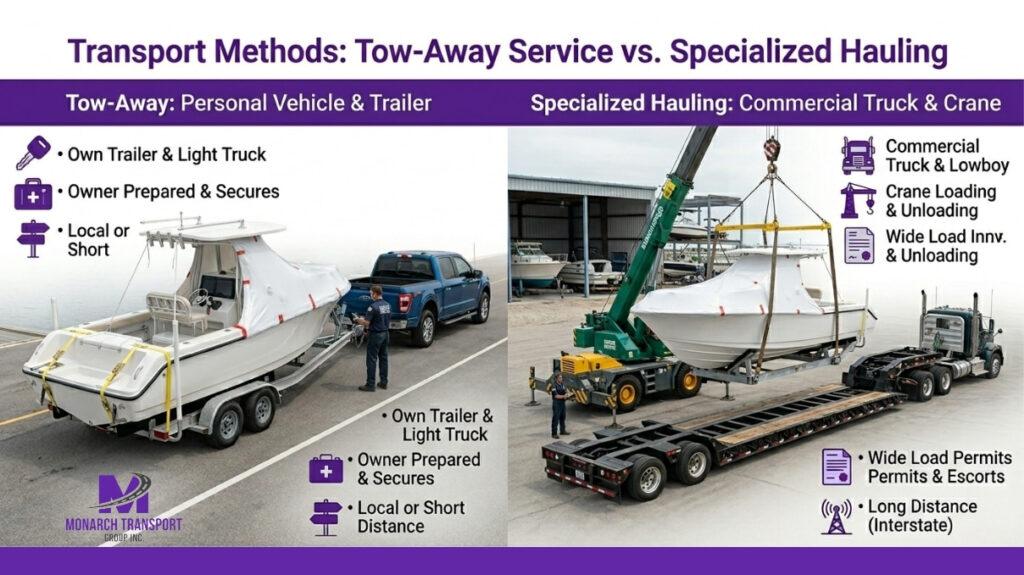
How the boat physically travels depends on what is sitting underneath the hull right now. Carriers generally offer two main solutions.
1. Tow-Away Service (Power Only)
This is exactly what it sounds like. If your boat is already sitting on a trailer, the transport company simply sends a heavy-duty pickup truck (like a Ford F-350 dually or a Freightliner SportChassis) to hook up to your hitch and tow it away.
This is the cheapest method, but it shifts a massive amount of liability onto you, the owner. The carrier’s insurance covers their truck and their driving, but your trailer must be roadworthy. If a 10-year-old tire blows out at highway speeds and damages the hull, or if the wheel bearings seize up and start a grease fire, you are responsible for the repair costs and the carrier’s downtime.
2. Flatbed, Step-Deck, and Lowboy Hauling
If you are buying a boat that lives in a slip on the water, or if you simply don’t trust your rusty single-axle trailer to survive a cross-country trip, the boat must be loaded onto the carrier’s commercial trailer.
The hidden catch here is the loading process. A truck driver cannot manually lift a 10,000-pound cabin cruiser onto their flatbed. You must arrange (and pay for) a marina with a marine travel lift or a commercial crane to hoist the boat out of the water and lower it onto the carrier’s trailer at the origin, and do the exact same thing at the destination.
| Method | Best For | Crane Required | Relative Cost |
| Tow-Away | Trailered boats under 8’6″ | No | $ |
| Flatbed | Small untrailered boats | Yes | $$ |
| Step-Deck | Mid-size yachts, cruisers | Yes | $$$ |
| Lowboy | Large yachts, sailboats, deep keels | Yes | $$$$ |
Average Boat Shipping Costs in 2026: What to Expect
Pricing in marine logistics is volatile. Two variables drive every invoice: diesel fuel costs and seasonal demand. Spring launches and fall winterizations consistently push rates above baseline – book early if your move falls between March and May or September and November.
Baseline averages for professional domestic transport in 2026 are well-established:
| Transport Distance | Cost per Mile (Standard) | Estimated Total |
| Short-Haul (0–300 miles) | $2.50–$3.75 | $400–$1,100 |
| Mid-Haul (300–1,000 miles) | $2.00–$3.00 | $800–$2,800 |
| Cross-Country (1,000+ miles) | $1.50–$2.50 | $2,000–$5,500+ |
These figures apply to standard legal-width vessels with a beam under 8’6″. Oversize permits and escort vehicle fees are billed separately.
Per-mile rates drop on longer hauls, but total mileage drives the final invoice up regardless. Specialized watercraft – deep-draft sailboats, wide-beam cruisers, catamarans – consistently land at the top of every range. Complex keel blocking, mast removal, and extended lowboy trailer requirements all add cost before the truck leaves the yard.
Estimate Your Boat Shipping Cost
Every boat shipping estimate depends on four variables: total mileage, beam width, trailer type, and current fuel surcharges. The ranges above apply to standard legal-width vessels – your actual quote shifts the moment beam exceeds 8’6″ or a lowboy trailer is required. Use the boat shipping cost calculator below to get a route-specific transport estimate in under 60 seconds.
These figures reflect baseline boat transport estimates for standard domestic routes across the continental United States. Oversize permit fees, escort vehicle costs, and marina crane charges are quoted separately. For an exact number tied to your vessel’s dimensions and pickup zip code, request a full quote from our dispatch team.
Preparing Your Vessel for Overland Transport
Preparing a vessel for overland transport requires securing loose gear, draining water systems, and disconnecting batteries to comply with Department of Transportation (DOT) safety regulations. Owners must remove external electronics, canvas covers, and hazardous materials while strictly managing fuel levels. Proper preparation prevents structural transit damage and ensures carrier liability coverage remains valid.
You have to change your perspective on what is about to happen to your boat. When your vessel is sitting in a marina or idling through a no-wake zone, it is in its natural habitat. When it is strapped to a steel trailer moving 70 miles per hour down Interstate 95, it is essentially enduring a multi-day Category 1 hurricane.
The wind shear, the intense road vibrations, and the flying debris will exploit any weak point on the hull or topside. If you hand the keys to the transport driver without physically stripping and securing the boat yourself, you’ll be picking up pieces of your expensive marine electronics off the side of the highway. The driver’s job is to drive the truck, not to pack your cabin.
Here is what actually needs to be done before the crane lifts your boat onto the flatbed.
The 70 MPH Hurricane: Canvas, Shrink Wrap, and Wind
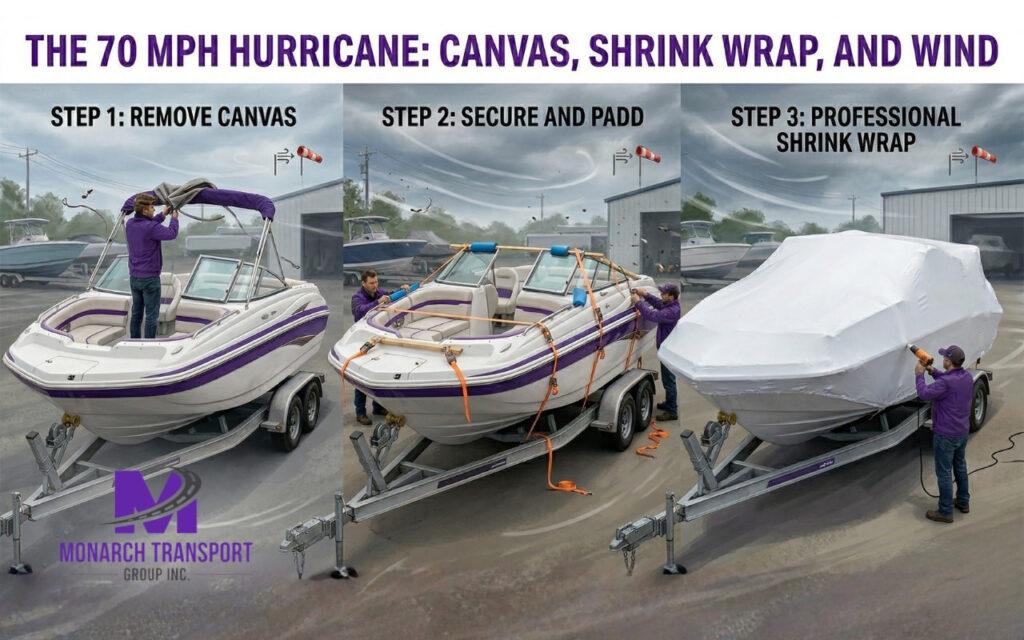
Wind is the absolute enemy of overland boat transport. If you leave your Bimini top up, the frame will violently bend and snap within the first fifty miles. If you leave your custom mooring cover loosely tied, the wind will get underneath it, turn it into a parachute, and physically rip the cleats right out of the fiberglass deck.
Fluid Management and Winterization
Transport companies are legally terrified of hazardous material leaks. A boat leaking 50 gallons of diesel fuel onto a commercial highway triggers a massive EPA environmental response, and the fines are catastrophic.
You must drop your fuel and water levels. Keep the gas or diesel tank at exactly one-quarter full. This leaves enough fuel to run the engines for loading and unloading, if necessary, while drastically reducing the vessel’s overall weight and minimizing fire risk.
Furthermore, if you are shipping a boat from Florida to New York in November, you cannot ignore the climate shift. The truck might drive through freezing temperatures in the Appalachian Mountains. If there is raw water sitting in your engine block, generator, or the air conditioning lines, it will freeze, expand, and crack the metal. You must fully winterize the mechanical systems before the boat ever leaves the warm weather.
Topsides and Electronics Teardown
Auto carriers don’t want the liability of your expensive toys. Strip the topsides completely.
Understanding Marine Transport Insurance
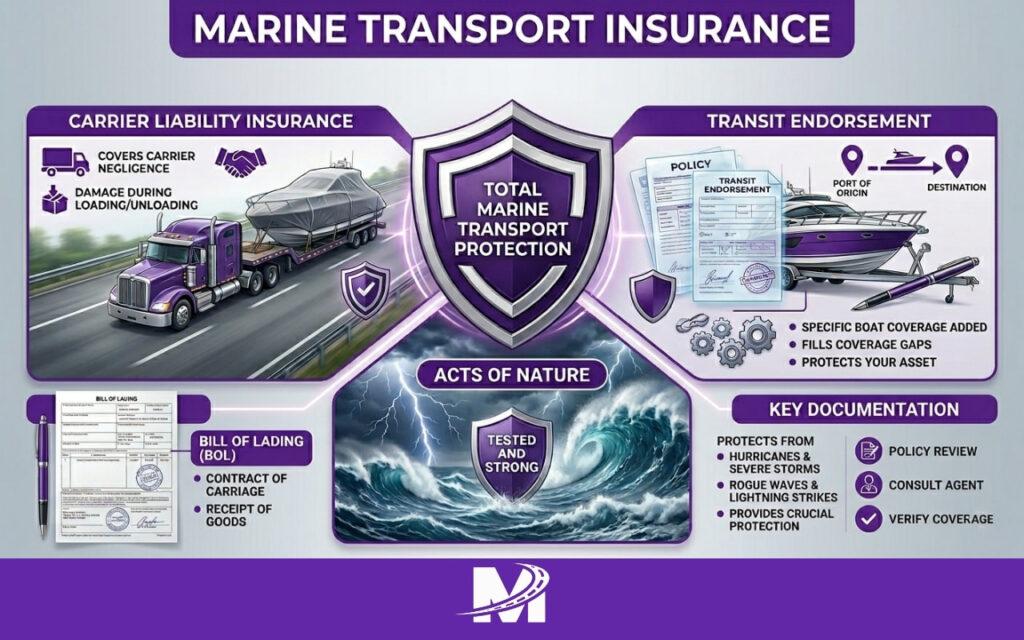
Marine transportation insurance is based on the carrier’s own contingent cargo policy, which generally covers $100,000 to $250,000 for driver negligence or accidents. However, owners of large vessels must obtain a particular transit endorsement or shipping rider through their personal marine insurance provider to ensure full replacement value and coverage for acts of nature.
Freight insurance is as simple as we want it to be – but we know that it is not. When a broker tells you not to worry, the carrier is fully insured; be aware that is only half the truth.
Yes, the trucking company has cargo insurance. They are legally required to do so by the Federal Motor Carrier Safety Administration. If the driver falls asleep at the wheel and rolls the truck into a ditch, destroying your 35-foot center console, their insurance pays out.
But what happens if a freak hailstorm rolls through Texas while your boat is parked at a weigh station, shattering the windshield and pitting the deck? The carrier’s insurance will almost certainly deny that claim, labeling it an “Act of God” that was completely outside the driver’s control.
Bridging the Coverage Gap
To protect yourself, you cannot rely entirely on the guy driving the truck. You must call your own marine insurance agent (the company that insures the boat while it is on the water) and explicitly tell them you are shipping the vessel overland.
Ask for a “transit endorsement” or a “transport rider.” This is a temporary add-on to your existing policy that covers the boat while it is in motion on the highway. It fills in the gaps that the commercial trucker’s policy ignores, covering things like road debris, weather damage, and vandalism at overnight truck stops.
The Bill of Lading (BOL) Inspection Trap
Just like auto transport, the Bill of Lading is your legal sword and shield. When the driver arrives at the marina to pick up the boat, they will walk around the hull with a clipboard, noting every single scratch, ding, and fiberglass spider-crack they can find.
When the boat arrives at its destination, you must do the exact same walk-around before the crane lifts it off the trailer. Climb up a ladder, check the rub rails, inspect the props, and look for gel coat burns from the straps. If you sign the delivery BOL and then notice a smashed trim tab the next morning, no insurance company on earth will honor your claim.
Navigating Marine Brokers, Carriers, and DOT Compliance
Selecting a boat shipping provider involves verifying active Department of Transportation (DOT) and Motor Carrier (MC) numbers through the FMCSA database. A reliable marine transport broker or direct carrier provides transparent pricing, a verifiable history of specialized watercraft hauling, and commercial cargo insurance without demanding untraceable upfront wire transfers.
The marine transport industry has a darker underbelly than standard car shipping. Because moving a boat is expensive, it attracts bad actors looking to make a quick buck off an inexperienced buyer. When you request a quote to move a 28-foot Sea Ray, your phone is going to explode with offers. Half of those people have never actually stepped foot on a marina.
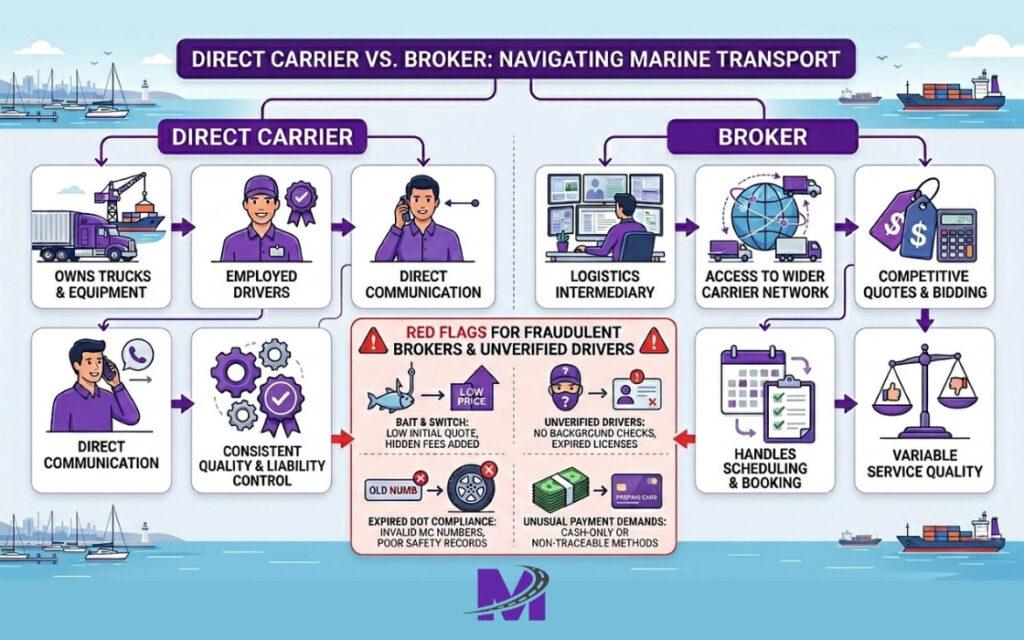
Understanding who you are actually hiring is the most critical step in this entire process. You are either hiring a direct carrier (the company that owns the truck) or a freight broker (the logistics manager who finds the truck for you). Both are completely viable paths, but they require different vetting strategies.
The Boat Hauler Network: Who Actually Moves Your Vessel
Unlike the auto transport world, where thousands of standardized car haulers crisscross the country daily, commercial boat haulers are a specialized, niche group. They operate custom lowboy trailers equipped with adjustable hydraulic pads and deep keel troughs.
When you use a broker, they post your boat’s dimensions on commercial freight load boards. This is where the vetting process makes or breaks your experience. A good broker will aggressively screen the carriers who bid on your load. They will check the carrier’s DOT safety record, verify their specific marine cargo insurance limits, and ensure they have the actual permits required to haul an oversized beam through a specific state.
The Danger of the “Guy with a Truck”
If you try to save money by using consumer-facing bidding sites (like certain well-known peer-to-peer shipping platforms), you run the risk of hiring an amateur. Someone with a heavy-duty pickup truck might bid $1,000 less than a commercial lowboy operator. But if that driver doesn’t have a commercial DOT number, commercial marine insurance, or the proper state permits for your 9-foot beam, the DOT weigh stations will impound your boat. You will be stuck paying impound fees, storage fees, and the cost of hiring a real commercial carrier to come rescue your vessel.
Spotting the “Bait and Switch” Marina Trap
In the auto industry, a delayed shipment means you have to rent a car for a few days. In the marine industry, a delayed shipment bleeds cash.
Here is how the classic marine broker scam works: You get a quote that is magically $800 cheaper than the next three competitors. The broker demands a $300 upfront deposit to “secure the truck.” The pickup day comes, and the crane at the marina lifts your boat out of the water, resting it on the staging blocks. And then… the truck never shows up.
Because the broker severely underpriced the run, no legitimate commercial carrier will accept the job off the load board. Your boat is now sitting on dry land at the origin marina. Marinas charge daily “on-the-hard” storage fees. Every day your boat sits there waiting for a phantom truck, you are losing money. Eventually, you have to fire the bad broker, lose your deposit, and pay the actual market rate to a legitimate carrier to finally get the boat moving.
Always look for guaranteed pricing, refuse to pay deposits via non-refundable wire transfers, and verify the broker’s reputation regarding dispatch times.
Conclusion
Overland boat transport rewards preparation and punishes shortcuts. Measure the hull yourself – don’t trust the manufacturer’s spec sheet. Remove the canvas, drop the antennas, winterize the engine block, and verify every carrier’s DOT number before a single deposit changes hands.
The owners who get burned are the ones who treat boat shipping like ordering a rideshare. The owners who don’t are the ones who showed up at the marina with a tape measure, a charged phone, and three verified carrier quotes already in hand.
Do the work upfront. The heavy-duty trucking network handles the permits, the weigh stations, and the diesel burns – but only after you’ve handed them a vessel that’s ready for 70 miles per hour on an open interstate.
Ready to move your boat? Get a free shipping quote today.
FAQ: Boat Transport
Professional boat transport averages $1.50–$3.50 per mile domestically. Short hauls under 300 miles cost $2.50–$3.75/mile ($400–$1,100 total). Cross-country routes over 1,000 miles drop to $1.50–$2.50/mile but total $2,000–$5,500+. Pricing shifts with diesel costs, seasonal demand, and beam width. Spring launches and fall winterizations consistently command premium rates above baseline averages.
Any vessel wider than 8’6″ legally qualifies as an oversize load. The carrier must obtain separate permits for every state on the route. Beams over 10–12 feet require civilian escort vehicles. Oversize transports cannot travel at night, on weekends, or during federal holidays, extending a standard two-day haul to five or more days and significantly increasing the total bill.
Only if total height – measured from keel to the highest fixed structure – exceeds 13 feet 6 inches on the trailer. That is the standard interstate bridge clearance limit. If the radar arch pushes the vessel over that threshold, a marine mechanic must unbolt and deck-strap it before transport. Always measure the combined trailer-plus-vessel height, not the boat’s height alone.
A transit endorsement is a temporary rider added to your existing marine insurance policy. It covers the vessel during overland movement. The commercial carrier’s mandatory cargo insurance only pays out for driver negligence – it explicitly excludes hailstorms, road debris, and vandalism at truck stops. Without a transit endorsement from your own insurer, those losses come entirely out of pocket.
A Florida-to-Michigan boat transport quote requires your vessel’s exact beam, overall length, and keel-to-arch height. That route covers approximately 1,300–1,400 miles depending on origin and destination zip codes, placing it firmly in the cross-country range of $2,000–$5,500 for standard-width vessels. Request quotes from at least three verified carriers and confirm each includes oversize permits if your beam exceeds 8’6″.
Search the FMCSA database at fmcsa.dot.gov using a carrier’s DOT or MC number to verify active operating authority. Legitimate local boat haulers hold commercial marine cargo insurance, not standard freight coverage. Avoid peer-to-peer bidding platforms where unlicensed operators undercut market rates – a carrier without proper state oversize permits will have your vessel impounded at the first DOT weigh station.
Sailboat mast removal is required when the combined height – keel to masthead while on the transport trailer – exceeds 13 feet 6 inches, the standard interstate bridge clearance limit. Most keelboats exceed this threshold. A marine rigger typically charges $300–$800 to unstep, pad, and deck-strap a mast. Factor that cost and the rigging labor at the destination into your total transport budget before requesting carrier quotes.
Related articles

How to Prepare Your Car for Shipping: Step-by-Step Checklist
IN THIS ARTICLE: Why Preparation is not just a Chore Step 1: Selecting Your Logistics Partner Step 2: The Evidence Phase – Cleaning and Documentation Step 3: Protecting the Extravagant
How to Ship a Motorcycle Safely: The 2026 Guide
IN THIS ARTICLE: The “Why” Behind the Shipping Method Option 1: The DIY Route (Towing it Yourself) Option 2: Open vs. Enclosed Transport Option 3: Specialized Motorcycle Shippers vs. General

How to Ship Your Electric Vehicle (EV) Safely in 2026
IN THIS ARTICLE: The Reality of EV Logistics in 2026 Why EVs Change the Math: The Weight Factor The “50% Rule”: Battery Safety and State of Charge (SoC) Vetting the
Open vs. Enclosed Auto Transport: Which Should You Choose?
IN THIS ARTICLE: The Reality of the Road: What is Open Car Shipping? Where Open Transport Makes Perfect Sense Comparison Table: Open Transport Quick Glance The Practitioner Tip: The Myth

Cross-Country Car Shipping: How to Save Money Safely
IN THIS ARTICLE: Why “Cheap” Doesn’t Have to Mean “Dangerous” 1. Open Transport: The Industry Gold Standard for Savings 2. The Power of “Terminal-to-Terminal” Shipping 3. Timing the Market: The

Complete Guide to RV Shipping in 2026
IN THIS ARTICLE: Introduction: The Freedom of the Road, Delivered by Professionals Understanding the Fleet: Classes and Types of RVs Methods of Transport: How We Get Your RV Home Measuring

Complete Guide to Car Shipping in 2026
The landscape of American mobility has shifted, making vehicle logistics more accessible and seamless than ever before. Understanding this new norm is the first step toward a stress-free relocation that

Car Shipping by Train: Costs, Process & What to Expect in 2026
IN THIS ARTICLE: The Two Faces of Rail Transport: Consumer vs. Commercial Why Choose the Tracks? (The Human Perspective) Dimensions and Constraints: Will Your Car Fit? The “Hidden” Logic of

Best Places to Buy a Motorcycle Online in the USA
IN THIS ARTICLE: The Digital Shift: Geography No Longer Constrains the Ride Where to Buy: Top 2026 Platforms Analysis Comparison Table: Platform Overview The Facet of Finance: Not Just the

How Much Does It Cost to Ship a Car Between States?
IN THIS ARTICLE: Average Cost Breakdown by Distance Primary Factors Influencing Your Shipping Quote Geographic Influence on Pricing Understanding the Quote Structure The Impact of Seasonality on Auto Transport Rates