
IN THIS ARTICLE:
- The Fundamental Difference: Dimensional Weight and Trailer Space
- Average Shipping Costs in 2026: What to Budget
- Best Time to Ship Your ATV or UTV – Seasonal Price Patterns
- The Variables That Ruin Your Quote
- Primary Transport Methods for ATVs and UTVs
- Open-Air Transport: The Industry Standard
- Enclosed Transport: Paying for Peace of Mind
- LTL Freight and Palletized Shipping
- Pre-Transport Preparation: The Seller and Buyer Checklists
- Navigating Brokers, Carriers, and the Booking Process
- Conclusion: Making the Right Choice in 2026
- FAQ
ATV and UTV shipping is the process of transporting powersports vehicles via specialized auto haulers or commercial freight networks. In 2026, standard ATV shipping costs average $300 to $600 for domestic transit, while UTV (Side-by-Side) transport ranges from $500 to $1,200. The primary transport methods include open-deck auto carriers, enclosed trailers, and Less-Than-Truckload (LTL) freight. Pricing is strictly calculated based on total mileage, exact vehicle dimensions, weight, and current diesel fuel surcharges.
Look, moving a 450-pound quad is a completely different logistical game than hauling a fully loaded, four-seat Polaris RZR that takes up the footprint of a Honda Civic. If you are buying a rig out of state, selling your custom build, or relocating closer to the trails, treating these two vehicle types as the same thing on a quote request is the fastest way to get hit with surprise fees at delivery.
If you’re planning to move your machine after buying or selling it, choosing the right ATV / UTV Shipping service is just as important as the deal itself. The wrong setup can lead to delays, added fees, or even transport refusal.
The transport industry has tightened up in 2026. Carriers are facing strict emission standards, high insurance premiums, and fluctuating fuel costs. They don’t have the margin to guess how big your machine is. Today, the platforms and carriers that move these machines require exact measurements, because in the freight world, space is quite literally money.
Let’s break down exactly how ATVs and UTVs are treated on the logistics grid, what you should actually be paying right now, and the hidden factors that will violently swing your final invoice.
The Fundamental Difference: Dimensional Weight and Trailer Space
To understand the cost difference between shipping an ATV (All-Terrain Vehicle) and a UTV (Utility Task Vehicle or Side-by-Side), you have to think like a dispatcher mapping out a 53-foot trailer.
Before diving into the details, here is how these two vehicle types compare across every factor that affects your shipping quote:
| Feature | ATV | UTV / Side-by-Side |
| Average width | ~4 ft | 5–6+ ft |
| Average length | 6–7 ft | 10–14 ft |
| Average weight | 400–800 lbs | 1,200–2,500 lbs |
| Trailer slot | Filler freight | Full car slot |
| Cross-country cost | $550–$800 | $900–$1,400 |
| LTL freight viable? | Yes | Rarely |
| Enclosed recommended? | High-value only | Modified/custom builds |
| Inop surcharge if not running | $100–$150 | $150–$250 |
The ATV Advantage
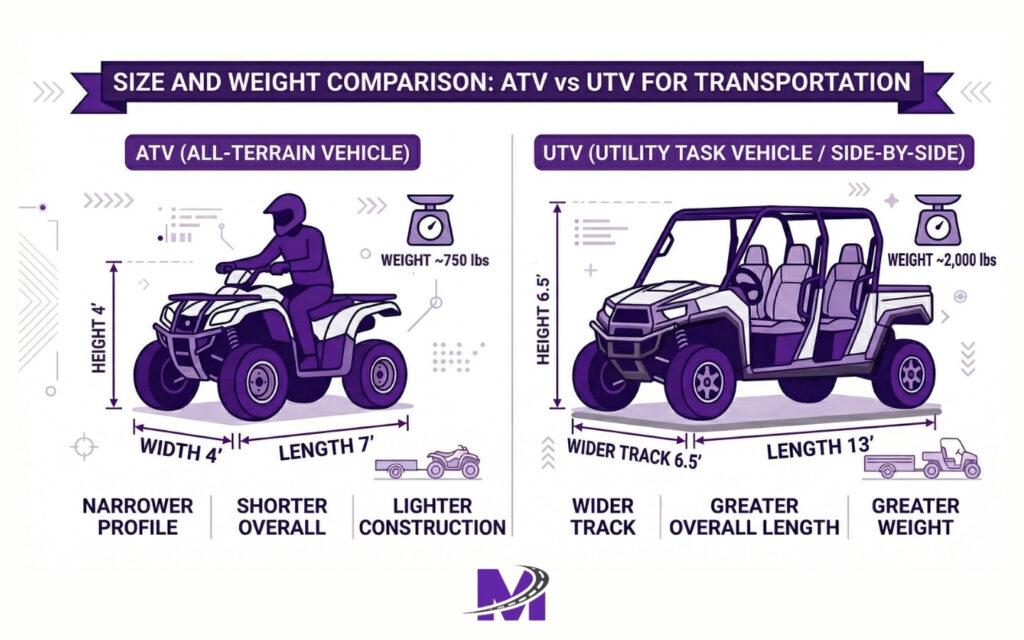
ATVs are inherently compact. A standard utility ATV is about 4 feet wide and 7 feet long. Because of this footprint, a clever auto hauler can frequently load ATVs sideways on a standard car trailer, fitting two or three machines into the slot normally reserved for a single sedan. Alternatively, ATVs can be easily strapped down in the bed of a heavy-duty pickup truck or an LTL freight trailer (if crated or palletized).Because they act as “filler freight” that carriers use to maximize empty pockets of space on their route, ATVs are generally cheap and fast to ship.
The UTV Problem
UTVs are a completely different animal. A modern four-seat side-by-side (like a Can-Am Maverick MAX) pushes 13 to 14 feet in length, over 6 feet in width, and can easily weigh upwards of 2,000 pounds.
You cannot load a UTV sideways. You cannot treat it as filler freight. A UTV occupies a dedicated car slot on an open auto hauler. Therefore, the carrier is going to charge you the baseline rate of shipping an actual car, plus potential surcharges if the UTV’s roll cage or suspension setup requires special loading ramps or limits the vertical space on a double-deck trailer.
Average Shipping Costs in 2026: What to Budget
Shipping rates fluctuate based on the season (expect spikes during the spring prep season and early fall hunting season), but heading into 2026, we have established clear baseline averages.
Note: The following estimates assume standard, non-modified vehicles traveling along major interstate routes.
| Transport Distance | Average ATV Cost | Average UTV Cost | Cost per Mile (Est.) |
| Short-Haul (0 – 500 Miles) | $200 – $350 | $400 – $600 | $0.80 – $1.50 |
| Mid-Haul (500 – 1,500 Miles) | $350 – $550 | $600 – $900 | $0.50 – $0.90 |
| Cross-Country (1,500+ Miles) | $550 – $800 | $900 – $1,400+ | $0.40 – $0.70 |
As you can see, the cost per mile drops significantly on longer hauls, but the overall ticket price climbs. This is because the heavy lifting for the carrier – the loading, securing, insurance paperwork, and route planning – happens on day one. Once the machine is strapped down, highway miles are relatively cheap.
Best Time to Ship Your ATV or UTV – Seasonal Price Patterns
Powersports shipping follows a predictable seasonal cycle that directly impacts both price and carrier availability. Booking at the wrong time of year can add $150–$300 to your final invoice with zero benefit.
| Season | Demand Level | Price Impact | Notes |
| November–February | Low | Cheapest rates | Winter delays possible in mountain routes |
| March–April | Rising | +10–15% | Spring prep season, riders preparing for trails |
| May–August | Peak | +20–30% | Highest demand, longest pickup windows |
| September–October | Moderate spike | +10–20% | Hunting season routes (Midwest, Mountain West) |
The single best window to ship a powersports vehicle is January through mid-February. Demand is at its annual low, carriers are actively looking for loads, and you have the most negotiating leverage on price. If your timeline allows any flexibility at all, this is the window to use.
The Variables That Ruin Your Quote
The prices listed above are for factory-spec machines. However, almost nobody in the powersports world leaves their machine stock. If you misrepresent your vehicle to a broker, the driver who shows up to load it has the right to either reject the load or demand a cash adjustment on the spot.
Here is what directly impacts your bottom line:
1. Aftermarket Modifications
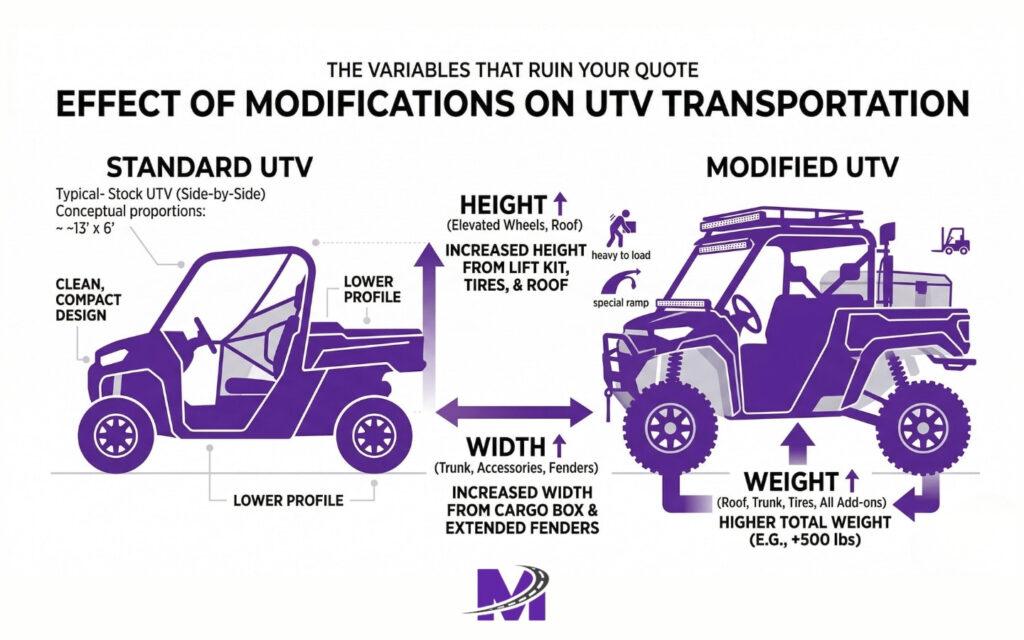
If you have a 6-inch portal gear lift and 35-inch mud tires on your UTV, you just radically changed its dimensional weight. It might be too wide to fit between the rails of a standard wedge trailer. It might be too tall to fit on the lower deck of a multi-car hauler. If you added a heavy-duty steel roof rack, long-travel suspension, or extended trailing arms, you must disclose the exact new dimensions (L x W x H) to your shipping broker. Specialized dimensions require specialized flatbed haulers, which instantly increases the rate.
2. Operability
Does the machine run, steer, and brake? If you are buying a project quad off Facebook Marketplace that has a blown motor, it is considered an “inoperable vehicle.” Carriers hate inoperable vehicles. To get a dead 1,500-pound UTV onto a trailer, the driver needs a heavy-duty winch and extra time. Expect an “inop surcharge” ranging from $100 to $250.
3. Location Logistics (The “Last Mile” Problem)
Auto haulers do not like driving massive rigs into residential subdivisions with tight cul-de-sacs, low-hanging tree branches, or steep gravel driveways. If the pickup or delivery location is far off the main interstate, deep in the mountains, or physically inaccessible for a tractor-trailer, you will pay a premium. In many cases, the most cost-effective move is to agree to meet the driver in a massive commercial parking lot. This is part of choosing between delivery models, learn more in Door-to-Door vs. Terminal-to-Terminal: Which Logistics Model Fits You?
Primary Transport Methods for ATVs and UTVs
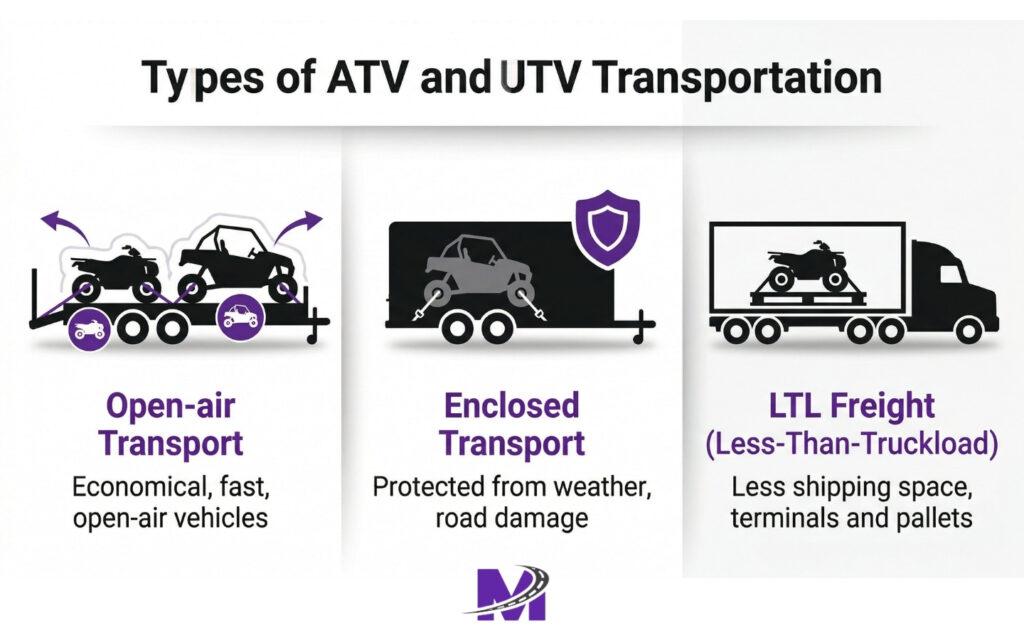
Transport methods for powersports vehicles include Open Auto Transport, Enclosed Carrier Transport, and Less-Than-Truckload (LTL) Freight. Open transport is the most cost-effective method, utilizing multi-car flatbeds. Enclosed transport provides comprehensive weather protection in sealed trailers at a 30% to 50% premium. LTL freight requires palletizing or crating the vehicle for commercial terminal-to-terminal shipping, making it viable primarily for compact ATVs.
When you finally pull the trigger on booking a shipment, the broker or carrier is going to present you with a few options. Choosing the right one depends entirely on the value of your machine, the time of year, and how much work you want to do before the truck arrives.
Nobody wants to overpay for shipping, but cheaping out on a cross-country haul in the middle of winter can leave your brand-new Side-by-Side looking like it just survived a salt mine explosion. Let’s look at how these machines actually get moved in the real world.
Open-Air Transport: The Industry Standard
For about 80% of powersports shipments, open transport is the default answer. This usually involves a standard wedge trailer pulled by a heavy-duty dually pickup, or a massive 18-wheeler auto hauler.
Because ATVs and UTVs are literally designed to be driven outside in the dirt, mud, and rain, paying extra to protect them from a little highway weather rarely makes sense for the average owner. If you are shipping a used Honda Rancher or a slightly bruised Yamaha Rhino to a hunting camp, open transport is exactly what you need.
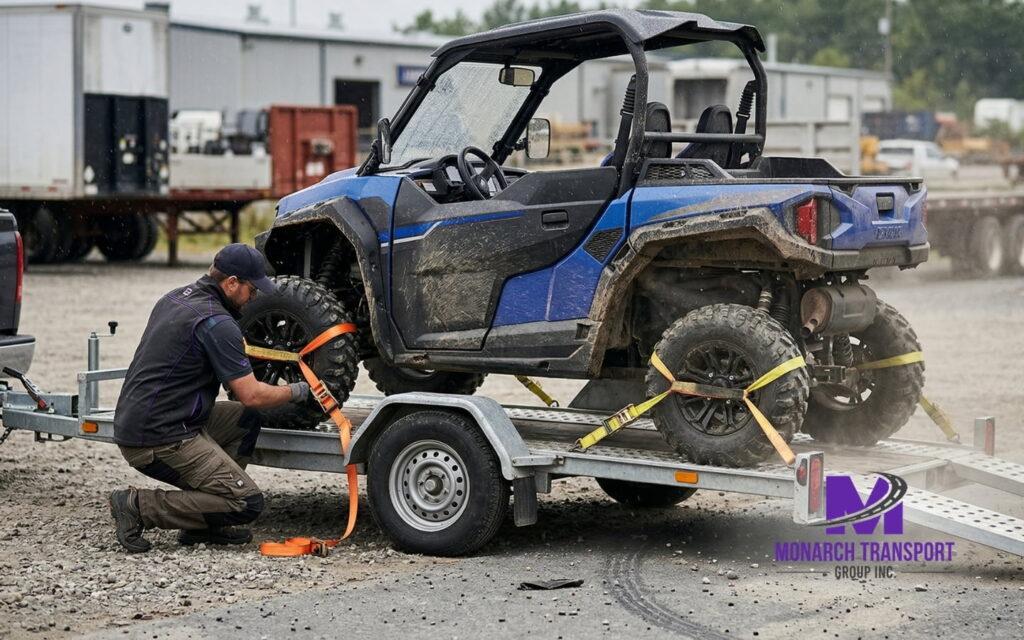
The machines are driven up the ramps, positioned to balance the trailer’s axle weight, and strapped down securely over the tires or frame.
If you’re unsure whether open transport is the right choice, this comparison of Open vs. Enclosed Auto Transport: Which Should You Choose? breaks it down in detail.
The reality check:
Open transport means your machine is exposed to everything the highway kicks up. If it snows, your UTV gets snowed on. If a truck ahead of the carrier kicks up a rock, your plastic windshield might take the hit. Most standard carrier insurance policies do not cover minor cosmetic damage caused by “acts of nature” or normal road debris during open transport. If you are shipping a pristine, custom-painted show rig, do not put it on an open trailer.
Enclosed Transport: Paying for Peace of Mind
Enclosed transport means your ATV or UTV is loaded into a hard-sided, fully sealed trailer. These are often the same climate-controlled rigs used to transport classic cars or high-end exotics.
You should expect to pay roughly 30% to 50% more for this service. Why? Because enclosed trailers carry fewer vehicles, take longer to load, and cost the carrier significantly more in fuel and insurance.
In 2026, enclosed transport makes sense in three specific scenarios:
LTL Freight and Palletized Shipping
Less-than-truckload (LTL) freight is a completely different logistics network. Instead of a driver picking up your machine and driving it straight to you, LTL involves commercial freight trucks moving cargo between massive distribution hubs.
This method is almost exclusively used for standard ATVs, not UTVs. To ship via LTL, you cannot just hand the driver the keys. The ATV must be completely drained of all fluids (gas, oil, coolant), the battery must be disconnected, and the entire machine must be strapped to a heavy-duty commercial pallet or enclosed in a custom wooden crate.
It is highly labor-intensive for the sender. However, if you are a dealership shipping a crate-new ATV to a buyer, or if you have access to a loading dock and a forklift, LTL freight can sometimes beat standard auto transport rates. For the average private buyer or seller, though, the hassle of crating the machine usually outweighs the savings.
Pre-Transport Preparation: The Seller and Buyer Checklists
Vehicle preparation for shipping requires cleaning the machine, documenting pre-existing damage, securing loose accessories, and reducing fuel levels to a quarter tank. Proper preparation prevents transit damage, satisfies carrier safety regulations, and ensures a smooth Bill of Lading (BOL) inspection upon delivery.
A carrier isn’t just going to blindly throw your machine on a trailer and hit the gas. They have strict liability protocols. If you fail to prepare the machine properly, the driver will either delay the pickup, refuse the load, or hit you with a preparation fee.
Here is exactly what needs to happen before the truck pulls up.
The Wash and the Walk-Around
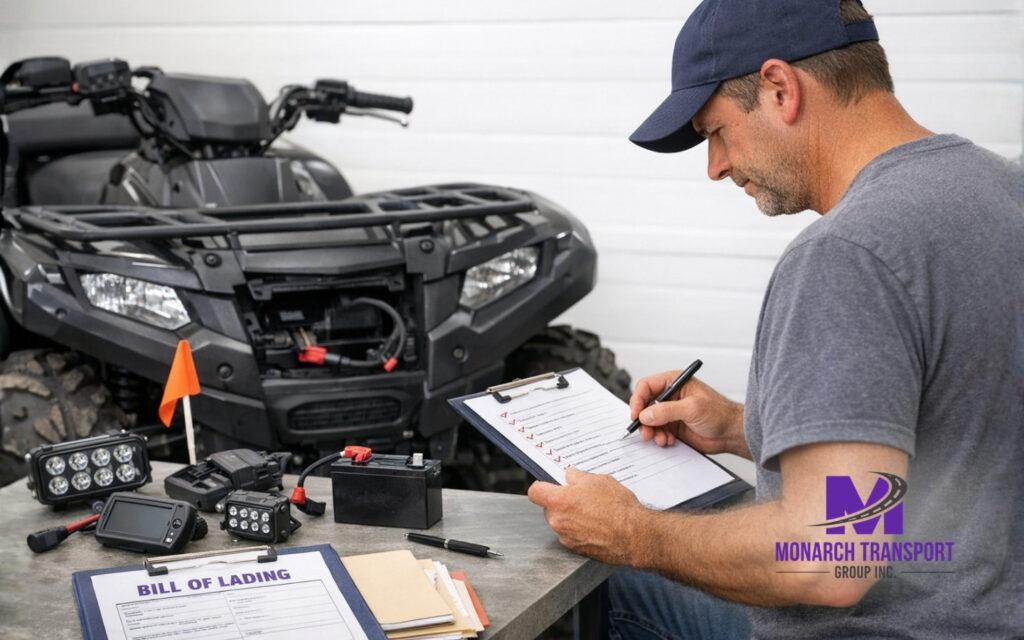
You cannot ship a machine that is caked in three inches of dried mud. The driver must perform a thorough physical inspection before loading the vehicle. This inspection is recorded on the Bill of Lading (BOL), which acts as your official contract and insurance document.
If the machine is filthy, the driver cannot see existing scratches, dents, or cracked plastics. If they can’t see the damage, they will note “Vehicle too dirty to inspect” on the BOL. If the machine arrives at its destination with a massive scrape on the roll cage, the insurance company will deny your claim immediately because you cannot prove the damage happened during transit. Wash the machine, take highly detailed, time-stamped photos from every angle, and keep a copy of the signed BOL.
Securing the Machine (Accessories and Keys)
Auto haulers are not responsible for your loose gear. A UTV bouncing down the highway on a trailer experiences sustained wind speeds and vibrations.
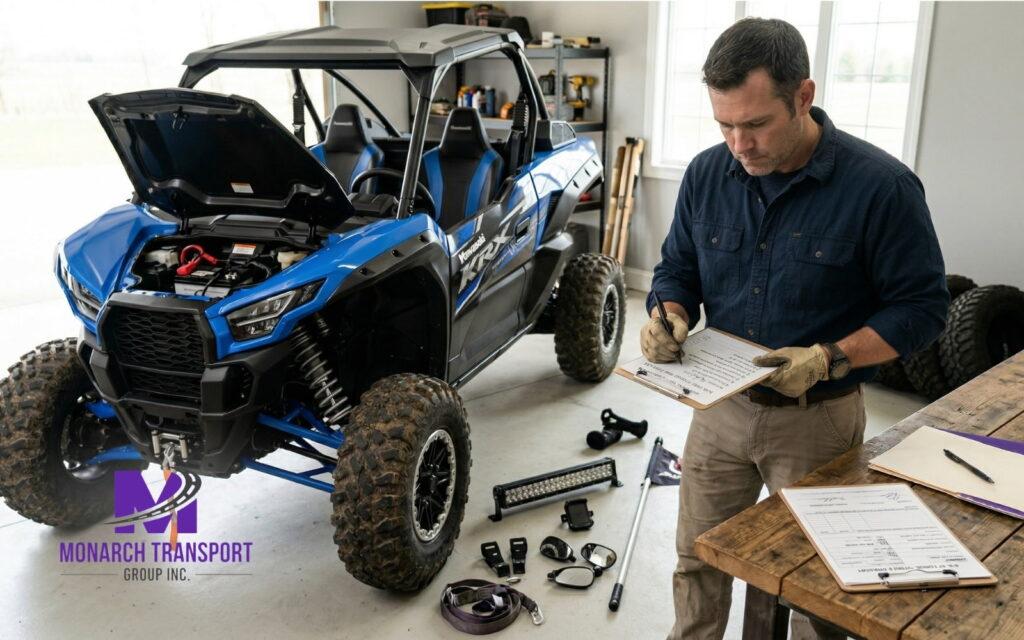
Before shipping, you must remove any easily detachable or fragile items from the machine. Take off the $500 GPS unit. Remove the LED whip flags. Unbolt the aftermarket soundbar if it isn’t permanently hardwired. If you have a half-windshield, consider removing it or securing it with bolts, as highway winds can easily snap the plastic mounts.
As for the keys, most dispatchers require one set of keys to travel with the machine so the driver can steer it on and off the trailer. Make absolutely sure you have a spare set at the destination, or zip-tie the primary key directly to the steering wheel so it doesn’t get lost in transit.
Fluid Management and Leaks
Carriers are terrified of leaks. If your older quad leaks oil onto the deck of an enclosed trailer, or worse, onto a pristine BMW parked below it on a multi-level open hauler, the carrier is liable for the damage.
Ensure the engine is mechanically sound and not actively dripping fluids. Furthermore, do not top off the gas tank. Keep the fuel level at exactly one-quarter tank. This provides enough fuel for the driver to load and unload the machine, but reduces the overall weight and minimizes the fire hazard during transport.
Navigating Brokers, Carriers, and the Booking Process
Selecting an ATV or UTV shipping provider involves verifying that the provider has active Department of Transportation (DOT) and Motor Carrier (MC) numbers in the FMCSA database. A reliable auto transport broker or direct carrier provides transparent, all-inclusive pricing, contingent cargo insurance of at least $100,000, and a verifiable history of specialized powersports hauling without demanding untraceable upfront wire transfers.
The biggest misunderstanding in the auto transport industry is who you are actually paying to move your machine. When you search for “UTV shipping quotes” online, 95% of the websites you land on are brokers, not actual trucking companies. They do not own a single truck. They own a phone, a desk, and access to a national freight load board called Central Dispatch.
There is absolutely nothing wrong with using a broker. In fact, a good broker is worth their weight in gold because they act as your logistics manager, vetting the actual drivers and ensuring the paperwork is flawless. However, the barrier to entry for becoming a broker is incredibly low, which means the market is flooded with operators who will say anything to get your deposit.
The “Lowball” Quote Trap
If you request quotes to move a four-seat Polaris Ranger from Texas to Ohio, and three companies quote $800 while one quotes $350, do not book the $350 quote. It is a bait-and-switch.
Here is exactly how this scam works: The bad broker gives you an artificially low price just to secure your non-refundable $150 deposit. They then post your vehicle on the national load board for $200 (the remaining balance). No legitimate carrier is going to haul a massive UTV halfway across the country for $200. Your machine will sit at the pickup location for weeks. Eventually, the broker will call you with a “fuel surcharge update” or claim “the route is exceptionally busy,” demanding you pay the actual market rate of $800 to get it moved. You lose time, you get frustrated, and you end up paying the real price anyway.
To avoid this, look for brokers who offer “guaranteed pricing” rather than “estimates,” and read their negative reviews carefully. You aren’t looking for a 5-star rating; you are looking to see how they handle the inevitable 1-star logistical failures.
Insurance and The Bill of Lading (BOL) Authority
Transport insurance for ATVs and UTVs is governed by the carrier’s contingent cargo policy, typically covering negligence, collision, or rollover during transit. The Bill of Lading (BOL) serves as the official receipt, structural inspection report, and contract of carriage, requiring physical signatures at both pickup and delivery to validate any subsequent damage claims.
Let’s get one thing straight: the carrier’s insurance covers the carrier’s mistakes. It does not cover a rock flying off a dump truck and cracking your ATV’s headlight. It does not cover your aftermarket roof flying off because you forgot to tighten the bolts.
The only way to successfully file an insurance claim for transit damage is through the Bill of Lading. When the driver drops off your Yamaha Wolverine, you are going to be excited. The driver will be tired and in a hurry. They will hand you a clipboard and tell you to sign. Do not sign it until you walk around the machine.
If the driver backed the UTV into a steel pole and bent the rear bumper, but you sign the BOL without noting the damage, you have legally declared that the machine was received in perfect condition. The insurance company will immediately deny your claim. Note every scratch, take pictures of the machine while it is still on the trailer, and only then sign the document.
Conclusion: Making the Right Choice in 2026
Shipping an ATV or UTV in 2026 requires balancing transport methods, accurate vehicle dimensions, and carrier reliability. Open-air auto transport remains the most cost-effective solution for standard ATVs, while heavily modified UTVs frequently necessitate enclosed trailers, specialized flatbeds, or custom freight quotes to accommodate larger footprints and protect high-value accessories.
Moving a powersports vehicle shouldn’t be a nightmare. The friction almost always comes from miscommunication. If you tell a driver you are shipping a standard quad, and they show up to find a fully customized mud-bogger with a massive lift kit and snorkel, the deal is going to fall apart on the spot.
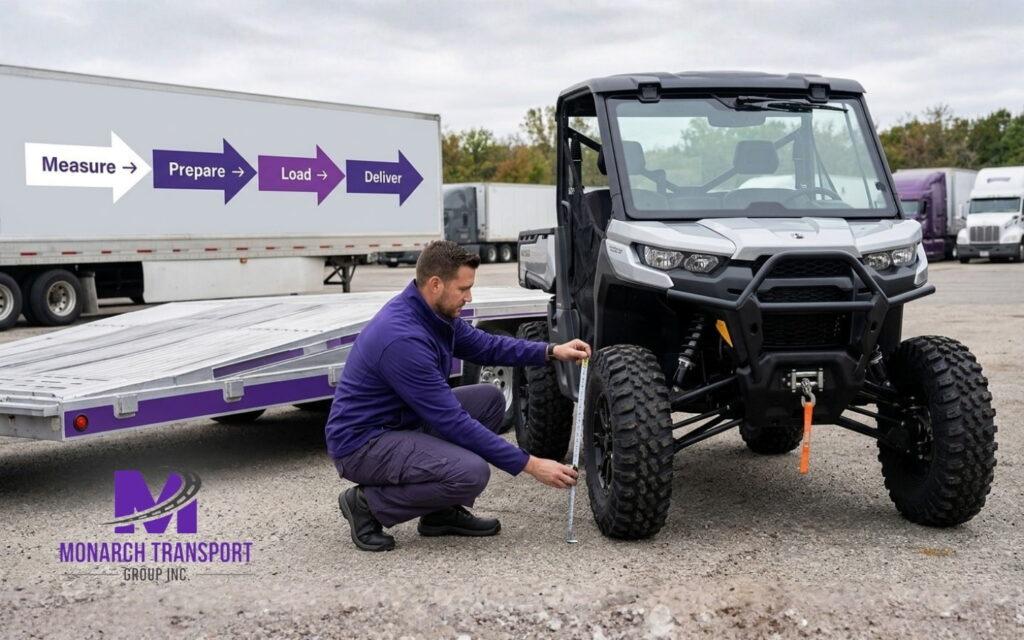
Measure your machine accurately with a tape measure. Do not rely on the factory spec sheet if you have changed the tires or suspension. Clean the vehicle so it can be properly inspected. Be honest with your broker about whether the machine actually runs.
The powersports world runs on trust – between riders, between buyers and sellers, and between customers and carriers. Monarch Auto Transport works exclusively with vetted, FMCSA-licensed carriers who understand that your machine isn’t just freight. It’s how you spend your weekends. Get a quote for your ATV or UTV shipment and have it moving to the next trailhead.
FAQ
Cross-country UTV shipping typically costs between $900 and $1,400 in 2026. Pricing heavily depends on the vehicle’s exact dimensions, total weight, and the chosen transport method. Enclosed shipping or hauling heavily modified, oversized Side-by-Sides will push the cost toward the higher end of that spectrum.
The most cost-effective method for shipping an ATV is open-air auto transport using a multi-car wedge trailer. Rates for short to mid-range distances usually fall between $200 and $500. Palletized Less-Than-Truckload (LTL) freight is also inexpensive but requires draining fluids and securing the machine to a commercial crate.
No. Department of Transportation (DOT) regulations strictly prohibit auto carriers from hauling household goods or personal items inside vehicles. Furthermore, carrier insurance policies do not cover loose gear. You must remove all helmets, tools, detachable GPS units, and aftermarket accessories before the carrier loads the machine.
Legitimate auto transport carriers carry mandatory cargo insurance, typically providing coverage of $100,000 to $250,000 per load. This covers carrier negligence or accidents. However, owners of high-value, custom-built UTVs should verify the carrier’s specific coverage limits before signing the Bill of Lading to ensure full replacement value is protected.
Transit times for powersports vehicles average 1 to 3 days for short hauls under 500 miles. Cross-country shipping typically takes 7 to 10 days, depending on weather conditions and Department of Transportation (DOT) driver-hour limits. Unpredictable route logistics for multi-car open trailers can occasionally extend delivery windows by 48 hours.
Yes, auto carriers can transport non-running ATVs or UTVs, but this requires an inoperable vehicle surcharge ranging from $100 to $250. The transport driver must use a specialized heavy-duty winch to safely load and unload the dead machine. You must strictly notify the shipping broker in advance of the vehicle’s exact mechanical condition.
Yes, and it often reduces your per-vehicle cost. If both machines are heading to the same destination, a broker can consolidate them onto a single trailer – the ATV typically fits as filler freight alongside the UTV’s dedicated slot. Always disclose both vehicles upfront when requesting a quote. Combining shipments can save $100–$200 compared to booking two separate orders.
For open and enclosed auto transport, you are not required to fully drain fluids, but fuel must be reduced to one-quarter tank maximum. This is a federal safety regulation for all vehicle transport. For LTL freight shipments, full fluid drainage including oil, coolant, and fuel is mandatory before the machine can be palletized and accepted at a freight terminal.
Modifications that push total width beyond 8.5 feet, height beyond 7.5 feet, or weight beyond the trailer’s rated capacity create serious shipping complications. Common problem modifications include extreme portal gear lifts, extended trailing arms, oversized tire packages, and heavy steel roof cages. Carriers may refuse the load or require a specialized flatbed at a significantly higher rate. Always measure your machine after modifications and disclose exact dimensions when requesting quotes.
Related articles
Car Shipping by Train: Costs, Process & What to Expect in 2026
IN THIS ARTICLE: The Two Faces of Rail Transport: Consumer vs. Commercial Why Choose the Tracks? (The Human Perspective) Dimensions and Constraints: Will Your Car Fit? The “Hidden” Logic of
Complete Guide to Car Shipping in 2026
The landscape of American mobility has shifted, making vehicle logistics more accessible and seamless than ever before. Understanding this new norm is the first step toward a stress-free relocation that

Complete Guide to RV Shipping in 2026
IN THIS ARTICLE: Introduction: The Freedom of the Road, Delivered by Professionals Understanding the Fleet: Classes and Types of RVs Methods of Transport: How We Get Your RV Home Measuring

Cross-Country Car Shipping: How to Save Money Safely
IN THIS ARTICLE: Why “Cheap” Doesn’t Have to Mean “Dangerous” 1. Open Transport: The Industry Gold Standard for Savings 2. The Power of “Terminal-to-Terminal” Shipping 3. Timing the Market: The

How State-to-State Car Transport Works: From Pickup to Delivery
IN THIS ARTICLE: Understanding the Auto Transport Ecosystem Choose Your Transport Type The Process of Shipping Calculating the Cost and Timeline of State-to-State Car Transport The 2026 EV Transport Protocol
How Much Does It Cost to Ship a Car Between States?
IN THIS ARTICLE: Average Cost Breakdown by Distance Primary Factors Influencing Your Shipping Quote Geographic Influence on Pricing Understanding the Quote Structure The Impact of Seasonality on Auto Transport Rates

How to Prepare Your Car for Shipping: Step-by-Step Checklist
IN THIS ARTICLE: Why Preparation is not just a Chore Step 1: Selecting Your Logistics Partner Step 2: The Evidence Phase – Cleaning and Documentation Step 3: Protecting the Extravagant

How to Ship Your Electric Vehicle (EV) Safely in 2026
IN THIS ARTICLE: The Reality of EV Logistics in 2026 Why EVs Change the Math: The Weight Factor The “50% Rule”: Battery Safety and State of Charge (SoC) Vetting the