
IN THIS ARTICLE:
- The Two Faces of Rail Transport: Consumer vs. Commercial
- Why Choose the Tracks? (The Human Perspective)
- Dimensions and Constraints: Will Your Car Fit?
- The “Hidden” Logic of Rail Schedules
- Car Shipping Costs: Train vs. Truck in 2026
- Train vs. Truck: The Ultimate Face-Off
- The “Terminal” Reality: What to Expect at the Yard
- Preparing Your Vehicle for Rail Transit: The Reality Check
- Insurance: Understanding the “Bill of Lading” Authority
- Conclusion: Is the Train Right for You?
- FAQ
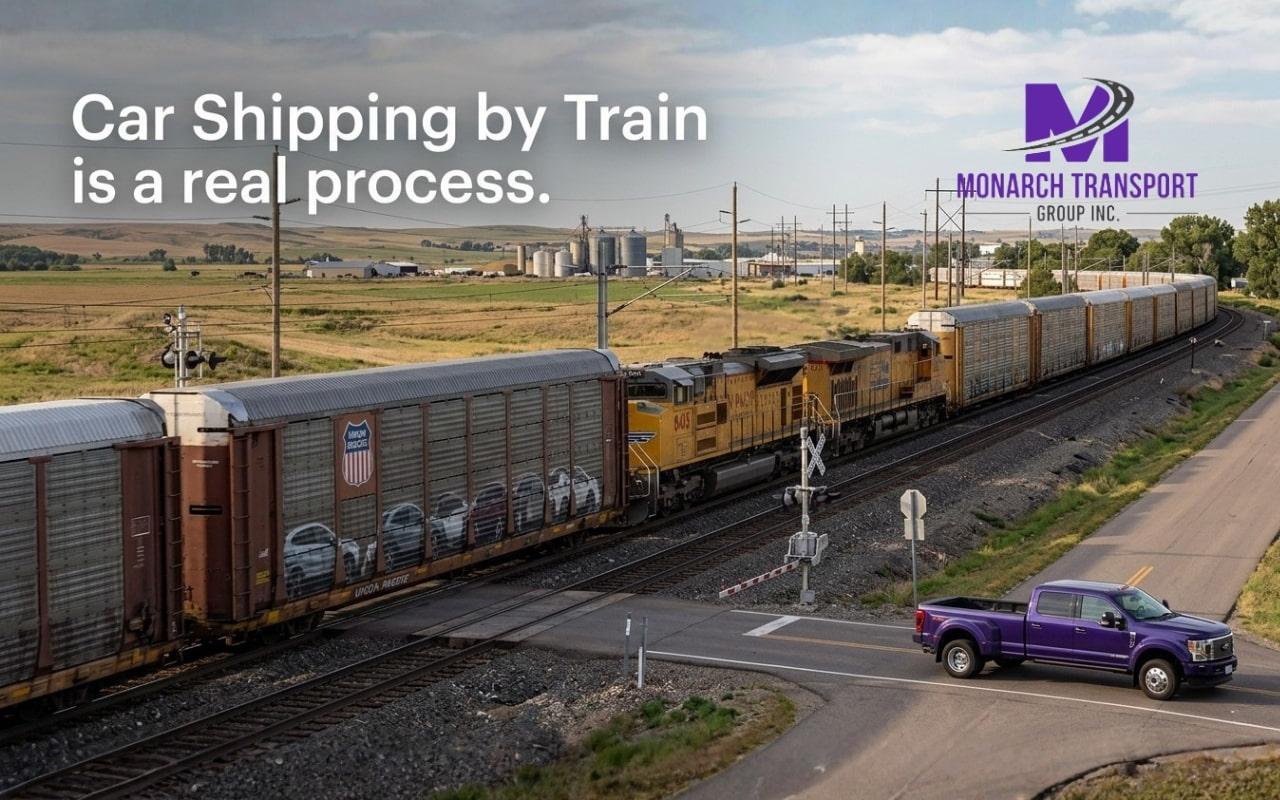
Car shipping by train is the process of transporting a motor vehicle via specialized rail carriers, primarily utilized for long-distance relocations. In 2026, the primary consumer option in the U.S. is the Amtrak Auto Train, with prices ranging from $250 to $600 per vehicle plus passenger fares. Commercial rail transport offers nationwide terminal-to-terminal shipping but is typically reserved for bulk dealer inventory or corporate relocations.
While most people immediately think of a massive open-air truck when they need to move a car, the rail system remains the “quiet giant” of the logistics world. It’s an older method, sure, but in 2026, it has found a very specific, very loyal niche. If you’re moving a car from the Northeast to Florida, or if you’re a collector who wants the absolute maximum protection from road debris without paying for a private enclosed trailer, the train is often your best bet.
However, rail transport isn’t a “one-size-fits-all” solution. It is a world of rigid schedules, specific terminal locations, and very clear rules about what can and cannot be inside your car. Unlike a truck driver who might meet you at a grocery store parking lot, the train doesn’t come to you. You go to the train. Let’s peel back the curtain on how this works in the current market and whether it’s actually the right move for your wallet and your vehicle.
The Two Faces of Rail Transport: Consumer vs. Commercial
To understand your options in 2026, you first have to distinguish between the two ways cars move on tracks.
1. The Consumer Route (Amtrak Auto Train)
This is the only service where you, as an individual, can simply book a ticket and bring your car along. It’s a specialized service running daily between Lorton, Virginia (near Washington, D.C.) and Sanford, Florida (near Orlando). You drive your car to the station, they load it onto a specialized “Auto Rack” car, and you hop into a passenger cabin. By the time you wake up the next morning, both you and your car are 900 miles further south. It’s a “cheat code” for avoiding the brutal I-95 traffic.
2. The Commercial Route (Freight Rail)
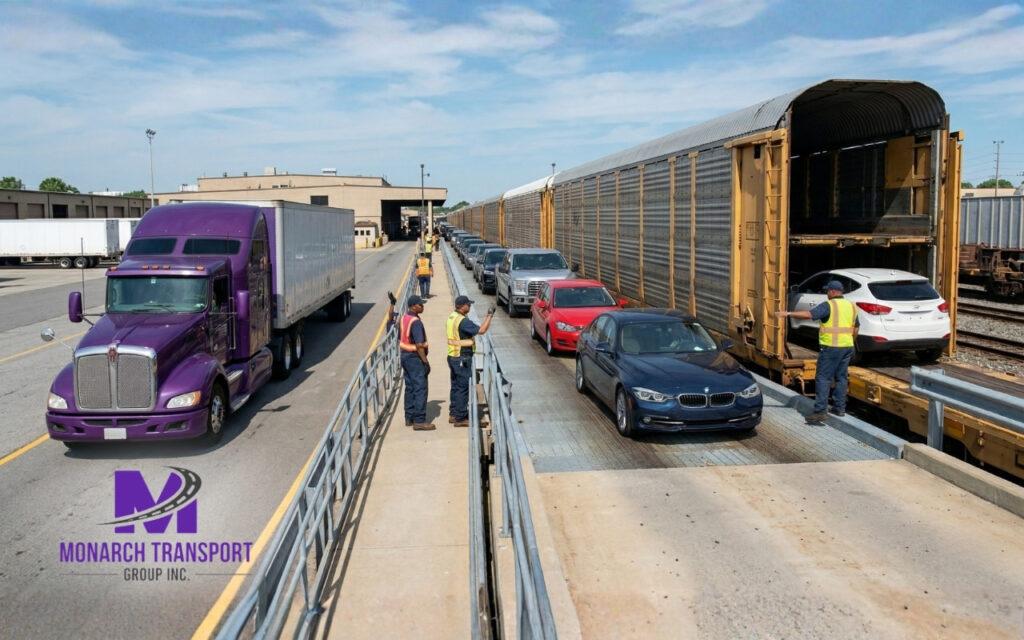
This is how the Toyotas and Fords of the world move thousands of cars from factories to dealerships. Major rail lines like Union Pacific or CSX handle this. Can you, as an individual, call them up to move one Honda Civic from Seattle to Chicago? Generally, no. To access the freight rail network, you usually have to work through a specialized broker who “batches” individual cars together to fill a railcar. It is almost always terminal-to-terminal, meaning you’ll be dropping off and picking up at massive industrial hubs, often on the outskirts of major cities.
Why Choose the Tracks? (The Human Perspective)
If we’re being honest, shipping by truck is usually faster and more flexible. So why bother with a train?
Dimensions and Constraints: Will Your Car Fit?
Trains are built for efficiency, which means they are built for standard sizes. This is where many people run into trouble. A standard railcar has very specific vertical and horizontal clearances.
The “Standard” Rule:
If you drive a stock sedan, a mid-size SUV, or a standard pickup truck, you’re usually fine. The problems start when you’ve added a 6-inch lift kit, massive off-road tires, or a roof-mounted cargo box that pushes your height over 85 inches.
| Vehicle Type | Standard Rail Clearance | Typical Surcharge |
| Sedan / Coupe | Up to 65″ height | None (Base Fare) |
| Standard SUV / Van | 65″ to 85″ height | $30 – $70 (Oversize Fee) |
| Modified Truck | Over 85″ height | Often Rejected |
If you have a dual-rear-wheel (dually) truck, you might as well forget about the Amtrak Auto Train; it simply won’t fit on their ramps. For commercial rail, some specialized carriers can handle larger loads, but you’ll pay a heavy premium for the space you’re occupying.
The “Hidden” Logic of Rail Schedules
Unlike the trucking industry, where a driver might be willing to push through the night to meet a deadline, the rail industry is bound by the tracks. If a freight train is delayed in a switching yard in Ohio, your car is delayed. There is no “detour” for a train.
In 2026, we’ve seen improvements in tracking technology. Most rail brokers now give you GPS-based updates but the rhythm of the railroad remains unhurried. You shouldn’t ship by rail if you need your car in exactly three days. Rail transport is for the planners. It’s for the person moving their summer home life in March and planning it back in October. It’s about the long game.
Car Shipping Costs: Train vs. Truck in 2026
Car shipping by train costs between $250 and $1,200, depending on distance, vehicle dimensions, and service type. While rail is 20-40% cheaper than truck transport for cross-country routes, it requires terminal-to-terminal logistics rather than door-to-door delivery. Passengers using the Amtrak Auto Train pay separate fares, while commercial rail shipping is managed through brokers specializing in enclosed multi-car railcar transport.
Let’s talk money, because that’s usually why people start looking at tracks in the first place. In the logistics world of 2026, fuel prices have stabilized, but the truck driver labor shortage hasn’t. This has made the price gap between a “man in a truck” and a “locomotive with 200 cars” wider than ever.
If you’re moving a standard sedan from New York to California, a truck might quote you $1,500 for open transport. A rail broker might get that down to $900. That $600 difference is significant, but you have to work for it. You aren’t paying for the “last mile” delivery, which means you’re the one driving to an industrial zone at 7:00 AM to hand over your keys.
The Cost Breakdown: Beyond the Base Fare
When you look at a quote for rail transport, it’s rarely just one number. In 2026, the industry has moved toward a more modular pricing structure. You’ll see the base “line-haul” rate, but the devil is in the surcharges.
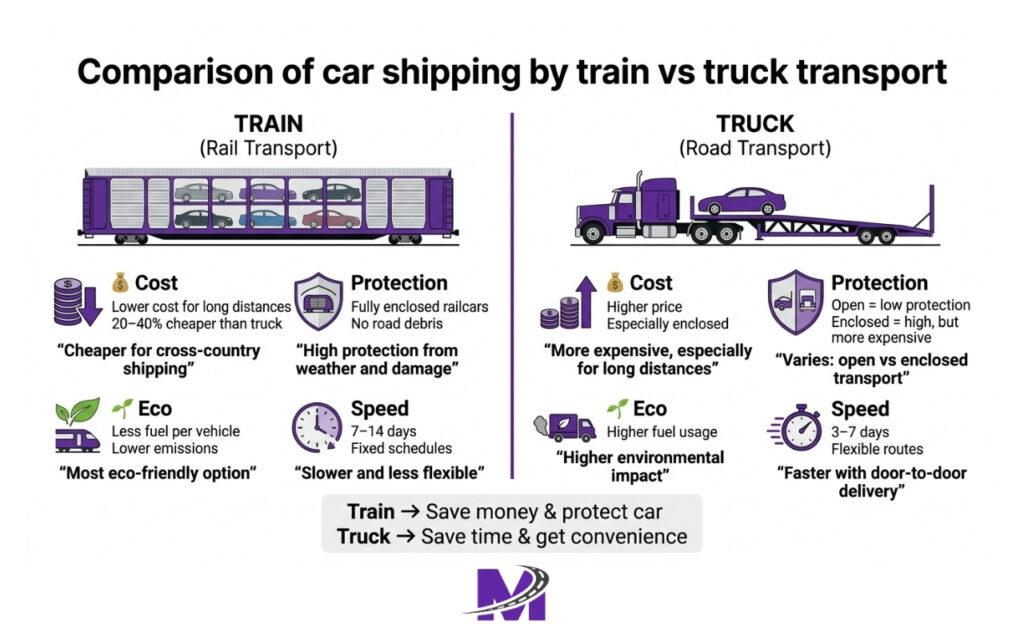
Train vs. Truck: The Ultimate Face-Off
This is the choice every relocator has to make. It’s a classic “Time vs. Money vs. Security” triangle. You can usually only pick two.
| Feature | Rail Transport (Train) | Road Transport (Truck) |
| Average Cost | Lower ($$) | Higher ($$$) |
| Speed | Slower (7-14 Days) | Faster (3-7 Days) |
| Delivery Type | Terminal-to-Terminal | Door-to-Door |
| Protection | High (Fully Enclosed) | Variable (Open or Enclosed) |
| Carbon Footprint | Low | High |
| Flexibility | Rigid Schedules | Flexible Pickup/Drop-off |
The Security Paradox
Here is a “human” insight: People often think trucks are safer because they can see the driver. In reality, the most dangerous part of a car’s journey is the highway. On a truck, your car is 5 feet away from texting drivers and flying gravel. On a train, your car is inside a steel box, 15 feet off the ground, moving on a dedicated path. In terms of “act of God” insurance claims, trains consistently outperform trucks.
The “Terminal” Reality: What to Expect at the Yard
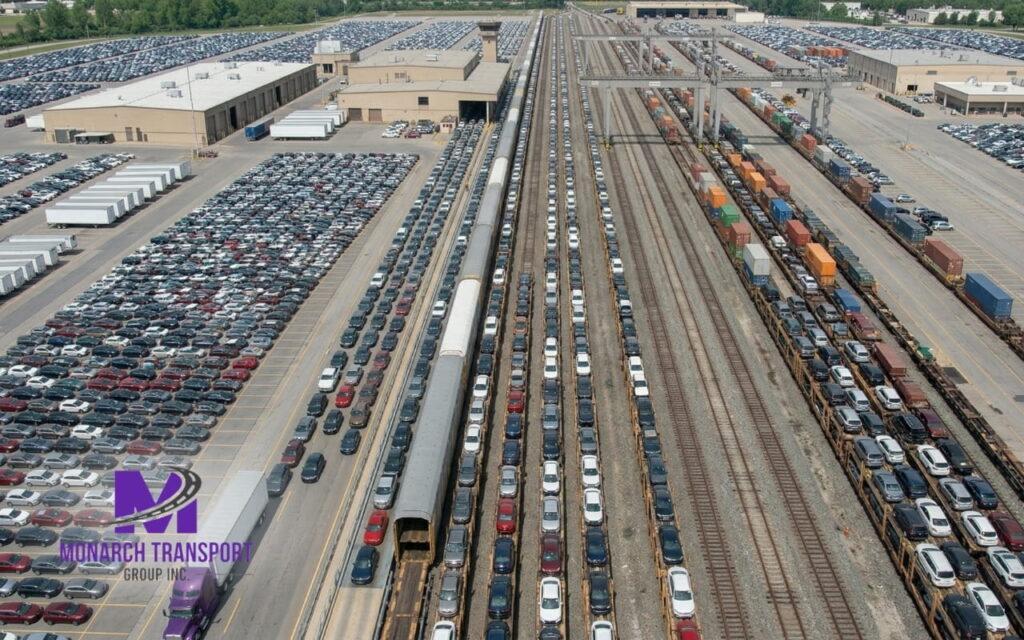
If you choose commercial rail (not Amtrak), your experience will be very… industrial. Don’t expect a polished lobby with a coffee machine. You will likely be driving to a massive, fenced-off asphalt desert filled with thousands of new cars wrapped in white plastic.
The Drop-off Process:
The Pickup Process:
This is where the “Train Time” factor kicks in. Trains don’t arrive at 2:00 PM; they arrive when the tracks are clear. You might get a notification that your car has arrived, but it might take another 24 hours for the yard crew to actually “ground” the vehicle (take it off the railcar and put it in the pickup lot). Patience isn’t just a virtue here; it’s a requirement.
Why Speed is the Biggest Trade-off
Let’s be candid: shipping by train is slow. A freight train isn’t a bullet train. It stops. It waits for other trains. It spends three days sitting in a yard in Omaha while railcars are rearranged.
If you are starting a new job on Monday and you need your car on Sunday, do not ship by train. The “transit time” given by brokers is almost always an estimate, not a guarantee. In 2026, supply chain hiccups are still a thing. If a bridge has an issue or a rail line is blocked for maintenance, your car stays where it is.
However, if you are a “snowbird” heading south for the winter and you’re flying down a week early anyway, the train is the perfect “set it and forget it” solution. You save the money, you save the wear and tear, and your car arrives clean and ready for the sunshine.
Preparing Your Vehicle for Rail Transit: The Reality Check
Preparing a car for rail transport requires reducing fuel levels to one-quarter tank, removing all personal items, and documenting the vehicle’s condition via a signed Bill of Lading. Unlike truck transport, rail carriers strictly prohibit loose items in the cabin due to safety and weight regulations. Owners must disable car alarms and remove aftermarket accessories to prevent transit damage or battery depletion during the 7-to-14-day shipping window.
If you’ve shipped a car by truck before, you might be used to a certain level of “flexibility,” maybe the driver let you leave a box of clothes in the trunk. On the railroad, that flexibility disappears. Rail yards are high-security, high-volume environments. If a car alarm starts blaring inside a sealed railcar in the middle of a 200-car train, nobody is going to hear it, and your battery will be dead long before it reaches the destination.
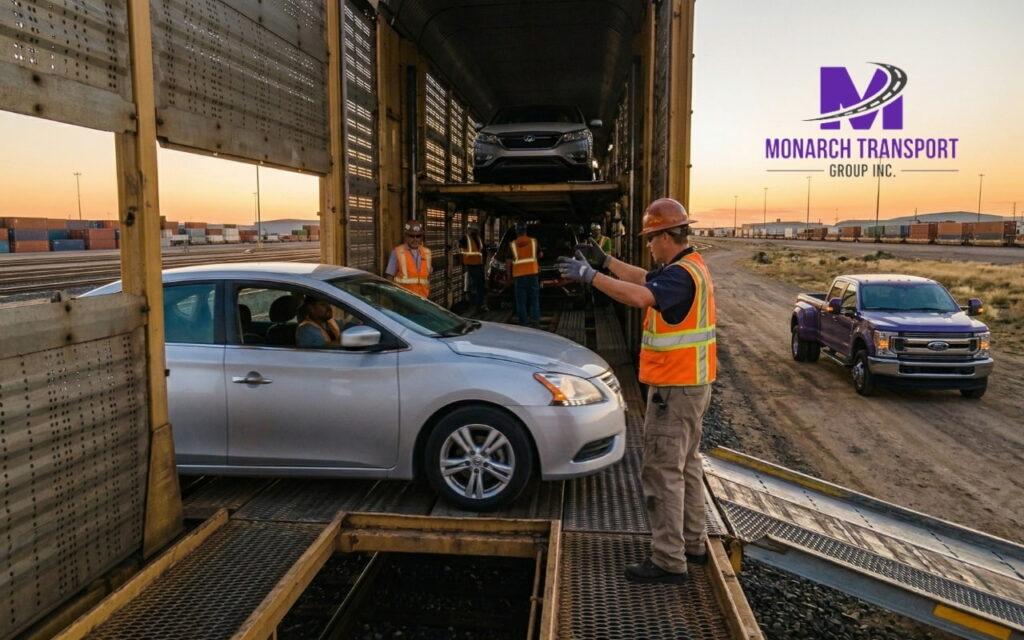
Preparing for the train is about making your car as “inert” as possible. You want it to be a heavy, stable brick that doesn’t leak, doesn’t beep, and doesn’t have anything that can fly off or be stolen. Let’s look at the non-negotiables.
The “Empty Cabin” Rule: Why Rail is Stricter
One of the biggest shocks for people shipping by freight rail is the “Zero Items” policy. Most commercial rail carriers will not move a car if they see a single suitcase or box through the window.
Why? It’s not just about theft. It’s about the “Auto Rack” (the railcar) itself. These racks are designed to maximize space. If 50 people decide to “stuff” their cars with 300 pounds of moving boxes, the weight distribution of the entire railcar changes. Furthermore, rail transport involves a lot of “slack action,” the tiny jolts that happen when a mile-long train starts or stops. Anything loose in your car will become a projectile, potentially smashing your interior glass or tearing the upholstery.
The Amtrak Exception:
If you are using the Amtrak Auto Train, you can leave luggage in your car. In fact, many people use their SUVs as giant suitcases. However, you still can’t access that luggage once the car is loaded, and Amtrak explicitly states they aren’t liable for anything left inside. If you’re going commercial freight, keep it empty. Period.
The 2026 Pre-Shipment Checklist
Don’t wait until you’re at the terminal to realize your roof rack is too tall. Run through this list 48 hours before your drop-off:
| Checklist Item | Requirement | Reason |
| Fuel Level | ¼ tank exactly | Fire safety regulation; too much is a hazard, too little stalls yard crew |
| Exterior Condition | Washed and clean | Dirty cars get “Unable to verify condition” on inspection — kills insurance claims |
| Car Alarm | Disabled | Train vibrations trigger motion sensors; dead battery guaranteed otherwise |
| Tire Pressure | At recommended PSI | Car sits 10+ days; low pressure causes flat spots on tires |
| Battery Health | Fully charged | Jumping a car inside a sealed railcar incurs service fees |
| Personal Items | Completely removed | Strict zero-item policy on all commercial rail carriers |
| Roof Racks / Accessories | Removed or secured | Must clear 85″ height limit; loose parts become projectiles |
| Toll Tags & Dashcams | Removed | Theft risk; not covered under standard cargo insurance |
Insurance: Understanding the “Bill of Lading” Authority
Understanding car shipping insurance for rail transport is one of the most overlooked steps in the entire process – and one of the most expensive mistakes relocators make.
Standard rail cargo insurance covers catastrophic events: a derailment, structural damage to the Auto Rack, or a major weather event. What it does not cover surprises most first-time shippers:
For high-value vehicles, standard cargo insurance is simply not enough. If you are shipping a classic car by train, a luxury sedan, or any vehicle valued over $50,000, you should explore three layers of protection:
| Coverage Type | What It Covers | Average Cost |
| Carrier Cargo Insurance | Derailment, structural railcar damage | Included in base rate |
| Personal Auto Insurance Transit Rider | Comprehensive coverage during shipping | $25–$75 one-time add-on |
| Broker Supplemental Gap Policy | Fills coverage gaps between carrier and personal insurance | $80–$200 depending on vehicle value |
The Bill of Lading as Legal Evidence
Your Bill of Lading (BOL) is the single most important document in any vehicle shipping by train claim. In 2026, most terminals generate a digital BOL backed by HD camera tunnel scans – but this technology has a known blind spot: the roof and the undercarriage.
Best practice for auto transport insurance documentation:
If your vehicle arrives damaged, the car shipping claim process requires you to note damage on the delivery receipt before signing. Once you sign without notation, most carriers will deny liability entirely – regardless of what the BOL says.
The “Last Mile” Logistics: Pick-up and Grounding
When the train finally rolls into the destination hub, the car isn’t immediately available. It has to be “grounded.” This is the process of unloading the cars from the railcar and moving them to the “Released for Pickup” lot.
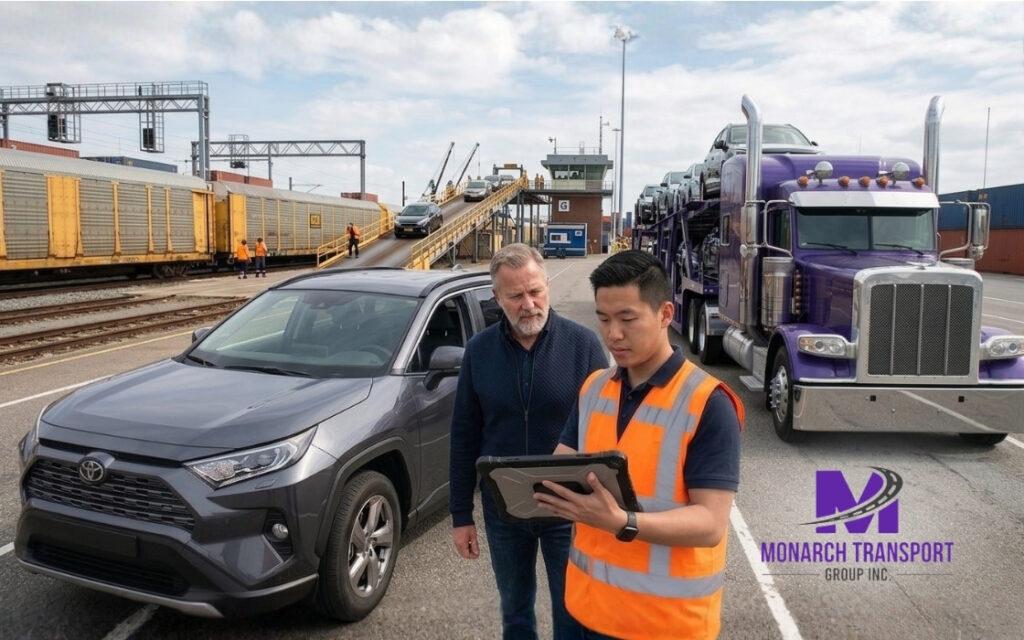
In 2026, most brokers will provide a tracking app. You’ll see “Arrived at Destination,” but you shouldn’t head to the yard until you see “Ready for Pickup.” If you show up early, you’ll likely be turned away at the gate. Bring your ID, your booking confirmation, and if you’re picking up at a commercial freight yard, be prepared to wait. These are working industrial sites, and consumer cars are often their lowest priority.
Conclusion: Is the Train Right for You?
Shipping your car by train in 2026 is a calculated trade-off. You are trading speed and the convenience of your front door for a lower price point, a smaller carbon footprint, and superior protection from the elements.
If you are in a rush or need door-to-door service, stick with a truck. But if you are moving a standard vehicle across the country, if you value the safety of an enclosed railcar, or if you are simply looking to save $500 while avoiding the madness of I-95, the tracks are waiting. It’s the “slow and steady” winner of the auto transport world.
If train transport doesn’t fit your needs, you can always use our company’s car shipping services for fast and reliable vehicle transport.
FAQ
Rail transport is generally 20% to 40% cheaper than truck transport for long-distance, cross-country routes. However, for shorter distances (under 500 miles), terminal fees and rail logistics often make truck transport more economical. Rail becomes significantly more cost-effective when shipping multiple vehicles or using terminal-to-terminal services.
The average transit time for car shipping by train is 7 to 14 days. While the actual time on the tracks may be shorter, the total window includes vehicle staging, loading into railcars, and the “grounding” process at the destination terminal. In contrast, door-to-door truck transport typically takes 3 to 7 days.
No, commercial rail carriers strictly prohibit personal items in vehicles during transit due to safety, theft, and weight regulations. The only exception is the Amtrak Auto Train, which allows passengers to leave luggage in the car, though it is not insured and cannot be accessed during the journey.
Rail transport is exceptionally safe because vehicles are typically housed in fully enclosed, steel “Auto Racks,” protecting them from weather, road debris, and vandalism. This provides a similar level of protection to “enclosed truck transport” but at a significantly lower price point, making it a favorite for collectors and dealerships.
The Amtrak Auto Train operates on a single, direct daily route between Lorton, Virginia (near Washington, D.C.) and Sanford, Florida (near Orlando). It is currently the only service in the United States that allows individual travelers to ship their cars while riding on the same train as passengers.
No, you generally cannot ship an inoperable vehicle by train. Both the Amtrak Auto Train and commercial rail carriers require vehicles to be in good working condition, as they must be driven up narrow, steep ramps into specialized railcars. If your car does not start, steer, or brake independently, you must utilize specialized truck transport equipped with winches or lift gates.
Related articles

Complete Guide to Car Shipping in 2026
The landscape of American mobility has shifted, making vehicle logistics more accessible and seamless than ever before. Understanding this new norm is the first step toward a stress-free relocation that

Complete Guide to RV Shipping in 2026
IN THIS ARTICLE: Introduction: The Freedom of the Road, Delivered by Professionals Understanding the Fleet: Classes and Types of RVs Methods of Transport: How We Get Your RV Home Measuring

Cross-Country Car Shipping: How to Save Money Safely
IN THIS ARTICLE: Why “Cheap” Doesn’t Have to Mean “Dangerous” 1. Open Transport: The Industry Gold Standard for Savings 2. The Power of “Terminal-to-Terminal” Shipping 3. Timing the Market: The
How Much Does It Cost to Ship a Car Between States?
IN THIS ARTICLE: Average Cost Breakdown by Distance Primary Factors Influencing Your Shipping Quote Geographic Influence on Pricing Understanding the Quote Structure The Impact of Seasonality on Auto Transport Rates

How State-to-State Car Transport Works: From Pickup to Delivery
IN THIS ARTICLE: Understanding the Auto Transport Ecosystem Step 1: Choose Your Transport Type Phase 2: The Process of Shipping Step 4: The Pickup and Bill of Lading (BOL) Phase

How to Prepare Your Car for Shipping: Step-by-Step Checklist
IN THIS ARTICLE: Why Preparation is not just a Chore Step 1: Selecting Your Logistics Partner Step 2: The Evidence Phase – Cleaning and Documentation Step 3: Protecting the Extravagant

How to Ship Your Electric Vehicle (EV) Safely in 2026
IN THIS ARTICLE: The Reality of EV Logistics in 2026 Why EVs Change the Math: The Weight Factor The “50% Rule”: Battery Safety and State of Charge (SoC) Vetting the

How to Spot and Avoid Car Shipping Scams in 2026
IN THIS ARTICLE: The State of Auto Transport Fraud in 2026 Red Flag #1: The “Impossible” Quote (Bait-and-Switch 2.0) The Rise of “Ghost” Brokers and AI-Cloned Websites Payment Red Flags:
Open vs. Enclosed Auto Transport: Which Should You Choose?
IN THIS ARTICLE: The Reality of the Road: What is Open Car Shipping? Where Open Transport Makes Perfect Sense Comparison Table: Open Transport Quick Glance The Practitioner Tip: The Myth