IN THIS ARTICLE:
- Why “Standard” Transport Doesn’t Cut It for Masterpieces
- The Anatomy of Protection: Hard-Sided vs. Soft-Sided Trailers
- The Low-Clearance Nightmare: Why Hydraulic Lifts Matter
- Beyond the Walls: The “White Glove” Handling Difference
- The Economics of “Overpaying” for Transport
- The Invisible Enemies: UV Rays and Thermal Shock
- Identifying the “A-Team”: A Vetting Checklist
- The Owner’s Responsibility: Preparing for Professional Care
- The “Low Clearance” Solution: Beyond Just Lifts
- Privacy: The Underrated Benefit
- The Owner’s Responsibility: Preparing for Professional Care
- The Inspection Masterclass: Your Final Defense
- Conclusion
- FAQ
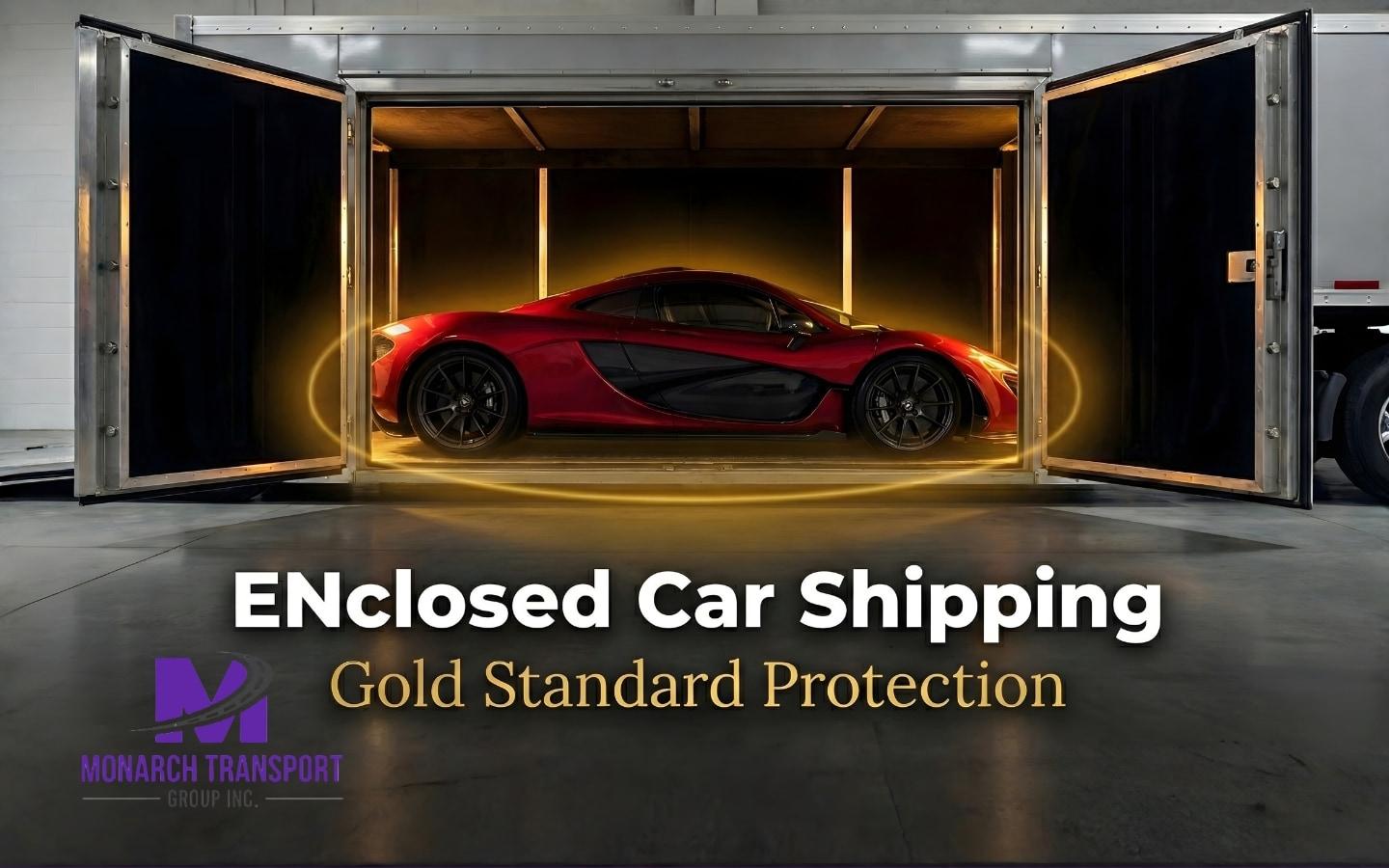
Enclosed car shipping is a premium transport service that utilizes fully covered trailers to protect high-value vehicles from road debris, weather, and theft. Unlike standard open transport, it features specialized equipment like hydraulic lift gates and soft tie-downs to ensure a damage-free journey. This method is the industry standard for luxury, classic, and exotic cars, in which preserving the vehicle’s pristine condition and market value is mandatory.
Why “Standard” Transport Doesn’t Cut It for Masterpieces
Let’s be honest: if you’re moving a standard SUV that you use for grocery runs and school drop-offs, open-air transport is perfectly fine. It’s the workhorse of the industry. But when we start talking about a vintage Porsche 911, a factory-fresh McLaren, or a custom-built restoration project, the “standard” rules no longer apply.
Shipping a luxury vehicle isn’t simply about getting it from Point A to Point B. It’s about risk mitigation. For a high-end vehicle, a single rock chip isn’t just a nuisance; it’s a thousand-dollar hit to the resale value. By utilizing professional enclosed car transport services, you effectively eliminate the variables of road grit, salt air, and unpredictable weather.
The Anatomy of Protection: Hard-Sided vs. Soft-Sided Trailers
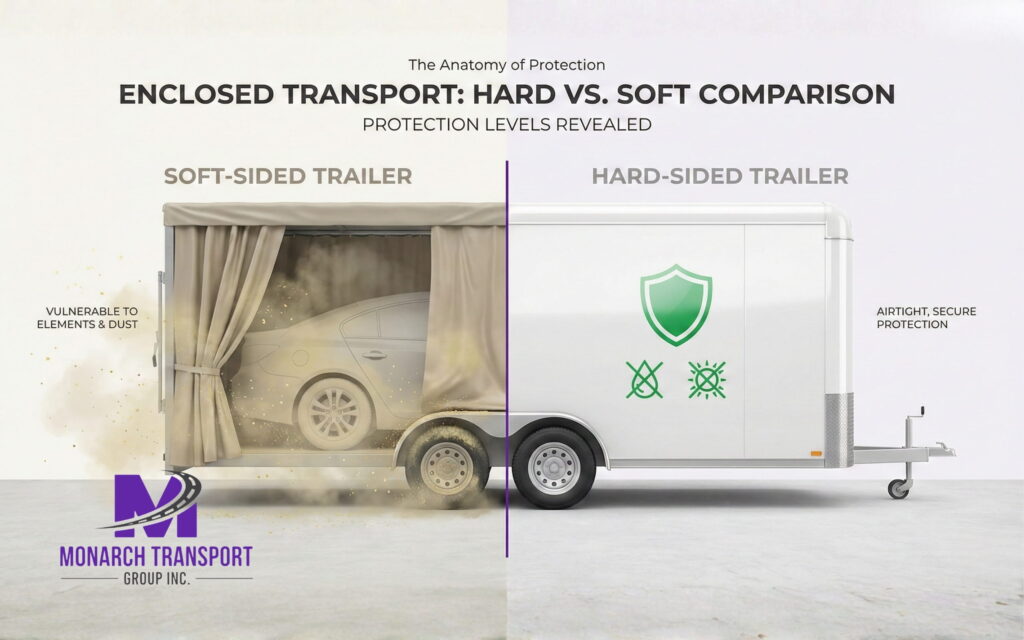
In the world of enclosed transport, not all “enclosed” trailers are created equal. As a practitioner, I often see owners get confused here, so let’s break down the two main types you’ll encounter.
1. Soft-Sided Enclosed Trailers
Think of these as regular open trailers that have been fitted with heavy-duty PVC-coated vinyl curtains.
2. Hard-Sided Enclosed Trailers (The Real Deal)
These are solid-wall containers, usually made of aluminum or composite materials. This is what you want if you’re shipping a show car or an exotic.
The Low-Clearance Nightmare: Why Hydraulic Lifts Matter
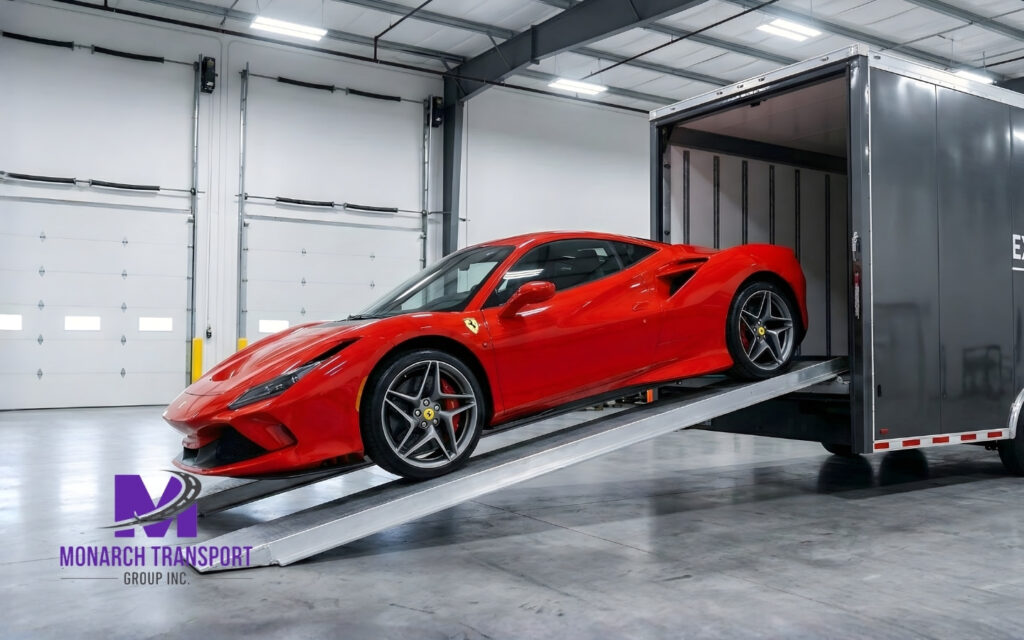
If you’ve ever owned a Lamborghini or a lowered classic, you know the “ramp anxiety.” Standard car haulers use long ramps to drive cars onto the trailer. If the angle is too steep, you’re going to hear that heart-wrenching scrape of the front splitter or the undercarriage.
This is where exclusive enclosed shipping earns its keep. Most high-end enclosed carriers use hydraulic lift gates. Instead of driving up a ramp, the car is driven onto a level platform that then lifts vertically until it’s flush with the trailer floor.
Beyond the Walls: The “White Glove” Handling Difference
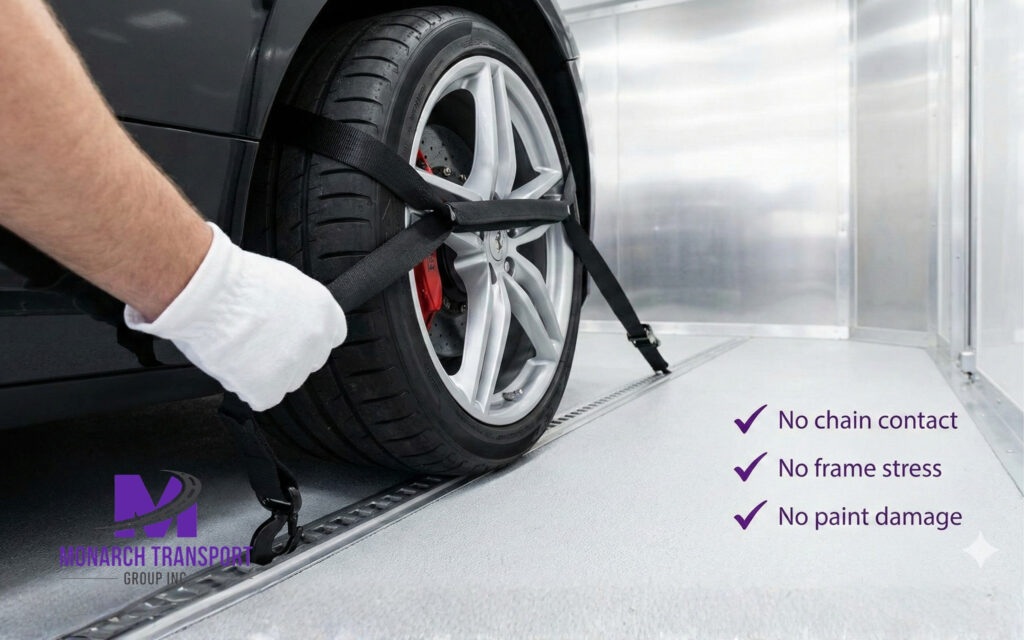
It’s not just the metal box that protects your car; it’s the person behind the wheel. Drivers in the enclosed sector are typically the veterans of the industry. They aren’t just “truckers”; they are specialized handlers.
The Economics of “Overpaying” for Transport
When you see a quote for enclosed car shipping that is $600 or $1,000 higher than an open-air quote, the gut reaction is often: “Is it really worth it?” From a purely financial standpoint, the answer depends on the math of depreciation.
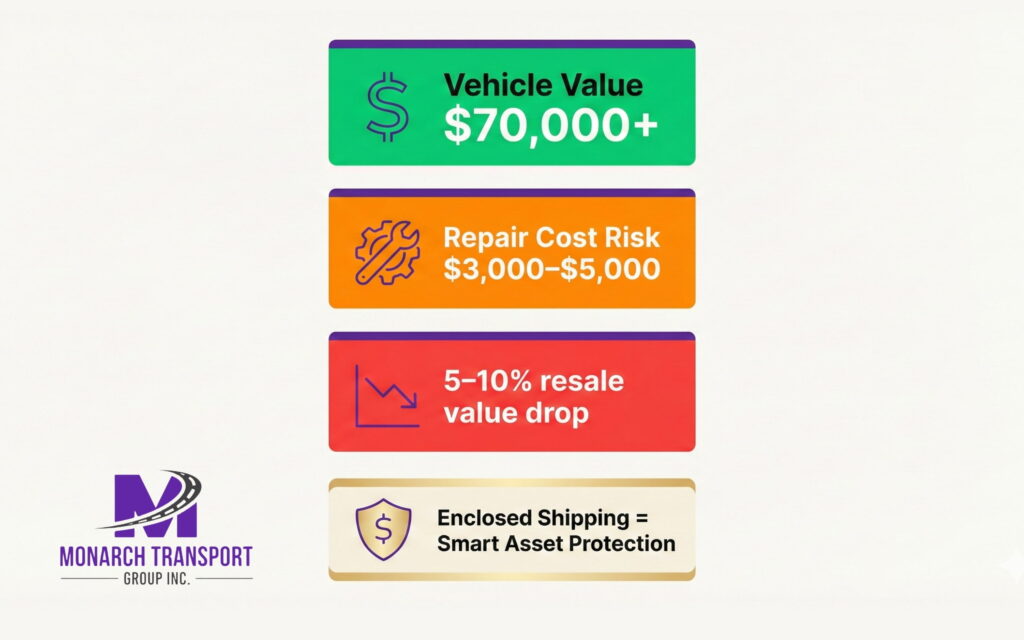
If you’re shipping a $150,000 Porsche GT3, a single significant scratch or a cluster of stone chips on the hood can easily cost $3,000 to $5,000 to repair properly (especially with specialized paints like Shark Blue or Paint-to-Sample options). Even if insurance covers the repair, the car now has a “documented repair” on its history, which can slice 5-10% off its resale value instantly. In this light, the extra $800 for an enclosed trailer isn’t an expense; it’s a tiny insurance premium to protect a massive asset.
When the Math Favors Enclosed Shipping:
The Invisible Enemies: UV Rays and Thermal Shock
We often talk about “road debris” as the main villain in car shipping. Rocks, tire rubber, and glass shards are obvious threats. But in 2026, we’re seeing more emphasis on the environmental aspects that most owners overlook during long-haul transit.
Solar Loading and UV Exposure
When a car sits on the top deck of an open carrier for five days across the Southwest, it is baked in strong UV light. While automotive paint is designed for the sun, a “stationary” bake is different from daily driving. Interior components, specifically vintage leather or Alcantara, can reach extreme temperatures, leading to “outgassing” of plastics or the drying out of delicate hides. Hard-sided enclosed trailers act as a thermal barrier, keeping the vehicle in a shaded, more stable environment.
The “Industrial Fallout” Problem
If your car is on an open trailer passing through industrial zones or near major railways, it is susceptible to “rail dust” tiny metallic particles that embed themselves in the clear coat. Once they get wet, they oxidize and create tiny rust spots. Removing this requires a professional clay-bar treatment or a “decon” wash. Enclosed shipping keeps your car in a “clean room” environment, ensuring it arrives ready for a car show, not a detailing shop.
Identifying the “A-Team”: A Vetting Checklist
For luxury transport, you need to go deeper than just checking a USDOT number. You are looking for competence.
The Owner’s Responsibility: Preparing for Professional Care
Success depends on how you hand over the keys.
The “Low Clearance” Solution: Beyond Just Lifts
We talked about hydraulic lift gates in the first part, but there’s another level of care for truly exotic machines. Some elite carriers use climate-controlled trailers.
While this might seem like overkill, think about high-performance EVs or cars with highly sensitive electronics. Rapid temperature swings (moving from the freezing Midwest to the humid Florida coast) can cause condensation in places you don’t want it. Climate control keeps the humidity and temperature at a steady level, effectively extending your garage’s environment across state lines.
Privacy: The Underrated Benefit
Finally, let’s examine something that isn’t about physics or finance: Privacy. In the age of social media, a high-profile car on an open trailer is an invitation for “car spotters” and unwanted attention. People take photos, they walk up to the trailer at rest stops, and they might even touch the vehicle.
Enclosed shipping offers “ghost” transport. To the rest of the world, it’s just another nondescript white or black semi-truck. No one knows if there’s a $10 million Ferrari 250 GTO inside or a load of high-end furniture. For many collectors, this privacy is the primary reason they choose enclosed services.
The Owner’s Responsibility: Preparing for Professional Care
While the carrier does the heavy lifting, the success of a “white-glove” transport depends significantly on how you hand over the keys. With my years of experience, the most seamless deliveries happen when the owner takes an hour to prepare the vehicle as if it were headed to a Concours d’Elegance.
The Cleaning Paradox
You might think, “Why wash the car if it’s going inside a trailer?” Here’s the secret: A dirty car is a hidden car. You cannot precisely document the condition of the paint if it’s covered in a layer of dust or road salt. A clean car allows both you and the driver to spot every existing micro-scratch or swirl mark during the initial inspection. This protects you from disputes later and shows the driver that you are an owner who notices the details.
The Alarm and Battery Trap
Current luxury cars and exotics are essentially rolling computers. When they are secured inside a trailer, the movement of the truck, vibrations, swaying, and tilting can trigger the vehicle’s internal motion sensors.
The “Quarter Tank” Rule
Weight matters. Every gallon of fuel weighs about six pounds. In a multi-car enclosed trailer, an extra 100 pounds of fuel per car adds up. Most carriers request that you have no more than 1/4 tank of gas. This is also a safety requirement for many marine and specialized transportrules to reduce fire risk.
The Inspection Masterclass: Your Final Defense
The delivery moment is often filled with excitement. Your “new” classic has arrived, or your luxury daily driver is finally back home. But this is the most critical time to stay focused. Professional enclosed shipping is highly safe, but “human error” is still a factor in 2026.
Lighting and Angles
Never perform a delivery inspection in the dark or under poor streetlights. If the driver arrives after sunset, use high-powered LED flashlights or move the car into a well-lit garage before signing the Bill of Lading (BOL).
Checking the “Hidden” Spots
In enclosed shipping, damage doesn’t usually come from rocks; it comes from loading.
The “Digital Paper Trail”
In 2026, the paper BOL is almost extinct. You’ll likely be signing a tablet. Do not sign until you have read the notes. If you see a new scratch, write it in the “Exceptions” or “Notes” section of the digital form. Once you sign a clean BOL, the carrier’s insurance company will almost certainly deny any later claims.
Conclusion
Enclosed car shipping is more than just a logistical choice; it’s an insurance policy for your vehicle’s soul. Whether it’s a million-dollar classic or a high-performance EV, these machines represent more than just transportation. They are investments of capital, time, and passion.
By choosing hard-sided trailers, hydraulic lifts, and experienced handlers, you are removing the “luck” factor from the equation. In a world where road conditions and weather are increasingly unpredictable, enclosed transport remains the only way to guarantee that your vehicle arrives in the exact same condition it left your driveway.
FAQ
The primary benefit is total protection from environmental hazards. Enclosed trailers shield high-value vehicles from road debris (rocks, glass), weather (hail, snow, UV rays), and industrial fallout. Additionally, enclosed transport offers enhanced security and privacy, making it the preferred choice for luxury, exotic, and classic cars that require “white-glove” handling.
Enclosed shipping typically costs 30% to 50% more than standard open-air transport. This price premium accounts for specialized equipment (such as hydraulic lift gates), higher insurance coverage limits (often up to $2 million), and the expertise of drivers trained to handle low-clearance and exotic vehicles.
Prepare your vehicle by cleaning it thoroughly to ensure an accurate condition report. Leave approximately 1/4 tank of fuel to minimize weight and comply with safety standards. You must also disable all anti-theft alarms or motion sensors, as the trailer’s movement can trigger them, leading to a drained battery upon delivery.
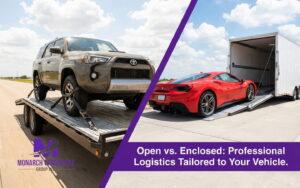
Hard-sided trailers feature solid aluminum or composite walls, offering maximum protection from impact, weather, and theft. Soft-sided trailers use heavy-duty vinyl curtains; while they provide privacy and shield from most rain and dust, they are not completely sealed. For high-end exotics and classic cars, hard-sided transport is the gold standard.
Hydraulic lift gates allow a vehicle to be loaded onto a trailer horizontally, without the steep angles required by traditional ramps. This is essential for exotic cars like Lamborghinis or McLarens, as it prevents the front splitter, side skirts, or undercarriage from scraping or sustaining structural damage during loading and unloading.