
IN THIS ARTICLE:
- The “Why” Behind the Shipping Method
- Option 1: The DIY Route (Towing it Yourself)
- Option 2: Open vs. Enclosed Transport
- Option 3: Specialized Motorcycle Shippers vs. General Freight
- The Pre-Shipment Ritual: Preparing the Machine
- The Legal Guardrails: The Bill of Lading (BOL)
- Avoiding the “Broker Trap” and 2026 Scams
- Timing: When to Book Motorcycle Shipping
- The Transit Phase: Staying in the Loop
- Delivery Day: The “Second Inspection”
- What to Do If Things Go Wrong (Insurance Claims)
- The Real Cost of Shipping a Motorcycle
- Final Takeaway Checklist:
- Conclusion
- FAQ
If you’ve spent any amount of time in the saddle, you know that a motorcycle isn’t just a “vehicle.” It’s a mix of engineering, memories, and let’s be honest, a significant financial investment. So, when the time comes that you can’t actually ride it to its destination, the anxiety kicks in. Whether you’ve just bought a vintage Ducati from a collector three states away, you’re relocating for a new job, or you’re heading to a rally and want to save your tires (and your back) for the actual event, the question is the same: How do I get this bike there without a scratch?
In 2026, the logistics world has changed. We have more tech and better tracking, but the physics of a falling motorcycle remains the same. If it isn’t secured correctly, it’s going to tip. In this guide, we’re going to break down exactly how to navigate the shipping process. We’ll look at your options, from the “I’ll do it myself” weekend project to hiring the pros at Monarch Transport Group.
The “Why” Behind the Shipping Method
Before we dive into the “how,” we need to talk about the “what.” Not every bike is shipped for the same reason, and that dictates your choice.
Understanding your priority, whether it’s cost, speed, or maximum protection, is the first step in not losing your mind during this process.
Option 1: The DIY Route (Towing it Yourself)
There’s a certain pride in self-reliance. The majority of riders are natural tinkerers. When you have a solid pickup truck or a dedicated trailer, the idea of transporting the bike yourself seems like the cheapest and most controlled option. You possess the keys, you know exactly how tight the straps are, and you can check on the load every time you pull over for coffee.
The Reality Check
The word “cheap” is, however, relative. By the time you add the price of a high-quality ramp (please, do not use a scrap 2×4 you have lying around), a set of professional-grade ratchet straps, wheel chocks, and the additional gas your truck will burn while pulling a trailer, those savings quickly evaporate.
The Gear You Actually Need:
The Human Factor
I have witnessed it a hundred times: someone attempts to ride the motorcycle up the ramp into the truck. Don’t do this. A single slip of the clutch or a foot losing traction on the ramp, and both you and the bike will end up on the ground. There should always be at least one, preferably two, spotters. Use the engine’s power to walk it up slowly while you stand on the ground beside the bike.
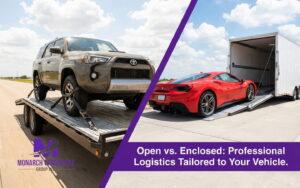
Option 2: Open vs. Enclosed Transport
When you decide to hire a professional service, you’ll hit the first large fork in the road: Open or Enclosed?
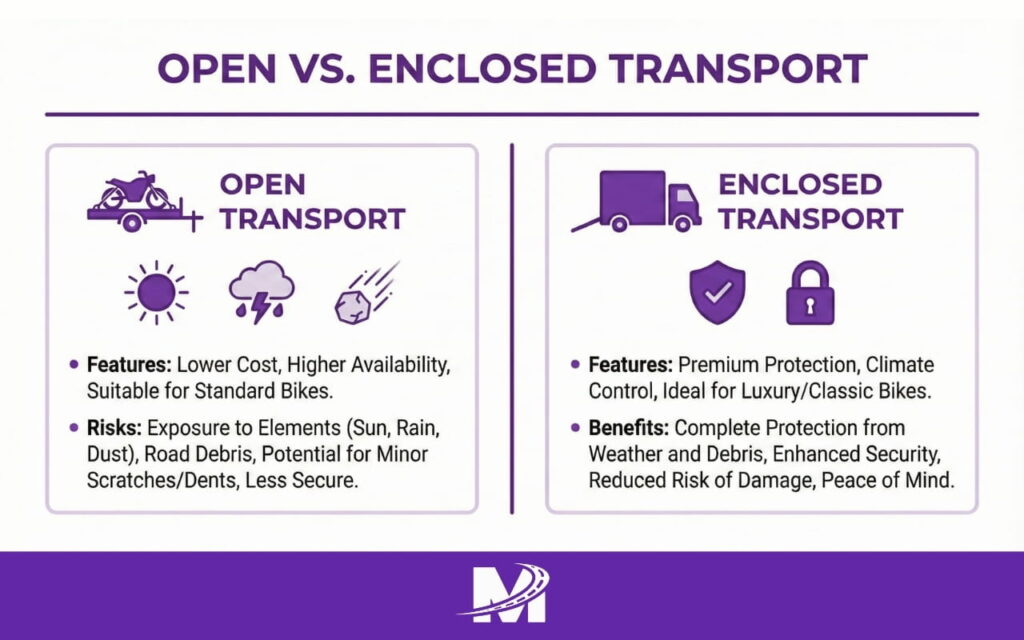
Open Transport
This is precisely what it sounds like. Your bike sits on a multi-vehicle trailer, exposed to the elements.
Enclosed Transport
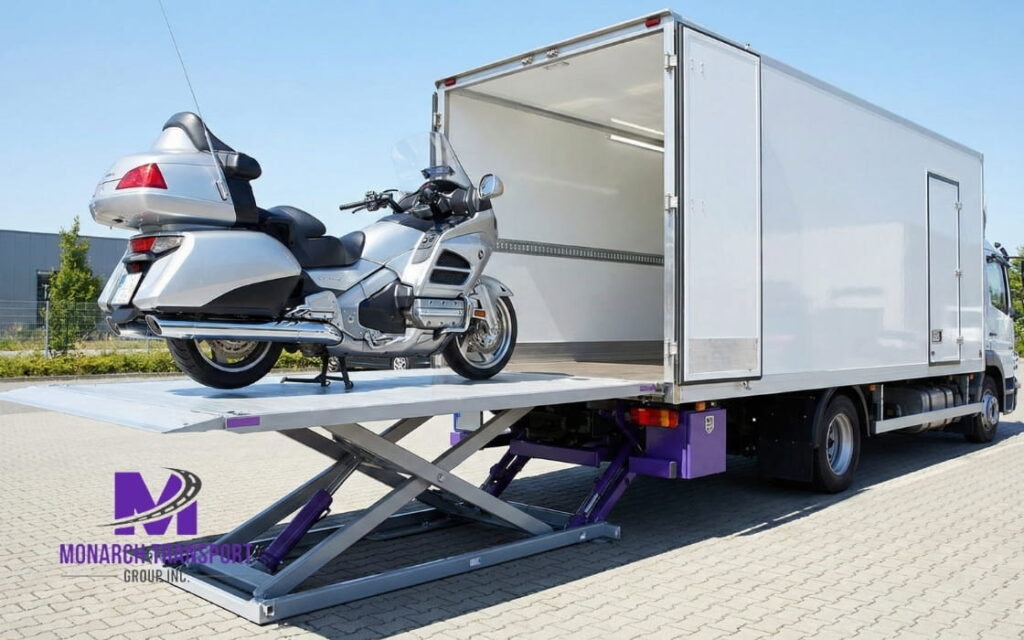
This is the gold standard, and it’s what we normally suggest at Monarch for anything of value. The motorcycle is kept inside a hard-sided trailer.
Option 3: Specialized Motorcycle Shippers vs. General Freight
This is where people often make their biggest mistake. They see a “Freight” company online that offers a low rate and think, “A truck is a truck, right?”
General Freight Carriers
These companies move pallets of toilet paper, engine blocks, and furniture. To them, your motorcycle is just another “SKU” (Stock Keeping Unit).
Specialized Shippers (The Monarch Way)
A specialized shipper knows that a motorcycle has specific “soft points.” We don’t need you to build a crate. We use specialized skids or “roll-on” loading systems designed specifically for two wheels.
Once you’ve decided on a shipping method, it’s tempting to just hand over the keys and walk away. But if you want your bike to arrive in the same condition it left, there’s a bit of “homework” involved. Think of this as the insurance you don’t have to pay for; it just takes a little time.
The Pre-Shipment Ritual: Preparing the Machine
In the professional transport world, a safe bike is a ready bike. The following is exactly how a pro prepares a motorcycle to be hauled across the country.
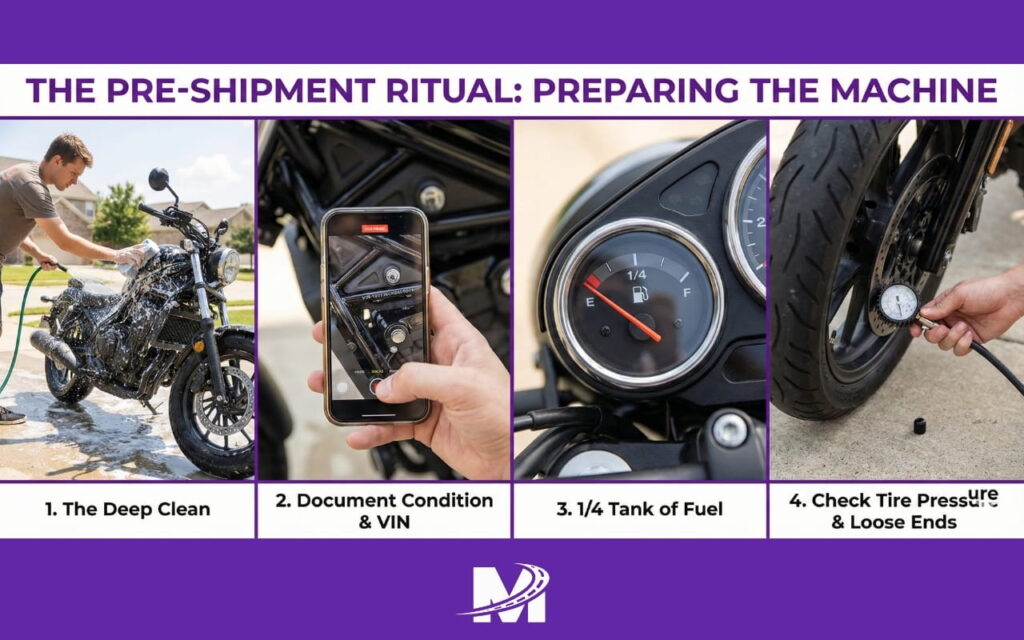
1. The Deep Clean (It’s not for vanity)
You might think, “Why wash it? It’s just going to gather dust in a truck anyway.” Here is the secret: it is impossible to accurately document damage on a dirty bike. Road grime and dust can easily conceal hairline cracks in the fairing, scratches on the tank, or slow oil leaks. Wash the bike thoroughly. When it’s dry, you have a “blank canvas” for inspection.
2. The Documentation (The “Before” Selfie)
Take lots of photos. In 2026, high-resolution video is even better. Start the video at the VIN plate and then take a slow walk around the bike. Focus on the contact points: the ends of the handlebars, the mirrors, the exhaust pipes, and the underside of the engine. This is your “get out of jail free” card if there is ever a disagreement about a new scratch later on.
3. The Gas Tank Rule
Most shippers desire 1/4 tank of fuel or less unless you are using a special-purpose crate. Why?
4. Battery and Alarms
If your motorcycle has an alarm system or a motion sensor installed, turn it off. Nothing is more annoying to a driver than an alarm that keeps screaming every time the truck hits a bump in Nebraska. It wears your battery down, and the driver may even be compelled to disconnect your battery terminals to silence the noise, which can cause havoc with modern onboard computers. If you have a keyless fob, talk to your shipper about whether it stays with the bike or goes in a secure box in the truck.
5. Loose Ends
Take off your GPS, toll passes, and any clip-on tank bags. Besides, remove any soft saddlebags that are not bolted on; they may flap in the wind (on an open trailer) or rub against the paint. Fold in your mirrors wherever you can.
The Legal Guardrails: The Bill of Lading (BOL)
If you take only one thing from this guide to memory, let it be this: The Bill of Lading is the only document that counts.
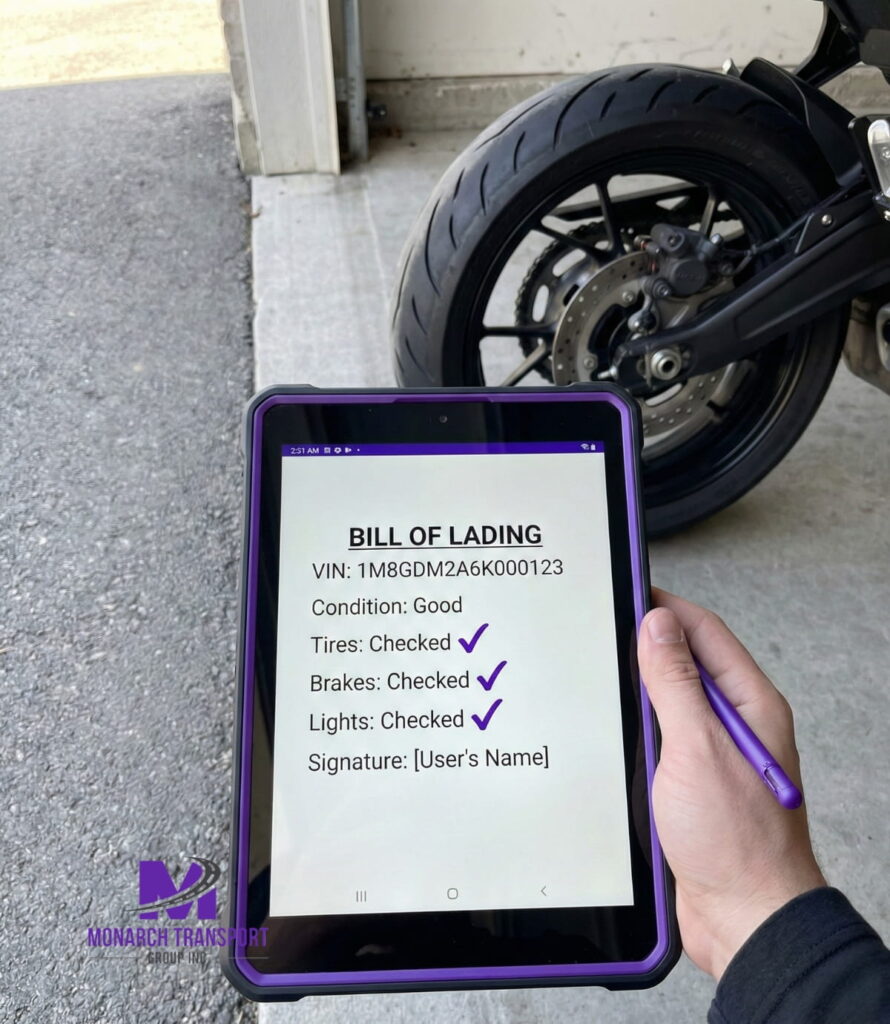
The BOL is your agreement and your receipt. When the driver arrives to pick up the bike, they will inspect it and document any existing damage on the BOL. Do not sign this blindly. If the driver marks “scratches on tank” and your tank is in perfect condition, speak up. By signing that sheet of paper, you are legally agreeing that the bike is in the condition described.
At the time of delivery, you will sign it again. This is your window to inspect the bike before the driver leaves. If you see a new scratch, mark it on the BOL immediately. Unless it is documented on the paperwork, an insurance claim will be an uphill battle.
Avoiding the “Broker Trap” and 2026 Scams
The shipping business is full of brokers. A broker doesn’t own any trucks; they simply buy your “lead” and sell it to the lowest bidder. This isn’t always bad, but it can lead to a total lack of accountability. You think you’re hiring Company A, but some guy in a rented van from Company Z shows up.
How to verify a legitimate carrier:
The “Ghost” Company:
In the last year or two, we’ve seen a rise in “ghost” shipping sites, slick websites that look professional but are run by scammers who take a “reservation fee” and then disappear.
Timing: When to Book Motorcycle Shipping
Shipping isn’t like ordering a pizza; you can’t always get it “now.” In 2026, the logistics chain is tighter than ever.
The Transit Phase: Staying in the Loop
Most high-end carriers now offer some form of GPS tracking. At Monarch, we know that hitting “refresh” on a map is a bit of a national pastime for bike owners. However, a word of advice: don’t panic if the “dot” on the map doesn’t move for eight hours. Truck drivers are bound by strict Federal “Hours of Service” (HOS) regulations. They have to sleep, they have to eat, and they have to navigate 2026 traffic patterns.
Communication is Key
The best way to stay sane is to maintain a good relationship with your coordinator or the driver.
Delivery Day: The “Second Inspection”
When the truck pulls up, the excitement is real. You want to hop on and ride immediately. But before you even put the kickstand down on your driveway, you need to perform your due diligence.
The “Walk-Around” 2.0
Pull out those photos and videos you took during Part 2. Do a slow walk-around with the driver present.
Signing Off
If everything looks perfect, sign the Bill of Lading (BOL) and enjoy your ride. If there is damage, and this is rare with specialized carriers, but can happen, note it on the BOL before the driver leaves. Take photos of the damage while it’s still on or near the truck. This is the only way to prove the damage happened during transit and not five minutes after the driver pulled away.
What to Do If Things Go Wrong (Insurance Claims)
No one likes to talk about it, but “Safe Shipping” includes knowing how to handle a mishap. If you find a scratch:
The Real Cost of Shipping a Motorcycle
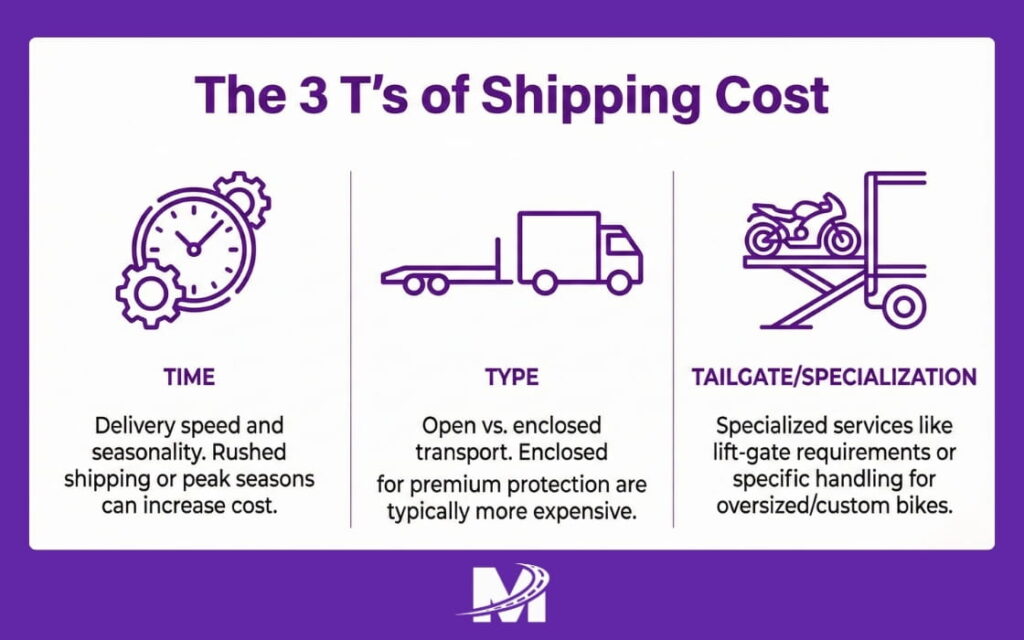
Let’s talk numbers. You’ll see quotes online ranging from $400 to $1,500. Why the massive gap? It comes down to the “Three T’s”: Time, Type, and Tailgate.
The “Hidden” Savings of Professional Shipping
When people say professional shipping is “too expensive,” they usually aren’t factoring in the cost of their own time. If you spend two days driving a truck, $300 in gas, $150 on a hotel, and $100 on tie-downs and a ramp, you’ve already spent $550 and two days of your life.
By the time you add the “stress tax” of worrying if the bike is falling over every time you hit a bump, the $700 or $900 you pay a pro starts to look like the bargain of the century.
Final Takeaway Checklist:
Conclusion
Shipping a motorcycle doesn’t have to be a lottery. It’s a process. By following these steps, putting in the prep work, and selecting a carrier that actually speaks “motorcycle” rather than just logistics, the transition from your old garage to your new one will be as smooth as a fresh strip of asphalt.
The logistics industry moves faster today than ever before, but the human aspect of motorcycle transportation remains the same. Your bike isn’t just a VIN number or a line on a manifest; it’s your next adventure. When you hire a carrier like Monarch Transport Group, one that recognizes the soul of a machine and not just its dimensions, you aren’t just buying a spot on a trailer. You are ensuring that your next journey begins exactly the way it was meant to: in pristine condition, documented correctly, and ready for the open road.
Safe riding, and we’ll see you on the road.
FAQ
There’s no exact number since it depends on a few things, but usually you’re looking at somewhere between $400 and $1,200. The price depends on how far you’re shipping, the size of your bike, and whether you go with open or enclosed transport. Things like fuel surcharges and busy seasons, like big rally weekends, can bump the price too. The easiest way to know for sure is just to get a free quote for your route.
Open transport is usually the way to save the most. Your bike rides on a shared multi-bike trailer, so you’re splitting fuel and labor costs with other riders. If you can be flexible with your pickup and delivery dates, carriers can fit you into their route more efficiently, which can lower the price even more. Just don’t cut corners on insurance, or handling cheaply isn’t worth wrecked peace of mind.
Most trips take about 3 to 10 business days once your bike is loaded. Short trips in the same state might only take a day or two, but coast-to-coast hauls, say, New York to California, take longer because drivers need rest breaks and weather can slow things down. Don’t forget to factor in a pickup window of a few days while the carrier schedules their arrival.
It’s simpler than most people think. First, get a quote and book a transporter with a valid DOT and MC number. Then prep your bike, clean it, check the fluids, and note any scratches or dents. When the driver shows up, you’ll do a quick inspection together and sign a Bill of Lading. After that, they handle all the logistics, and you just meet them at the destination to pick up your bike.
To get your motorcycle ready for shipping, start by giving it a good wash so you can spot any scratches before the trip. Check the fluids and make sure there aren’t any leaks, and keep the gas tank about a quarter full. Unlock the steering and turn off any extra alarms so they don’t drain the battery. Finally, take off anything that isn’t firmly attached: GPS units, toll passes, soft luggage, so nothing gets damaged or falls off along the way.
Yes, but you need to let your transporter know upfront. Shipping a “non-runner” requires specialized equipment, such as a winch or a heavy-duty liftgate, to get the bike safely onto the trailer. Most carriers charge an additional “inoperable fee” (usually $50–$150) to cover the extra labor and equipment needed. As long as the bike rolls and steers, we can get it where it needs to go.
Related articles
Complete Guide to Car Shipping in 2026
The landscape of American mobility has shifted, making vehicle logistics more accessible and seamless than ever before. Understanding this new norm is the first step toward a stress-free relocation that

Complete Guide to RV Shipping in 2026
IN THIS ARTICLE: Introduction: The Freedom of the Road, Delivered by Professionals Understanding the Fleet: Classes and Types of RVs Methods of Transport: How We Get Your RV Home Measuring
Open vs. Enclosed Auto Transport: Which Should You Choose?
IN THIS ARTICLE: The Reality of the Road: What is Open Car Shipping? Where Open Transport Makes Perfect Sense Comparison Table: Open Transport Quick Glance The Practitioner Tip: The Myth