
IN THIS ARTICLE:
- The Reality of the Road: What is Open Car Shipping?
- Where Open Transport Makes Perfect Sense
- Comparison Table: Open Transport Quick Glance
- The Practitioner Tip: The Myth of the Dirty Car
- Closed Auto Transport: The Shipping Accommodation of the First Class
- Why Pay the Premium? The Technical Advantages
- Who Should Choose Enclosed Transport?
- Comparison Table: The Investment Breakdown
- The Reality Check: Cons of the “First Class” Option
- Conclusion
- FAQ
Handing over the keys to your car is never just a transaction; it is an act of trust. Whether it is the daily driver that gets your kids to school safely or a vintage masterpiece you have spent years restoring, a car is a vessel of memories and a significant investment.
When you realize you need to move it across the country, the first question that hits you isn’t just “how much,” but “how safe?”
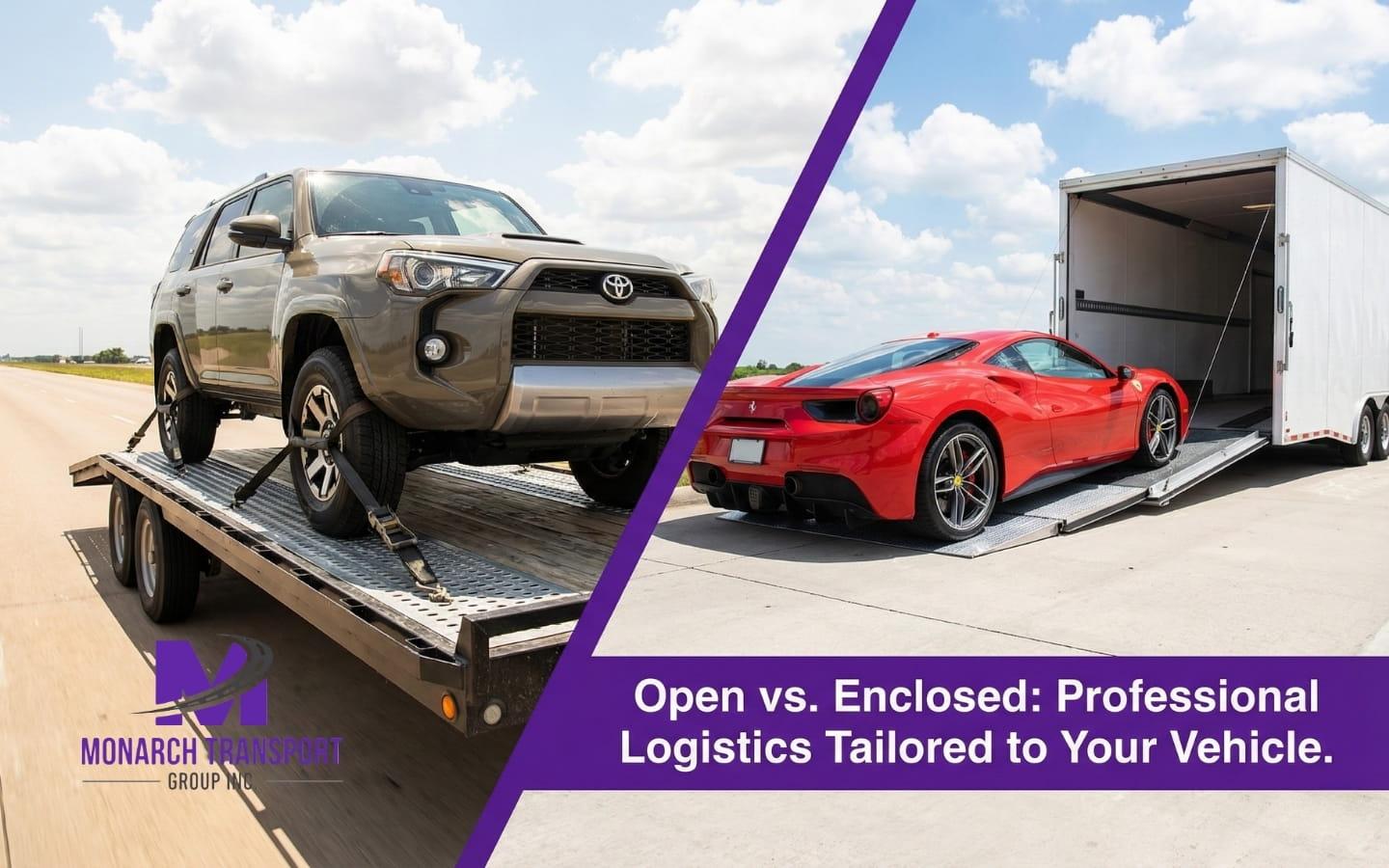
The industry usually boils this decision down to two main paths: Open and Enclosed auto transport. At first glance, it might look like deciding between an affordable and a higher-end option. However, from our experience at Monarch Transport, the difference is about more than just price: it is about which method best matches your vehicle’s characteristics and gives you peace of mind.
The Reality of the Road: What is Open Car Shipping?
If you have ever driven on an American interstate, you have seen open car shipping in action. These are the massive, two-tiered trailers carrying up to 10 vehicles at a time, looking like a giant steel-and-rubber puzzle moving at highway speeds.
In open auto transport, your vehicle is shipped on a trailer without walls, a ceiling, or a solid floor. Your car is “out in the open,” fully exposed to the world. It experiences exactly what you experience when you drive: the wind, the sun, and the occasional rain shower.
Reason It is the Industry Standard
It is not surprising that almost 90 percent of the total vehicles traversed in the U.S. do so. As a practitioner, open transport is considered to be the foundation of the economy. The reason why car haulers like these trailers is that they achieve maximum profits; the more cars are loaded the fewer units will cost them.
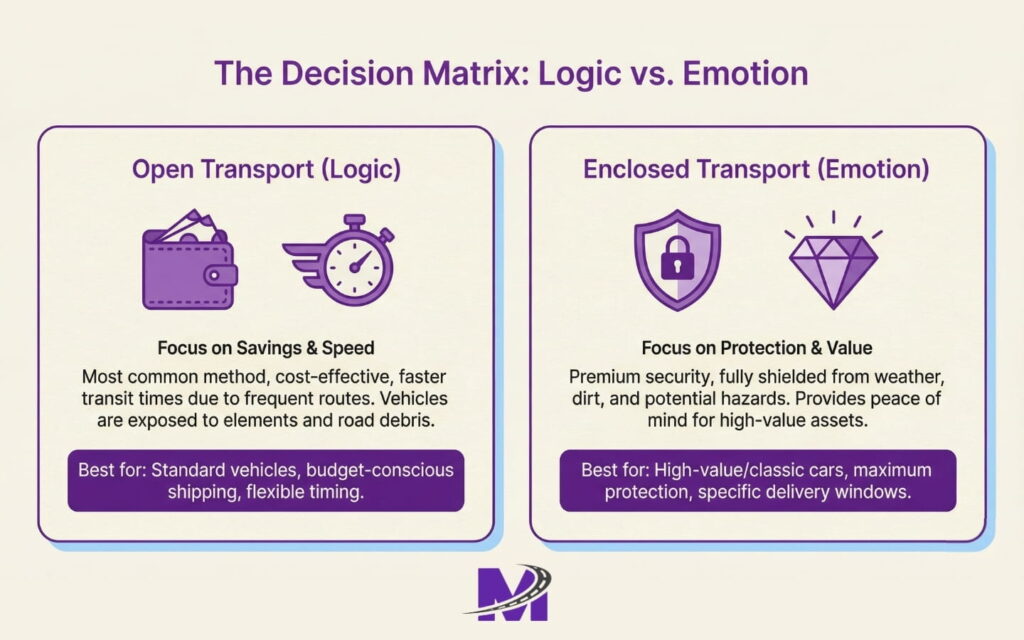
The price, however, is the major attraction to you, the consumer. Open shipping is very cheap and it is usually half the price of an enclosed trailer. It is the “coach class” of the skies; it may take you to a common destination as efficiently and safely as without the trappings of a private cabin.
Dealing with the Elements: The Emotional Trade-off
The greatest challenge to most owners is the “exposure.” Yes, there will be an exposure of your car to the weather. When it rains in Nebraska, your car becomes wet. In case dust exists in Arizona, your car becomes dusty.
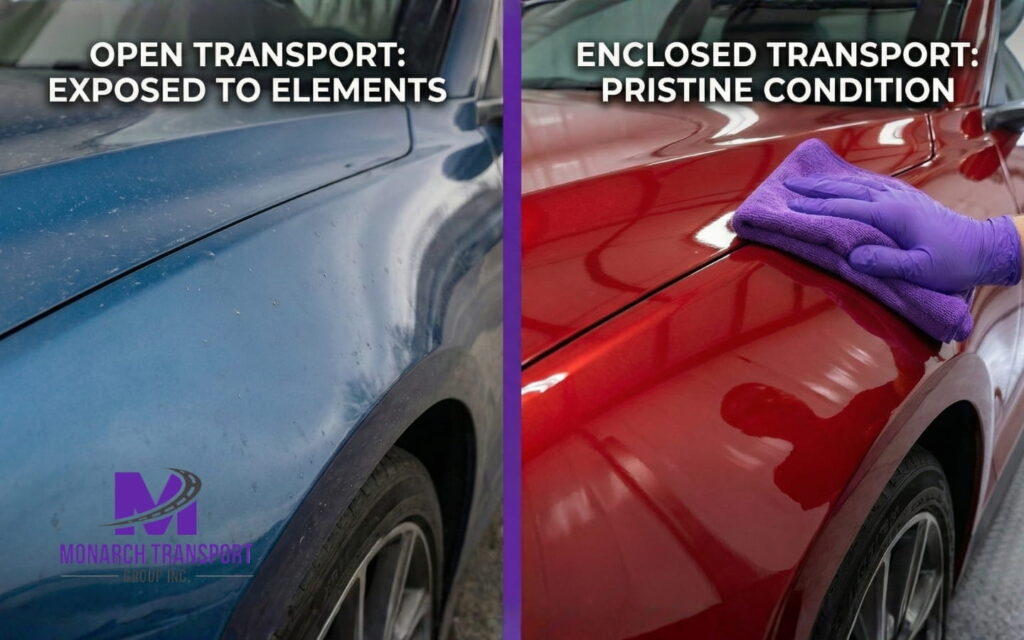
But speaking of what we have observed, is it very exceptional that damage due to weather or road debris shall occur on an open trailer? Consider it in this way: your car is meant to be outside. It is right in your driveway, it runs the parking lot of the grocery store, and is running 70 mph on the highway five days a week. The largest “risk” is most likely road grime that is washed off a surface in a quick car wash when getting the vehicle delivered.
Where Open Transport Makes Perfect Sense
We always advise our clients to be realistic. When you purchased a car at a normal dealership, a good Ford, a strong Honda, or a new Hyundai, then chances are that all you need is an open transport.
1. You Are on a Budget
Moving is expensive. Every dollar matters between the deposits, packing, and traveling. Open transportation will help you save between 400 and 800 dollars, depending on the distance. When your car is used as a daily driver with already its own quota of highway miles, you may not want to spend half of your moving budget on a so-called rolling vault.
2. You Need It Done Fast
It is a logistical fact that is ignored by many. Due to the large percentage of open carriers in the fleet on the road, they are significantly easier to book. In case you have to have your car collected within 48 hours, then there is virtually a carrier with an open truck in the vicinity.
3. You Value Reliability Over Aesthetics
Open transport is the workhorse of the industry. These drivers are incredibly experienced because they handle such high volume. While your car might arrive with a little bit of “road dust,” the mechanical safety of the transport is top-tier.
Comparison Table: Open Transport Quick Glance
| Feature | Open Transport Details |
| Best For | Standard daily drivers, SUVs, and budget-conscious moves. |
| Price Point | The most affordable ($). |
| Availability | Very high; thousands of carriers available nationwide. |
| Protection | Basic; exposed to weather and road debris. |
| Capacity | 8 to 10 vehicles per trailer. |
The Practitioner Tip: The Myth of the Dirty Car
At Monarch Transport Group, I hear someone say every day, “I am afraid that the wind will destroy my car.” The fact is that modern open trailers are designed with wind deflectors and certain tie-down systems that reduce movement. The cars are not merely sitting there; they are tied with professional-grade straps or chains.
Although road debris may sometimes flick up, it is no more prone to occur on a trailer than when operating the car in the driver’s seat. Actually, others suggest it is safer in the trailer because the car is not adding miles to the odometer, the engine is not running, and no one is at the wheel to make a mistake.
Closed Auto Transport: The Shipping Accommodation of the First Class
When the dependable vehicle of the interstate is open transport, then the enclosed auto transport is the personal jet of the logistics industry. When you take this option, your car is not being undertransported, but is being spared. It is carried in a fully enclosed trailer with solid walls, a ceiling, and a floor, offering greater security and protection than an open trailer.
This is commonly referred to as white-glove service in the industry. It is a specialized niche, and only 10% of all customers use it; once they do, they have no other option.
Why Pay the Premium? The Technical Advantages
The question that is most apparent at Monarch Transport Group is: Why is this 40-50% more expensive? The solution is in the machinery and the knowledge needed to run it.
Complete Safeguarding against the Elements
An enclosed trailer is a one-wheel vault. Whereas an open trailer exposes your vehicle to the elements in the form of rain, snow, and road salt, as well as other curious individuals, an enclosed unit gives you the assurance that your car will be delivered in the same condition that it was packed.
Low clearance Special Equipment
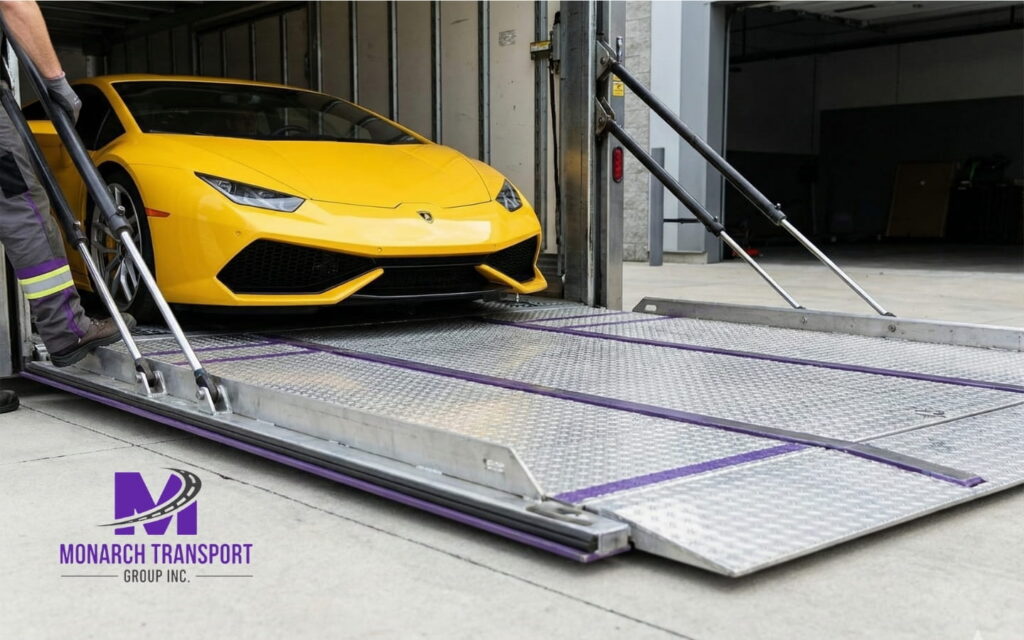
This is a very serious area that most owners fail to consider until they fall upon the loading ramp. Most high-performance sports cars believe that Lamborghinis, Porsches, or lowriders of a custom nature have minimal or very low ground clearance, usually 4 inches or less. Most of the enclosed carriers have hydraulic lift gates or special extended ramps that remain perfectly even with the ground.
High-Tier Security
There is an emotional weight to owning a rare vehicle. Knowing that your car is hidden behind solid walls invisible to burglars or curious passersby during overnight stops provides a level of “sleep-at-night” security.
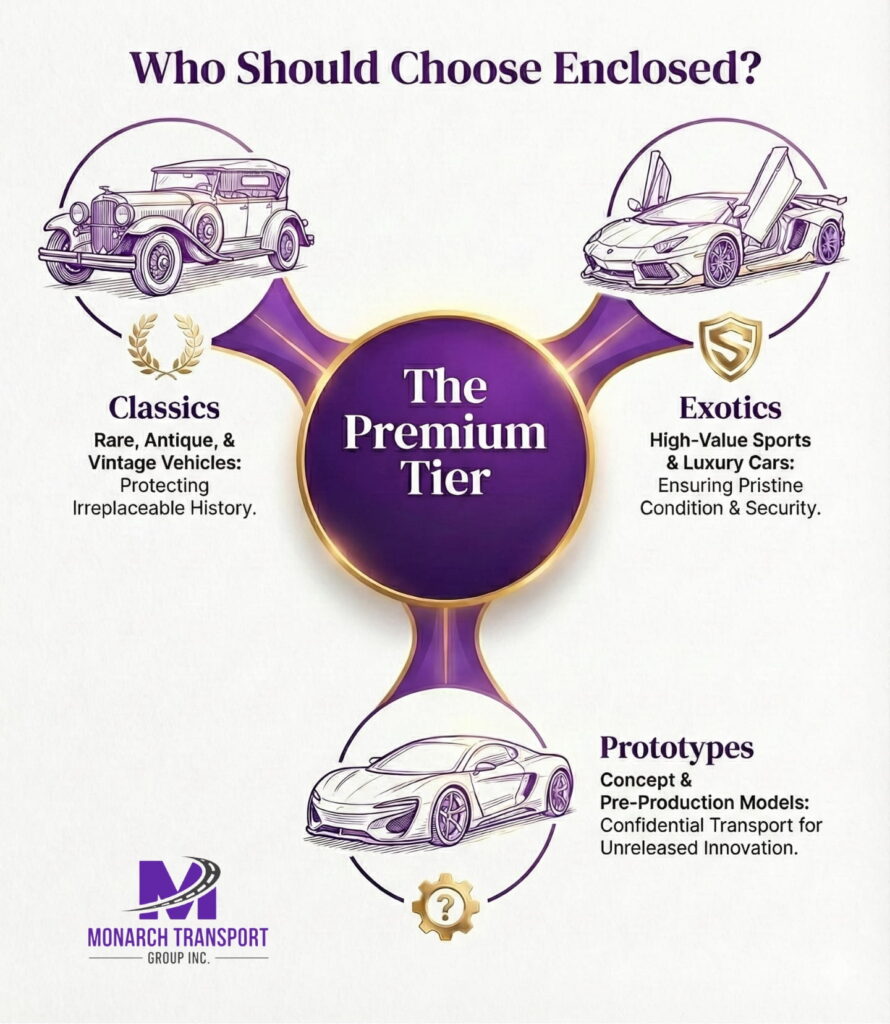
Who Should Choose Enclosed Transport?
We don’t recommend enclosed shipping for everyone, but for certain vehicle categories, it is the only professional choice.
Comparison Table: The Investment Breakdown
| Feature | Enclosed Transport Details |
| Best For | Exotic, classic, luxury, and low-clearance vehicles. |
| Price Point | Premium; approximately 40-50% more expensive ($$$). |
| Availability | Limited; fewer specialized carriers on the road. |
| Protection | Maximum; 4 walls, ceiling, and floor protection. |
| Capacity | 1 to 7 vehicles depending on trailer size. |
The Reality Check: Cons of the “First Class” Option
While it is the safest method, enclosed transport does come with its own set of logistical hurdles:
You should choose Enclosed Transport if:
Conclusion
There is no right or wrong answer to whether to use open or enclosed auto transport; it is a matter of finding the solution that best fits your situation.
The hero of the story is open transport for the vast majority of our clients. It is the cheap, dependable, and practical workhorse. But for those who possess a part of automotive history or a high-performance masterwork, enclosed transport offers a sanctuary that cannot be categorized by price.
At the end of the day, your car is not just steel and glass; it is your mobility and your lifestyle. At Monarch Transport, we take pride in handling each vehicle with the respect it deserves, regardless of the trailer it is straddling.
FAQ
The enclosed car transport is generally a little longer than the open transport, which is approximately 7-14 days across the nation. The timing will be based on distance, route, and carrier availability.
Automobiles transported on open trailers tend to accumulate dust, dirt, and light road grime along the way. Enclosed vehicle transportation keeps the vehicle far cleaner, shielding it against the weather, debris, and bird droppings.
Well, open trailers leave cars vulnerable to small rocks, gravel, and other road debris. Although rare, minor damage, such as chips and scratches, may occur to the paint or trim. This is eliminated by enclosed transport.
Open transport is cost-effective and widely available, but exposes vehicles to weather and road debris. Enclosed transport is more expensive but provides full protection from the elements.
Open auto transport costs typically range from $400 to $1,000 for cross-country shipments, depending on distance, car size, and season.
Yes. Enclosed transport protects vehicles from rain, sun, road debris, and curious eyes, making it the safest option. It’s ideal for high-value cars, classics, and motorcycles.
Related articles
Complete Guide to Car Shipping in 2026
The landscape of American mobility has shifted, making vehicle logistics more accessible and seamless than ever before. Understanding this new norm is the first step toward a stress-free relocation that

Complete Guide to RV Shipping in 2026
IN THIS ARTICLE: Introduction: The Freedom of the Road, Delivered by Professionals Understanding the Fleet: Classes and Types of RVs Methods of Transport: How We Get Your RV Home Measuring
How to Prepare Your Car for Shipping: Step-by-Step Checklist
IN THIS ARTICLE: Why Preparation is not just a Chore Step 1: Selecting Your Logistics Partner Step 2: The Evidence Phase – Cleaning and Documentation Step 3: Protecting the Extravagant