
IN THIS ARTICLE:
- Understanding the Auto Transport Ecosystem
- Step 1: Choose Your Transport Type
- Phase 2: The Process of Shipping
- Step 4: The Pickup and Bill of Lading (BOL)
- Phase 3: Transit and Delivery
- Calculating the Cost and Timeline of State-to-State Car Transport
- 3. The 2026 EV Transport Protocol
- Estimated Car Shipping Costs (2026 Projections)
- Scheduling: The “Pickup Window” Reality
- The “Expert-Practitioner” Preparation Checklist
- Completing the Journey: Delivery, Documentation, and Insurance Protocols
- Understanding Insurance Claims and 2026 Coverage Caps
- The 5-Step Damage Claim Process
- Conclusion
- FAQ
Interstate auto transport is a logistics service in which an expert carrier transports a vehicle from one state to another using specialized equipment such as open or enclosed trailers. It is a five-step process: getting a quote, making a booking with a carrier or broker, preparing the vehicle, picking it up after a formal inspection (Bill of Lading), and delivering it. This service is intended to help you avoid the dangers of long-distance driving, save you time, and spare your vehicle from needless depreciation and mileage.
Understanding the Auto Transport Ecosystem
To understand how the process works, you must first identify the two types of companies that facilitate the move. In the United States, the industry is regulated by the Federal Motor Carrier Safety Administration (FMCSA), and every legitimate provider must have an active USDOT number.
Brokers as Opposed to Direct Carriers
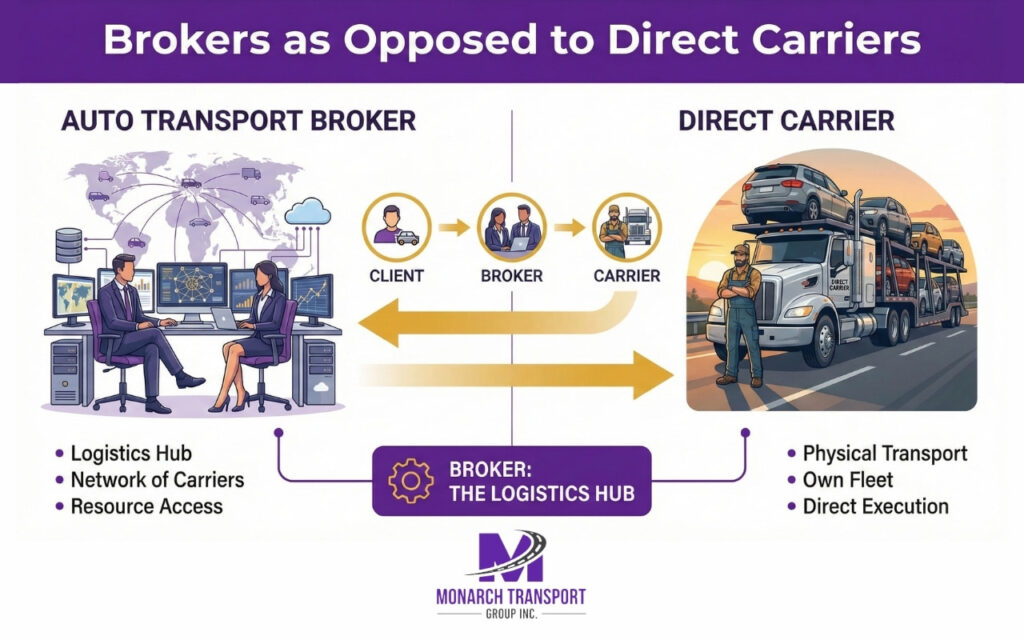
Most consumers deal with brokers since they provide more flexible scheduling and better prices as a result of their access to a wider pool of drivers.
Step 1: Choose Your Transport Type
You need to figure out in advance how you want the vehicle transported before a truck is sent out. This is the most important decision you make when it comes to the final price and the amount of wear and tear on your car.
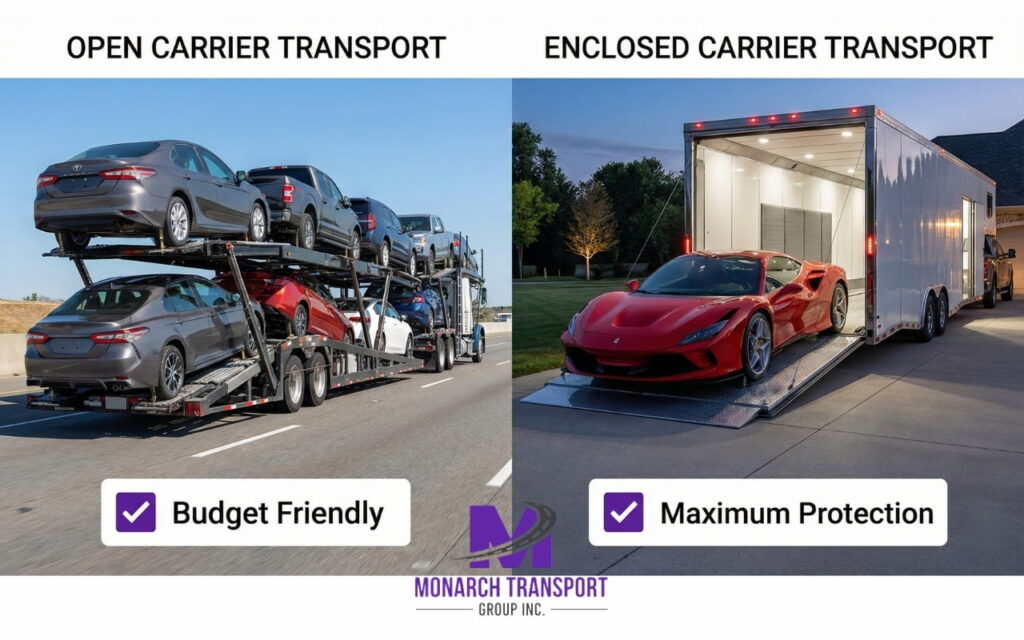
Open Carrier Transport
It is the most traditional method used in sales between dealers and private individuals. Cars go onto an open, multi-level trailer (usually carrying 7 to 10 vehicles).
Enclosed Carrier Transport
The vehicle is inside a fully enclosed, hard or soft-sided trailer. This is the gold standard for high-value assets.
Phase 2: The Process of Shipping
Similar to your driveway right now, you are required to follow a certain regulatory sequence to pick up your “stuff” so as to put it in your new home safely and responsibly.
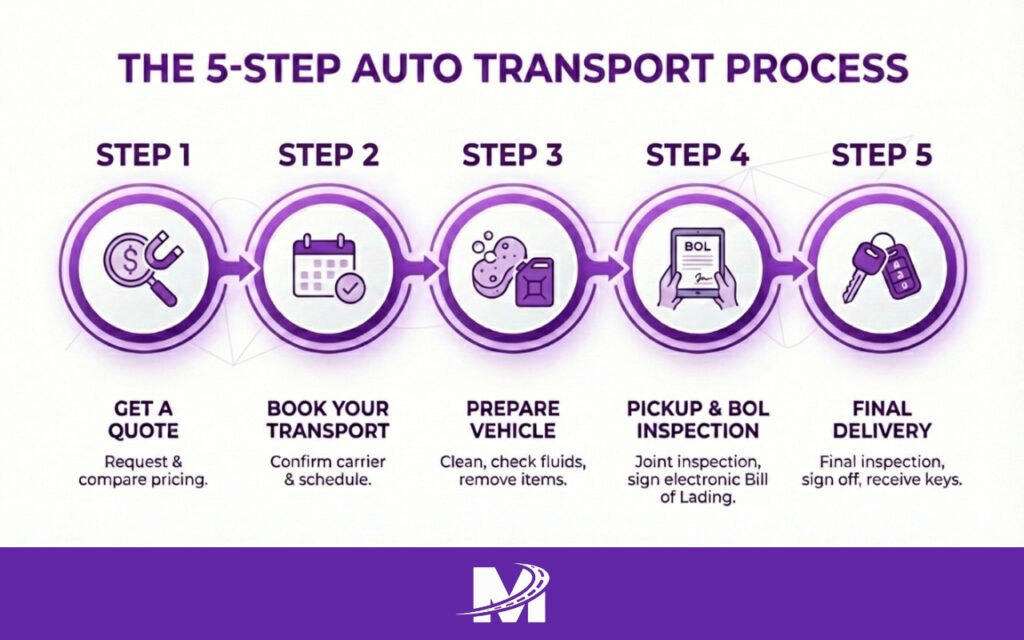
Step 1: Requesting a Quote and Booking
You start by entering your car’s make, model, whether it runs, and the pickup/delivery zip codes. Car rental rates are high due to a strong seasonal demand and fuel surcharges in effect for 2026. After you accept a quote, a broker will “post” your load to the national load board.
Step 2: The Dispatch – Carrier Assignment
A carrier that wants to haul your load will “claim” the load. That is about all you need for a driver’s name, phone number, and a 1 to 5-day pick-up window. The broker runs a compliance check to confirm the carrier’s cargo insurance is current and adequate (generally $100,000 for open carriers).
Step 3: Preparing the Vehicle for Pickup
You need to plan ahead if you do not want to lose time or suffer breakage and loss.
Step 4: The Pickup and Bill of Lading (BOL)
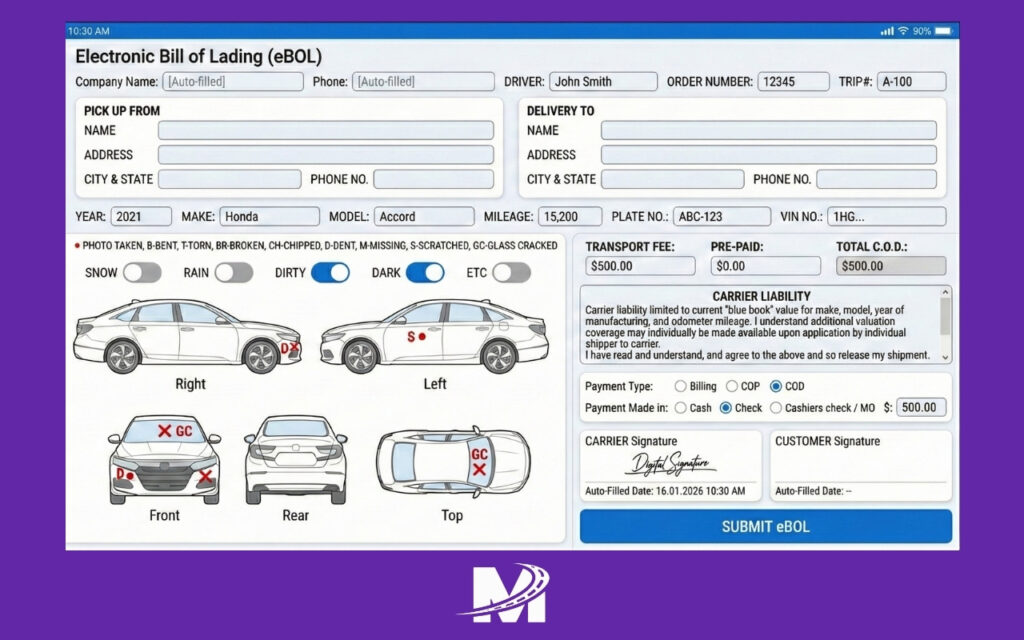
Upon the driver’s arrival, you (or your agent) will conduct a joint walkaround. The driver will note any scratches, dents, or chips on the Bill of Lading.
Phase 3: Transit and Delivery
Once the car is loaded, it is in “transit.” You can expect updates from the driver or your broker’s tracking service.
| Distance | Typical Transit Time |
| 0 – 500 Miles | 1 – 2 Days |
| 500 – 1,500 Miles | 3 – 5 Days |
| 1,500+ Miles | 7 – 10 Days |
The Final Handover
The driver will contact you 12–24 hours before arrival. If your street is too narrow for a 75-foot trailer, you will meet the driver at a nearby large parking lot.
Calculating the Cost and Timeline of State-to-State Car Transport
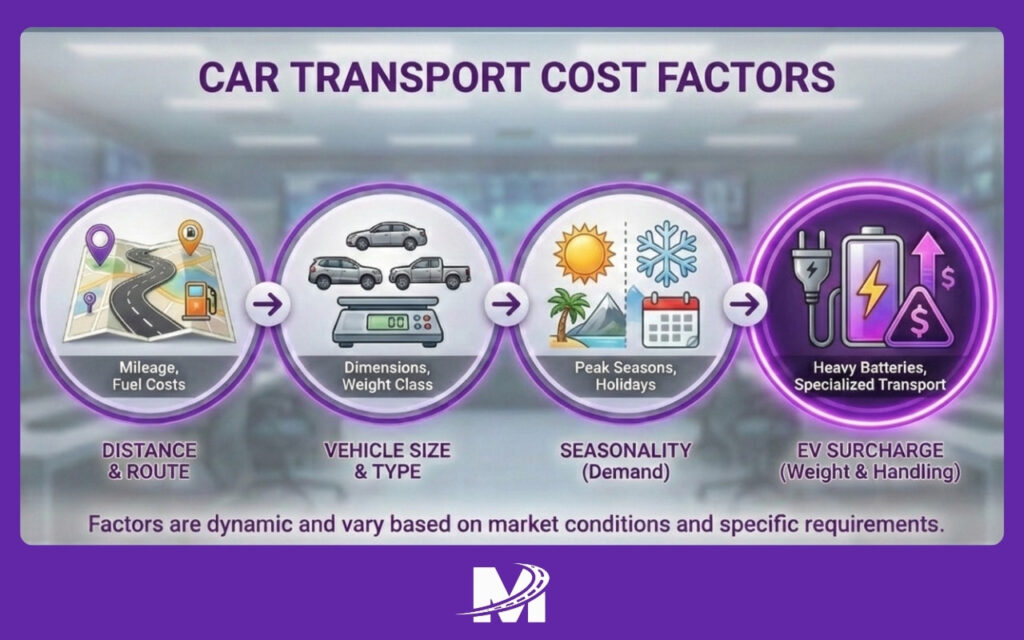
One to two vehicle state transport costs $600 to $1,800 in 2026 and varies due to a number of factors, such as distance, vehicle size, and the method of transport (open or enclosed). For a distance of less than 500 miles, $1.50-$2.50 per mile is an average rate you can expect, while for long-distance routes beyond 2,500 miles, a better value is offered at $0.60-$0.95 per mile. Total transit time is usually 1 to 10 days due to federal driver safety regulations and the complexity of routes.
The Economics of Auto Transport Prices
Shipping prices are no longer determined solely by distance in 2026. Carriers are weighing the structurally higher operating costs caused by rising insurance premiums and labor shortages against the logistical efficiency of certain routes.
City Hub Efficiency
Carriers value efficiency. Shipping from large city hubs (Los Angeles to Dallas) tends to be cheaper per mile than shipping shorter distances into rural locations. If a driver has to “deadhead” (drive without cargo) 100 miles to get to your small town, that’s a cost you’re sharing.
Vehicle Weight & Size
The Gross Vehicle Weight Rating (GVWR) of a carrier’s trailer is limited. Full-sized SUVs, dually trucks, and electric vehicles (EVs) take up more of the weight capacity as well as physical space.
3. The 2026 EV Transport Protocol
Electric vehicles present unique logistical challenges due to their weight and battery safety requirements.
Estimated Car Shipping Costs (2026 Projections)
| Distance | Open Carrier (Sedan) | Enclosed Carrier (Sedan) | Est. Transit Time |
| Short Haul (<500 mi) | $600 – $850 | $900 – $1,150 | 1 – 3 Days |
| Mid-Range (500–1,500 mi) | $850 – $1,300 | $1,500 – $1,900 | 3 – 6 Days |
| Long Haul (1,500–2,500 mi) | $1,200 – $1,650 | $1,800 – $2,400 | 6 – 9 Days |
| Cross-Country (>2,500 mi) | $1,400 – $1,900 | $2,200 – $3,000+ | 8 – 11 Days |
Scheduling: The “Pickup Window” Reality
One common point of frustration is the “pickup window.” Auto transport is not a precision-timed service like a flight; it is more like a moving puzzle.
The “Expert-Practitioner” Preparation Checklist
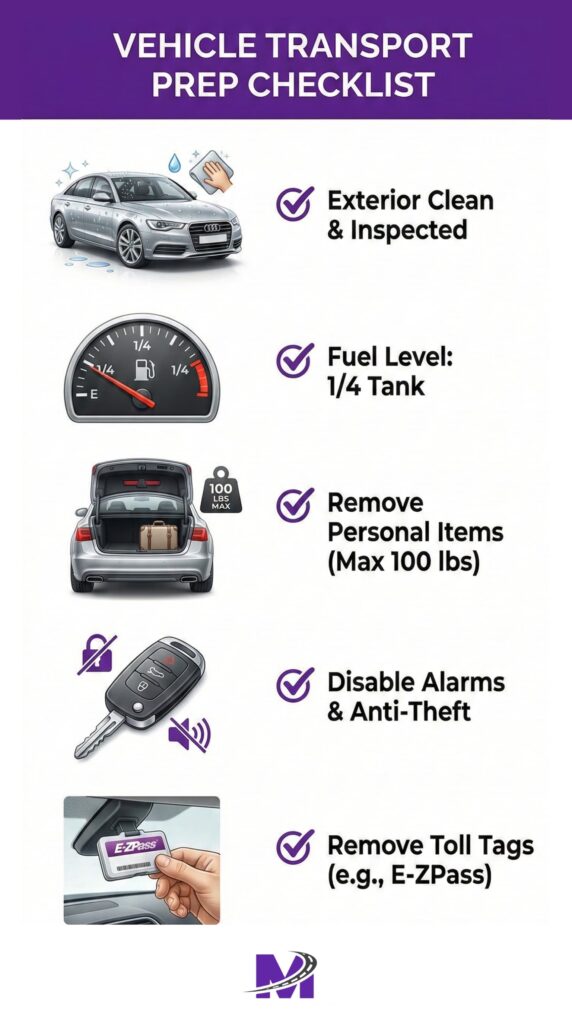
Before the truck arrives, follow this professional checklist to ensure your car is accepted and protected.
Completing the Journey: Delivery, Documentation, and Insurance Protocols
To finalize state-to-state car transport, you’ll have to check out the delivery process, which consists of a 24-hour reminder of arrival, physical or electronic inspection of the auto, and signing the final Bill of Lading (BOL). This step is legally significant as your signature on the BOL serves as proof that the vehicle was received in the described condition. By 2026, the majority of carriers will use electronic Bills of Lading (eBOL) along with digital time-stamped photos to provide a transparent handover.
What are the new 2026 rules for car shipping and delivery?
Starting in late 2025 and into 2026, the Federal Motor Carrier Safety Administration (FMCSA) has been ramping up the move to digital responsibility. All interstate carriers are now required to have Electronic Logging Devices (ELDs) and are moving toward digital DVIRs (Driver Vehicle Inspection Reports). For the end customer, this translates into more accurate delivery windows as real-time GPS tracking is now the norm for the trustworthy brokers. In addition, the sector has switched to using USDOT numbers as the main identification on all transport contracts in October 2025.
Phase 3: The Delivery and Final Inspection Protocol
The delivery stage is your best and last opportunity to protect your financial interests. As soon as the vehicle is unloaded from the trailer, your job changes from that of a passive watcher to an active inspector.
Understanding Insurance Claims and 2026 Coverage Caps
While professional transport is incredibly safe, damage occurs in less than 3% of shipments. Knowing how to navigate the insurance landscape ensures you are never out of pocket for carrier negligence.
Carrier Cargo Insurance vs. Personal Insurance
Licensed carriers are required to carry Cargo Insurance (usually $100,000 for open trailers, and as much as $1,000,000 for enclosed trailers). This insurance pays for damage caused by the carrier while performing its duties, such as loading/unloading scrapes or equipment malfunction.
The 5-Step Damage Claim Process
Conclusion
State-to-state car transport in 2026 is a complex and data-driven industry that benefits the prepared customer. Knowing the options for logistics rhythm, from Open and Enclosed trailers to the Bill of Lading, allows you to turn a complicated move into a coordinated move.
The shift to electronic paperwork and tight supervision by the FMCSA means car shipping is more transparent than it has ever been. But the basic rules of the road apply: VET your company, DOCUMENT your vehicle’s condition, and COMMUNICATE clearly with your driver. When you engage the process as an educated partner and not just a passive passenger, you can be sure that your vehicle will be waiting for you at its new home should you choose to continue your journey.
FAQ
Professional state-to-state car transport is generally done using open or enclosed carriers. Open vehicle transport is more common and affordable, while enclosed carriers offer better protection for expensive vehicles. There are other methods, as well, such as professional driveaway services, rail transport, or you doing your own towing. For interstate relocations, trucking-based shipping remains the standard for its combination of dependability and affordability.
In 2026, the average cost to ship a sedan 1,000 miles on an open carrier typically ranges from $700 to $1,100. Rates are calculated based on mileage, with long-distance trips (1,500+ miles) averaging $0.45–$0.75 per mile. Factors such as vehicle size, current fuel surcharges, seasonal demand, and the choice of enclosed transport can increase these rates by 30% to 50%.
The most trustworthy car shipping companies are those that are properly registered with the FMCSA and have a valid USDOT number. A first-rate company will be upfront about pricing with no hidden fees, have full cargo insurance (usually $100,000+), and must have been in the business for a number of years with good, verified customer reviews. Stay away from companies that require a large deposit before a carrier is assigned.
Conventional towing is far costlier than professional carrier transport, with tow trucks regularly charging $2 to $4 a mile. For a 1,000-mile trip, it can cost a couple of thousand dollars to tow a vehicle, which is why it’s not really feasible for long distances. Most owners use multi-car carriers instead, as they spread fuel and labor expense over multiple vehicles and reduce the per-car rate by more than 50%.
Effective preparation involves washing the exterior to facilitate an accurate damage inspection and removing all personal belongings to meet weight and insurance regulations. You must disable alarms, deactivate toll tags, and maintain the fuel tank at exactly one-quarter full. Finally, take time-stamped photos of all angles to document the vehicle’s condition before the joint inspection at pickup.
Related articles

Best Places to Buy a Motorcycle Online in the USA
IN THIS ARTICLE: The Digital Shift: Geography No Longer Constrains the Ride Where to Buy: Top 2026 Platforms Analysis Comparison Table: Platform Overview The Facet of Finance: Not Just the
Complete Guide to Car Shipping in 2026
The landscape of American mobility has shifted, making vehicle logistics more accessible and seamless than ever before. Understanding this new norm is the first step toward a stress-free relocation that

Complete Guide to RV Shipping in 2026
IN THIS ARTICLE: Introduction: The Freedom of the Road, Delivered by Professionals Understanding the Fleet: Classes and Types of RVs Methods of Transport: How We Get Your RV Home Measuring

How to Prepare Your Car for Shipping: Step-by-Step Checklist
IN THIS ARTICLE: Why Preparation is not just a Chore Step 1: Selecting Your Logistics Partner Step 2: The Evidence Phase – Cleaning and Documentation Step 3: Protecting the Extravagant
How to Ship a Motorcycle Safely: The 2026 Guide
IN THIS ARTICLE: The “Why” Behind the Shipping Method Option 1: The DIY Route (Towing it Yourself) Option 2: Open vs. Enclosed Transport Option 3: Specialized Motorcycle Shippers vs. General
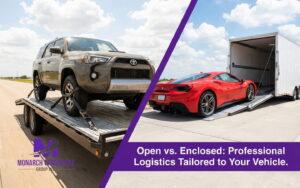
Open vs. Enclosed Auto Transport: Which Should You Choose?
IN THIS ARTICLE: The Reality of the Road: What is Open Car Shipping? Where Open Transport Makes Perfect Sense Comparison Table: Open Transport Quick Glance The Practitioner Tip: The Myth