
IN THIS ARTICLE:
- The Reality of EV Logistics in 2026
- Why EVs Change the Math: The Weight Factor
- The “50% Rule”: Battery Safety and State of Charge (SoC)
- Vetting the Carrier (The “Non-Negotiables”)
- Choosing Your Method: Open vs. Enclosed
- Pre-Shipping Checklist: The “Human” Version
- The 2026 EV Shipping Cost Breakdown
- Insurance: Mind the “Battery Gap”
- The Handover: More Than Just a Signature
- Understanding 2026 Regulations
- The Delivery Process: Your Final Inspection Checklist
- Filing a Claim: What to Do If Things Go Wrong
- Conclusion
- FAQ
Shipping an EV safely in 2026 requires selecting a carrier with reinforced trailers to handle the extra 30% weight compared to ICE cars, maintaining a 45–55% battery charge to prevent thermal runaway, and opting for enclosed transport for luxury models. Key safety protocols include verifying lithium-ion certifications and using specialized low-clearance ramps to protect the battery chassis.
The Reality of EV Logistics in 2026
Let’s be honest: shipping a car has always been a bit of a headache. In 2026, while EVs still represent a small fraction of the total cars on American roads (roughly 2–3%), their presence in the specialized transport market is growing rapidly. We aren’t just moving metal boxes anymore; we’re moving high-capacity, high-voltage energy storage systems on wheels.
If you’re planning to ship your Tesla, Rivian, or that new Lucid you just treated yourself to, you need to realize that the old-school rules of auto transport don’t quite fit. The weight distribution is different, the safety risks are unique, and the price tag reflects the specialized equipment needed. For a reliable experience, it is essential to work with a professional car transport service that understands these nuances.
Why EVs Change the Math: The Weight Factor
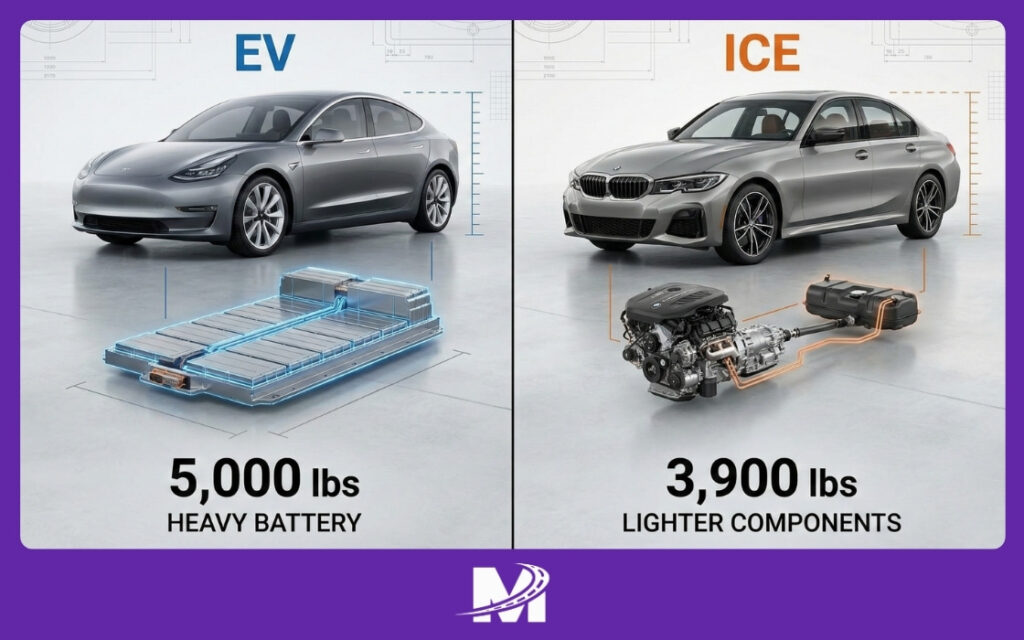
The first thing any carrier will notice about your EV isn’t its sleek aerodynamic lines; it’s the fact that it’s heavy. Really heavy.
Your average mid-sized electric sedan often weighs as much as a full-sized gas-powered SUV. Why? Because lithium-ion battery packs are dense. For example, a Tesla Model 3 weighs roughly 1,000 pounds more than a Honda Civic. When you multiply that across a multi-car carrier holding 7–9 vehicles, you’re looking at several extra tons of pressure on the trailer’s hydraulics and tires.
What this means for you:
The “50% Rule”: Battery Safety and State of Charge (SoC)
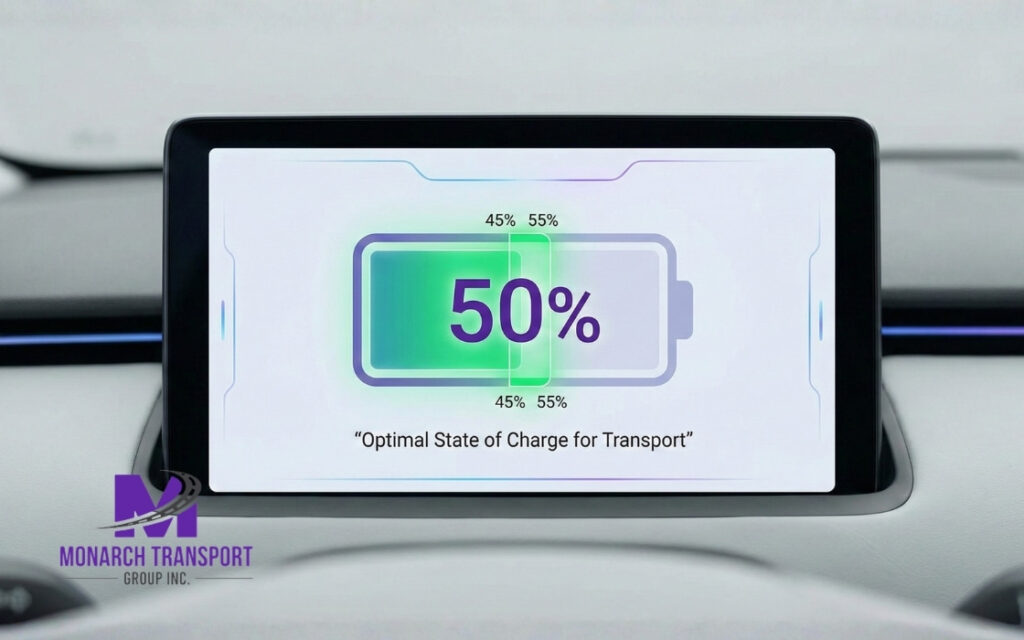
While the FMCSA provides general guidelines for the safe transportation of hazardous materials (including lithium batteries), best industry practices recommend maintaining a charge between 45% and 55% during transit.
Why the 50% target?
Vetting the Carrier (The “Non-Negotiables”)
In 2026, every broker will tell you they can ship an EV. Not all of them should. When you’re talking to a potential carrier, look for these specific red flags and green lights.
The Certification Check
Ask the carrier if their drivers are specifically trained or experienced in handling high-voltage vehicles. While there isn’t a single universal “EV License” for auto transporters in 2026, an expert driver should demonstrate a working knowledge of:
Equipment Matters
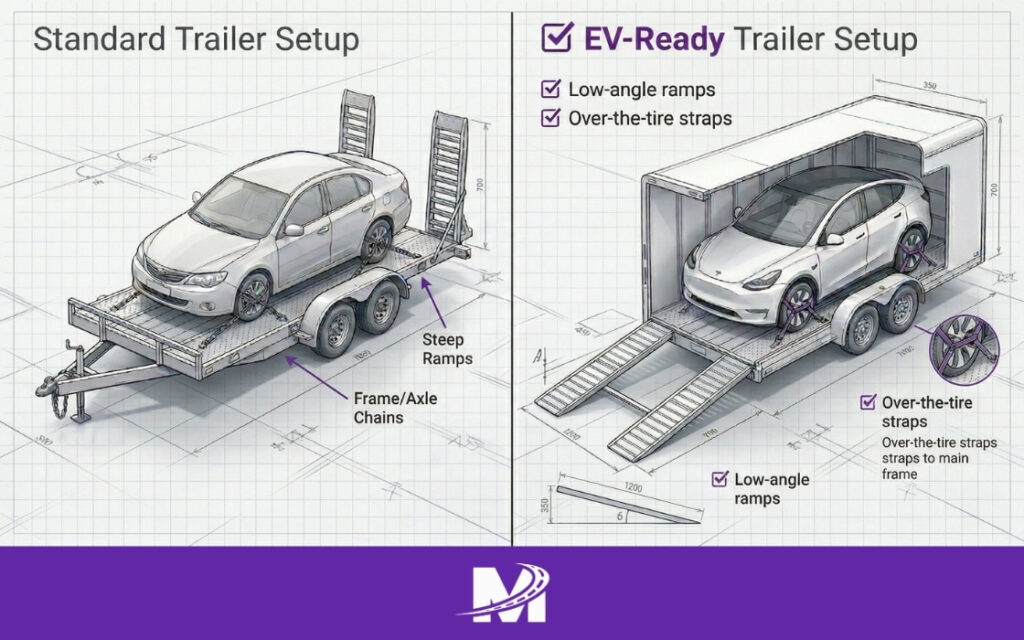
Don’t just settle for the cheapest quote. Look for companies that mention:
| Feature | Standard Transport | Recommended EV Transport |
| Ramps | Standard Steel | Low-Angle / Hydraulic |
| Tie-Downs | Chassis Hooks | Over-the-Tire Straps |
| Suspension | Spring Leaf | Air-Ride |
| Battery Knowledge | “Just drive it on” | State-of-Charge Monitoring |
Choosing Your Method: Open vs. Enclosed
This is where the rubber meets the road and where your budget gets tested. Not every vehicle requires a “white-glove” service, but cutting corners on a high-end car can lead to a logistical nightmare.
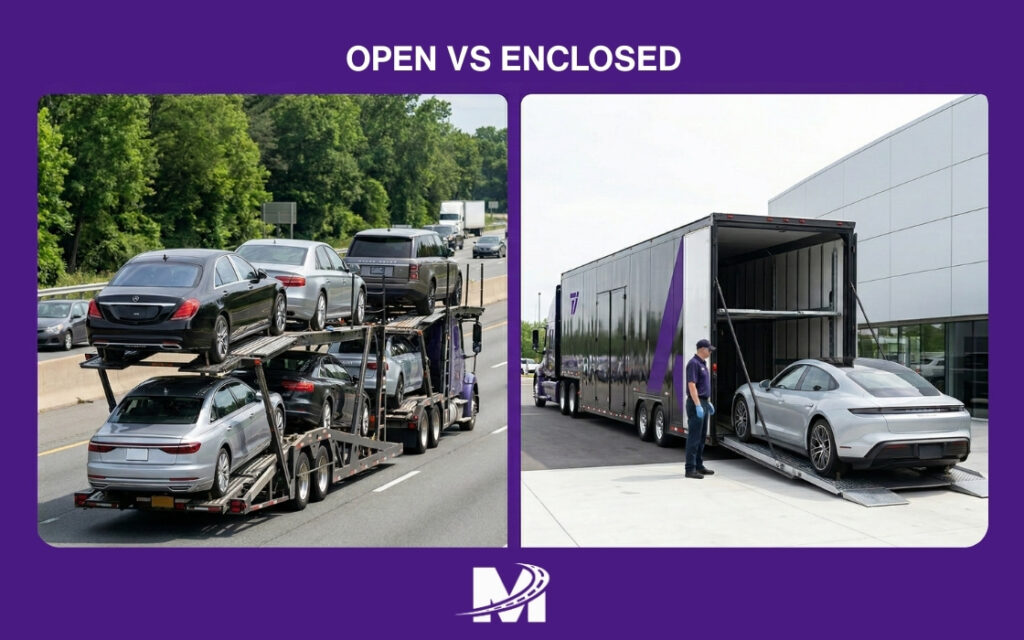
Your decision hinges on two main factors: your vehicle’s value and your tolerance for road exposure. To find the right fit for your specific move, you need to weigh the pros and cons of Open vs. Enclosed Auto Transport based on your car’s ground clearance, the current season, and your total shipping budget.
Open Transport: The Budget-Friendly Workhorse
If your EV is a daily driver (like a standard Chevy Bolt or a base Model Y) and you aren’t worried about a little road dust or rain, open transport is fine. Just remember: it’s exposed. In 2026, the sheer number of EVs on open trailers has improved the “standard” of these trailers, but the risks of rock chips and weather remain the same.
Enclosed Transport: The “White Glove” Standard
For anything over $80,000, think Lucid Air, Rivian R1S, or a Tesla Model S Plaid. I always recommend enclosed shipping.
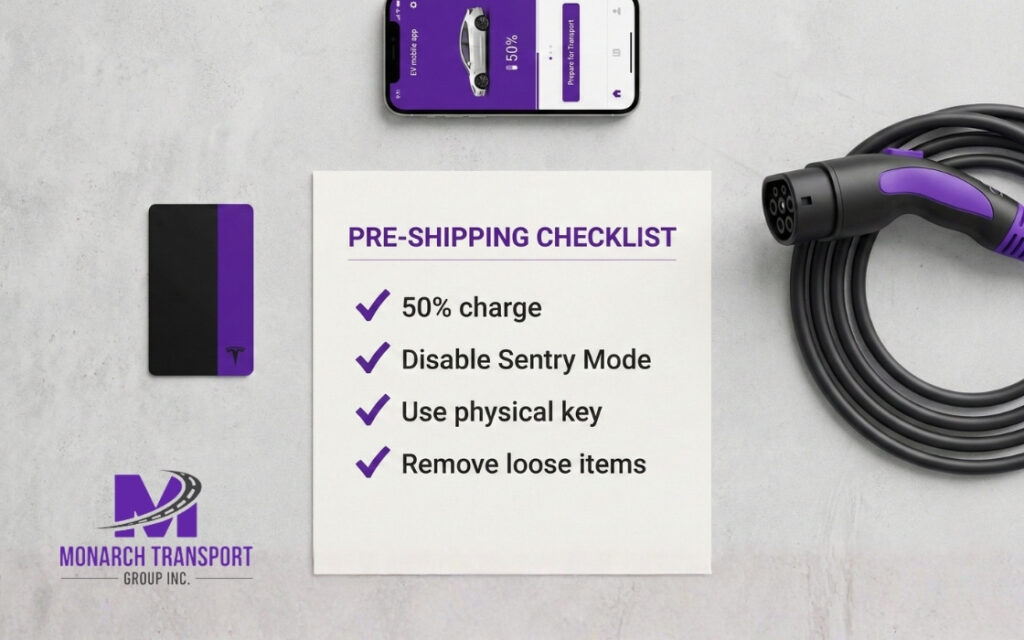
Pre-Shipping Checklist: The “Human” Version
Before the driver pulls up, do these three things (your future self will thank you):
The 2026 EV Shipping Cost Breakdown
Shipping an EV in 2026 costs an average of $1,100 to $2,800, depending on distance and transport type. While the per-mile rate for long-haul trips has stabilized, EVs carry a “weight premium” of 15–20% because their lithium-ion batteries reduce the total number of vehicles a carrier can legally haul under federal weight limits.
When you get a quote today, the numbers might look slightly higher than what you paid for a gas car three years ago. It’s not just inflation, it’s physics. A carrier that usually fits nine Honda Accords might only be able to fit seven or eight Teslas or Rivians before hitting the Gross Vehicle Weight Rating (GVWR) limit. You aren’t just paying for the space; you’re paying for the “lost” spot on the trailer that your car’s extra 1,500 pounds occupies.
Estimated 2026 Shipping Rates for EVs:
| Distance | Open Transport (Daily Driver) | Enclosed Transport (Luxury/New) |
| Short (Under 500 mi) | $650 – $950 | $900 – $1,300 |
| Medium (500 – 1,500 mi) | $950 – $1,600 | $1,500 – $2,200 |
| Long (1,500+ mi) | $1,400 – $2,500 | $2,100 – $3,200+ |
Note: Prices vary by route popularity (e.g., LA to NYC is cheaper than rural Montana to Maine) and seasonal demand.
Insurance: Mind the “Battery Gap”
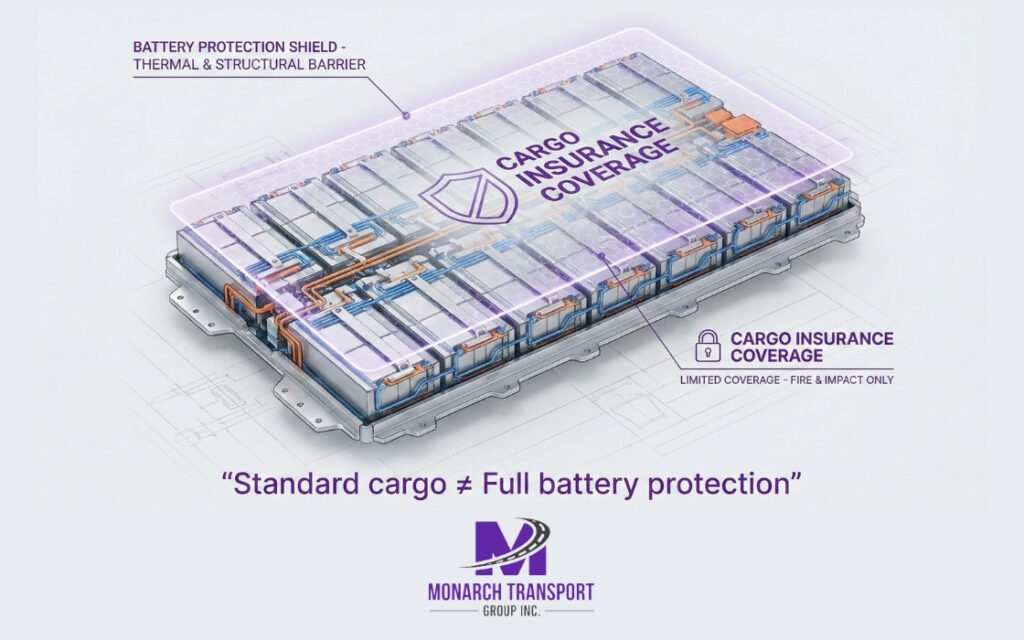
Standard carrier insurance usually covers external damage like dents or scratches, but it rarely accounts for internal battery faults or software glitches that might occur during transit. In 2026, EV repair costs are roughly 25% higher than those of ICE vehicles, meaning a minor undercarriage scrape can turn into a $20,000 battery replacement, a cost that often exceeds a carrier’s “per-car” liability limit.
Most reputable carriers carry $100,000 to $250,000 in cargo insurance, which sounds like a lot until you realize they are hauling six other $100,000 EVs. If the trailer flips, that coverage gets stretched thin.
The Handover: More Than Just a Signature
The Bill of Lading (BOL) is your primary legal defense if something goes wrong. For an EV, the inspection needs to be more surgical than a standard walk-around; you need to document the “health” of the car, not just its appearance.
When the driver arrives, don’t let them rush you. In the world of 2026 logistics, “efficient” sometimes means “hurried.” Stand your ground and check these three EV-specific points:
Expert Insight: If your EV has a “Sentry Mode” or “Gear Guard,” turn it off for the actual journey to save battery, but keep it on during the loading and unloading process if the battery level allows. It’s a great way to have an “eye in the sky” during the most high-risk moments of the trip.
Understanding 2026 Regulations
As of January 2026, the Department of Transportation (DOT) and FMCSA have tightened rules on “Used Lithium-Ion Battery” transport. While these rules mostly target damaged or recycled batteries, they have made carriers much more cautious about “inoperable” EVs.
If your EV has a dead battery or a “Safety Fault” light on the dash, you must disclose this immediately. Most carriers will refuse to ship a “dead” EV due to the increased fire risk and the specialized winch equipment required to move a 5,000-lb brick. Expect to pay a $200–$500 “Inoperable Fee” if your car can’t move under its own power.
The Delivery Process: Your Final Inspection Checklist
When your electric vehicle arrives at its destination in 2026, the delivery phase is more than just a drop-off; it is a critical verification of your car’s high-tech systems and structural integrity. You must perform a three-point inspection covering the physical body, the battery chassis, and the electronic functionality before signing the final Bill of Lading.
The “moment of truth” usually happens on a driveway or a nearby parking lot. In 2026, many high-end carriers use real-time GPS tracking apps, so you likely watched your car’s progress across state lines. But once the driver lowers those ramps, your focus needs to shift from the app to the asphalt.
Step 1: The Visual Walk-Around
Start with the basics. Look for the “travel scars” rock chips, scratches, or salt spray if it was an open carrier. Because EVs in 2026 often feature minimalist, aero-efficient designs with large glass roofs, check the seals and the glass for any stress cracks that might have occurred during the vibrations of a 2,000-mile journey.
Step 2: The Undercarriage (The “EV Essential”)
If there is one thing you don’t skip, it’s this. Grab your phone, turn on the flashlight, and look under the car. You are looking for any signs of “decking” damage. This happens if the car was loaded too close to another vehicle or if it bottomed out on a steep ramp. In 2026, battery packs are better shielded than they were five years ago, but a deep puncture or a structural dent in the battery casing is a safety hazard that requires immediate attention.
Step 3: Systems Check
Get inside. Wake the car up.
Filing a Claim: What to Do If Things Go Wrong
If you find a scratch on your Lucid or a dent in your Rivian’s tailgate, do not sign the Bill of Lading (BOL) as “received in good condition.” This is the single biggest mistake owners make. Once you sign that digital or paper form without notes, you are legally acknowledging that the car arrived in perfect condition, making an insurance claim nearly impossible.
Conclusion
Shipping an electric vehicle in 2026 is no longer the “experimental” logistical nightmare it once was. The industry has caught up to the weight, the safety needs, and the tech-heavy nature of our cars. However, the responsibility for a safe trip still sits squarely with you.
By choosing a carrier that understands the 50% battery rule, uses the right equipment, and respects the specialized nature of your EV, you aren’t just moving a car; you’re protecting a massive investment in the future of mobility. Stay vigilant, document everything, and remember: in the world of EV transport, “good enough” equipment isn’t good enough.
FAQ
In 2026, expect to pay 15–20% more for EV shipping. This premium covers the added weight of the battery packs, which reduces the total number of cars a trailer can carry. Specialized equipment like reinforced ramps and high-capacity trailers also contributes to the higher price point compared to lighter internal combustion vehicles.
The industry standard for safety and battery health is 45% to 55% State of Charge (SoC). This level minimizes the volatility of the lithium-ion cells, reducing the risk of thermal runaway while ensuring there is enough energy to maintain the vehicle’s security systems and “vampire drain” during a 7–10 day transit.
Yes, extreme cold can temporarily reduce your battery’s range and slow down the vehicle’s computer systems. If you are shipping to a cold climate in an open carrier, don’t be alarmed if the battery percentage drops faster than expected. For maximum protection against temperature swings, enclosed transport is the highly recommended choice.
You should remove all loose personal items, but most carriers allow you to keep charging cables if they are secured in the trunk or “frunk.” Ensure they are padded or in their original cases to prevent them from sliding around and causing interior damage during the vibrations of the journey.
While not “necessary” for a daily driver, it is strongly advised for any EV valued over $80,000 or models with sensitive matte paint. Enclosed transport protects against road debris, weather, and prying eyes, providing an extra layer of security for the high-tech sensors and cameras that are vital to an EV’s operation.

Related articles

Complete Guide to Car Shipping in 2026
The landscape of American mobility has shifted, making vehicle logistics more accessible and seamless than ever before. Understanding this new norm is the first step toward a stress-free relocation that

Complete Guide to RV Shipping in 2026
IN THIS ARTICLE: Introduction: The Freedom of the Road, Delivered by Professionals Understanding the Fleet: Classes and Types of RVs Methods of Transport: How We Get Your RV Home Measuring

Cross-Country Car Shipping: How to Save Money Safely
IN THIS ARTICLE: Why “Cheap” Doesn’t Have to Mean “Dangerous” 1. Open Transport: The Industry Gold Standard for Savings 2. The Power of “Terminal-to-Terminal” Shipping 3. Timing the Market: The

Door-to-Door vs. Terminal-to-Terminal: Which Logistics Model Fits You?
IN THIS ARTICLE: Understanding the Two Primary Logistics Models Comparative Analysis: Door-to-Door vs. Terminal-to-Terminal The Financial and Temporal Mechanics of Shipping Models Geographical Impact: Urban vs. Rural Accessibility The Final

How to Prepare Your Car for Shipping: Step-by-Step Checklist
IN THIS ARTICLE: Why Preparation is not just a Chore Step 1: Selecting Your Logistics Partner Step 2: The Evidence Phase – Cleaning and Documentation Step 3: Protecting the Extravagant

How to Spot and Avoid Car Shipping Scams in 2026
IN THIS ARTICLE: The State of Auto Transport Fraud in 2026 Red Flag #1: The “Impossible” Quote (Bait-and-Switch 2.0) The Rise of “Ghost” Brokers and AI-Cloned Websites Payment Red Flags: