
IN THIS ARTICLE:
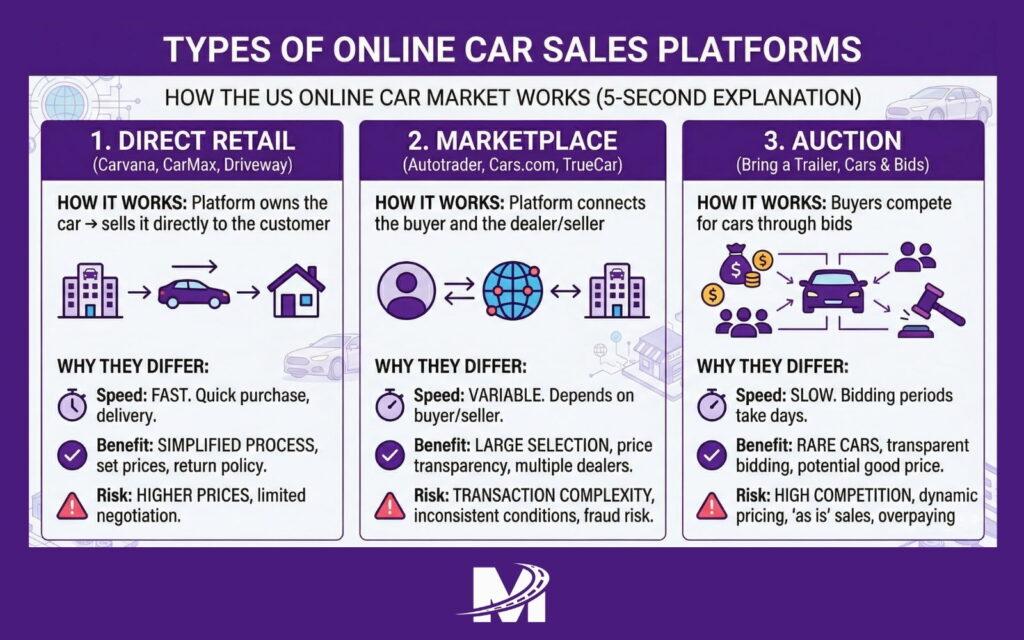
Buying or selling a used car online involves using digital marketplaces to find inventory, secure financing, trade in an existing vehicle, or finalize a private sale. The best online car platforms in 2026 connect buyers and sellers through direct retail, peer-to-peer networks, or dealer aggregators, offering doorstep delivery, digital paperwork, and transparent vehicle history reports.
The landscape has matured significantly over the last few years. We’ve moved past the experimental phase of buying cars from our couches. Today, it’s just how business is done. The traditional dealership model, where you spend four hours sipping stale coffee while a salesperson “talks to their manager,” is actively being forced to adapt or die.
The platforms that actually matter are the ones solving the hardest logistical problems. Once you actually buy a vehicle, the next step is figuring out delivery, whether it’s across the state or cross-country. If you’re new to this, check out this Complete Guide to Car Shipping in 2026 to understand how the process works end-to-end.
Some platforms own the cars. Some just connect you to the people who do. Some are built for speed, others for maximum profit on a private sale. Let’s break down the top contenders dominating the market right now, looking at what actually works and where the friction still hides.
Platform Comparison at a Glance
Not every platform works the same way – some own the inventory, some just list it, and some run live auctions. The table below maps all eleven platforms by type, fee structure, and return policy so you can identify the right category before diving into individual reviews.
| Platform | Type | Best For | Buyer Fee | Seller Fee | Return Policy |
| Carvana | Direct retailer | Convenience, no-haggle | None | None | 7 days |
| CarMax | Omnichannel retailer | Hybrid online/in-person | Transfer: $99–$1,990 | None | 30 days |
| Autotrader | Aggregator | Wide market search | None (platform) | Listing fee varies | None |
| Cars.com | Aggregator | Data-driven buyers | None (platform) | Listing fee varies | None |
| CarGurus | Aggregator | Deal ratings, dealer search | None (platform) | Listing fee varies | None |
| Driveway | Dealer network e-commerce | Post-sale service support | None | None | Varies |
| Bring a Trailer | Curated auction | Classic & collector cars | 5% (max $5,000) | $99–$249 | None |
| Cars & Bids | Modern enthusiast auction | 1980s–present sports cars | 4.5% (max $4,500) | $49–$99 | None |
| Facebook Marketplace | Peer-to-peer | Maximum cash, private sales | None | None | None |
| TrueCar | Dealer pricing network | Avoiding negotiation | None | None | Dealer dependent |
| Leasehackr | Lease transfer marketplace | Low monthly payments | Varies | Varies | None |
1. Carvana: The Giant of Direct-to-Consumer Auto Retail
Carvana is a direct-to-consumer online used car retailer that manages its own national inventory. The platform allows users to browse, finance, purchase, and trade in vehicles entirely online, offering nationwide home delivery or pickup at localized automated vehicle vending machines.
If you want the “Amazon Prime” experience of buying a car, this is still the baseline. Carvana took a massive hit a few years ago due to title delays and logistical bottlenecks, but heading into 2026, its backend processes are notably tighter.
What makes Carvana work is the sheer lack of human interaction required. You find the car, spin the 360-degree virtual tour (which aggressively highlights exterior scratches and interior wear), plug in your financing, and click buy. It’s almost dangerously easy.
Selling a car to Carvana is equally sterile in the best way possible. You punch in your VIN, answer a few questions about tire tread and warning lights, and an algorithm spits out a firm offer.
Most buyers underestimate the shipping side of the process. Even when platforms offer delivery, understanding how transport works (pricing, timelines, insurance) can save you hundreds, especially for cross-country purchases. See how to save money on cross-country car shipping before you commit to any platform’s delivery option. You can also compare independent options like professional Car Shipping services if you want more control over cost and timing.
2. CarMax: The King of the Omnichannel Experience
CarMax is an omnichannel used vehicle retailer offering a hybrid buying and selling experience. Customers can complete transactions fully online, in person at physical retail locations, or through a combination of both, with upfront, no-haggle pricing and nationwide inventory transfers.
Not everyone is ready to buy a $30,000 machine sight unseen. CarMax understands this psychological barrier better than anyone else in the market. They give you the digital tools of a tech startup, but back them up with massive physical lots in almost every major metropolitan area.
This hybrid approach is incredibly practical. Let’s say you find a specific Toyota RAV4 Hybrid on their app, but it’s three states away. You can pay a transfer fee ($99–$1,990 depending on distance, and this fee is non-refundable once the vehicle is in transit – read the fine print carefully) to have it shipped to your local CarMax. Once it arrives, you can look it over, sit in it, and smell the upholstery before signing the final digital documents.
From a seller’s perspective, CarMax is often the benchmark. If you are trying to sell your car elsewhere, your first step should always be to get a baseline online appraisal from CarMax. Their offers are good for seven days. Even if you plan to sell privately, knowing exactly what a corporate giant will pay you in cash today gives you massive leverage.
CarMax also stands out with a 30-day return policy – the longest of any major used car retailer in the US. This is a meaningful differentiator for buyers who want maximum protection on a high-stakes purchase.
3. Autotrader: The Ultimate Aggregator and Search Engine
Autotrader is a digital automotive marketplace and classifieds website that connects buyers with both private sellers and professional dealerships. It does not own inventory but provides comprehensive search tools, vehicle history integration, and pricing guidance powered by its parent company, Kelley Blue Book.
Autotrader is the old guard, but it has adapted exceptionally well. If Carvana is a retail store, Autotrader is Google. It is a massive aggregator. When you are looking for something highly specific – say, a manual transmission Porsche or a heavily depreciated fleet truck – this is where you cast your widest net.
Because they aggregate data from thousands of independent dealers and private sellers, the user experience is naturally going to be disjointed. You might find a perfectly structured listing with 40 high-res photos from a luxury dealership right next to a blurry, two-sentence listing from a private seller who insists “I know what I have.”
The integration with Kelley Blue Book (KBB) is Autotrader’s strongest weapon in 2026. As you scroll through listings, you get immediate visual indicators that tell you whether a car is overpriced or a great deal, based on real-time market data.
4. CarGurus: The Algorithm-First Marketplace
CarGurus is one of the two largest used car websites in the US by active inventory, aggregating listings from over 40,000 dealerships and private sellers nationwide. The platform is built around its proprietary Instant Market Value (IMV) algorithm, which rates every listing as Overpriced, Fair Deal, Good Deal, or Great Deal based on real transaction data in your ZIP code.
If Autotrader is a wide net, CarGurus is a precision filter. The deal-rating system is the platform’s defining feature, and it genuinely works. Instead of manually comparing dozens of similar listings, the algorithm does the heavy lifting – flagging which vehicles represent real market value and which ones a dealer is hoping an uninformed buyer will overpay for.
CarGurus also provides transparent price history on individual listings. You can see whether a dealer has lowered the price three times over the past 45 days – which is exactly the kind of leverage a buyer needs walking into a negotiation.
5. Cars.com: The Data-Driven Buyer’s Tool
Cars.com is an automotive classifieds platform and research hub that aggregates vehicle listings from local dealerships and private sellers. The platform emphasizes pricing transparency and dealer reputation, using market data to rate deals as ‘Great,’ ‘Good,’ or ‘Fair’ and to aggregate reviews of local dealership experiences.
At first glance, Cars.com looks a lot like Autotrader and CarGurus. They are all essentially large bulletin boards for cars. However, Cars.com has carved out a distinct niche by focusing heavily on the dealer ecosystem and raw operational data.
If you are the type of buyer who loves spreadsheets, this platform feels like home. They don’t just show you the car; they show you the context. You can see how long a specific vehicle has been sitting on a dealer’s lot – this is incredibly valuable leverage. If a car has been sitting for 85 days, that dealer is likely paying floor plan interest on it and will be much more motivated to negotiate than they would be on a car that arrived last week.
Furthermore, their dealer review system is robust. Because you will inevitably have to transition from the online platform to interacting with a physical dealership, knowing beforehand that a specific lot has a reputation for pushing aggressive financing tactics can save you a massive headache.
6. Driveway: The Dealership Network’s Digital Answer
Driveway is an e-commerce platform owned by Lithia Motors that enables consumers to buy, sell, and finance used vehicles entirely online. It leverages a massive existing network of physical dealerships to provide national inventory, upfront pricing, and home delivery services across the United States.
This is the traditional dealership world’s digital play, and it comes with one unfair structural advantage: existing infrastructure. For years, legacy dealers watched tech startups eat their lunch in the digital space. Driveway is the response. Because Lithia owns hundreds of physical dealerships, Driveway isn’t trying to build a national logistics network from scratch – they already have one.
The primary benefit here is the post-purchase reality. When you buy a car from a purely digital startup, getting warranty work or handling a mechanical dispute can feel like screaming into a void of customer service chat windows. With Driveway, if your recently delivered SUV starts making a grinding noise, you can often take it to a local Lithia-owned service center. That physical safety net is meaningful for buyers who remain anxious about the sight-unseen digital model.
Selling to them is straightforward, but don’t expect inflated acquisition prices. They know exactly what your trade-in will sell for at auction, and their offers reflect that.
7. Bring a Trailer (BaT): The Enthusiast’s Auction House
Bring a Trailer is a curated online auction platform specializing in vintage, classic, and enthusiast vehicles. It operates on a submission-based model where sellers list thoroughly documented cars, and registered bidders compete in real-time, transparent auctions with community-driven commentary.
If you have a pristine 2004 BMW M3 with a manual transmission, or an obscure 1980s homologation rally car, do not take it to CarMax. You put it on BaT. This platform has fundamentally rewired how collector and enthusiast cars are valued.
The secret sauce isn’t the auction software – it’s the comments section. Every listing is subjected to the most rigorous crowd-sourced vetting process on the internet. If a seller tries to pass off a repainted panel as “original factory paint,” a user will inevitably spot the slightly misaligned clear coat in photo #147 and call them out publicly. It forces extreme transparency. Sellers learn quickly that hiding flaws will destroy their auction, while over-communicating issues actually builds bidding confidence.
8. Cars & Bids: The Modern Rad-Era Marketplace
Cars & Bids is an online automotive auction platform focused specifically on modern enthusiast cars from the 1980s to the present. The site streamlines the auction process with capped buyer fees and faster listing turnarounds compared to traditional classic car auction platforms.
The platform was founded by automotive YouTuber Doug DeMuro, who leveraged his large enthusiast audience to seed the initial user base. Note that DeMuro sold his ownership stake in the platform in 2023 – Cars & Bids now operates independently, though it retains the brand identity and community culture he established.
While older auction platforms leaned heavily into million-dollar Ferraris and air-cooled Porsches, Cars & Bids focused on the “Radwood” generation: heavily modified Subaru WRXs, clean Honda S2000s, and well-preserved late-1990s oddities.
9. Facebook Marketplace: The Wild West of Private Sales
Facebook Marketplace is a peer-to-peer social commerce platform where local users buy and sell vehicles directly. It serves as a decentralized classifieds hub with no listing fees, using social profiles to establish a baseline for identity verification for private-party transactions.
This is the raw, unfiltered end of the used car market. There are no algorithms protecting you, no warranties, and no customer service to call.
If your goal is to extract the absolute maximum cash for your old car, this is where you sell it. By cutting out the dealer’s margin entirely, you pocket the difference. But you pay for that extra cash in time and patience. Expect a barrage of “Is this still available?” messages, aggressive lowball offers, and buyers who ghost after agreeing to meet.
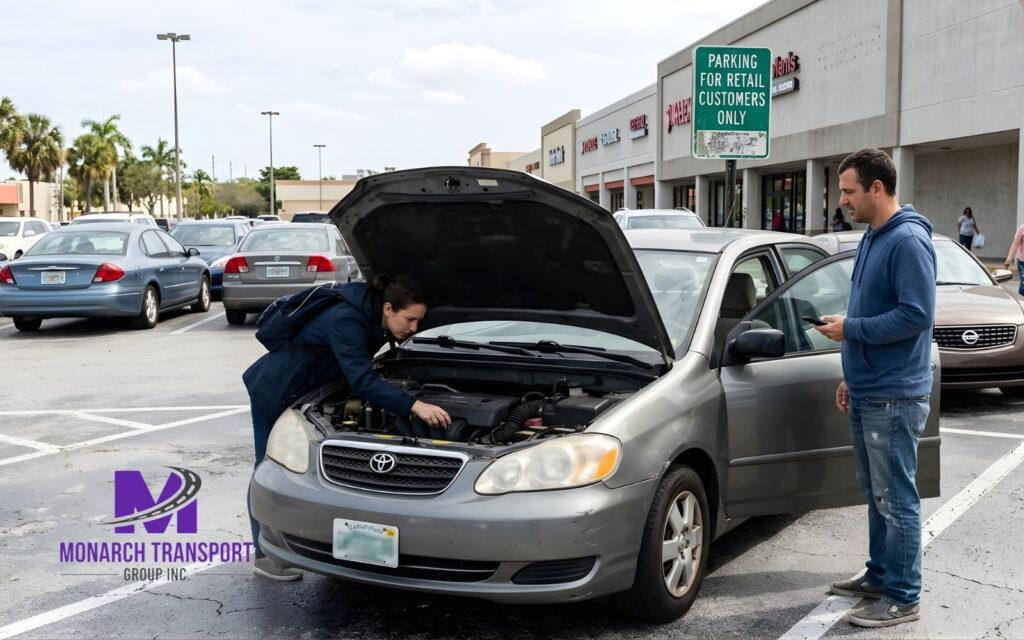
Here’s how to protect yourself: How to Spot and Avoid Car Shipping Scams. If you are buying on Marketplace in 2026, you must pay for your own Carfax report and insist on meeting at a bank or police station to handle the paperwork. It is chaotic, but for the street-smart buyer, it’s highly lucrative.
10. TrueCar: The Upfront Pricing Network
TrueCar is an automotive pricing and information website that connects buyers with a network of certified dealers. The platform provides upfront, discounted pricing based on actual recent sales data in a specific zip code, allowing consumers to bypass traditional dealership negotiations and secure guaranteed savings before visiting a lot.
If you fundamentally despise the process of haggling but still want the traditional dealership experience (perhaps to look at multiple trims in person or negotiate a complex trade-in), TrueCar is your bridge. They essentially commoditize the negotiation process.
The platform aggregates massive amounts of transactional data to show you the “bell curve” of what people are actually paying for a specific vehicle in your city this week. It cuts through the MSRP illusion. Once you find the car and the price you like, TrueCar generates a guaranteed offer certificate. You take that certificate to the certified dealer, and that becomes your baseline price.
Before committing to any deal, it’s smart to calculate total ownership cost including delivery. You can quickly estimate pricing using our cost to ship a car between states guide.
Safety: How to Protect Yourself on Any Platform
Regardless of which platform you use, these steps apply universally:
The Bottom Line: Choosing Your 2026 Auto Platform
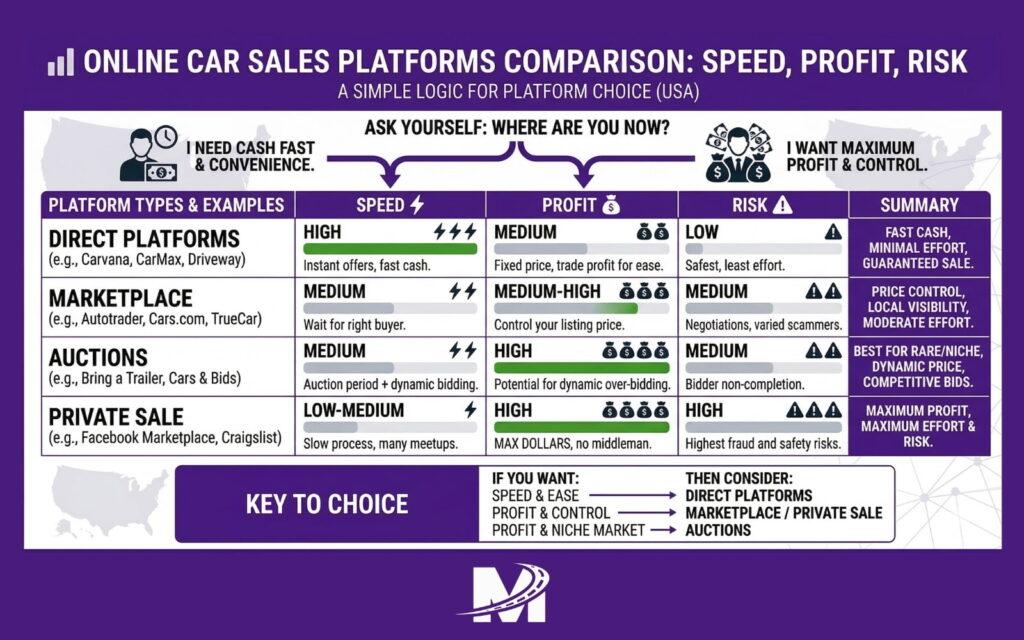
The fragmentation of the used car market means there is no longer a single best place to buy or sell. The right platform depends entirely on which resource you’re optimizing – your time or your money.
If you have high risk tolerance and want to extract every dollar of equity from your old car, Facebook Marketplace is your arena. If you’re exhausted and just want a reliable commuter car delivered to your driveway, you’re paying the Carvana or Driveway premium for that convenience. If you’re chasing a specific collector car and want global exposure, BaT or Cars & Bids is where serious buyers look. And if you want the widest possible search net before committing to anything, CarGurus or Autotrader is your starting point.
The transaction itself has been successfully digitized. Your job as a consumer in 2026 is to decide which platform’s model aligns with your financial constraints, patience level, and how much verification work you’re willing to do yourself.
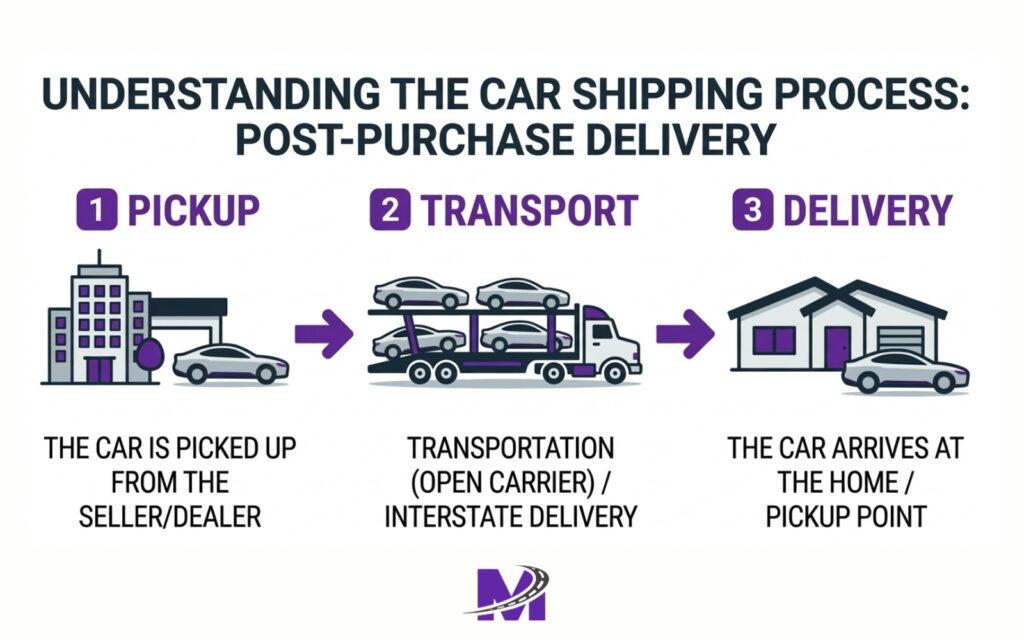
Once you’ve found the right car, the next step is getting it home. Whether you’re buying from a private seller three states away or a dealership across the country,Monarch Transport Group connects you with FMCSA-licensed carriers for door-to-door vehicle delivery across all 48 contiguous states. Once the car is on its way, make sure you know what to expect from state-to-state car transport from pickup window to final delivery inspection.
FAQ
Autotrader and CarGurus are the largest used car websites in the US by inventory volume, each aggregating millions of listings from private sellers and over 40,000 dealerships nationwide. Both function as search engines rather than direct retailers – they do not own inventory but provide pricing data, vehicle history integration, and dealer reviews to help buyers compare options across the full market.
Private sales on Facebook Marketplace typically return the most money by eliminating dealer margins entirely. For instant corporate offers, CarMax and Carvana generate algorithm-based cash bids valid for seven days. CarMax appraisals are redeemable at any physical location. Neither platform will match a strong private sale price, but both provide a reliable cash floor within minutes.
Run a free VIN check at nicb.org to confirm the vehicle is not stolen or salvaged. Purchase a Carfax or AutoCheck report to review accident history, title status, and odometer records. Commission an independent pre-purchase inspection ($100–$200) from a mechanic near the seller. Complete the title transfer and cash exchange inside a bank – never at a parking lot or private residence.
Facebook Marketplace and Craigslist are the primary sources for vehicles under $5,000. Franchise dealerships and online retailers rarely stock inventory at this price point because reconditioning costs consume most of the margin. Buyers in this range operate exclusively in the private-party market, where mechanical inspection before purchase is essential – budget vehicles carry higher risk of undisclosed problems.
Yes. CarMax charges a non-refundable transfer fee of $99–$1,990 to ship a vehicle to your local store. Bring a Trailer charges buyers a 5% premium on the final auction price, capped at $5,000. Cars & Bids charges buyers 4.5%, capped at $4,500. Carvana does not charge a separate buyer fee but prices inventory above private market value to cover delivery and reconditioning costs.
Yes, provided you follow a defined verification process. Order an independent pre-purchase inspection before payment, review a full vehicle history report, and verify the VIN through the NICB. Carvana offers a 7-day return window and CarMax offers 30 days – both function as a post-delivery test period. Hundreds of thousands of Americans complete sight-unseen purchases annually using this process.
Carvana and CarMax support full transactions – search, financing, and purchase – inside their mobile apps. CarGurus and Autotrader are the strongest tools for browsing aggregated inventory across dealers and private sellers, with real-time deal ratings based on local market data. Facebook Marketplace is the dominant platform for private sales under $10,000.
Never pay by wire transfer or gift card – no legitimate seller uses these methods. Verify the VIN independently before sending money. For out-of-state purchases, require an independent inspection before payment. Complete private-party paperwork inside a bank. Pricing 20–30% below comparable listings on the same platform is a reliable indicator of fraud, not a genuine discount.
No. Both platforms use fixed, no-haggle pricing – the listed price is the final transaction price. Carvana’s algorithm sets prices based on market data and reconditioning costs. CarMax appraises and prices each vehicle independently at acquisition. Buyers who want to negotiate should use Autotrader, Cars.com, or TrueCar, which connect directly with dealerships where price negotiation remains standard.
Carvana and CarMax both approve financing for scores as low as 500–550, though rates at that level are substantially higher than market average. A score of 680 or above generally qualifies for competitive financing terms. Pre-qualifying through your own bank or credit union before shopping establishes a baseline rate – platform financing is then worth accepting only if it comes in lower.
Related articles

Best Places to Buy a Motorcycle Online in the USA
IN THIS ARTICLE: The Digital Shift: Geography No Longer Constrains the Ride Where to Buy: Top 2026 Platforms Analysis Comparison Table: Platform Overview The Facet of Finance: Not Just the

Car Shipping by Train: Costs, Process & What to Expect in 2026
IN THIS ARTICLE: The Two Faces of Rail Transport: Consumer vs. Commercial Why Choose the Tracks? (The Human Perspective) Dimensions and Constraints: Will Your Car Fit? The “Hidden” Logic of

ATV vs UTV Shipping: Costs, Methods & What to Expect in 2026
IN THIS ARTICLE: The Fundamental Difference: Dimensional Weight and Trailer Space Average Shipping Costs in 2026: What to Budget Best Time to Ship Your ATV or UTV – Seasonal Price

Complete Guide to Car Shipping in 2026
The landscape of American mobility has shifted, making vehicle logistics more accessible and seamless than ever before. Understanding this new norm is the first step toward a stress-free relocation that

Door-to-Door vs. Terminal-to-Terminal: Which Logistics Model Fits You?
IN THIS ARTICLE: Understanding the Two Primary Logistics Models Comparative Analysis: Door-to-Door vs. Terminal-to-Terminal The Financial and Temporal Mechanics of Shipping Models Geographical Impact: Urban vs. Rural Accessibility The Final

Enclosed Car Shipping: The Gold Standard for Luxury and Exotic Vehicle Transport
IN THIS ARTICLE: Why “Standard” Transport Doesn’t Cut It for Masterpieces The Anatomy of Protection: Hard-Sided vs. Soft-Sided Trailers The Low-Clearance Nightmare: Why Hydraulic Lifts Matter Beyond the Walls: The

How State-to-State Car Transport Works: From Pickup to Delivery
IN THIS ARTICLE: Understanding the Auto Transport Ecosystem Choose Your Transport Type The Process of Shipping Calculating the Cost and Timeline of State-to-State Car Transport The 2026 EV Transport Protocol

How Much Does It Cost to Ship a Car Between States?
IN THIS ARTICLE: Average Cost Breakdown by Distance Primary Factors Influencing Your Shipping Quote Geographic Influence on Pricing Understanding the Quote Structure The Impact of Seasonality on Auto Transport Rates