
IN THIS ARTICLE:
- What Is an Auto Transport Broker?
- What Is an Auto Transport Carrier?
- The Key Differences Side by Side
- Does Using a Broker Cost More?
- What Is “Dual Authority” – Brokers That Are Also Carriers
- How to Verify Any Broker or Carrier Before You Book
- When Direct Carrier Booking Actually Makes Sense
- Your Rights When Working With a Broker
- The Bottom Line – Which One Should You Choose?
- Conclusion
- Broker vs. Carrier FAQ
You requested three car shipping quotes. One comes from a company stating they “coordinate your shipment.” Another emphasizes they “operate our own fleet.” The third claims to do both. The prices vary by hundreds of dollars, leaving you entirely unsure who to trust with a high-value asset like your vehicle.
The auto transport industry operates on a highly specific, tiered logistics network. Choosing the wrong type of company for your specific route can lead to significant delays, unexpected fees, or an unresponsive customer service experience when you need help most.
This guide breaks down the internal mechanics of the industry so you understand exactly what you are paying for – and which option provides the right protection for your move.
Ready to compare verified transport options? Get a secure quote from Monarch’s vetted network today.
What Is an Auto Transport Broker?
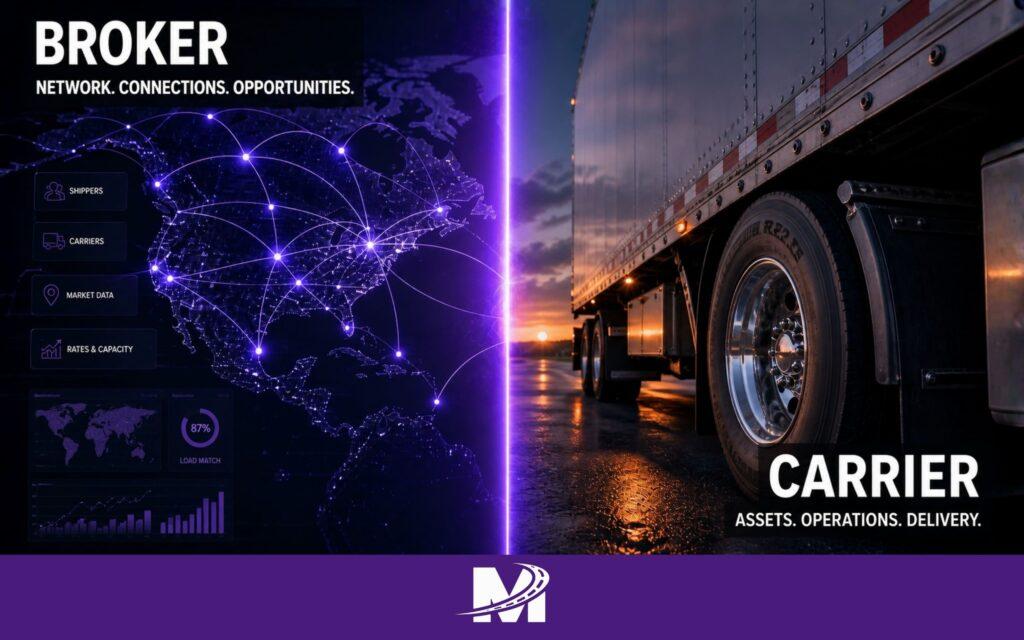
An auto transport broker acts as the dedicated logistics manager and intermediary between you and the physical truck driver. Brokers do not own transport trailers, do not employ drivers, and do not physically move your car.
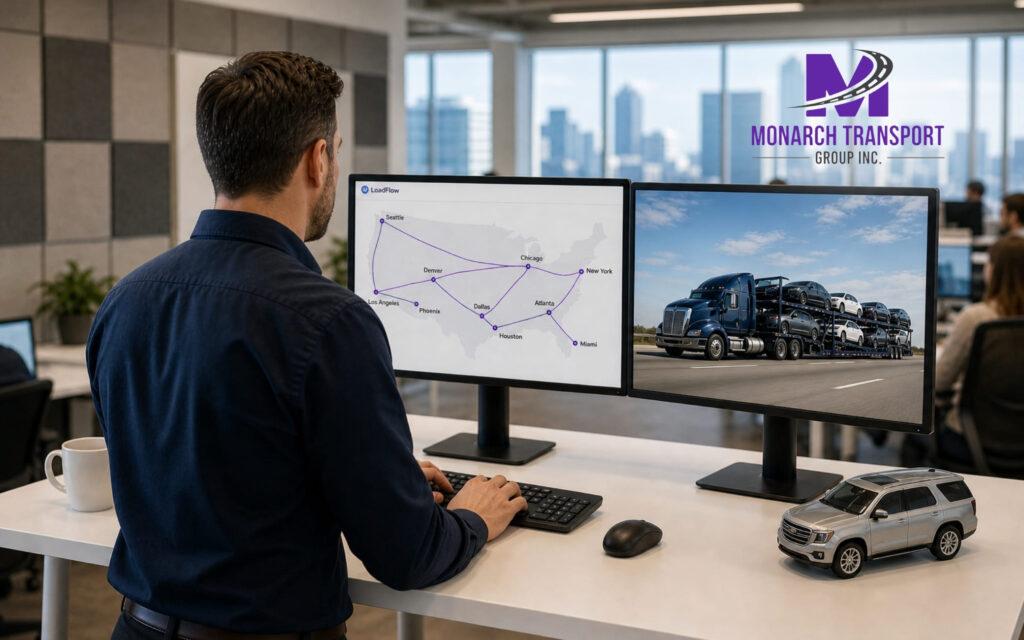
When you book with a broker, they take your vehicle’s specific details – make, model, route, and timeline – and post them to a national load board. The most prominent of these closed-loop networks is Central Dispatch, the central nervous system of the auto transport industry. It allows brokers to broadcast available freight to thousands of independent drivers simultaneously.
What a broker actually does behind the scenes:
Verifies credentials. Before assigning your vehicle, a legitimate broker checks the carrier’s FMCSA license and confirms their active cargo insurance policies are in order.
Negotiates pricing. Brokers bargain directly with carrier dispatchers, adjusting the “bounty” on your vehicle on the load board to secure a trailer spot at the most competitive rate.
Coordinates logistics. They align pickup windows, delivery schedules, and driver communication on your behalf.
Resolves problems. If a truck breaks down in transit or a driver cancels at the last minute, the broker immediately sources a replacement carrier so your shipment is not left stranded.
Here is the industry reality most competitors gloss over: the vast majority of auto transport carriers are small owner-operators running just one to three trucks. They do not have marketing departments, customer service teams, or consumer-facing websites. They secure nearly 100% of their freight through load boards. For the average consumer shipping a single vehicle, a broker is often the only practical way to access this massive nationwide network of independent drivers.
For a complete overview of how the auto transport process works from booking through delivery, see our Complete Guide to Car Shipping in 2026.
What Is an Auto Transport Carrier?
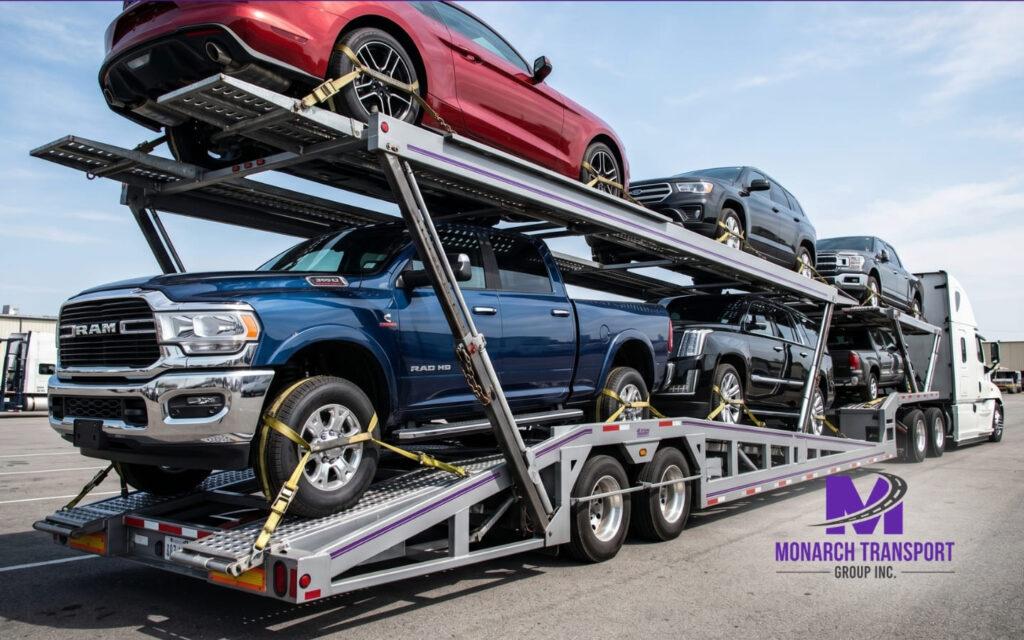
An auto transport carrier is the company executing the physical relocation of your vehicle. They own the semi-trucks, employ the drivers, and hold the primary Motor Truck Cargo insurance that covers your vehicle while it is in transit. The carrier assumes legal and physical responsibility for your car from the moment it is loaded until the final delivery signature.
The carrier landscape breaks into two primary categories:
Large fleet carriers. Companies operating ten or more transport trailers. They typically run fixed regional routes – for example, exclusively running I-95 between New York and Florida – maintain dedicated dispatch teams, and operate on highly predictable schedules.
Owner-operators. Independent drivers who own one or two trucks. They dominate the industry numerically and offer routing flexibility, but their schedules are more susceptible to weather delays, traffic, or mechanical issues.
Booking a direct carrier means bypassing the broker and contracting with the trucking company itself. Finding them requires manual effort: searching the FMCSA SAFER system by DOT number to verify active authority and safety records, or navigating self-service platforms to negotiate with dispatchers directly.
Need to move your car safely? Connect with reliable carriers on your exact route through Monarch.
The Key Differences Side by Side
| Feature | Auto Transport Broker | Auto Transport Carrier |
| Owns the truck | ❌ No | ✅ Yes |
| Who you call with questions | ✅ Broker – single point of contact | ✅ Driver or dispatch directly |
| Network coverage | Nationwide via load board | Limited to fixed or regional routes |
| Price competition | ✅ Multiple carriers bid for your load | Fixed rate based on operating cost |
| Carrier vetting | ✅ Broker verifies insurance and DOT status | You must self-verify all credentials |
| If truck breaks down | ✅ Broker reassigns to a new truck | You wait for repairs or rebook |
| Best for long-distance | ✅ Yes – accesses the national network | Limited unless they run that specific lane |
| Best for short regional routes | Works fine | ✅ Sometimes more direct and efficient |
| Accountability | Broker acts as your logistical advocate | Direct accountability, no middleman |
For more context on what the transport process looks like once a carrier is assigned, see our State-to-State Car Transport Guide.
Does Using a Broker Cost More?
The most common assumption in auto transport is that cutting out the middleman automatically saves money. While that logic applies to retail purchases, it falls apart in the freight industry due to the mechanics of trailer capacity.
Brokers charge a commission – typically $150 to $300 – built into your final quote. However, direct carriers are motivated to avoid running trailers with empty spots. A carrier will accept a lower payout per vehicle from a broker to guarantee a fully loaded truck, rather than risk driving 1,000 miles with an empty upper deck searching for a retail customer.
Because brokers negotiate these wholesale rates directly with dispatchers, the final price you pay through a broker is often identical to – or occasionally lower than – what a carrier would quote you directly for a single, one-off shipment.
The only scenario where booking directly with a carrier reliably costs less is if you already have a relationship with a specific driver who regularly runs your exact route and will extend a recurring direct discount.
A reality check from Reddit illustrates this well. A user on r/AutoTransport managed to save $50 by booking directly with a carrier rather than going through a broker. However, he noted it took three hours of calling dispatchers, cross-referencing safety records on the FMCSA SAFER system, and verifying insurance certificates. For a single residential shipment, most people will reasonably conclude that $50 is not worth three hours of acting as your own logistics coordinator.
For a full breakdown of what drives car shipping costs across different routes and seasons, see our guide on how much it costs to ship a car between states.
What Is “Dual Authority” – Brokers That Are Also Carriers
When researching top-tier auto transport companies, you will encounter businesses that claim to operate their own fleet while simultaneously acting as a brokerage. This is not a marketing tactic – it is a federally regulated designation known as “dual authority.”
Large logistics operations often hold both an MC number (licensing them to broker freight) and a USDOT number (licensing them to operate commercial trucks). The FMCSA requires both designations to be independently registered and maintained with active authority.
When you book with a dual-authority company, they check internally first. If one of their own trailers is scheduled to run your route and has an available spot, they dispatch their own driver. If their fleet is fully booked or does not service your specific destination, they pivot to their brokerage license and place your vehicle on the load board to secure an independent carrier.
For the consumer, dual authority offers three concrete advantages:
Maximum flexibility. You get the reliability of a large corporate entity combined with the massive reach of a broker network.
Potential cost savings. If they load your car onto their own equipment, the saved brokerage commission is occasionally passed down to the customer.
Single point of accountability. Whether they transport it themselves or broker it out, the company remains your primary contact throughout the shipment.
You can verify dual authority status by searching any company’s name in the FMCSA SAFER database. A legitimate dual-authority provider will list both “Broker” and “Carrier” as active under their Operating Authority.
See if a dual-authority provider is the right fit for your route. Start your free Monarch quote here.
How to Verify Any Broker or Carrier Before You Book
Trusting a company with a $30,000 to $100,000 asset requires more than reading Google reviews. You must verify their legal standing at the federal level before signing a contract or paying any deposit.
Steps to verify an auto transport broker:
Steps to verify an auto transport carrier:
Immediate red flags – cancel your transaction if:
For a comprehensive checklist of warning signs and how to identify fraudulent operators, see our guide on how to spot and avoid car shipping scams in 2026.
When Direct Carrier Booking Actually Makes Sense
Most auto transport articles – largely written by brokerages – imply you should never book a direct carrier. That is not accurate. While a broker is the right choice for most residential moves, there are specific scenarios where booking directly is the smarter, more efficient approach.
Scenario 1: Short regional routes (under 300 miles) If you are shipping from Los Angeles to San Diego or from Dallas to Houston, you do not need a national load board. Short intrastate routes are serviced by local carriers and small regional operators that can often be found through local directories. Booking directly bypasses the broker commission entirely for a simple, single-day transit.
Scenario 2: Repeat booking with a trusted carrier If you are a snowbird who has successfully shipped your vehicle with the same driver for two consecutive seasons, keep using them directly. Once you establish a relationship with a reliable owner-operator who runs your exact seasonal route, direct booking guarantees the driver you trust – and the carrier keeps 100% of the transport fee, which can translate into a loyalty discount for you.
Scenario 3: Businesses and dealerships Volume creates leverage. If you operate a dealership, fleet management company, or auction house shipping dozens of vehicles monthly, you have the scale to negotiate direct wholesale contracts with large fleet carriers and avoid retail broker fees on every transaction.
For every other scenario – especially first-time shippers, cross-country moves, or complex routes – a broker is the appropriate choice.
Shipping a single vehicle cross-country? Let Monarch’s network handle the logistics and get your quote today.
Your Rights When Working With a Broker
The auto transport industry is federally regulated, and first-time shippers are often unaware of the consumer protections available to them. Here are your definitive rights when navigating a brokerage contract.
“My broker went silent after I paid the deposit.” A legitimate broker should only charge a deposit after a carrier has been officially assigned and a dispatch sheet is generated. If a broker takes a deposit upfront and stops responding, they are in breach of their contractual obligation. You have the right to demand an immediate refund. If they refuse, file a formal complaint through USA.gov’s consumer complaint portal and report their MC number directly to the FMCSA.
“Can I refuse the assigned carrier?” Yes. When a broker notifies you that a carrier has been assigned, ask for the carrier’s DOT number before the final dispatch paperwork is signed. If you check their safety record on the FMCSA SAFER system and find a concerning history, you can reject that carrier and request reassignment to a different operator.
“Can I contact the driver directly?” Once the vehicle is dispatched, you have the right to direct communication. While the broker remains your advocate for logistical issues, you should receive the driver’s direct contact information to coordinate exact pickup timing, gate access, and delivery logistics.
Standard deposit norms. The industry standard is a nominal deposit of $100 to $200 charged to a credit card only after the carrier is secured. The remaining balance is paid directly to the driver at delivery via cash, cashier’s check, or money order. Any broker demanding 50% upfront via wire transfer or Zelle is operating outside normal industry practice and should be avoided.
The Bottom Line – Which One Should You Choose?
Choose an auto transport broker if:
Choose a direct carrier if:
For the vast majority of residential customers, using a broker is the right decision. The nationwide network access, built-in insurance verification, and load board negotiating power make the broker commission a worthwhile investment compared to the time and risk of coordinating the logistics yourself.
Conclusion
The broker vs. carrier debate has a straightforward answer once you understand how the industry actually works. Brokers are not middlemen inflating prices – they are logistics coordinators with access to a nationwide network of drivers that most consumers could never reach on their own. Carriers are not hidden gems waiting to offer secret discounts – they are small operators who depend on load boards to stay busy.
For a single cross-country or interstate shipment, the math almost always favors using a reputable broker. You get insurance verification, reassignment protection if something goes wrong, and a single point of contact from quote to delivery. The commission is the price of that infrastructure.
If you are shipping a short regional route, returning to a driver you trust, or running a business with volume leverage – direct carrier booking is a legitimate and sensible option.
The only genuinely wrong choice is booking without verifying credentials first. Whether you go through a broker or a carrier, the FMCSA SAFER database costs nothing to check and takes two minutes. Make that check a non-negotiable part of every auto transport transaction you ever make.
Broker vs. Carrier FAQ
Not necessarily. Brokers negotiate wholesale rates directly with carriers who need to fill trailer space. The final price through a broker is frequently equal to or lower than what a carrier would quote a retail customer directly for a one-off shipment.
The carrier is legally and financially responsible. Damage claims are filed against the carrier’s Motor Truck Cargo insurance. The broker acts as your advocate in facilitating the paperwork but is not the insurer.
You have the right to refuse. Check the carrier’s DOT number and safety record on the FMCSA SAFER system before the truck arrives. If you are uncomfortable with their history, instruct the broker to reassign your vehicle to a different carrier.
Ask for their MC number and check it in the FMCSA SAFER database. Confirm their Operating Authority is listed as “Active” and that they maintain the federally required $75,000 surety bond.
Central Dispatch is the primary national load board used by the auto transport industry. Licensed brokers post available vehicles, and verified carriers search the platform for freight that fits their existing highway routes.
Yes – this is called “dual authority.” Companies holding both an active DOT number and an MC number can transport vehicles on their own equipment or broker shipments out to independent carriers depending on availability. You can confirm this status in the FMCSA SAFER database, where a legitimate dual-authority provider lists both “Broker” and “Carrier” as active.
Sometimes, but rarely by much. A direct carrier can save you money mainly if you already have a relationship with a driver who regularly runs your exact route. One Reddit user saved $50 booking direct, but it took three hours of calling dispatchers and verifying safety records – for most single shipments, that trade-off isn’t worth it.
Direct booking works best for short regional routes under 300 miles, repeat customers with a trusted owner-operator on a recurring seasonal route, or businesses and dealerships shipping enough volume to negotiate wholesale contracts.
A legitimate broker only charges a deposit once a carrier is assigned and a dispatch sheet is generated. If they take a deposit upfront and stop responding, you have the right to demand a refund. If they refuse, file a complaint through USA.gov’s consumer complaint portal and report their MC number to the FMCSA.
Yes. Once a carrier is assigned and your vehicle is dispatched, you have the right to the driver’s direct contact information to coordinate exact pickup timing, gate access, and delivery logistics, even though the broker remains your point of contact for broader issues.
Related articles

10 Best Platforms to Buy or Sell Used Cars Online in 2026
IN THIS ARTICLE: Platform Comparison at a Glance Safety: How to Protect Yourself on Any Platform The Bottom Line: Choosing Your 2026 Auto Platform FAQ Buying or selling a used

Car Shipping by Train: Costs, Process & What to Expect in 2026
IN THIS ARTICLE: The Two Faces of Rail Transport: Consumer vs. Commercial Why Choose the Tracks? (The Human Perspective) Dimensions and Constraints: Will Your Car Fit? The “Hidden” Logic of
Complete Guide to Car Shipping in 2026
The landscape of American mobility has shifted, making vehicle logistics more accessible and seamless than ever before. Understanding this new norm is the first step toward a stress-free relocation that

Complete Guide to RV Shipping in 2026
IN THIS ARTICLE: Introduction: The Freedom of the Road, Delivered by Professionals Understanding the Fleet: Classes and Types of RVs Methods of Transport: How We Get Your RV Home Measuring

Cross-Country Car Shipping: How to Save Money Safely
IN THIS ARTICLE: Why “Cheap” Doesn’t Have to Mean “Dangerous” 1. Open Transport: The Industry Gold Standard for Savings 2. The Power of “Terminal-to-Terminal” Shipping 3. Timing the Market: The

Door-to-Door vs. Terminal-to-Terminal: Which Logistics Model Fits You?
IN THIS ARTICLE: Understanding the Two Primary Logistics Models Comparative Analysis: Door-to-Door vs. Terminal-to-Terminal The Financial and Temporal Mechanics of Shipping Models Geographical Impact: Urban vs. Rural Accessibility The Final

How Much Does It Cost to Ship a Car Between States?
IN THIS ARTICLE: Average Cost Breakdown by Distance Primary Factors Influencing Your Shipping Quote Geographic Influence on Pricing Understanding the Quote Structure The Impact of Seasonality on Auto Transport Rates

How State-to-State Car Transport Works: From Pickup to Delivery
IN THIS ARTICLE: Understanding the Auto Transport Ecosystem Choose Your Transport Type The Process of Shipping Calculating the Cost and Timeline of State-to-State Car Transport The 2026 EV Transport Protocol