

IN THIS ARTICLE:
- The Two Timelines Nobody Separates (But Should)
- Realistic Transit Times by Route Distance
- Dispatch Time by Season: The Variable Nobody Controls
- How Route Type Affects Your Timeline
- Open vs. Enclosed Transport: Timeline Differences
- How Pickup and Delivery Type Affect Timeline
- What Actually Causes Delays (And Which Are Your Fault)
- Timeline for Specific Common Routes
- How to Speed Up Your Car Shipping Timeline
- What to Do While Your Car Is in Transit
- 7 to 14 Days: What That Range Actually Means For Your Move
- FAQ: Car Shipping Timelines
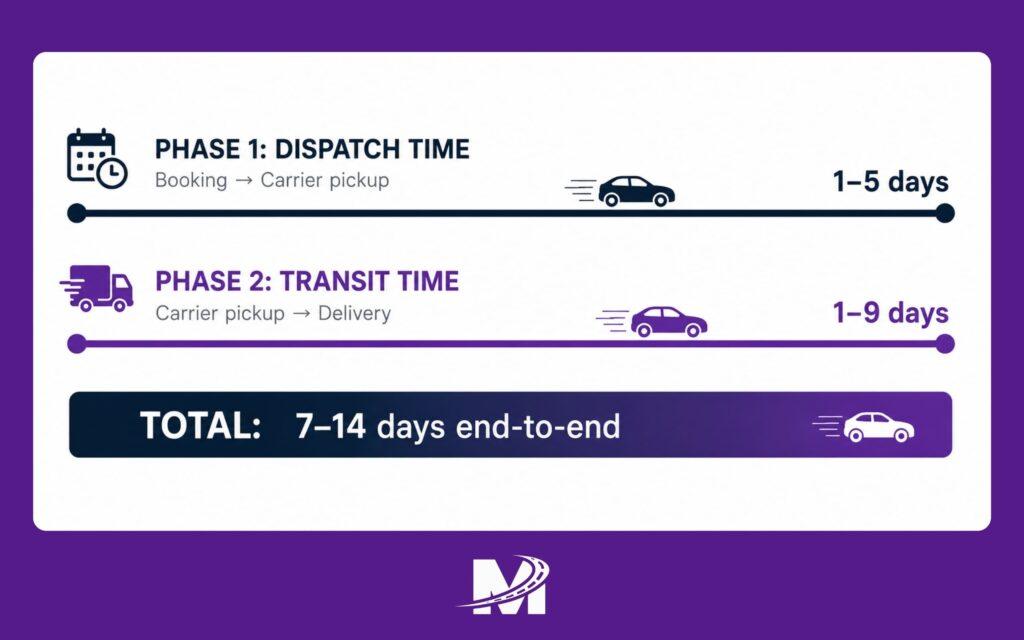
Shipping a car typically takes 7 to 14 days end-to-end – from the moment you book to the moment your keys are back in your hand. But that number bundles together two very different clocks: the time it takes to find and dispatch a carrier (1 to 5 days), and the actual transit time once your car is on a truck (1 to 9 days). Confusing the two is the most common reason people are caught off guard when their car doesn’t arrive when they expected.
This guide breaks down both clocks separately, by route, by season, and by transport type – so you can plan an actual schedule, not just hope for the best. Want to skip straight to your route? Get a timeline estimate with the Monarch car shipping quote tool.
The Two Timelines Nobody Separates (But Should)
Before getting to route-by-route numbers, the single most useful thing to understand about car shipping timelines is that there are two distinct phases, and they run on completely different logic.
Phase 1: Dispatch time (1–5 days) This is the time between when you book and when a carrier physically picks up your vehicle. It’s determined by how many trucks are running your route at that moment, how flexible your pickup window is, and what time of year it is. On a popular corridor in the off-season, dispatch can happen within 24 hours. On a rural route in peak summer, it can stretch to five days or more.
Phase 2: Transit time (1–9 days) This is the time the car spends on the truck. It’s determined almost entirely by distance, with weather and driver hours-of-service regulations as secondary factors. Transit time is far more predictable than dispatch time once you know your route.
Most guides quote “7 to 14 days” without explaining that these two phases behave completely differently. Understanding the split is what lets you troubleshoot delays and set realistic expectations with whoever is waiting for the car on the other end. For a full picture of how the process works from start to finish, see our state-to-state car transport guide.
Realistic Transit Times by Route Distance
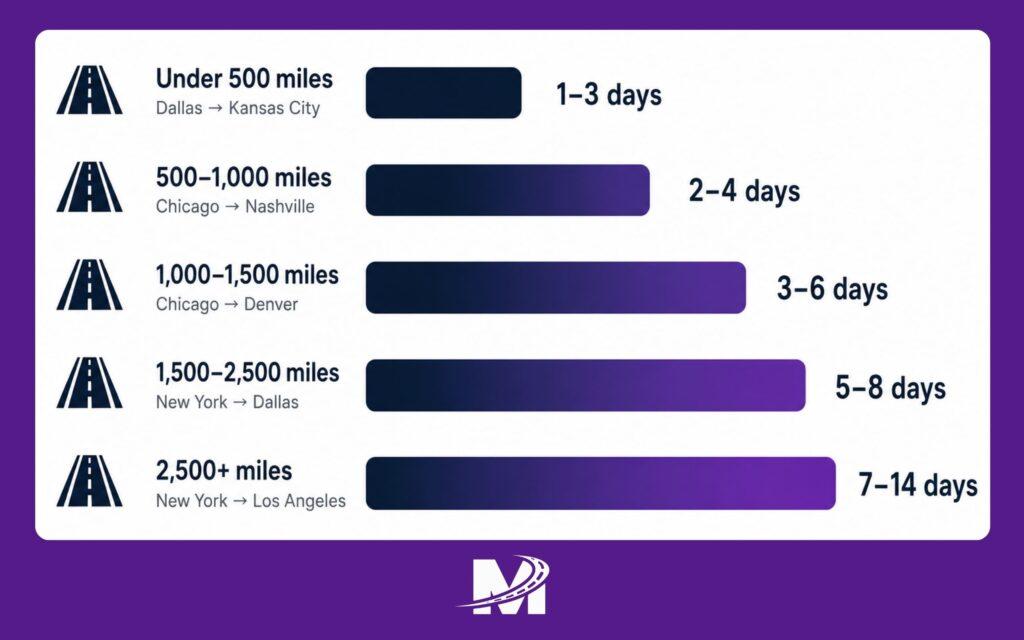
The table below reflects actual transit times after carrier pickup – not total time from booking.
| Distance | Realistic Transit Time | Example Routes |
| Under 500 miles | 1 – 3 days | Dallas to Kansas City; LA to Las Vegas; Atlanta to Charlotte |
| 500 – 1,000 miles | 2 – 4 days | Chicago to Nashville; Houston to Miami; NYC to Cleveland |
| 1,000 – 1,500 miles | 3 – 6 days | Chicago to Denver; Atlanta to Houston; Seattle to San Francisco |
| 1,500 – 2,500 miles | 5 – 8 days | New York to Dallas; Miami to Chicago; Denver to Atlanta |
| 2,500+ miles (cross-country) | 7 – 14 days | New York to Los Angeles; Miami to Seattle; Boston to San Diego |
Why cross-country takes so long: It’s not just the miles. Federal Hours of Service (HOS) regulations – enforced by the Federal Motor Carrier Safety Administration (FMCSA) – limit commercial drivers to 11 hours of driving per 14-hour window, with mandatory 10-hour rest breaks. A New York to Los Angeles run is roughly 2,800 miles. At highway speeds with stops, a carrier covering that route is looking at 5–6 driving days minimum – and that’s before accounting for loading other vehicles, traffic in major metros, or weather.
Dispatch Time by Season: The Variable Nobody Controls
Transit time is relatively predictable. Dispatch time is where timelines go wrong – and it’s almost entirely driven by season and route popularity.
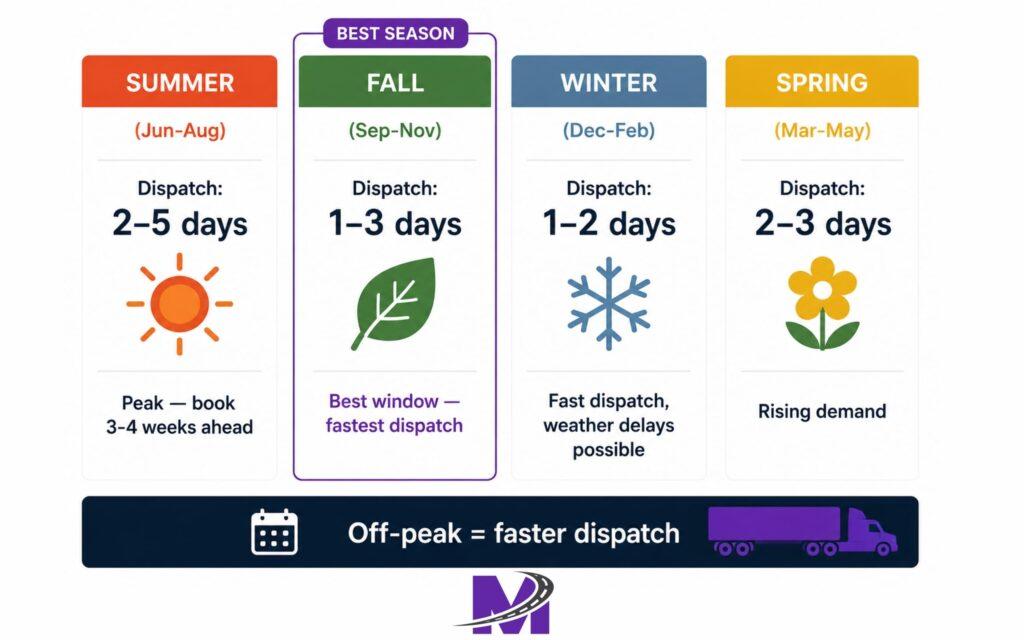
Summer (June – August): High Demand, Slower Dispatch
Summer is peak season for auto transport. College students are moving. Families are relocating before school starts. Snowbirds who shipped south in the fall are sending their cars back north. The result: carriers have their trailers full and can afford to be selective about which jobs they take.
What this means in practice: On popular corridors (Florida to New York, California to Texas), dispatch during summer is still typically 2–4 days. On less-traveled routes or rural pickups, it can stretch to 5–7 days as you wait for a carrier to have a route that passes near you.
Booking lead time: Plan for 3–4 weeks of lead time if you’re moving in the summer. Not because transit takes longer, but because you want your pickup date to have enough buffer that a 3-day dispatch delay doesn’t cascade into a logistical problem.
Fall (September – November): The Sweet Spot
September and October are the best months to ship if your priority is predictable timelines. Demand is dropping from its summer peak, carriers have more flexibility, and weather hasn’t yet become a factor in most of the country. Dispatch times tighten to 1–3 days on most routes.
The exception: the “snowbird corridor” from the Northeast and Midwest to Florida and Arizona. October and November see a surge of retirees shipping their cars south for winter, which creates a specific demand spike on those routes. If you’re shipping south in fall, expect summer-like dispatch times and pricing on Florida and Arizona-bound routes. Our snowbird car shipping guide explains how to navigate this seasonal pattern.
Winter (December – February): Fast Dispatch, Slow Transit
Winter is counterintuitive. Demand is at its lowest, which means dispatch is often the fastest of any season – 1–2 days on most routes. But transit times can stretch due to weather delays: snowstorms in the Midwest and Rockies, icy passes in the Appalachians, and reduced speeds on winter roads.
The practical implication: if your delivery has a hard deadline (a work start date, a cross-country move), winter is the season when building extra buffer into your timeline matters most. Dispatch will be fast. The truck may still sit in a storm for 12 hours in Wyoming.
The December anomaly: The first two weeks of December behave like fall – demand is moderate, and dispatch is fast. The last two weeks of December and early January are disrupted by holiday schedules, reduced driver availability, and terminal closures at some shipping hubs. If you can avoid shipping December 15 – January 5, you’ll have a smoother experience.
Spring (March – May): Rising Demand, Manageable Timelines
Spring is the second busiest season, but it doesn’t hit summer intensity until late May. March and April are reliable months – dispatch within 2–3 days on most routes, no significant weather complications except in the northern Plains. By May, prices and timelines start trending toward summer levels.
How Route Type Affects Your Timeline
Distance is the headline factor, but the specific route you’re shipping matters beyond just the mileage. Two routes of the same distance can have significantly different timelines based on how many carriers run them.
High-Volume Corridors: Fastest Dispatch
These routes have dozens of carriers running them weekly. Dispatch is fast, competition keeps prices fair, and transit is as smooth as any long-haul can be:
On these corridors, dispatch time is often 1–2 days, even in peak season. They are the highways of the auto transport world – trucks are always moving.
Mid-Volume Routes: Standard Timelines
Most state-to-state moves fall here. Routes between regional metros that aren’t on the primary national corridors – Chicago to Denver, Atlanta to Dallas, Seattle to Portland – have regular carrier traffic but not the density of the top corridors. Dispatch is typically 2–4 days year-round.
Low-Volume and Rural Routes: Where Delays Happen
This is where most timeline surprises occur. If your pickup or delivery point is more than 50 miles from a major interstate, you’re off the primary carrier network. Carriers who run that area may only pass through once or twice a week, meaning dispatch windows of 3–7 days are realistic even in the off-season.
The practical fix: Ask your broker whether your location is on a primary route or off it. If you’re in a rural area, offer to drive the car to the nearest major highway hub – a Pilot truck stop, a terminal facility, or even a large shopping center near an interstate. This single step can reduce your dispatch time by 1–3 days and often drops the quote as well.
Open vs. Enclosed Transport: Timeline Differences
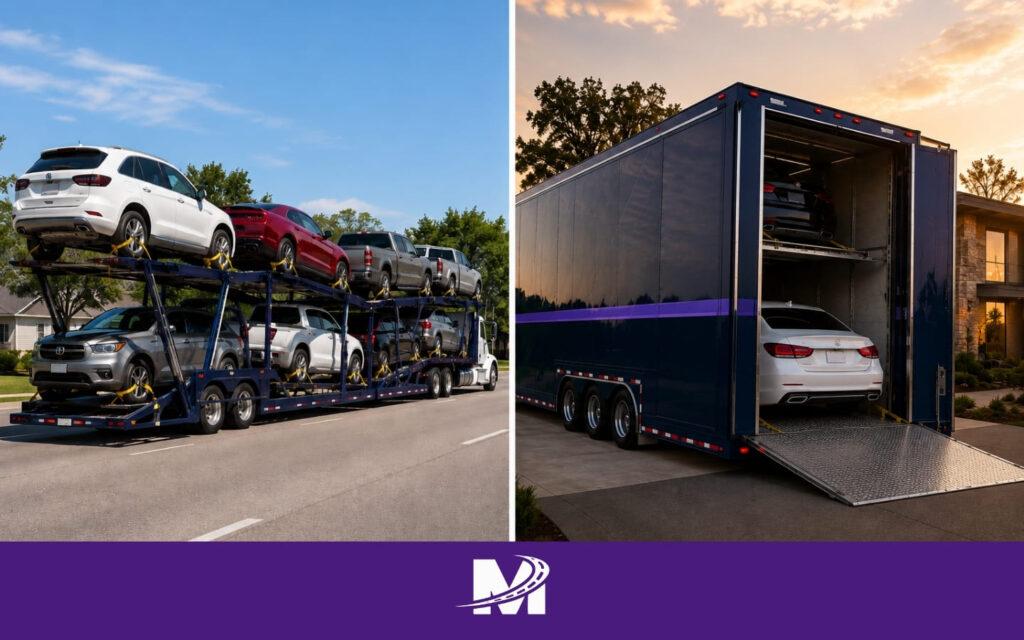
The difference in timeline between open and enclosed transport is smaller than most people expect – but it’s real. For a full comparison of both methods, see our open vs. enclosed auto transport guide.
Open transport is the industry default. There are significantly more open carriers on every route. A broker posting your vehicle on the load board at a market rate in open transport will typically get it assigned within 1–3 days on popular routes.
Enclosed transport uses specialized trailers. There are far fewer of them – fewer carriers, fewer trucks per route, fewer scheduling options. On a popular corridor, dispatch for enclosed transport is typically 2–5 days. On a less-traveled route, it can stretch to 5–7 days in peak season.
The transit time difference once on the road is minimal – enclosed carriers drive the same roads at the same speeds. The timeline difference is almost entirely in dispatch.
One thing consistently missed elsewhere: enclosed transport doesn’t just take longer because there are fewer trucks. It also takes longer because enclosed carriers often consolidate multiple pickups on a single trip, meaning your car may sit at an intermediate depot for a day while the carrier fills the rest of the trailer. Ask your broker specifically whether your enclosed carrier does direct transport or consolidated runs.
How Pickup and Delivery Type Affect Timeline
Door-to-door vs. terminal-to-terminal has a real but often misunderstood effect on timelines. Our door-to-door vs. terminal-to-terminal guide covers the full logistics of both models – here’s how they compare in terms of time.
Door-to-door is faster for most people because there’s no wait at a terminal while your car is consolidated onto the next outbound truck. The carrier comes to your location, loads, and proceeds.
Terminal-to-terminal can add 2–5 days to the total process – not because transit is slower, but because your car may sit at the origin terminal for 1–3 days before the right outbound carrier picks it up, and may sit at the destination terminal for 1-2 days before you pick it up. The upside is lower cost and more flexibility on your own schedule.
If your timeline is tight, door-to-door is the right choice even at a higher cost. If you’re flexible on a 3-4 day window at either end, terminal-to-terminal can save money without major inconvenience.
What Actually Causes Delays (And Which Are Your Fault)
Most timeline guides list causes of delay without distinguishing between delays you can prevent and delays that are outside anyone’s control. Here’s the honest version.
Preventable Delays
Inoperable or non-ready vehicle. If your car doesn’t start, won’t roll, or has issues that weren’t disclosed at booking, the driver may decline to load it. The carrier reschedules, your slot on the truck goes to another vehicle, and you’re back in the dispatch queue. Our car preparation checklist covers everything to have ready before pickup day.
Inaccessible pickup or delivery location. A carrier with a 75-foot truck cannot navigate a steep driveway, a low-clearance parking garage, or a street with overhead utility wires at 10 feet. If the driver can’t reach your location, they’ll leave and reschedule. Meet the driver at a nearby, accessible location if your address is complicated.
Missing or incorrect paperwork. For interstate transport, the carrier needs the title or registration to match the vehicle. If there’s a name discrepancy or a document is unavailable at pickup, the driver will leave. Have your paperwork ready before the pickup window opens.
Last-minute date changes from your side. If you call to reschedule your pickup 24 hours before the window, you lose your carrier assignment and go back into the dispatch queue, often adding 2–5 days. Changes to bookings should be made at least 5 days before the pickup window.
Unpreventable Delays
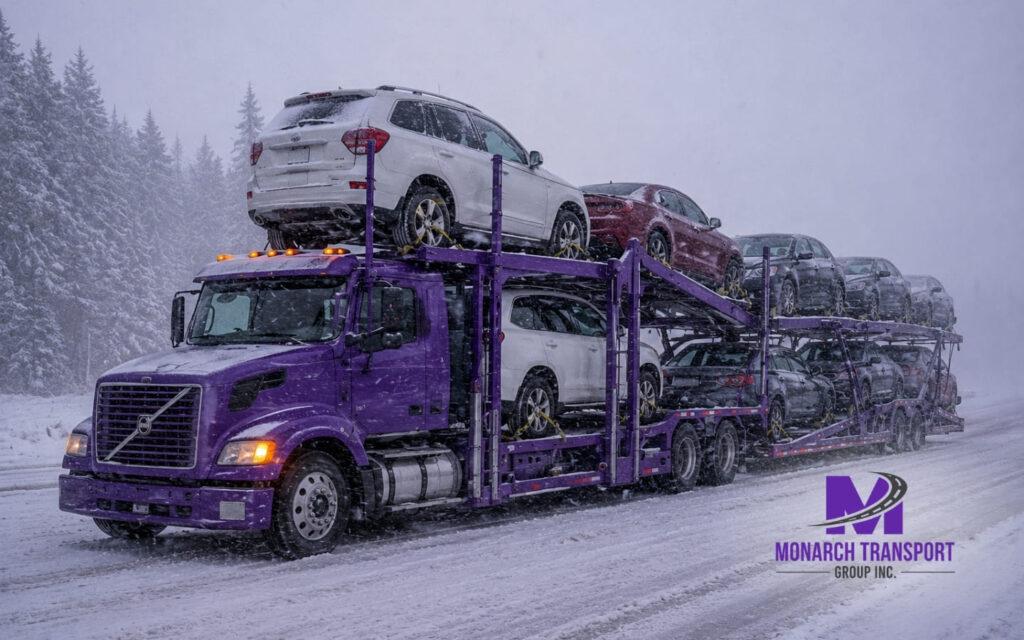
Weather. A blizzard in the Rockies, an ice storm in Texas, or a hurricane warning in Florida will stop trucks. This is not the carrier’s failure. Build a weather buffer into any winter or early spring shipment, particularly for routes through mountain passes or the Gulf Coast. The National Weather Service road conditions map is a useful tool to check conditions on your route before and during transit.
Traffic and route disruptions. A major accident on I-40, construction-related lane closures on I-80, or a bridge weight restriction that forces a detour adds hours to a day’s driving. These are real but rare events that affect transit time by hours rather than days.
Driver HOS compliance. Federal law is not optional. If a driver hits their 11-hour driving limit 200 miles from your destination, they stop and rest for 10 hours. Your car will arrive the next day. This is not a delay – it’s the law being followed correctly.
Timeline for Specific Common Routes
Rather than just giving you abstract ranges, here are realistic end-to-end estimates (dispatch + transit) for the most commonly shipped routes, assuming standard conditions and door-to-door open transport.
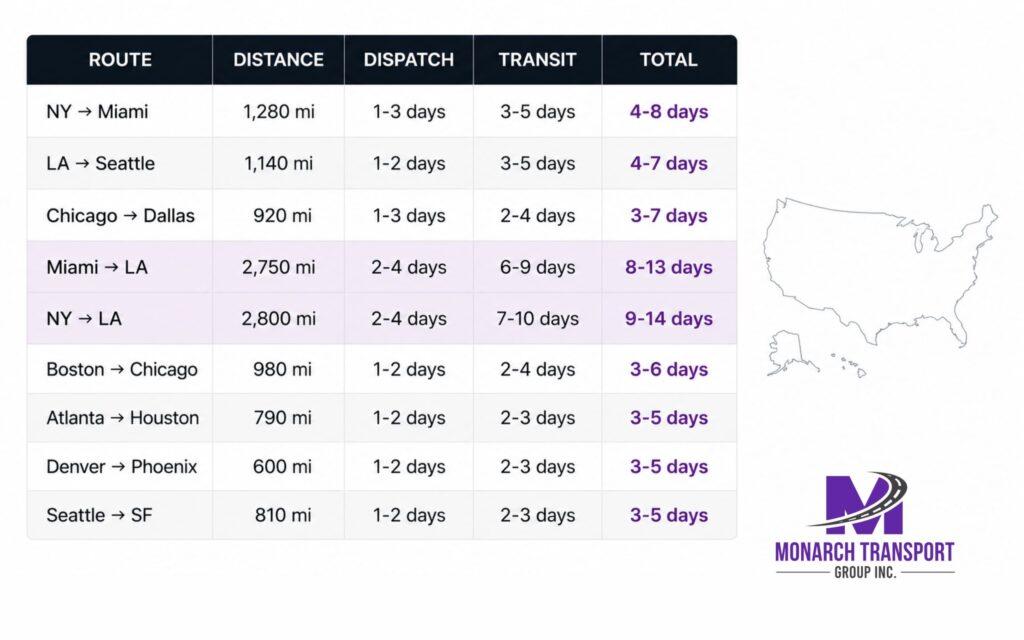
Estimates assume off-peak season, standard pickup location accessibility, and no weather events. Summer peak adds 1-3 days to dispatch on most routes.
How to Speed Up Your Car Shipping Timeline
If your move has a hard deadline, here are the levers you can actually pull.
Book 2–3 weeks in advance. This is the single highest-impact action. Last-minute bookings (under 7 days) often require paying an expedited premium of $150–$300, and even then dispatch isn’t guaranteed faster on low-volume routes.
Use open transport. More trucks, faster dispatch. If your vehicle doesn’t specifically require enclosed transport, open is faster on every route.
Offer a flexible pickup window. Giving the broker a 5–7 day pickup window instead of a specific date lets them match you with whatever carrier is already running your route. This alone can cut dispatch time by 1–3 days.
Choose door-to-door over terminal-to-terminal if timeline matters. The price premium is worth it when you’re counting days.
Be accessible at pickup. Have the car fueled at 1/4 tank, accessible, clean enough to inspect, and paperwork ready. A driver who can load and go without complications keeps your slot on the truck and keeps the timeline on track.
Consider expedited shipping for true hard deadlines. Most brokers offer an expedited option where your vehicle gets priority placement on the load board at a premium rate. This typically guarantees carrier assignment within 24–48 hours on popular routes. It costs $150–$400 more but is worth it when the alternative is a missed start date at a new job or an overlapping rental on both ends of a move. You can select this option directly when using the Monarch car shipping calculator.

What to Do While Your Car Is in Transit
Most carriers provide a direct phone number for the driver or dispatcher at the time of pickup. Use it. A brief check-in call on day 3 of a 7-day transit is entirely reasonable and often reassuring – drivers appreciate knowing the recipient is reachable at delivery.
You can also monitor your shipment status without calling anyone – Monarch’s order tracking page gives you real-time updates from dispatch through delivery.
If you reach day 10 on a shipment that was quoted at 7–9 days, call the broker – not the driver. The broker coordinates logistics and has visibility into what’s happening. The driver may simply be completing other drops on the route before reaching you.
The most common cause of “late” deliveries: The car was loaded on time and is making progress, but the recipient expected the lower end of the transit range, and the car is tracking toward the upper end. A 7–10 day quote means anywhere from 7 to 10 days is on schedule. Day 8 is not late on a 7–10 day quote.
7 to 14 Days: What That Range Actually Means For Your Move
End-to-end, from booking to delivery, here’s the realistic breakdown for the most common scenario – a cross-country open transport, door-to-door, booked 2 weeks out in standard season:
For a mid-range route (500–1,500 miles) in similar conditions:
Peak summer adds 2–4 days to dispatch on most routes. Winter weather can add 1–3 days to transit. Rural pickups add 2–5 days to dispatch.
Ready to ship? Explore Monarch’s car transport service or get an instant timeline and price estimate with the car shipping quote tool.
FAQ: Car Shipping Timelines
Cross-country shipping (2,500+ miles, such as New York to Los Angeles) typically takes 9 to 14 days end-to-end: 2 to 4 days for carrier dispatch and 7 to 10 days in transit. Federal driving hour limits mean even a non-stop 2,800-mile run requires at least 5 to 6 driving days, with loading stops and mandatory rest periods extending it further.
A 1,000-mile route typically takes 3 to 6 days total – 1 to 2 days for dispatch on a popular corridor and 2 to 4 days in transit. Examples include Chicago to Nashville, Boston to Cleveland, or Atlanta to Dallas. Rural pickup or delivery points add 1 to 3 days to dispatch.
Summer (June–August) is peak season. Transit times stay the same, but dispatch – the time to find and assign a carrier – runs 2 to 5 days on popular routes and up to 7 days on rural or low-volume routes. Book 3 to 4 weeks ahead in summer to avoid delays cascading into your move schedule.
Dispatch is fastest in winter (often 1 to 2 days) because demand is low. But transit can be slower due to weather – blizzards, icy mountain passes, and reduced speeds in winter conditions. Build 2 to 3 extra days of buffer into any winter shipment, especially on routes through the Midwest, Rockies, or northern states.
Expedited open transport, door-to-door, booked with a 24-hour pickup window. This guarantees carrier assignment within 24 to 48 hours on most routes and costs $150 to $400 more than a standard booking. Transit time doesn’t change – it’s still determined by distance. Expedited shipping buys you faster dispatch, not faster driving.
Open transport is faster. There are significantly more open carriers on every route, so dispatch typically runs 1 to 3 days faster than enclosed. Once on the road, both types drive the same speeds on the same roads. The timeline difference is entirely in how quickly a carrier gets assigned to your shipment.
The most common causes: rural pickup or delivery location (fewer carriers pass through), last-minute booking during peak season (carrier supply is tight), weather delays in transit (driver legally must stop in unsafe conditions), or the car is tracking toward the upper end of a quoted range (day 10 of a 7–10 day quote is on schedule, not late). If you’re past the upper end of your quoted range, contact your broker – not the driver – for a status update.
2 to 3 weeks before your desired pickup date is the optimal window. Earlier than that, and fuel price changes may make the quote inaccurate. Later than 7 days, and you’re at risk of paying expedited rates or not having carrier availability during your specific window. Summer moves warrant 3 to 4 weeks of lead time due to higher demand.
Rarely. Standard sedans, SUVs, and trucks all load and transport on the same timelines. Non-operational vehicles, oversized vehicles (lifted trucks, extended chassis), and classic or exotic cars shipped enclosed may have slightly longer dispatch windows due to specific equipment or handling requirements. If your vehicle has any non-standard features, disclose them at the time of booking.
Yes, for dispatch. Expedited service guarantees priority placement on the carrier’s load board, typically resulting in your vehicle being assigned within 24 to 48 hours. Transit time remains the same – a driver still needs 7 to 9 days to legally drive 2,800 miles. If a service promises faster physical transit than distance and HOS regulations allow, that’s a red flag.
Related articles

How to Ship a Motorcycle Safely: The 2026 Guide
IN THIS ARTICLE: The “Why” Behind the Shipping Method Option 1: The DIY Route (Towing it Yourself) Option 2: Open vs. Enclosed Transport Option 3: Specialized Motorcycle Shippers vs. General

How to Ship Your Electric Vehicle (EV) Safely in 2026
IN THIS ARTICLE: The Reality of EV Logistics in 2026 Why EVs Change the Math: The Weight Factor The “50% Rule”: Battery Safety and State of Charge (SoC) Vetting the

How State-to-State Car Transport Works: From Pickup to Delivery
IN THIS ARTICLE: Understanding the Auto Transport Ecosystem Choose Your Transport Type The Process of Shipping Calculating the Cost and Timeline of State-to-State Car Transport The 2026 EV Transport Protocol

How Much Does It Cost to Ship a Car Between States?
IN THIS ARTICLE: Average Cost Breakdown by Distance Primary Factors Influencing Your Shipping Quote Geographic Influence on Pricing Understanding the Quote Structure The Impact of Seasonality on Auto Transport Rates

Cross-Country Car Shipping: How to Save Money Safely
IN THIS ARTICLE: Why “Cheap” Doesn’t Have to Mean “Dangerous” 1. Open Transport: The Industry Gold Standard for Savings 2. The Power of “Terminal-to-Terminal” Shipping 3. Timing the Market: The

Complete Guide to Car Shipping in 2026
The landscape of American mobility has shifted, making vehicle logistics more accessible and seamless than ever before. Understanding this new norm is the first step toward a stress-free relocation that

Complete Guide to RV Shipping in 2026
IN THIS ARTICLE: Introduction: The Freedom of the Road, Delivered by Professionals Understanding the Fleet: Classes and Types of RVs Methods of Transport: How We Get Your RV Home Measuring

Auto Transport Broker vs. Carrier: Which One Should You Use?
IN THIS ARTICLE: What Is an Auto Transport Broker? What Is an Auto Transport Carrier? The Key Differences Side by Side Does Using a Broker Cost More? What Is “Dual