
IN THIS ARTICLE:
- The Real Reason Summer Prices Spike (It’s Not What You Think)
- The 5 Factors That Push Summer Prices Up
- Which Summer Month Is Actually the Most Expensive?
- How Summer Pricing Varies by Route
- 7 Proven Ways to Beat Summer Shipping Prices
- Is It Worth Waiting Until Fall to Ship?
- What About Shipping an EV in Summer?
- What Your Summer Car Shipping Quote Actually Includes (And What It Doesn’t)
- How to Spot Summer Car Shipping Scams
- Conclusion
- FAQ: Why Is Car Shipping So Expensive?
You requested an auto transport quote back in April for a standard cross-country move, and the estimate came in at $850. Now it is July, your move is three weeks away, and that exact same route for the exact same vehicle is suddenly quoting at $1,200.
Your car did not get heavier. The distance between the two cities did not increase. The only variable that changed was the calendar month.
If you are looking at a summer car shipping quote and wondering why the numbers seem inflated, you are experiencing the peak season premium. Between June and August, the auto transport industry operates at maximum capacity. However, the price increase is not a random markup applied by brokers looking to squeeze out extra profit. It is the direct result of backend logistics, dispatcher bidding wars, and a massive surge in nationwide demand hitting a fixed supply of carrier trucks.
Understanding exactly why summer car shipping costs more is the first step to beating the system. Below is the full mechanical breakdown of summer pricing – and the specific strategies you can use to lower your quote without compromising on service quality or carrier reliability.
Want to lock in a competitive rate before prices peak? Get a secure summer shipping quote from Monarch today.
The Real Reason Summer Prices Spike (It’s Not What You Think)
Most customers assume auto transport companies simply update their pricing sheets on June 1st to charge more during moving season. The reality is considerably more complex, and it all depends on a system most customers never hear about: the load board.
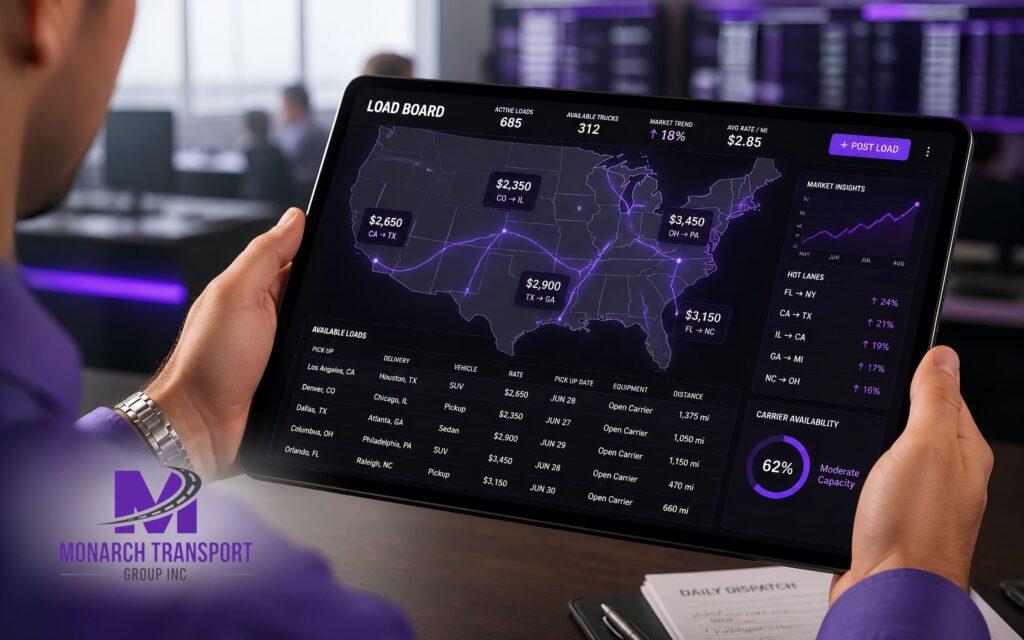
To understand summer car shipping cost fluctuations, you first need to understand how the industry is actually structured. Brokers – the companies you request quotes from – typically do not own trucks. Carriers – the actual drivers hauling your vehicle across the country – typically do not have sales teams or consumer-facing websites. Brokers connect your vehicle to carriers using national digital load boards, the most prominent being Central Dispatch, which operates as the primary marketplace for the entire auto transport industry in the United States.
Think of a load board as a real-time stock exchange for car shipping. A broker accepts your transport order and posts your vehicle on the board with a specific dollar amount attached – this is called a “bounty.” Carriers log into the board, search for vehicles along their planned route, and select the loads that pay the highest bounty per mile. A carrier can physically load only 7 to 9 vehicles on a standard open hauler, a limit enforced by Department of Transportation (DOT) federal weight regulations. Every spot on that trailer is therefore premium real estate.
Here is how the math changes between January and July:
In January, there might be 10 cars waiting to ship from Ohio to Texas, with 5 carriers actively looking for loads on that corridor. The broker can post your vehicle at a moderate bounty – say $750 – and a carrier will pick it up within a day or two because they need to fill the trailer.
In July, the math flips entirely. There are now 50 cars waiting to ship on that same Ohio to Texas route, but carrier capacity has barely changed. To ensure a carrier selects your vehicle over the 49 others competing for that same trailer space, your broker has to raise the bounty. If they leave the price at the April rate, carriers will bypass your vehicle entirely and load the cars with higher payouts. This backend bidding war is what dictates the final price you see on your quote.
It is the exact same algorithmic logic as Uber surge pricing during a rainstorm or after a stadium concert ends. The supply of drivers is fixed. The demand spikes. The algorithm prices accordingly – and in auto transport, you are the one funding that adjustment.
The 5 Factors That Push Summer Prices Up
The load board bidding war is triggered by a massive influx of vehicles entering the carrier network simultaneously. But where do all these extra cars come from? The summer peak season pressure is driven by five distinct forces hitting the logistics network simultaneously.
1. Families Moving During School Break
The primary driver of the summer auto transport surge is residential relocation. According to U.S. Census Bureau moving data, the overwhelming majority of household moves in the United States are concentrated between Memorial Day and Labor Day. Families deliberately wait for the school year to end before packing up and relocating, whether across the state or across the country.
Every family move cross-country requires one or two vehicles for transportation. A family moving from Chicago to Phoenix cannot realistically drive two cars to their new home at the same time. One of those vehicles ends up on the load board, instantly increasing competition for carrier space. Multiply this by tens of thousands of families making identical decisions in June and July, and the scale of the demand surge becomes clear.

2. The College Student Migration
The college demographic creates a highly predictable, two-directional wave of auto transport demand that bookends the summer season.
In May and early June, students returning home from out-of-state universities need their cars transported back. Many cannot drive home themselves – they flew to school in September and have been without their vehicle all year, or the drive is simply too long to manage alone at the end of finals week. By late July and August, the flow reverses. Parents across the country begin shipping cars to campuses in preparation for the fall semester.
This student migration creates dense, localized congestion on specific corridors: Northeast to Southeast, Midwest to California, Texas to the Mountain West. If your route overlaps with a major college transport lane, you are competing directly with this demographic for the same carrier space throughout the summer.
3. Late Snowbird Returns (May–June)
While many winter residents begin heading north in late March and April, a significant wave of late-departing snowbirds migrates back from Florida, Arizona, and Texas well into May and June. These late snowbird returns overlap directly with the opening of family relocation season and the first phase of the student migration.
The result is a severe bottleneck on northbound Sun Belt lanes. Carriers departing the Southeast and Southwest have their pick of vehicles. They can afford to be selective, taking only the highest-paying loads on the board. Anyone shipping northbound out of Florida in late May or June will feel this pressure directly in their quote.
For a complete breakdown of snowbird-specific auto transport logistics, see our detailed guide on snowbird car shipping and how to get the best northbound rate.
4. Hurricane Season (June–November)
Weather is a major, frequently underestimated pricing factor for summer auto transport. The Atlantic hurricane season officially begins on June 1st and runs through November 30th, covering the entire summer shipping peak. During this period, tropical storms, severe heat events, and active hurricane tracking become regular logistics complications along the Gulf Coast and Southeast Florida.
Many independent owner-operators – the small carriers who own and drive their own trucks – actively avoid high-risk routes during peak hurricane months to protect their equipment, their cargo, and their insurance rates. When a Category 2 storm is tracking toward Tampa or New Orleans, carriers reroute entirely, abandoning those corridors for weeks at a time.
Fewer available trucks on a route means remaining carriers gain significant pricing leverage. Anyone shipping into or out of the Southeast between June and October should factor hurricane season into both their timeline and their budget. A storm that makes landfall during your shipping window can delay transit by a week or more and significantly drive up prices as the backlog of delayed shipments floods back onto the load board.

5. Rising Diesel Fuel Prices
Auto haulers average between 4 and 5 miles per gallon fully loaded – dramatically less fuel-efficient than a standard passenger vehicle. This makes diesel price fluctuations a direct and immediate cost driver for every carrier on the road.
During the summer, national fuel demand rises substantially as Americans take vacations and seasonal travel increases across the board. This seasonal demand spike consistently drives up diesel prices at the pump. Carriers operating on thin margins cannot absorb this increase – they pass it directly to consumers through higher base rates.
The U.S. Energy Information Administration (EIA) tracks diesel prices weekly and historically shows clear summer peaks. If fuel costs are hitting multi-month highs in July, your car shipping quote will reflect that operational reality within days. There is no buffering mechanism between fuel costs and transport pricing.
See how these factors affect your specific route. Calculate your summer shipping cost instantly with Monarch’s quote tool.
Which Summer Month Is Actually the Most Expensive?
“Summer shipping” is too broad a category when you are trying to budget accurately. A quote generated for early June will look substantially different from a quote generated for late August. Treating the entire June-to-August window as uniform pricing leads to poor planning decisions.
July represents the absolute peak of the auto transport calendar. It sits at the convergence of all demand drivers: the end of Q2 corporate relocations, peak week for family moves, the heaviest phase of college student migration, and the midpoint of hurricane season. There is no good news in July for anyone on a tight transport budget.
The good news is that the curve drops meaningfully on either side of that peak.
| Month | Demand Level | Relative Price vs. Winter | Primary Driver |
| May | Rising | +10–15% | Late snowbird returns, early student moves |
| June | Peak | +20–30% | School ends, family relocation wave begins |
| July | Absolute Peak | +25–40% | All demographic factors overlap simultaneously |
| August | Declining | +15–25% | Student moves wind down, families are settled |
| September | Normalizing | +5–10% | Demand drops, carriers actively seek loads |
| October | Low Season | Baseline to +5% | Pre-snowbird calm, ideal balance of cost and speed |
The strategic takeaway: if you have any flexibility in your schedule, even a shift of two to three weeks can yield meaningful savings. If you must ship in summer and can choose between June and August, aim for August – the initial family relocation rush has cleared. If you have a choice between July and September, the difference in price on many routes will easily cover the cost of a flight or a few hotel nights while you wait.
How Summer Pricing Varies by Route
The summer premium is not a uniform fee applied nationwide. Price increases are hyperlocalized and depend entirely on the traffic volume flowing through specific regional highway corridors.
Load boards operate on route density. If you are shipping on a highly saturated corridor, you will pay the maximum summer premium. If your route runs perpendicular to the primary migration flows, your quote might look surprisingly competitive – even in July.
High-Demand Corridors (Maximum Summer Premium)
These routes carry the heaviest traffic volume during peak season and consistently command the highest prices:
New York / New Jersey → Florida: One of the busiest auto transport corridors in the country year-round, this lane becomes saturated during summer with family relocations, early snowbird prep, and corporate moves into the Southeast. Carriers operating here have no shortage of vehicles to choose from.
California → Northeast: A major corporate relocation corridor driven by tech and finance industry moves. Workers relocating from Silicon Valley to New York or Boston compete with family movers, dealership inventory transfers, and online car purchases for a limited number of carrier slots.
Midwest → Southeast: High volume from permanent relocations, vacation-home transports, and the reverse of the college student wave. Carriers on this lane are selective and price accordingly.
If you are shipping on any of these corridors between June and August, plan your budget around peak pricing. There is limited negotiating room because carriers genuinely have better-paying options available to them.
Medium-Demand Corridors
Texas ↔ Midwest: Steady volume from oil industry relocations and family moves, but wide enough carrier availability to prevent prices from reaching the extremes of coastal corridors.
Mountain States ↔ West Coast: Prices increase moderately, but usually remain manageable unless a major wildfire reroutes I-80 or I-15, forcing carriers to add significant mileage.
Lower-Demand Routes
Routes like Oklahoma to Tennessee, Nevada to Idaho, or Wisconsin to Montana sit outside the primary migration flows. Carriers servicing these secondary corridors are often actively seeking freight to make their routes economically viable. The summer premium on these lanes is minimal – sometimes nonexistent – because the load board competition is simply not as intense.
If your pickup and delivery points are not in a major coastal metro or Sun Belt hub, your summer quote may be far more reasonable than you expect. For a detailed overview of how state-to-state transport routes are priced, see our Complete Guide to Car Shipping in 2026.
Find out how your specific route prices out this summer. Request a fast, accurate quote here.
7 Proven Ways to Beat Summer Shipping Prices
You cannot change the macroeconomic factors in the auto transport industry. You cannot reduce the number of families moving in July or force more carriers onto the road. But you can control exactly how your broker interacts with the load board – and those decisions directly affect how high a bounty needs to be placed on your vehicle.
These seven tactics force the system to work in your favor, keeping your cost as low as possible without sacrificing carrier reliability.
1. Book 3 to 4 Weeks Early – Not 1 Week
Lead time is the single most powerful tool available to any customer shipping in the summer. When you contact a broker five days before your needed pickup date, the dispatcher has no room to maneuver. They must immediately post a large bounty on the load board to attract a carrier before your window closes. There is no time for incremental bidding – they go straight to a premium price.
When you book 3 to 4 weeks in advance, the broker can post your vehicle at a moderate, competitive rate and give the market time to respond. If the initial price does not attract a carrier in the first few days, they raise it slightly and wait again. This gradual adjustment process regularly saves customers $150 to $300 compared to last-minute summer bookings.
The FMCSA (Federal Motor Carrier Safety Administration) requires all carriers to be licensed and insured regardless of price point, so booking early does not mean sacrificing protection – it just means your broker has time to find a fully compliant carrier at a standard rate rather than a panic rate.
2. Use a 3 to 5-Day Pickup Window
Demanding a strict single pickup date – “the carrier must arrive on July 14th, not July 13th, not July 15th” – forces the broker to find a carrier whose existing route schedule perfectly aligns with that exact day. The narrower the window, the higher the premium required to achieve that specific timing.
A 3-to-5-day flexible window changes the dispatcher’s entire approach. Instead of hunting for a carrier that fits a rigid date, they can match your vehicle with a truck that is already routing through your area. That carrier fills their last empty spot at a standard load board rate rather than accepting a distress rate. The cost reduction for simply offering flexibility on pickup timing is often $100 to $200 in the summer market.
3. Book Mid-Week (Tuesday Through Thursday)
Auto transport dispatching has its own version of Monday morning chaos. Customers who missed their Friday pickups flood phones and inboxes on Monday morning. Brokers are managing rerouting, customer complaints, and new last-minute bookings simultaneously. Friday afternoons are equally disorganized, as customers panic about weekend moves. The load board during these windows is noisy, competitive, and expensive.
Tuesday through Thursday operate differently. Dispatchers are not firefighting weekend fallout. They have time to work the load board methodically, find carriers on efficient routes, and negotiate standard rates. Requesting your quote and finalizing your booking mid-week consistently produces more accurate, less inflated pricing.
4. Avoid Holiday Weekends Entirely
The 4th of July and Labor Day weekend are the two most disruptive events on the summer auto transport calendar. Many independent owner-operators take these weekends off entirely to be with their families – a completely reasonable choice that severely shrinks the available carrier pool.
The critical problem: demand for moving does not drop over holiday weekends. Families trying to align their move with a long weekend actually spike transport requests right before these dates. The supply of trucks collapses while demand holds steady or increases. Avoid scheduling your pickup or delivery within three business days of either holiday.
5. Choose Open Transport Over Enclosed (For Standard Vehicles)
One of the primary reasons customers upgrade to enclosed transport in winter is protection from road salt and snow accumulation. Both threats are absent in summer. Unless you are shipping a classic vehicle, a low-clearance exotic, or a high-value luxury car where cosmetic protection is paramount, standard open transport is perfectly adequate for June through August.
Open transport represents approximately 90% of the carrier fleet and runs 30% to 50% cheaper than enclosed trailers. Choosing enclosed transport in summer when open transport is safe and sufficient is simply overpaying for protection you do not need.
For a full comparison of when each transport type makes sense, see our guide: Open vs. Enclosed Auto Transport – Which Should You Choose?

6. Consider Terminal-to-Terminal Shipping
Door-to-door transport is the most convenient option – the carrier picks up your vehicle from your home address and delivers it to your destination address. But residential pickups require carriers to navigate neighborhood streets, deal with low-clearance turns, and spend extra time per stop.
During peak summer months when carriers have their pick of loads, many prefer terminal-based shipments where multiple vehicles can be loaded at a single commercial location in one efficient stop. By agreeing to drop your vehicle at a regional transport terminal near your current location and picking it up at a terminal near your destination, you remove the residential delivery complexity. Carriers regularly discount terminal loads by $100 to $200 compared to door-to-door service on the same route.
If the terminal is within a reasonable driving distance, this trade-off is often worth it. For a full breakdown of how both service models work, see: Door-to-Door vs. Terminal-to-Terminal – Which Logistics Model Fits You?
7. Get Multiple Quotes on the Same Day
Load board dynamics shift continuously based on real-time carrier availability, fuel prices, and competing vehicle volume. A quote generated last Tuesday is not a reliable reference point for what you will pay today. A broker who offered you $900 a week ago may call back requesting $1,200 this week because two major carriers on your corridor broke down and the available truck count dropped.
When comparing brokers, request all quotes on the same calendar day. This ensures you are comparing real-time market pricing, not stale data from different points in time. Three quotes from the same Tuesday afternoon will give you a genuinely accurate picture of where the market sits and which broker is performing best against current load board conditions.
Ready to put these strategies to work? Compare rates now with Monarch and lock in your vehicle’s spot on the trailer.
Is It Worth Waiting Until Fall to Ship?
A question that appears regularly in auto transport forums and consumer moving communities is whether it makes financial sense to simply wait out the summer surge entirely. The short answer depends on your flexibility and your specific situation.
If you have a firm deadline, do not wait. Starting a new job in another city, a real estate closing date, or a student moving into a dorm for the fall semester all create hard deadlines that cannot flex around seasonal pricing. In these situations, the smart move is to book early within your summer window and use the tactics above to minimize the premium as much as possible.
If you have genuine flexibility, fall is significantly better. The transition from July to September dramatically changes the load board dynamics. The family relocation wave ends. College students are settled. Carriers who have been turning down lower-paying loads all summer are now actively searching for freight to keep their trucks moving. The leverage shifts from the carrier to the customer.
October is historically the best single month for auto transport value. Prices drop back near their annual baseline, carrier availability is high, weather is cooperative across most of the country, and the southbound snowbird migration has not yet begun in earnest. If you can push a non-urgent shipment to October, you are shipping in the closest thing the industry has to an ideal window.
Book in July vs. Book in September – Estimated Cost Difference
| Transport Route | Peak July Estimate | Early September Estimate | Potential Savings |
| New York, NY → Miami, FL | $1,150 | $850 | $300 |
| Los Angeles, CA → Chicago, IL | $1,300 | $1,050 | $250 |
| Dallas, TX → Denver, CO | $850 | $700 | $150 |
These figures represent typical open transport estimates. Actual quotes vary based on vehicle size, exact pickup and delivery locations, and real-time carrier availability on the booking date.
Have flexible dates? Compare summer vs. fall shipping rates for your route with a free quote.
What About Shipping an EV in Summer?
Electric vehicles have become a common sight in residential and snowbird transport markets, but they introduce a separate set of logistical challenges during the summer peak that significantly affect pricing.
Weight is the primary cost driver. EV battery packs add between 800 and 1,500 pounds compared to equivalent combustion-engine vehicles. Because DOT axle weight regulations for auto haulers do not change based on what the truck is carrying, a carrier hauling EVs physically cannot load as many vehicles as they would with a standard mix of gas-powered cars. To compensate for the revenue lost from fewer vehicles per load, carriers charge a premium for individual EV slots.
Heat amplifies the risk. Lithium-ion batteries generate heat during transit, and extreme summer temperatures add to that load. Carriers handling EVs in summer must ensure adequate airflow and avoid leaving vehicles in stationary, unshaded conditions for extended periods. This operational caution adds to the complexity and cost of EV-specific transport during peak season.
Not all carriers accept EVs. Standard open car haulers may lack the specific wheel strap configurations required for heavier EV models, or carry cargo insurance limits that do not adequately cover a $70,000+ Tesla or Rivian replacement cost. During the summer, when carrier availability is already constrained, the subset of EV-qualified carriers shrinks further. Expect to pay a 15% to 20% surcharge above standard vehicle pricing when shipping a Tesla, Rivian, Mustang Mach-E, or similar electric vehicle between June and August.
When requesting an EV quote, always specify the exact make, model, and trim upfront. A carrier who discovers mid-dispatch that the vehicle is a 5,400-pound Rivian R1T rather than a Toyota Camry will either reprice or cancel – both scenarios are worse than accurate disclosure at the start.
For full preparation instructions and carrier selection guidance for electric vehicles, see our dedicated guide: How to Ship Your Electric Vehicle (EV) Safely in 2026.
Need specialized transport for your EV? Get a quote from Monarch’s EV-capable carrier network.
What Your Summer Car Shipping Quote Actually Includes (And What It Doesn’t)
One of the most common sources of frustration during peak season is receiving a low initial quote that grows significantly by the time the vehicle is picked up or delivered. Understanding exactly what a standard auto transport quote covers – and what costs can appear afterward – eliminates this problem entirely.
What Is Typically Included in a Standard Quote
A legitimate auto transport quote from a licensed broker covers the following by default:
Carrier transport cost: The primary cost of loading your vehicle onto the carrier’s trailer and delivering it to the destination city. This is the core service and the largest line item.
Basic cargo insurance: All carriers operating legally in the United States are required by federal regulation to carry cargo liability insurance. This covers damage that occurs during the physical transport of the vehicle – not pre-existing damage, not personal items left inside, and not damage that results from the vehicle’s own mechanical failure during loading.
Standard pickup and delivery: For door-to-door service, this means the carrier attempts to reach as close to your specified address as safely and legally possible. If your street cannot accommodate a large transport trailer – due to low-clearance trees, weight-restricted roads, or HOA restrictions – the carrier will meet you at a nearby accessible location.
What Can Add Cost After the Initial Quote
Inoperable vehicle surcharge: If your car does not start, does not roll, or cannot be steered, the carrier must use a winch to load it. This is a specialized service that typically adds $150 to $300 on top of the standard quote. Ensure your vehicle is operational before the carrier arrives, or disclose the condition upfront to get an accurate all-in price.
Oversized vehicle surcharge: Standard open haulers are designed around standard-size passenger vehicles. Full-size lifted trucks, extended vans, modified vehicles with non-factory roof racks, and vehicles with wide aftermarket body kits can exceed the hauler’s standard slot dimensions and require special positioning. This typically adds $75 to $200, depending on the carrier and the extent of the modification.
Last-minute scheduling premium: If you need a carrier dispatched within 24 to 48 hours during peak season, most brokers will disclose this as an expedited service. If they do not disclose it and you only discover the premium at pickup, that is a red flag worth escalating.
Insurance upgrades: The standard carrier cargo insurance covers transport damage up to the carrier’s policy limit – typically between $100,000 and $250,000. For owners of high-value luxury or classic vehicles, this limit may be insufficient. Supplemental coverage is available and should be arranged before pickup, not after.
The cleanest way to avoid post-booking surprises is to ask your broker one direct question before placing a deposit: “Is this quote all-inclusive, and what conditions would cause the final price to change?” A reputable broker answers that question in full. A broker who deflects or gives a vague answer is worth replacing before you commit.
For a comprehensive understanding of how state-to-state auto transport pricing is structured from first contact through delivery, see our State-to-State Car Transport Guide: From Pickup to Delivery.

How to Spot Summer Car Shipping Scams
Peak season creates the ideal environment for fraudulent operators. When customers are stressed about moving deadlines and actively searching for any available carrier, bad actors exploit that urgency with tactics designed to extract deposits before disappearing.
The most common summer scam pattern: a broker offers a quote significantly below current market rates – $500 for a route everyone else is quoting at $900 – and requests a large upfront deposit to “hold your spot.” Once the deposit is collected, the broker either becomes unresponsive, claims a truck is “en route” indefinitely, or delivers a vehicle weeks late in damaged condition with no insurance documentation available.
Three red flags specific to summer bookings:
Prices far below current market rates. If every legitimate broker is quoting $1,100 for a route in July and one company offers $650, that is not a deal. It is a warning sign. Carriers set the market price based on load board competition – no broker can sustainably undercut the entire market by 40%.
Requests for large cash deposits before a carrier is assigned. Reputable brokers collect a small deposit at booking and the balance at delivery or upon carrier assignment. Any company demanding 50% or more upfront before a specific carrier has been confirmed should be declined.
No verifiable FMCSA registration. Every legitimate auto transport broker in the United States is required to register with the FMCSA and maintain a valid MC (Motor Carrier) number. You can verify any company’s registration status directly on the FMCSA website in seconds. If a broker cannot provide an MC number or their number returns no results, do not proceed.
For a complete checklist of scam warning signs and how to verify a legitimate auto transport company, see our guide: How to Spot and Avoid Car Shipping Scams in 2026.
Conclusion
Summer is the most expensive time of year to ship a car – but it is not an unbeatable market. The price premium is not arbitrary. It is the direct result of a real-time carrier bidding system responding to a predictable, annual surge in demand. Once you understand the mechanics of the load board, the pricing stops feeling like a mystery and becomes manageable.
The customers who pay the least in peak season are not the ones who get lucky. They are the ones who book four weeks out instead of four days out, offer a flexible pickup window instead of a rigid date, and choose the right transport type for their vehicle and timeline. Those decisions cost nothing to make and routinely save $200 to $400 per shipment.
If your move is locked in for June or July, use the strategies in this guide and get your quote in now – carrier spots fill faster than most people expect. If your timeline has room, September and October offer the best combination of price, availability, and weather in the entire calendar year.
Either way, the worst move is waiting and hoping the price comes down on its own. It rarely does.
Get your free summer quote from Monarch Transport and lock in your rate today.
FAQ: Why Is Car Shipping So Expensive?
Car shipping costs reflect a chain of operational expenses that most people don’t see: diesel fuel, driver wages, insurance, trailer maintenance, broker fees, and empty-mile repositioning. A single carrier running a cross-country route burns hundreds of gallons of diesel and must cover regulatory compliance costs before a single vehicle is loaded. The price you pay is not just for the miles – it is for the entire logistics infrastructure behind them.
The gap between quotes usually comes down to one of three things: broker margin, carrier quality, or quote legitimacy. A low quote often means the broker has underestimated the carrier bounty needed to attract a driver on your route. A suspiciously cheap quote is frequently a placeholder designed to collect your deposit – not a real carrier commitment. Always compare at least three quotes and treat anything more than 20% below the average as a red flag.
Significantly. Popular corridors like Los Angeles to New York or Chicago to Miami have dozens of carriers running them weekly, which keeps prices competitive. Remote or rural routes force carriers to deadhead – drive empty miles to reach your pickup location – and that cost is passed directly to you. If your pickup or delivery point is more than 50 miles from a major interstate, expect a surcharge of $75 to $150.
Yes. Carriers price by space and weight. A standard sedan is the baseline. Full-size SUVs, pickup trucks, and oversized vehicles take up more trailer space and add weight, which increases fuel consumption. Large trucks and SUVs typically run 15% to 25% higher than sedan rates on the same route. Modified vehicles – lifted trucks, roof racks, or non-standard dimensions – may require special positioning on the trailer, adding another $100 to $200.
Door-to-door service requires the carrier to navigate residential streets, deal with low-hanging wires, and wait for you to be available – all of which consume time and fuel. Terminal-to-terminal removes that last-mile burden entirely. The carrier drops your vehicle at a central hub, which is faster and cheaper to execute. The savings are typically $50 to $150 per shipment, though you need to factor in your own transportation to and from the terminal.
Yes, for the vast majority of vehicles. Open carriers transport approximately 95% of all vehicles shipped in the United States, including brand-new cars from manufacturer plants to dealerships. Your car will be exposed to road dust and weather, but it will arrive with professional tie-downs, cargo insurance of $100,000 to $250,000, and a documented condition report. Unless your vehicle is a classic, exotic, or freshly painted car worth over $50,000, open carrier is the financially rational choice.
The optimal booking window is 14 to 21 days before your desired pickup date. This gives brokers enough time to post your order on the load board and attract competitive carrier bids. Booking within a week of your pickup forces the broker to offer a higher bounty to attract any available driver, which adds $150 to $300 to your final price. Booking more than 6 weeks out provides no additional savings – carriers plan routes only 2 to 3 weeks ahead.
Flexibility. Carriers fill empty trailer slots at discounted rates to avoid deadheading. If you offer a 5 to 7-day pickup window instead of a fixed date, brokers can match your vehicle to a driver already running your route who needs one more car to make the load profitable. This single adjustment consistently produces lower quotes than any other tactic, including booking early or choosing terminal drop-off.
Only in specific circumstances. Enclosed transport costs 40% to 60% more than open carrier and is worth the premium if your vehicle is valued over $50,000, has a freshly restored or custom paint job, or contains sensitive electronics that cannot tolerate temperature extremes. For a standard daily driver, the additional cost buys protection your vehicle’s condition does not require. The insurance coverage on a reputable open carrier is sufficient for the overwhelming majority of shipments.
Related articles

10 Best Platforms to Buy or Sell Used Cars Online in 2026
IN THIS ARTICLE: Platform Comparison at a Glance Safety: How to Protect Yourself on Any Platform The Bottom Line: Choosing Your 2026 Auto Platform FAQ Buying or selling a used

Car Shipping by Train: Costs, Process & What to Expect in 2026
IN THIS ARTICLE: The Two Faces of Rail Transport: Consumer vs. Commercial Why Choose the Tracks? (The Human Perspective) Dimensions and Constraints: Will Your Car Fit? The “Hidden” Logic of

Cross-Country Car Shipping: How to Save Money Safely
IN THIS ARTICLE: Why “Cheap” Doesn’t Have to Mean “Dangerous” 1. Open Transport: The Industry Gold Standard for Savings 2. The Power of “Terminal-to-Terminal” Shipping 3. Timing the Market: The

Complete Guide to RV Shipping in 2026
IN THIS ARTICLE: Introduction: The Freedom of the Road, Delivered by Professionals Understanding the Fleet: Classes and Types of RVs Methods of Transport: How We Get Your RV Home Measuring

Complete Guide to Car Shipping in 2026
The landscape of American mobility has shifted, making vehicle logistics more accessible and seamless than ever before. Understanding this new norm is the first step toward a stress-free relocation that

Best Places to Buy a Motorcycle Online in the USA
IN THIS ARTICLE: The Digital Shift: Geography No Longer Constrains the Ride Where to Buy: Top 2026 Platforms Analysis Comparison Table: Platform Overview The Facet of Finance: Not Just the

How to Ship a Motorcycle Safely: The 2026 Guide
IN THIS ARTICLE: The “Why” Behind the Shipping Method Option 1: The DIY Route (Towing it Yourself) Option 2: Open vs. Enclosed Transport Option 3: Specialized Motorcycle Shippers vs. General

How to Prepare Your Car for Shipping: Step-by-Step Checklist
IN THIS ARTICLE: Why Preparation is not just a Chore Step 1: Selecting Your Logistics Partner Step 2: The Evidence Phase – Cleaning and Documentation Step 3: Protecting the Extravagant