
IN THIS ARTICLE:
- Average Boat Shipping Cost in 2026
- What Determines Boat Shipping Cost?
- Why Short Hauls Cost More Per Mile
- How Boat Size Changes the Price
- Tow-Away vs. Flatbed vs. Step-Deck vs. Lowboy: Cost Comparison
- Additional Boat Shipping Fees You May Pay
- Seasonal and Fuel Pricing Swings
- Boat Shipping Cost Examples
- How to Lower Your Boat Shipping Cost
- How to Get an Accurate Boat Shipping Quote
- How We Estimate Boat Shipping Costs
- FAQ About Boat Shipping Cost
In 2026, typical boat shipping costs range from $1.50 to $3.75 per mile, with a full invoice from $400 for a short local tow to over $8,000 for a large yacht traveling cross-country. That is the basic rate. If you then include factors such as an unusually wide beam, special loading equipment, permits, or an escort vehicle, the cost goes well above that figure – and that’s precisely what this guide is intended to help you work out.
Our complete boat transport guide already covers the full process: beam width and legal limits, tow-away versus flatbed hauling, prepping the boat, insurance, vetting a carrier. This one has a narrower job. It’s here to answer a single question: why does your quote look the way it does, and how do you tell if it’s fair?
If the three quotations you’ve obtained for the same boat differ by $1,500, then please keep reading since that difference is the one this article looks at.
Estimated Boat Shipping Cost = Base Rate × Distance + Oversize Fees + Loading Costs + Route Costs + Seasonal Fees
All of the quotes you will ever receive are various forms of that formula; the following explains the parts that fill it in.
Average Boat Shipping Cost in 2026
All quotes begin the same way – by taking the rate per mile, multiplying it by the distance, and then adjusting for factors that make the job easier or harder than average. The base figure is that applicable to a typical vessel measuring under 8’6″ in width, which is carried on a trailer suitable for use on roads and has easy access at both ends.
| Short-haul (0–300 miles) | $2.50–$3.75 | $400–$1,100 |
| Mid-haul (300–1,000 miles) | $2.00–$3.00 | $800–$2,800 |
| Cross-country (1,000+ miles) | $1.50–$2.50 | $2,000–$5,500+ |
The per-mile rate decreases as the distance of the trip increases – this isn’t a discount; it’s simply a matter of mathematics. The costs involved in dispatching, running insurance checks, and coordinating loading are roughly the same whether the truck travels 150 miles or 1,500, so when the journey is short, those fixed costs are spread over fewer miles, and the rate has to go up to make up for it. As a result, a 250-mile move can cost more per mile than a 1,200-mile move.
Think of this table as a floor, not a ceiling. It assumes a boat that behaves itself – legal width, no crane, no permits. Change any one of those and the math changes with it, which is the whole subject of the rest of this guide. If you’d rather skip the mental math, our boat calculator will run the numbers for your actual route.
What Determines Boat Shipping Cost?
A company isn’t, in fact, pricing ‘a boat’; they are pricing several factors, most of which have nothing to do with how far you’re traveling:
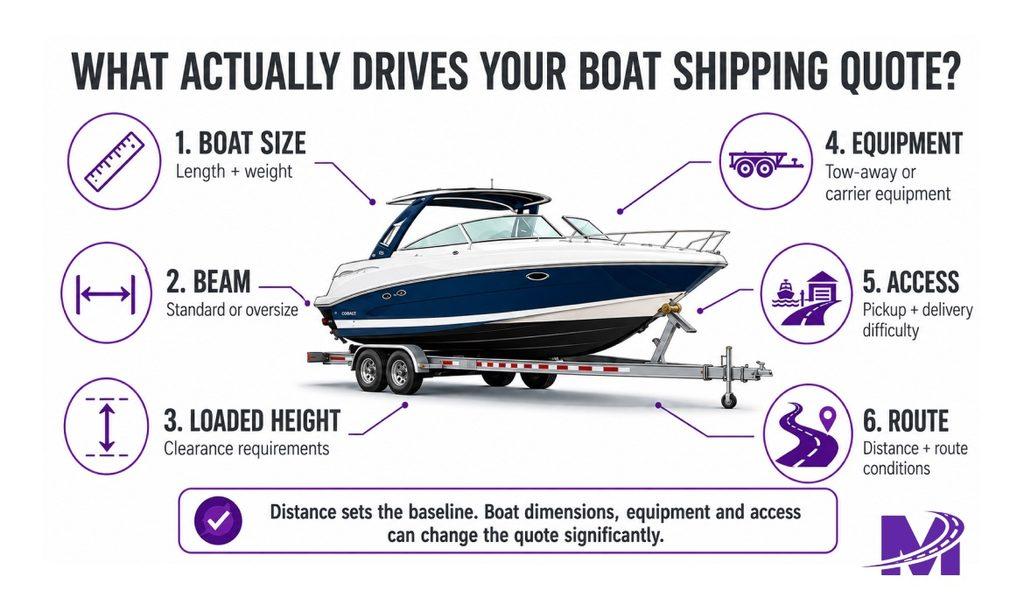
When people are sending goods for the first time, they tend to focus on the first line item and only quickly look at the others. From our experience, it is the beam width, height, and access that usually have a greater effect on the quote than mileage does. We recommend taking the time to consider these three factors.
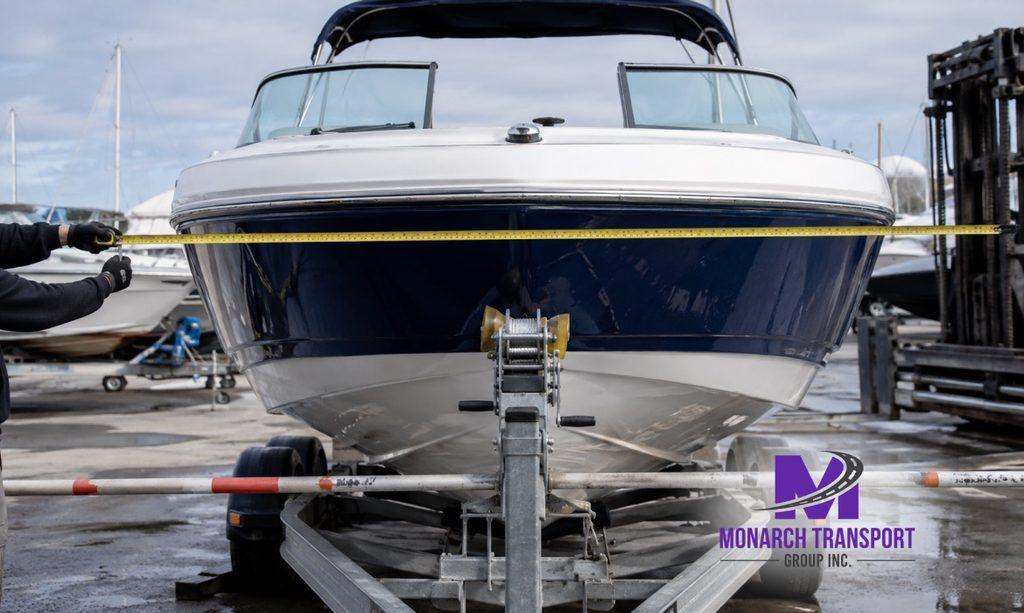
The width of the beam affects the legal status of the load rather than just the cost. Although we go into this in full during the size breakdown, it’s worth mentioning here – no other item on this list can turn a straightforward haul into a multi-state permitting nightmare the way that a few extra inches of beam can.
Height gets missed constantly. Owners measure the hull and forget the hardtop, tower, or radar arch sitting on top of it. A boat that’s perfectly legal in width can still get rerouted onto a longer path if it’s too tall to clear a standard highway bridge – the Federal Highway Administration sets the general vertical clearance standards carriers plan routes around.
The aspect that is most frequently mentioned in the various forms is actually never inquired about. A driveway which has a direct view of the road makes no real difference, whereas a marina having a narrow yard, soft ground close to the water, or a steep launch ramp involves extra time and it is this extra time that carriers charge for.
Why Short Hauls Cost More Per Mile
It can be difficult for every new boat owner, so it’s worthwhile going through the math once and doing it properly.
If the carrier’s fixed cost for a job – including dispatching, insurance verification, trailer assignment, and route planning – is about $300 regardless of the distance, then on a trip of 150 miles that $300 is spread over 150 miles and adds approximately $2 per mile to the real cost of driving. If the same job is extended to 1,500 miles, the identical $300 is spread ten times thinner and adds about $0.20 per mile. Apart from this, nothing else changes. The job isn’t any easier or harder – it’s simply that the fixed cost has more distance over which to be distributed.
That is to say, when you compare a quote for 200 miles with one for 1,200 miles simply on the basis of cost per mile, you’re actually comparing two different kinds of calculations, and the result of such a comparison will mislead you. You should look at the total cost instead. Even if the carrier is entirely fair in its pricing, the shorter-haul figure will appear worse on a per-mile basis.
How Boat Size Changes the Price
Everyone first asks about length, and this is important mainly since it has implications regarding weight, beam, and the kind of equipment required to load the item, not because of the miles involved.
| Under 20 ft | Almost always under 8’6″ | Base rate applies | $750–$1,400 |
| 20–28 ft | Usually standard width | +15–25% over base | $1,000–$1,900 |
| 28–36 ft | Sometimes oversize | +40–60% over base | $1,400–$2,800 |
| 36+ ft / yacht | Frequently oversize, often needs a crane | Custom quote, often +100% or more | $3,000–$8,000+ |
Under 8’6″ beam: the easy tier
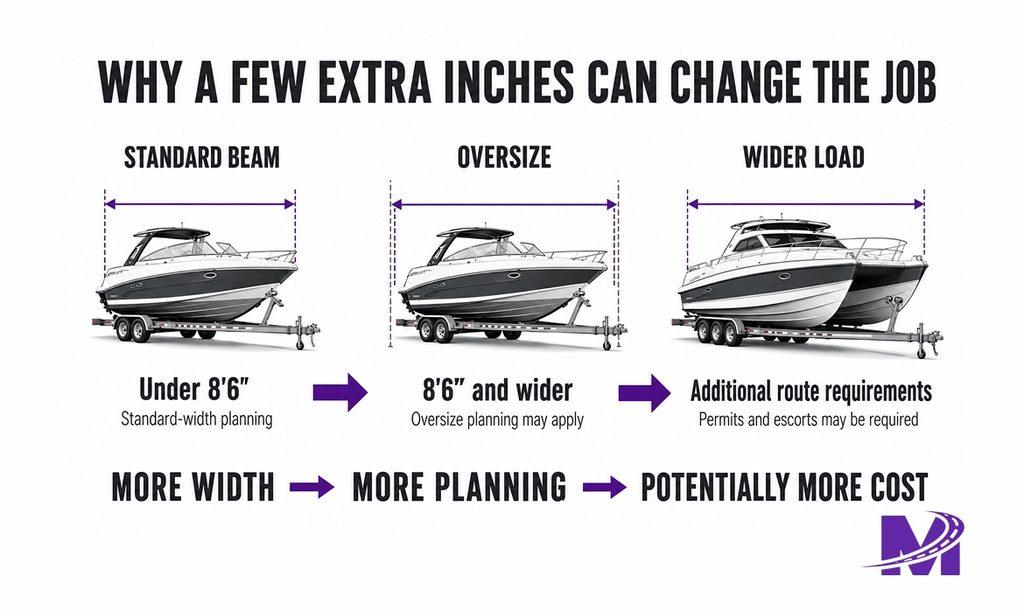
If the widest part of your boat is less than 8 feet 6 inches, then you fall within standard freight conditions – there will be no need for permits, no escort vehicles, and no route limitations. The baseline table mentioned above applies perfectly in this case, with no asterisks.
8’6″ and up: oversize territory
Cross that line and the job stops being a simple haul. Oversize permits are generally required in each state the route passes through, and the exact requirements and fees are set individually by each state’s transportation department – as a planning number, individual state permits often land somewhere in the $50–$250 range, though a few states run higher and a few lower. The FMCSA site has current federal oversize-load guidance if you want to check. Beams past 10–12 feet often call for a civilian escort vehicle, and beyond 14 feet you might be looking at a police escort in some jurisdictions. Our boat transport guide has the full beam-width table and escort thresholds if you want the legal detail. Short version: oversize loads are also commonly restricted from traveling at night, on weekends, or over holidays, which can turn a two-day trip into four or five and add cost on its own.
Wide-beam boats and large yachts
A wide-beam cruiser or catamaran has two cost drivers stacked on top of one another – since it is heavier, it requires greater towing capacity and is almost certainly oversize, which means that it will need the appropriate permits and may also require an escort. Large yachts add a third element: they generally cannot be towed on a trailer and therefore need a flatbed, a step-deck, or a lowboy, together with a crane or a travel lift at both ends. The industry’s estimates usually place the cost of long-distance yacht transport somewhere between $1,000 and $5,000 or more depending on the size of the yacht, a figure that agrees with the yacht-tier entry in the table above when the distance increases.
Tow-Away vs. Flatbed vs. Step-Deck vs. Lowboy: Cost Comparison
The effect that the way in which your boat is moved has on the final price is more than most owners anticipate, mainly since it depends on the requirements on the loading side.
| Tow-away | Boats already on a roadworthy trailer | No | $ |
| Flatbed | Small untrailered boats | Yes | $$ |
| Step-deck | Mid-size yachts and cruisers | Yes | $$$ |
| Lowboy | Large yachts, sailboats, deep keels | Yes | $$$$ |
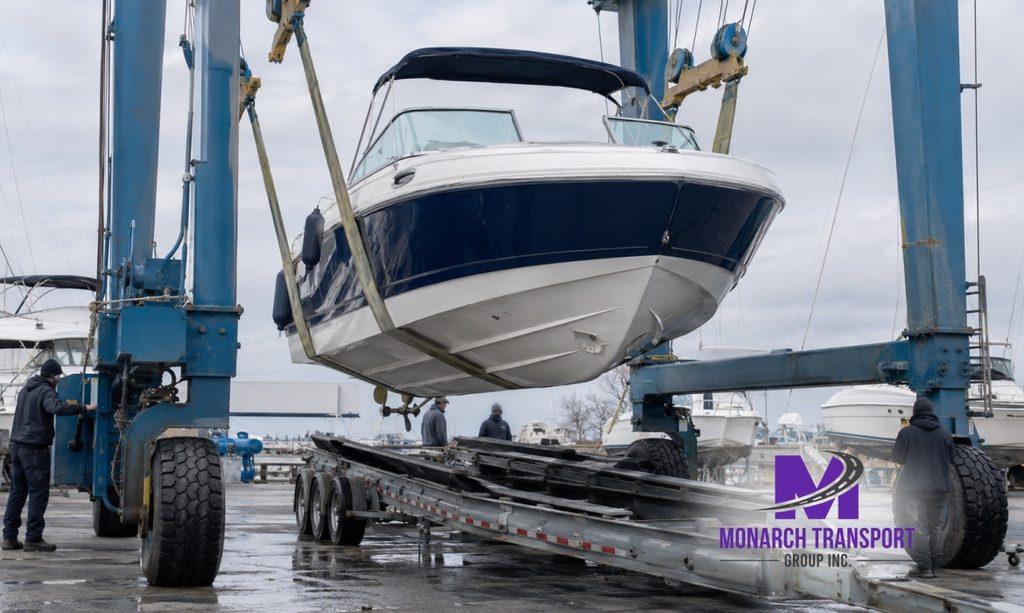
Tow-away services win by a large margin on price, and the reason for this is simple: there’s no need for anyone to lift the boat. As long as your boat is already on a sound and is on a trailer that is road legal, the carrier just connects up and drives off. But the moment a crane or a travel lift is involved – whether it’s because the boat has been stored in a slip or the trailer isn’t up to standard – you have to pay for the rental of the equipment, for the labor at the yard, and for the coordination at both ends of the journey. That particular charge often exceeds the extra fuel cost resulting from the longer route.
Additional Boat Shipping Fees You May Pay
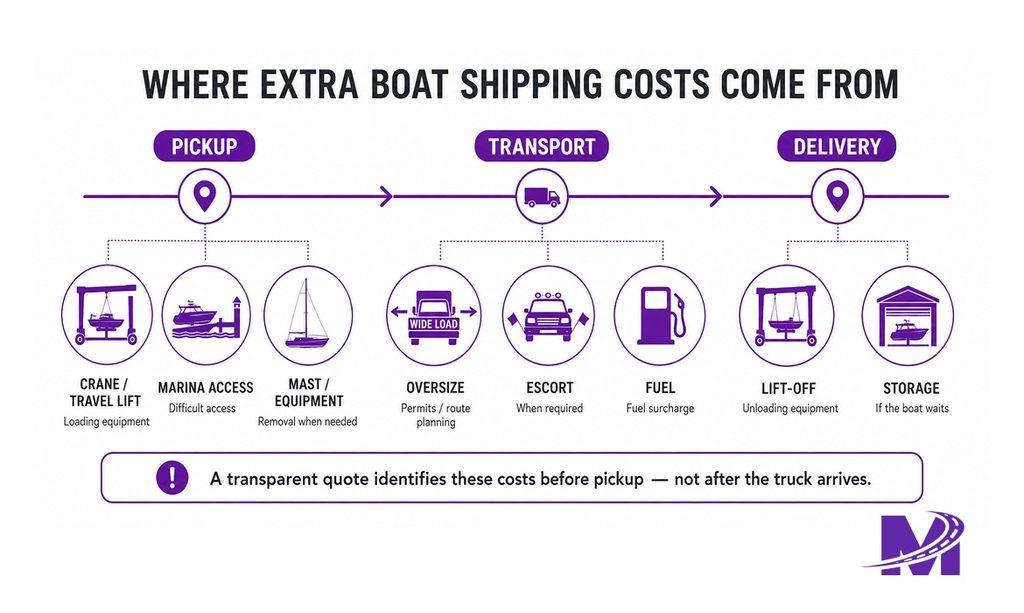
The base amount is almost never the total invoice amount. The following charges are usually added on and are given as planning ranges rather than as fixed prices – the actual amounts vary depending on the carrier, state, and route.
These costs are not in any way concealed – they are foreseeable expenses associated with the size of your boat and the route you’re taking, even though the exact amount will vary depending on the carrier and the state. A reasonable quote can be distinguished from a poor one by the fact that the carrier states them clearly at the beginning rather than letting you discover them on pickup day.
A quick check: if a quote is considerably lower than all the other bids and no one has asked about the condition of your beam, height, or trailer, then they’re not pricing your boat at all. Instead, they’re pricing a standard one, and the gap becomes your issue when the truck actually arrives.
Seasonal and Fuel Pricing Swings
Two things move the whole market up and down independent of your specific boat: the calendar and diesel prices.
Spring launch season – roughly March through May – is the busiest stretch in boat transport. Everyone who winterized in the fall wants their boat back in the water at once, and carrier capacity tightens fast. Peak-season rates run noticeably above baseline, though how much depends on your route, boat size, and how far ahead you book.
Fall haul-out season, September through November, creates the mirror-image rush – snowbirds moving boats south, lake boats coming out for winter storage.
Winter outside the fall rush, and late summer, tend to be the softest windows. Fewer boats moving, more carrier capacity sitting open, and generally your best shot at negotiating if your dates have any give in them.
Fuel surcharges move on their own schedule, independent of season. Diesel is one of a carrier’s highest costs, so most quotes carry a fuel surcharge calculated separately and adjusted to current prices rather than locked in months ahead. The percentage varies by carrier – ask to see it broken out on your quote.
Boat Shipping Cost Examples
Numbers land better when you can see them applied to something real. Here are five scenarios, all overland transport under 2026 conditions.
20 ft runabout, 500 miles, standard beam. Base rate applies cleanly. Estimated total: $900–$1,400.
28 ft cruiser, 1,000 miles, standard beam, tow-away. Mid-haul base rate, no permits needed. Estimated total: $2,000–$2,900.
35 ft cabin cruiser, 1,500 miles, beam just over 8’6″. Cross-country base rate, plus permits across the route and a modest oversize adjustment. Estimated total: $3,500–$5,200.
Wide-beam cruiser, 10.5 ft beam, 800 miles. Oversize permits in every state on the route, plus a possible escort vehicle depending on state thresholds. Estimated total: $2,800–$4,300.
34 ft sailboat with mast, 1,200 miles. Cross-country base rate, plus mast unstepping and deck-strapping at pickup, and re-stepping at delivery. Estimated total: $3,200–$4,800, before rigging labor at the destination.
Treat these as planning ranges, not guarantees. Your actual number depends on your exact dimensions, trailer condition, and pickup/delivery access – which is exactly why a real quote needs your measurements before it means anything at all.
How to Lower Your Boat Shipping Cost
A handful of decisions move the needle more than any amount of haggling:
How to Get an Accurate Boat Shipping Quote
An accurate quote starts with accurate measurements, not a phone call. Have these ready before you request pricing:
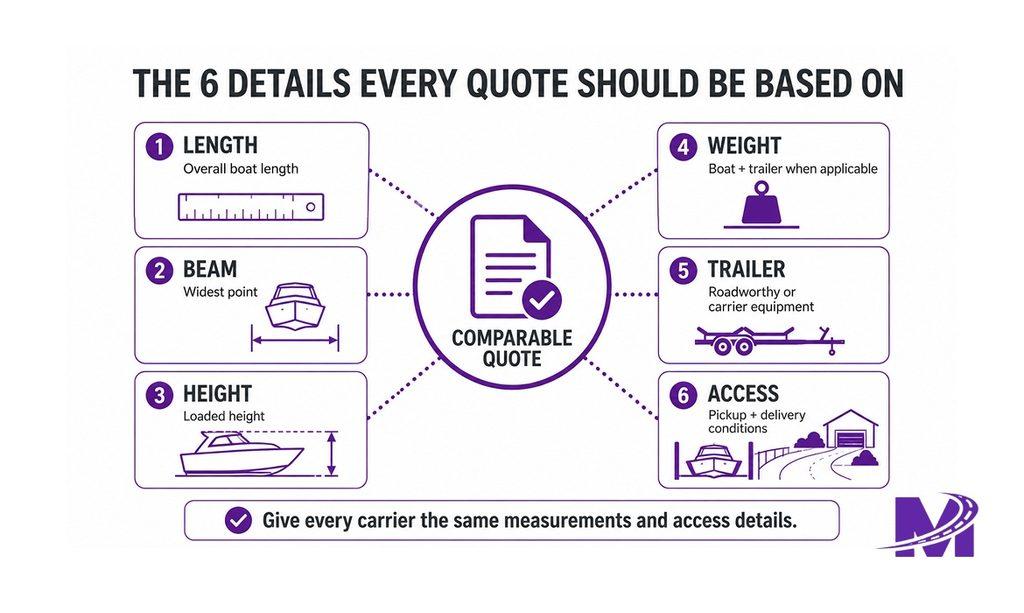
Give every carrier you contact the same complete set of numbers. That’s what actually makes quotes comparable – two quotes built from different information aren’t quotes for the same job, even if they look like it on paper.
If you’d rather have a route-specific number without waiting on a callback, our boat shipping calculator gets you a working estimate in under a minute, and our boat transport service page walks through how we vet the carriers we work with for hauls like this.
How We Estimate Boat Shipping Costs
The ranges in this guide are planning estimates, not a fixed price list. They’re built from standard per-mile rate benchmarks, the legal thresholds that trigger oversize pricing (8’6″ beam, 13’6″ height), and the fee categories carriers typically itemize. Actual pricing varies by carrier, state, and current market conditions, so treat every figure here as a starting point for comparing quotes rather than a guarantee. The only number that actually applies to your boat is the one built from your real measurements.
Ready to see what your route actually costs? Get a free boat shipping quote and compare it against the ranges above.
FAQ About Boat Shipping Cost
Standard boats under 8’6″ in beam typically run $1.50–$3.75 per mile depending on distance, with short hauls costing more per mile than cross-country moves. Oversize boats add permit and escort costs on top of the per-mile rate.
Averages assume a standard-width boat on a roadworthy trailer with easy access at both ends. If your beam exceeds 8’6″, your trailer needs replacing, or the pickup location needs a crane, your quote will land above the baseline – and it should, since those are real added costs, not padding.
Beam width, in most cases. Length affects trailer size and weight, but beam is what triggers oversize permits, potential escort vehicles, and route restrictions – the changes that actually reshape the job.
Yes, almost always. Tow-away service on a roadworthy trailer skips the cost of a crane, travel lift, and loading labor that flatbed or lowboy transport requires.
Outside of spring launch season (March–May) and fall haul-out season (September–November), when demand and rates both climb. Booking during the quieter winter months generally gets better pricing and availability.
Measure the overall length, beam, and loaded height yourself rather than trusting manufacturer specs, note the trailer’s condition, and check pickup/delivery access for cranes or tight turns. Feed that full picture into a shipping calculator or to multiple carriers, and you’ll get quotes that are actually comparable.
Usually because the first quote was based on a rough guess rather than an actual measurement – loaded height in particular is easy to underestimate. Measuring your own boat before asking for quotes is the best way to avoid this.
In most cases, yes. A beam over the standard 8’6″ width limit generally moves the shipment into oversize-load requirements even by a small margin, though exact rules and permit costs vary by state. Permit cost and escort requirements usually scale up as the beam gets wider. If your boat is close to the line, it’s worth checking whether folding rails, mirrors, or fenders can bring it back under the limit before seeking quotes.
Cross-country moves (1,000+ miles) typically fall in the $1.50–$2.50 per-mile range for a standard-width boat, putting most cross-country hauls in the $2,000–$5,500+ range depending on boat size, beam, and any oversize fees. Larger boats and oversize beams push toward the higher end.
A 20-foot boat under 8’6″ in beam, on a roadworthy trailer, generally lands near the low end of the size-based pricing table above – commonly $750–$1,900 depending on distance. Shorter routes carry a higher per-mile rate, longer routes a lower one, for roughly the same total.

Related articles

Popular State-to-State Car Shipping Routes: Costs & Transit Times Compared (2026)
IN THIS ARTICLE: State-to-State Car Shipping Routes: Cost & Transit Time What factors influence the cost of shipping cars from one state to another? How long does transport between states

Seasonal Car Shipping Tips: What to Know Before Shipping in Summer
IN THIS ARTICLE: Why Summer Is the Most Demanding Season for Auto Transport The Price Reality: How Much More Does Summer Shipping Cost? The Heat Problem – What Open Trailers

Snowbird Car Shipping – How to Send Your Car to Florida for Winter
IN THIS ARTICLE: What Is Snowbird Car Shipping and How Does It Work? When to Book Snowbird Auto Transport to Florida How Much Does Snowbird Car Shipping to Florida Cost?

How Much Does It Cost to Ship a Car Between States?
IN THIS ARTICLE: Average Cost Breakdown by Distance Primary Factors Influencing Your Shipping Quote Geographic Influence on Pricing Understanding the Quote Structure The Impact of Seasonality on Auto Transport Rates

Door-to-Door vs. Terminal-to-Terminal: Which Logistics Model Fits You?
IN THIS ARTICLE: Understanding the Two Primary Logistics Models Comparative Analysis: Door-to-Door vs. Terminal-to-Terminal The Financial and Temporal Mechanics of Shipping Models Geographical Impact: Urban vs. Rural Accessibility The Final

Cross-Country Car Shipping: How to Save Money Safely
IN THIS ARTICLE: Why “Cheap” Doesn’t Have to Mean “Dangerous” 1. Open Transport: The Industry Gold Standard for Savings 2. The Power of “Terminal-to-Terminal” Shipping 3. Timing the Market: The

Boat Transport Guide: Professional Shipping Made Simple
IN THIS ARTICLE: How Does Boat Beam Width Affect Shipping Cost? Transport Methods: Tow-Away Service vs. Specialized Hauling Average Boat Shipping Costs in 2026: What to Expect Preparing Your Vessel

Car Shipping by Train: Costs, Process & What to Expect in 2026
IN THIS ARTICLE: The Two Faces of Rail Transport: Consumer vs. Commercial Why Choose the Tracks? (The Human Perspective) Dimensions and Constraints: Will Your Car Fit? The “Hidden” Logic of