
IN THIS ARTICLE:
- Do I Need My Lender’s Permission to Ship a Car?
- Financed vs. Leased – Why the Difference Matters
- What a Standard Domestic Move Actually Requires
- When You Actually Need a Lienholder Authorization Letter
- Which Lenders Tend to Say Yes
- How to Actually Get the Letter
- Leases Have an Extra Layer – Mileage and Relocation Clauses
- The Documents You’ll Actually Be Asked For
- What Happens If Your Lender Says No
- Insurance During Transit – Whose Policy Actually Covers It
- A Practical Checklist Before You Book
- Conclusion
- FAQ About Shipping a Leased or Financed Car
A car you’re still paying off isn’t fully yours yet. The bank or the leasing company holds the title until the loan is paid off or the lease ends, which means they technically have a say in where that car goes. Most people never think about this until they’re standing in front of a moving truck wondering whether they need anyone’s permission to put their own car on it.
The short answer is that you almost always can ship a financed or leased car, and for a standard move within the lower 48 states, most lenders never even find out it happened. The requirements get real the moment a port enters the picture – Hawaii, Alaska, Puerto Rico, or anywhere overseas – or when your lease agreement has a relocation clause buried in the fine print. This guide covers exactly what changes between those two scenarios, what a lienholder authorization letter actually needs to say, which lenders tend to approve these requests, and what happens if your lender says no.
Do I Need My Lender’s Permission to Ship a Car?
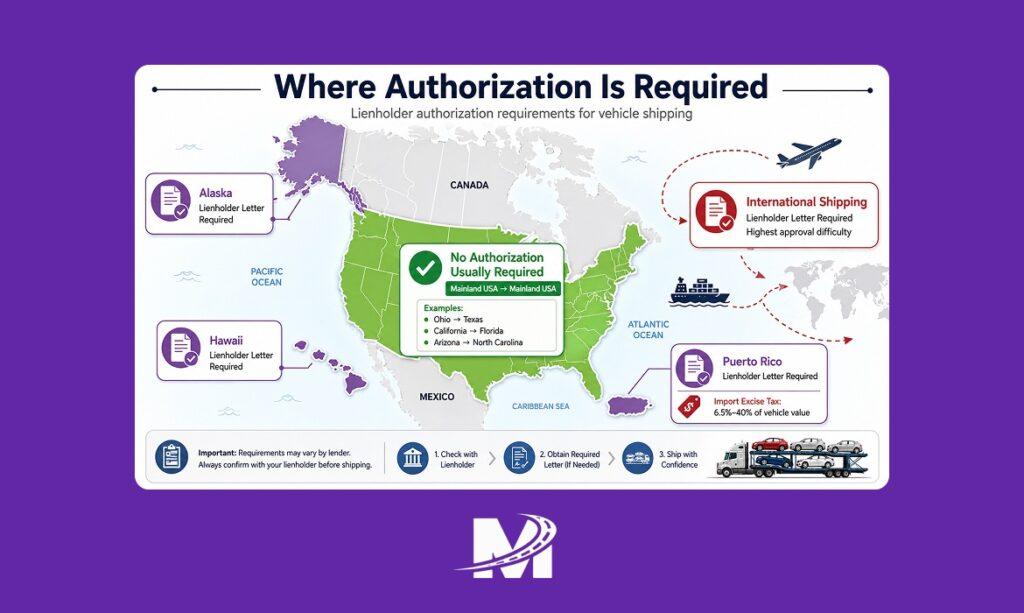
For a move between two mainland states, no. Carriers don’t ask for lender approval, and most loan agreements don’t restrict where the car goes inside the country. Permission becomes a real requirement the moment the car leaves the mainland – Hawaii, Alaska, Puerto Rico, or overseas – where ports check for a lienholder authorization letter before releasing the vehicle.
| Destination | Lender letter? | What to expect |
| Mainland U.S. → Mainland U.S. | Usually no | Keys and a signed Bill of Lading are all the carrier needs |
| Hawaii | Usually yes | The port won’t release a lienholder vehicle without it |
| Alaska | Usually yes | Same port requirement as Hawaii |
| Puerto Rico | Yes | Notarized letter, plus a local import excise tax on arrival |
| International | Often denied | Many lenders require the loan paid off first |
Everything below is that table explained in practice – what each destination actually asks for, how long the paperwork takes, and where leases add a second set of rules on top.
Financed vs. Leased – Why the Difference Matters
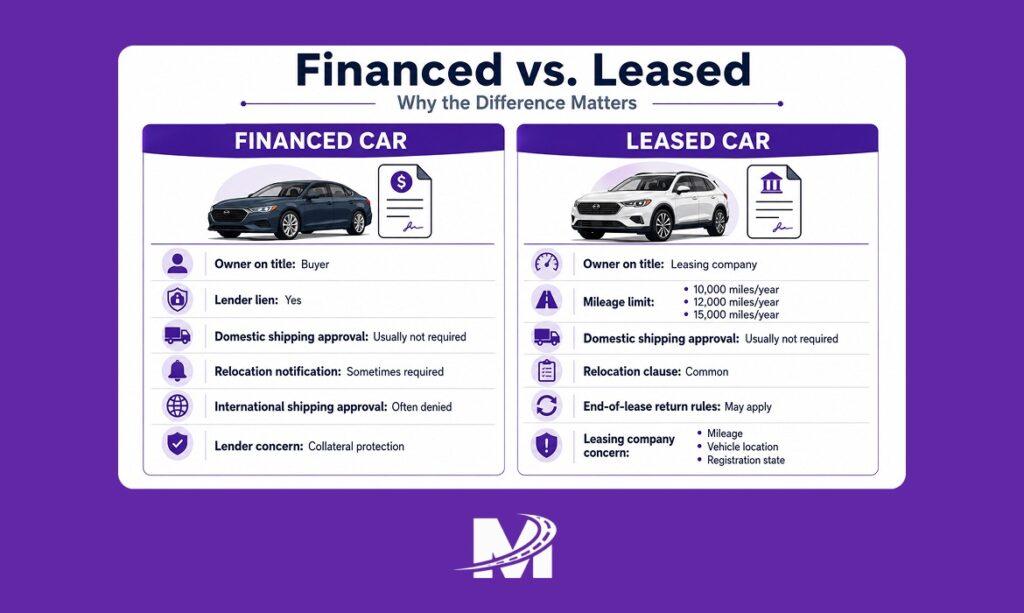
A financed car and a leased car create different obligations once you start moving it, and conflating the two is where a lot of people get tripped up.
With a financed car, you’re the owner on paper – your name is on the title, with the lender’s lien attached until the loan balance hits zero. The lender’s interest is purely financial: they want their collateral protected and they want to get paid. Most loan agreements don’t restrict where you drive or store the car within the United States, though a handful do require notification before a permanent move out of state, mostly for record-keeping and insurance purposes. In practical terms, shipping a car with a lien is handled the same as shipping any financed vehicle on a domestic route – the lien governs who holds the title, not who can put the car on a trailer.
A leased car works differently because the leasing company owns the vehicle outright. You’re renting the right to drive it under specific terms: a mileage cap (typically 10,000–15,000 miles per year), wear-and-tear standards, and in many cases a geographic or relocation clause that spells out whether the car can be taken to a different state on a permanent basis. The Consumer Financial Protection Bureau’s overview of leasing versus buying lays out these mileage and wear-and-tear terms clearly if you want the plain-language version before digging into your own contract.
That ownership difference is why a financed car ships almost identically to one you own free and clear, while a leased car can trigger contract obligations that have nothing to do with the shipping company and everything to do with the lease itself.
What a Standard Domestic Move Actually Requires
For the overwhelming majority of shipments – moving a financed or leased car from one mainland state to another – the carrier’s side of the paperwork is short.
A licensed auto transport company needs the vehicle keys, a way to reach you before pickup and delivery, and your signature on the Bill of Lading at both ends. That’s the contract of carriage and the condition report rolled into one document, and it’s the only paperwork most carriers require regardless of whether the car is financed, leased, or paid off outright. Title, registration, and proof of your personal auto insurance are not something a domestic carrier typically asks for, since the car isn’t changing ownership and isn’t being driven under your insurance policy while it’s strapped to a trailer – the carrier’s own cargo insurance covers it during transit.
Where the obligation actually lives is between you and your lender, not between you and the shipping company. Two things are worth doing before you book, even though no one will ask you to prove you did them:
Pull out your loan or lease agreement and look for a relocation or geographic-use clause. Most financed vehicles have no such restriction. Leases are the ones more likely to mention it, and the language is usually buried several pages into the contract rather than called out clearly.
Tell your insurer if you’re moving to a new state permanently, separate from the shipping itself. Auto insurance rates and minimum coverage requirements vary by state, and your policy may need updating regardless of how the car gets there.
If your situation is a temporary domestic move – sending the car to a different state for a few weeks rather than relocating it permanently – most lenders and leasing companies have no process for this at all, because nothing in the loan or lease changes. The friction shows up specifically around permanent relocation and international or island shipments, which is the next section.
Can I Ship a Financed Car to Another State?
Yes, and it works exactly like shipping a car you own outright. Ohio to Texas, California to Florida – the carrier needs keys and a signature, not a title or a lender letter. Many borrowers search for this as “can I ship a car that still has a loan on it,” and for mainland U.S. moves the answer is generally yes, with no extra paperwork at all.
When You Actually Need a Lienholder Authorization Letter
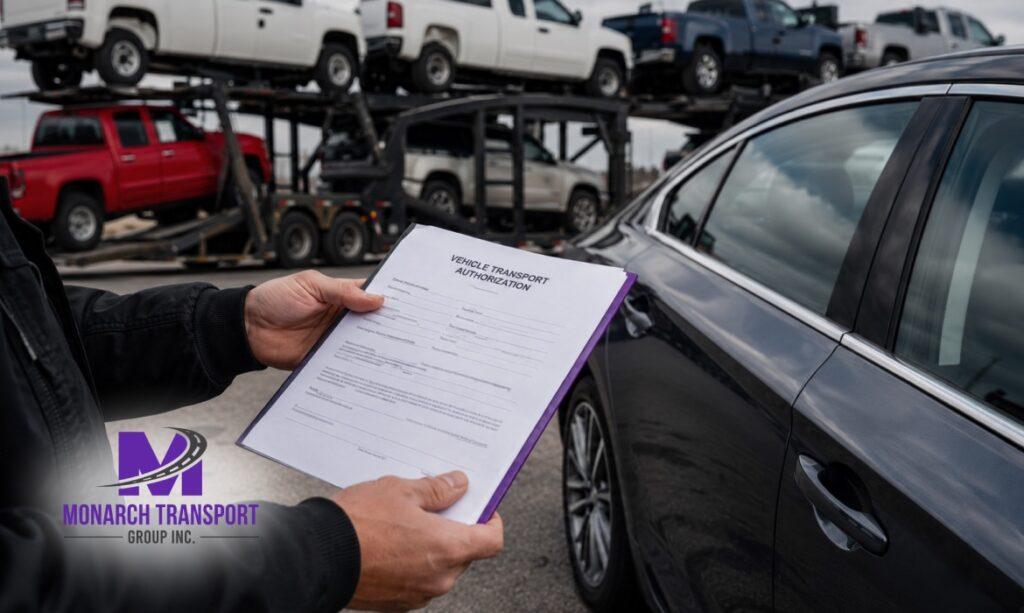
A lienholder authorization letter is a formal document from your bank or leasing company, on their letterhead, stating that they permit the vehicle to be moved to a specific destination. It should include the vehicle’s VIN, your name as the borrower or lessee, the destination, and the approximate shipping window. Getting one typically takes anywhere from a few business days to two weeks depending on how responsive your lender is, so this isn’t something to request the week before you need the car gone.
You need this letter in three situations:
Shipping to Hawaii or Alaska. Ports won’t release a financed or leased vehicle without it, since the car is leaving the contiguous United States and the lender’s collateral is, from their perspective, becoming harder to repossess if something goes wrong.
Shipping to Puerto Rico or any U.S. territory. Same logic, same requirement. Puerto Rico also adds its own import excise tax on top of shipping costs, ranging roughly from 6.5% to 40% of the vehicle’s value depending on the model, which you can estimate using the Puerto Rico Treasury Department’s official SURI calculator before you commit to the move.
Shipping internationally. This is where lenders get genuinely strict, and for good reason: if you default on a loan for a car that’s now in another country, repossession becomes close to impossible. Most major lenders won’t authorize an international move while a loan is still active. The realistic paths forward are paying off the remaining balance to get a clear title, refinancing with a lender that explicitly allows international relocation, or in rare cases taking out a personal loan to clear the existing one.
What you don’t need a letter for: a standard move from, say, Ohio to Texas. No port authority is checking your paperwork, and the carrier has no mechanism or legal requirement to ask for one – get a quote for a route like this in about a minute.
Which Lenders Tend to Say Yes
Policy varies more by lender type than by brand name. Credit unions have a reputation for approving out-of-territory and Puerto Rico shipments more readily than the large national banks, and lenders that serve military families are generally used to relocation requests that come with orders attached. Large national banks and manufacturer-owned finance arms tend to be stricter, particularly on international moves.
None of this is guaranteed, policies change without notice, and individual loan officers have discretion. Treat it as a starting expectation rather than an answer – the only way to know for certain is to call your own lender.
How to Actually Get the Letter
Calling general customer service rarely gets you anywhere on this. Ask specifically for the title department, the collateral department, or whatever division handles lien releases and title-related requests – that’s the team that actually has authority to issue this kind of letter, and a front-line phone rep usually doesn’t. Be specific about the destination on the first call; “shipping my car” gets a different answer than “shipping my car to Puerto Rico” or “shipping my car overseas,” and a vague request just gets you transferred twice before anyone gives you a real answer.
Get the approval in writing even if someone tells you verbally that it’s fine. A verbal “yes” from a call center rep means nothing to a port authority or a carrier checking documentation, and it means nothing if that same lender later disputes the move. Only a notarized letter on letterhead actually moves the process forward.
Leases Have an Extra Layer – Mileage and Relocation Clauses
Shipping doesn’t add mileage to a leased car’s odometer the way driving it would, which is part of why people ship leased cars in the first place – it’s a way to relocate a car without burning through a mileage allowance that’s already tight. A 2,000-mile cross-country drive can run up several hundred dollars in overage charges at lease-end; shipping the car adds zero miles regardless of distance.
But mileage isn’t the only thing a lease restricts. Many lease agreements include a relocation or permissible-use clause that has nothing to do with how the car physically gets somewhere and everything to do with where it’s registered and garaged long-term. If you’re moving permanently to a new state with a leased car still under contract, separately from the act of shipping it, your lessor will generally want to know – partly because sales tax may differ between your old state and new one, and partly because the title may need to be re-registered in your new state of residence. This is a notification obligation between you and the leasing company, not a transport requirement, and it applies whether you drive the car yourself or have it shipped.
If your lease term is ending soon after the move, ask the leasing company whether they have an authorized dealership in your destination state where the car can be returned. Some do; others require the car to go back to the original region, which is its own logistics question worth settling before the lease clock runs out.
The Documents You’ll Actually Be Asked For
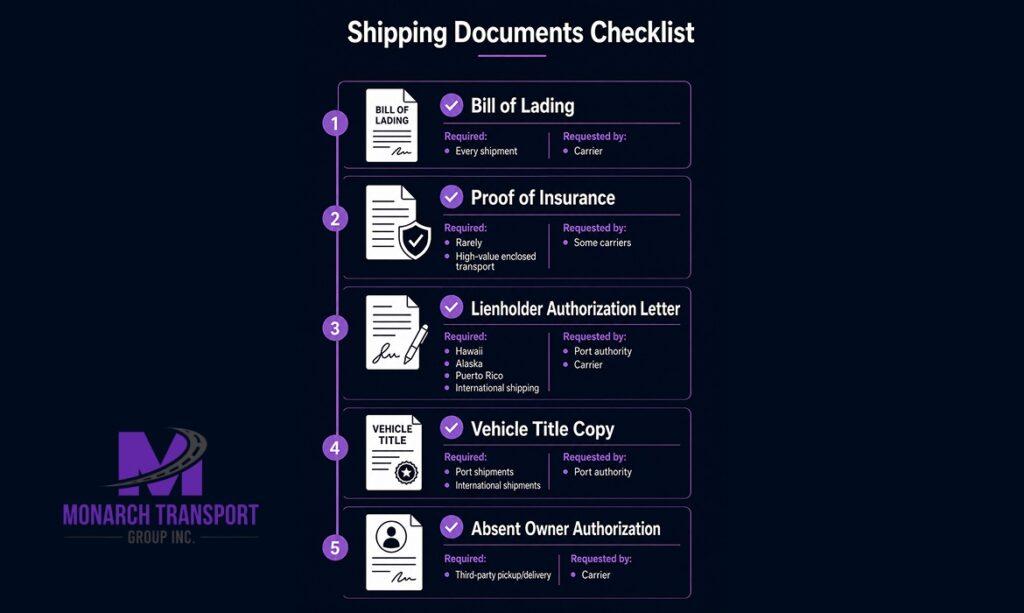
Stripped of the auction- and port-specific exceptions, here’s what tends to come up across a normal shipment:
| Document | Required For | Who Asks |
| Bill of Lading | Every shipment | The carrier, at pickup and delivery |
| Proof of insurance (yours) | Rarely, for high-value enclosed shipments | Some carriers, case by case |
| Lienholder authorization letter | Hawaii, Alaska, Puerto Rico, international | Port authority or carrier |
| Vehicle title copy | Port or international shipments | Port authority |
| Absent-owner authorization (notarized) | When someone else hands off the car for you | The carrier |
The Bill of Lading is worth understanding in detail since it’s the one document every shipment generates. It’s prepared by the driver at pickup, records the vehicle’s condition with a diagram or photos, and gets signed by both you and the driver at pickup and again at delivery. If the car arrives with damage that wasn’t on the pickup report, the BOL is what makes a claim possible; sign a clean delivery report without checking the car first, and you’ve effectively waived your ability to dispute anything found later. Monarch’s guide to preparing your car for shipping walks through the inspection and documentation process in more detail if this is your first time shipping a vehicle of any kind.
An absent-owner authorization comes up specifically when you won’t be the one physically handing over keys or signing for delivery – a family member, a property manager, or a neighbor standing in for you. It needs to be notarized and should name the person, the vehicle’s VIN, and both addresses involved. Without it, a carrier can legally refuse to release the vehicle to anyone but you.
What Happens If Your Lender Says No
A denial isn’t necessarily the end of the conversation, but the available paths depend heavily on whether the car is financed or leased.
If it’s financed and the lender won’t authorize an international move, paying off the remaining loan balance clears the lien and gets you a title with no restrictions attached. For a Puerto Rico or territory shipment specifically, refinancing with a credit union that more commonly approves these requests is also worth exploring before assuming the move is impossible.
If it’s leased, the options narrow. Most leases stay legally binding regardless of where you live, so a denied relocation doesn’t release you from payments – it just means the car needs to either stay registered in its original area or you need to negotiate an amendment with the leasing company. A lease transfer or assumption, through services like LeaseTrader or Swapalease, is sometimes a workable exit if the lessor’s answer is a hard no and the move is non-negotiable on your end. Breaking a lease early without one of these paths typically triggers an early termination fee plus the remaining balance of scheduled payments, which is rarely the cheaper option compared to waiting out the lease term in its original state if that’s at all feasible.
One narrow exception: active-duty servicemembers who lease a vehicle before deployment can sometimes terminate the lease without penalty under the Servicemembers Civil Relief Act, provided the orders meet specific conditions tied to the timing and nature of the move. This is a narrow protection with real procedural requirements, so anyone in this situation should talk to their base legal assistance office before assuming it applies.
Insurance During Transit – Whose Policy Actually Covers It
This question comes up constantly and the answer surprises people: your personal auto insurance generally doesn’t need to be the policy covering the car while it’s on a carrier’s trailer. The carrier is required to maintain its own cargo insurance covering vehicles in its care, and that’s the coverage that applies if something goes wrong during transit – not your policy, even though you’re the one paying the premium on it.
That said, your lender will still expect your own comprehensive and collision coverage to remain active and unbroken throughout, since a lapse in coverage technically violates most loan and lease agreements regardless of where the car physically is at the time. Before booking, a quick call to your insurance provider to confirm the policy stays valid during the shipping window – and that it covers the destination state if you’re relocating permanently – closes the one gap that catches people off guard.
If you want documentation of the carrier’s coverage specifically, ask your broker for the carrier’s Certificate of Insurance before pickup. A reputable company will hand this over without hesitation, and checking it takes a few minutes against months of headache if a claim ever comes up.
A Practical Checklist Before You Book
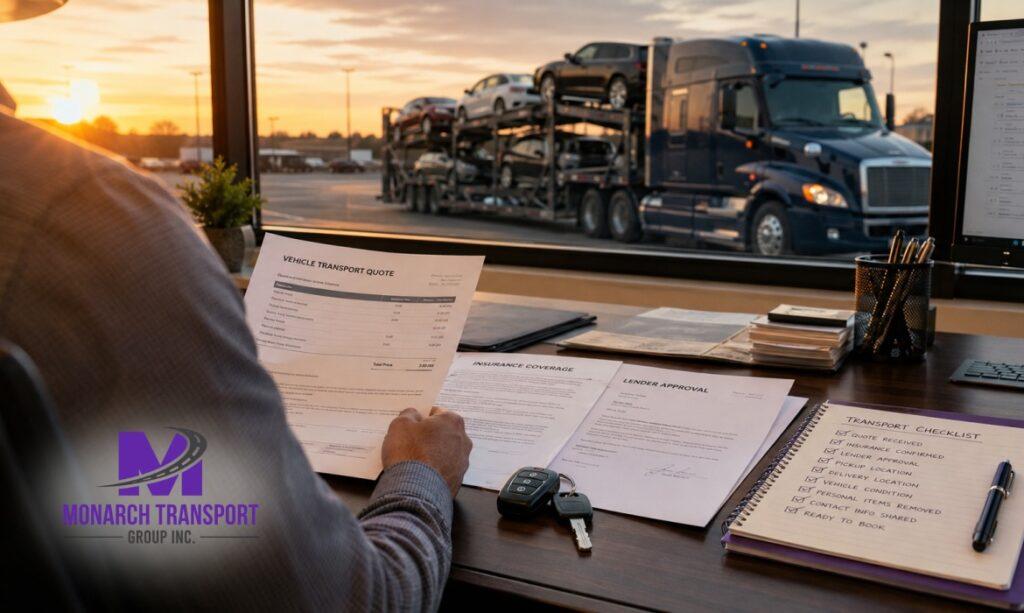
Pulling all of the above into a sequence that actually saves time – for the shipping side specifically, here’s how the process works once you’re ready to book:
Conclusion
A car you’re still paying off isn’t an obstacle to shipping it – it’s just a piece of paperwork to check before you book, not after. For a routine move between mainland states, that paperwork is essentially nothing: the carrier needs your keys and a signature on the Bill of Lading, and your lender never enters the picture. The moment a port or a border shows up – Hawaii, Alaska, Puerto Rico, anywhere overseas – that’s when a lienholder letter becomes the thing standing between you and a scheduled pickup, and it’s worth requesting weeks rather than days in advance. Leases add one more layer worth a five-minute read of your contract: a relocation clause that has nothing to do with shipping itself and everything to do with where the car ends up registered.
None of this is complicated once you know which box you’re in. Read the agreement, make the right phone call if your destination requires one, and the actual shipping process is the easy part. Get a free quote from Monarch Auto Transport and find out exactly what moving your financed or leased car will cost before you finalize anything with your lender.
FAQ About Shipping a Leased or Financed Car
Yes. A financed car ships exactly like one you own outright for standard moves within the lower 48 states – the carrier needs the keys and your signature on the Bill of Lading, nothing more. The only added requirement is a lienholder authorization letter, and that only applies for shipments to Hawaii, Alaska, Puerto Rico, or international destinations.
For a standard domestic shipment, the Bill of Lading is the only document most carriers require, prepared by the driver at pickup and signed at both pickup and delivery. Title, registration, and personal insurance proof are rarely requested for routine moves. A lienholder authorization letter, a copy of the vehicle title, and proof of insurance become relevant specifically for port-based or international shipments.
Yes, and the shipping process itself is identical to a financed or owned car. What’s different is the lease agreement: check it for relocation or geographic-use clauses before a permanent move, since the leasing company owns the vehicle and may require notification or written approval for that scenario, separate from the act of shipping.
Yes. A lien is simply the lender’s claim on the title, and it doesn’t stop the car from being loaded onto a trailer. For mainland routes no one checks lien status at all; for Hawaii, Alaska, Puerto Rico, or overseas shipments, the lienholder’s written authorization is what the port will want to see.
No. Loan or lease status has no effect on price. Cost depends on distance, vehicle size, transport type, and season – the same factors that determine pricing for any vehicle. A typical domestic shipment runs $350 to $1,500 depending on the route and whether you choose open or enclosed transport.
Generally no for a routine move. Most financing agreements don’t restrict in-country relocation. It’s still worth a quick check of your specific loan agreement, since requirements vary by lender, but the vast majority of financed vehicles ship within the continental United States with zero lender involvement.
For a financed car, paying off the remaining balance clears the lien and removes any restriction. For a lease, options are more limited: negotiating an amendment with the leasing company, transferring the lease to someone else, or accepting an early termination fee are the realistic paths if the lessor won’t budge and the move isn’t optional.
Related articles
Auto Transport Broker vs. Carrier: Which One Should You Use?
IN THIS ARTICLE: What Is an Auto Transport Broker? What Is an Auto Transport Carrier? The Key Differences Side by Side Does Using a Broker Cost More? What Is “Dual

Best Places to Buy a Motorcycle Online in the USA
IN THIS ARTICLE: The Digital Shift: Geography No Longer Constrains the Ride Where to Buy: Top 2026 Platforms Analysis Comparison Table: Platform Overview The Facet of Finance: Not Just the

Car Shipping Insurance: What’s Actually Covered (And What’s Not)
IN THIS ARTICLE: The Most Important Distinction Nobody Tells You Upfront What Car Shipping Insurance Actually Covers What Is NOT Covered – The Real Exclusions Coverage Limits – What the

Car Shipping by Train: Costs, Process & What to Expect in 2026
IN THIS ARTICLE: The Two Faces of Rail Transport: Consumer vs. Commercial Why Choose the Tracks? (The Human Perspective) Dimensions and Constraints: Will Your Car Fit? The “Hidden” Logic of

Cross-Country Car Shipping: How to Save Money Safely
IN THIS ARTICLE: Why “Cheap” Doesn’t Have to Mean “Dangerous” 1. Open Transport: The Industry Gold Standard for Savings 2. The Power of “Terminal-to-Terminal” Shipping 3. Timing the Market: The

Complete Guide to RV Shipping in 2026
IN THIS ARTICLE: Introduction: The Freedom of the Road, Delivered by Professionals Understanding the Fleet: Classes and Types of RVs Methods of Transport: How We Get Your RV Home Measuring

Complete Guide to Car Shipping in 2026
The landscape of American mobility has shifted, making vehicle logistics more accessible and seamless than ever before. Understanding this new norm is the first step toward a stress-free relocation that

Door-to-Door vs. Terminal-to-Terminal: Which Logistics Model Fits You?
IN THIS ARTICLE: Understanding the Two Primary Logistics Models Comparative Analysis: Door-to-Door vs. Terminal-to-Terminal The Financial and Temporal Mechanics of Shipping Models Geographical Impact: Urban vs. Rural Accessibility The Final