
IN THIS ARTICLE:
- Key Takeaways
- Quick Reference: Documents by Situation
- Document 1: Government-Issued Photo ID
- Document 2: Bill of Lading – The Most Important Document in Car Shipping
- Documents for Financed or Leased Vehicles
- What Documents Are Needed If You Won’t Be Present at Pickup or Delivery?
- Documents When Shipping a Car You Just Bought Online or at Auction
- Documents That Are Rarely Required for Standard Shipments
- What Documents You Need After Delivery: Registering in Your New State
- Common Document Mistakes That Delay Car Shipments
- Final Thoughts: Paperwork Is the Easiest Part of Car Shipping
- FAQ: Documents for Shipping a Car Across State Lines
Shipping a car across state lines involves less paperwork than most people expect. Unlike international shipping or title transfers, domestic auto transport does not require a stack of legal forms. The process is primarily commercial – your vehicle is treated as cargo, not as a vehicle being driven on public roads – and the documentation requirements reflect that. For a full overview of how the process works, see our state-to-state car transport guide.
That said, the exact documents you need depend on your specific situation: whether the car is financed or leased, whether you will be present at pickup and delivery, whether you recently purchased the vehicle online, and whether your carrier has additional internal requirements. This guide breaks down every scenario clearly so you can prepare the right paperwork before your carrier arrives. Ready to book? Use the Monarch shipping calculator to get an instant rate for your route.
Key Takeaways
Quick Reference: Documents by Situation
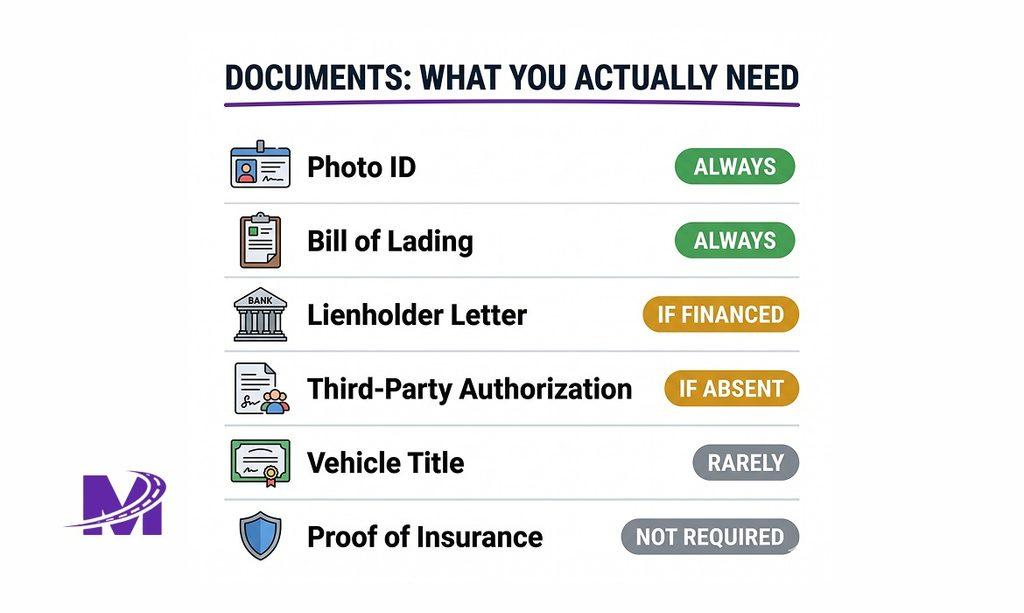
Before going into detail, here is the practical summary. Most domestic shipments through a licensed car transport service require only the first two items. The rest apply in specific circumstances.
| Document | Required? | When It Applies |
| Government-issued photo ID | Always | Every shipment – verifies identity of person releasing vehicle |
| Bill of Lading (BOL) | Always | Issued by driver at pickup; signed at pickup and delivery |
| Lienholder authorization letter | Conditional | Required if the car is financed or leased |
| Absent owner / third-party authorization | Conditional | Required if you will not be present at pickup or delivery |
| Vehicle title | Rarely required | Some carriers request for recently purchased or unregistered vehicles |
| Vehicle registration | Rarely required | Most carriers do not ask; occasionally requested for verification |
| Proof of personal insurance | Not required | Carrier cargo insurance covers transport; personal policy recommended for Acts of God |
| Bill of sale / purchase agreement | Situational | Useful when shipping a car just bought online or at auction |
Document 1: Government-Issued Photo ID
A valid government-issued photo ID is required at pickup. This is how the carrier verifies that the person releasing the vehicle is authorized to do so. A driver’s license, state ID, or passport all qualify. The ID does not need to match the vehicle registration – it simply confirms the identity of the person handing over the keys. If someone else is releasing the vehicle on your behalf, see the section on third-party authorization below.
Your ID does not need to be from the state where the vehicle is currently located. Out-of-state IDs, passports, and military IDs are all accepted by standard carriers. The only requirement is that it is government-issued, includes a photo, and is not expired.
Document 2: Bill of Lading – The Most Important Document in Car Shipping
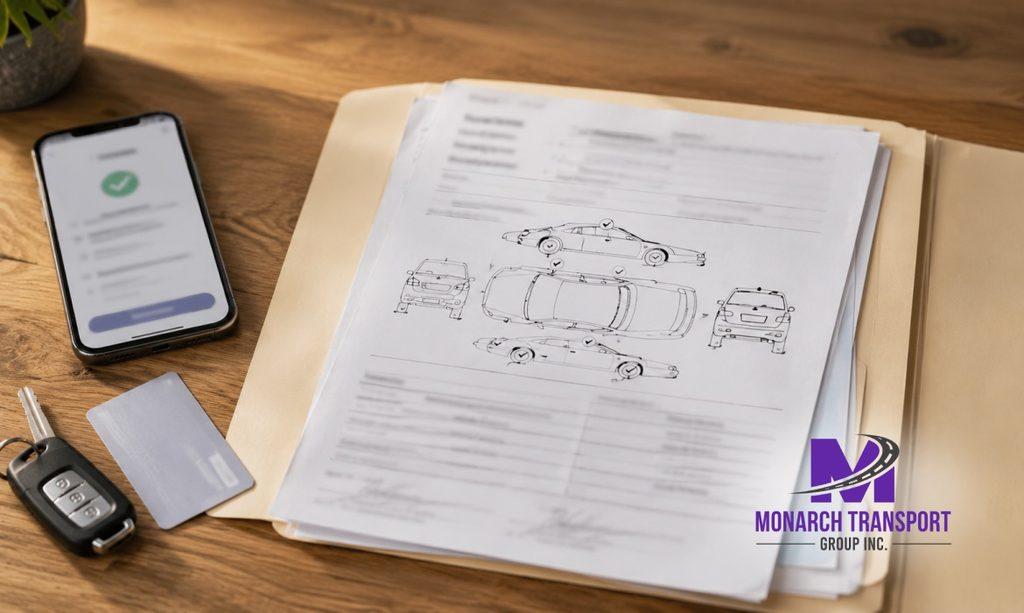
The Bill of Lading (BOL) is the single most important document in the entire auto transport process. It is not something you prepare in advance – the carrier driver creates it at pickup. But understanding what it is and what it does is essential, because it determines your ability to file a damage claim if anything goes wrong. Before your car ships, review our complete car shipping preparation checklist to make sure the pickup goes smoothly.
What the Bill of Lading Contains
Why You Must Review It Carefully Before Signing
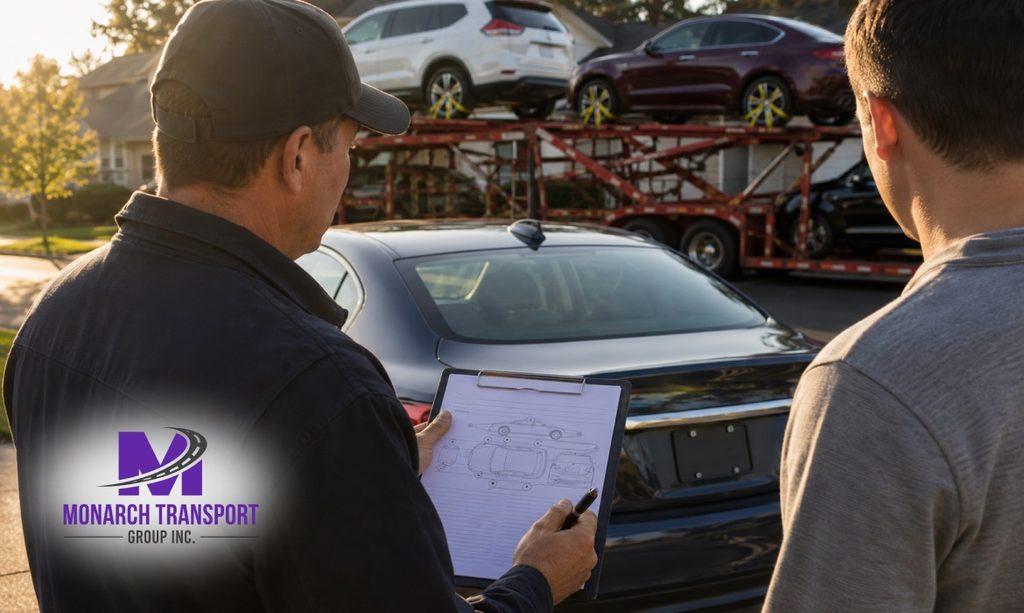
The BOL is your legal protection. Once you sign at pickup, any damage not listed on it is presumed to have occurred during transport. Walk around the entire vehicle with the driver before signing – all four panels, the roof, both bumpers. If you notice damage that is not listed, add it yourself before signing. Do not let a driver rush you through this step. At delivery, compare the vehicle’s condition to the pickup BOL. Any new damage must be noted on the delivery BOL before you sign. Learn more about this process in our how to prepare your car for shipping guide.
Keep Your Copy
The driver will give you a copy of the BOL at both pickup and delivery. Keep both. If you need to file a damage claim, you will need the pickup BOL as evidence of the vehicle’s pre-transport condition. Without it, the carrier has no legal obligation to accept responsibility for damage.
Documents for Financed or Leased Vehicles
If your car is financed through a bank or credit union, or if you are leasing it, the lender or leasing company technically holds an interest in the vehicle. Some carriers – particularly for cross-country routes or when shipping to port states – require proof that the lienholder has authorized the transport.

Lienholder Authorization Letter
A lienholder authorization letter is a written statement from your bank, credit union, or leasing company confirming they permit the vehicle to be transported. It does not need to be a formal legal document – a signed letter on company letterhead or an official email confirmation is typically sufficient.
How to get one:
Not all carriers require this for standard domestic routes. Confirm with your broker before the pickup date whether your specific carrier requires a lienholder letter. If you are shipping a leased vehicle specifically, also check your lease agreement – some leases restrict geographic transport. For details on leased or financed vehicle shipping, see: How to Ship a Leased or Financed Car.
What Documents Are Needed If You Won’t Be Present at Pickup or Delivery?
This is one of the most common situations in auto transport – and one of the least clearly explained by competitors. You may be flying ahead to your new location, or someone else is coordinating the pickup on your behalf. In these cases, additional authorization is required. The door-to-door car transport model makes this easy to coordinate, but the paperwork still needs to be in place.
Third-Party Pickup or Delivery Authorization
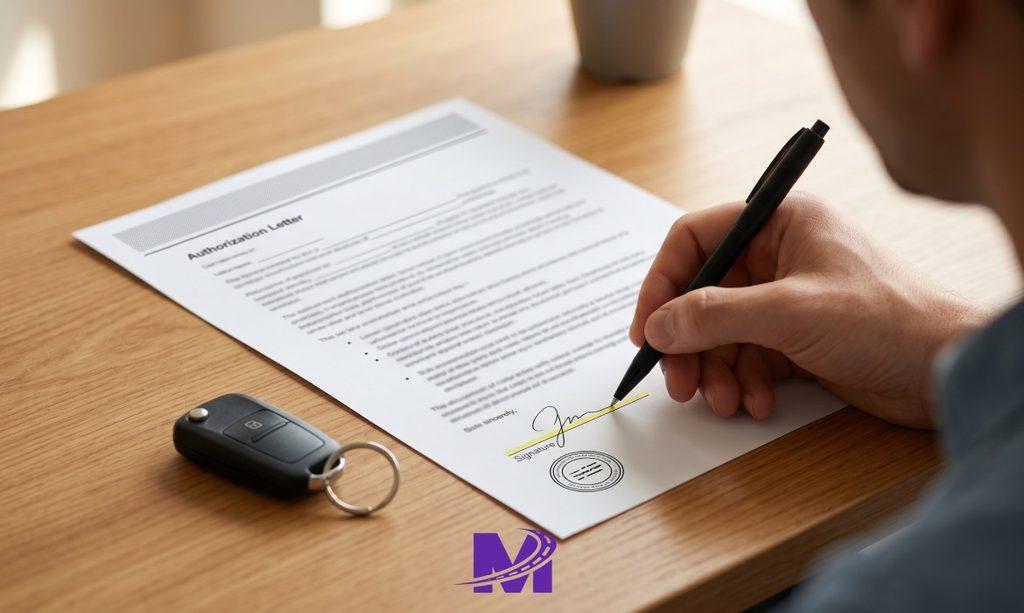
If someone other than the registered owner or person listed on the shipping order will be present at pickup or delivery, you need to provide a written authorization. This is sometimes called an ‘absent owner letter’ or ‘third-party authorization.’ It does not need to be notarized for most standard domestic carriers, but some require it – confirm with your broker.
A basic authorization letter should include:
Power of Attorney (POA)
For more complex situations – particularly military deployments, international moves, or situations where the person handling the vehicle needs full legal authority to act on your behalf – a notarized Power of Attorney may be required. This gives the designated person legal authority to sign documents and make decisions about the vehicle in your absence.
A general POA is broader than needed for most auto transport situations. Ask your broker whether a simple written authorization or a formal notarized POA is required for your specific carrier. Most standard domestic shipments can be handled with a simple letter. For special cases like military shipping, see our complete guide to car shipping.
Documents When Shipping a Car You Just Bought Online or at Auction
Buying a car online and shipping it home is increasingly common. The document requirements differ slightly from a standard owner-to-new-address shipment. If you recently purchased a vehicle and the title has not yet been transferred to your name, you will need to confirm ownership through alternative documentation. For a full guide on this process, see: How to Ship a Car You Just Bought Online.
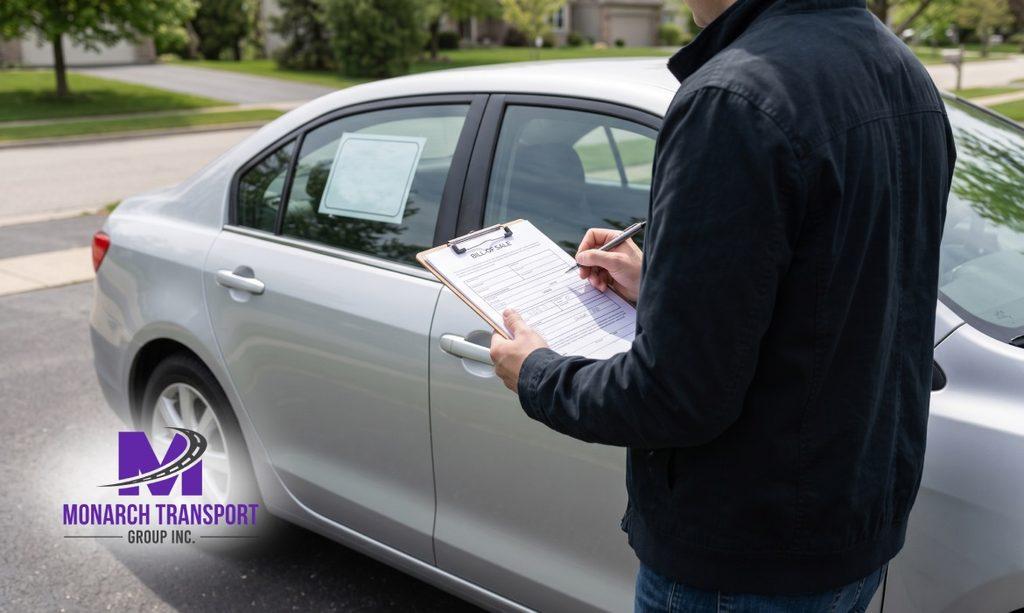
Bill of Sale / Purchase Agreement
If you do not yet have a title in your name – which is common when buying from a private seller, at auction, or through an online marketplace – a bill of sale or purchase agreement serves as proof of ownership for transport purposes. This document should include:
Temporary Tags and Dealer Paperwork
If the vehicle came with temporary tags or dealer-issued paperwork confirming the sale, keep those documents accessible at pickup. Some carriers, particularly on routes where the vehicle is being shipped immediately after purchase with no registration yet in your name, may request to see the purchase documentation to confirm you have a legal right to transport the vehicle. This is especially relevant when shipping from auction houses like Copart or IAAI – see our guide on auction car shipping for what to prepare.
Documents That Are Rarely Required for Standard Shipments
Several documents that competitors list as requirements are actually optional for most domestic shipments. Knowing the difference saves you from unnecessary preparation – and from being misled by carriers with unusually broad document demands. For standard open car transport, the list is short.
Vehicle Title
Most domestic auto carriers do not require a title to transport your vehicle. The car is treated as cargo – not as a vehicle being registered or sold – so ownership verification through the title is not part of the standard process. Exceptions: some carriers may request a title copy for recently purchased vehicles, and international or port shipments (such as Hawaii or Alaska) may require the original title.
Vehicle Registration
Registration is rarely required by carriers. Your vehicle’s registration is relevant to driving on public roads, not to transport as cargo. That said, having a copy of the registration available at pickup is not a bad idea – it provides VIN confirmation and owner details that may help resolve any ambiguity.
Proof of Personal Auto Insurance
All FMCSA-licensed carriers are required by federal law to carry cargo insurance. This covers physical damage to your vehicle during transport. You do not need to show proof of your personal auto insurance to use a carrier’s service. However, maintaining your own policy during transport is advisable – standard carrier cargo insurance typically excludes ‘Acts of God’ such as hail, flooding, or extreme weather events. Your personal comprehensive coverage may apply where carrier insurance does not. For details on what is and is not covered, see: car shipping insurance: what’s actually covered.
What Documents You Need After Delivery: Registering in Your New State
Once your car arrives at its new location, the transport documents are done. But if you are relocating permanently, you will need to re-register the vehicle in your new state. This is a separate process from the transport itself – handled through the state DMV – and the timeline varies by state. Most states require new residents to transfer registration within 30 to 90 days of establishing residency.
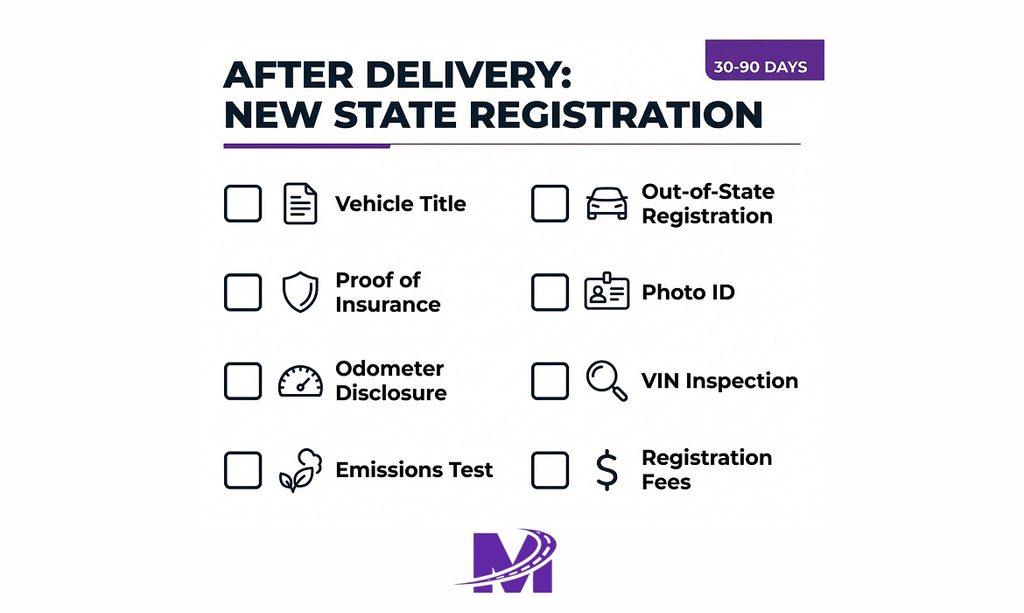
Typical DMV Requirements for Out-of-State Registration
Some states also require a safety inspection before issuing new plates. Check your destination state’s DMV website for the specific timeline and requirements before your vehicle arrives. If you are shipping a financed vehicle, the lienholder will typically hold the title and coordinate the transfer – confirm this process with your lender before the move. For full context on the relocation process, see our guide on how to ship a car for a job relocation.
Common Document Mistakes That Delay Car Shipments
Most shipment delays related to paperwork are preventable. These are the situations that most frequently cause last-minute problems. Avoid them by confirming all requirements with your broker before pickup day. If you are uncertain about the process, getting a quote from Monarch and confirming requirements upfront prevents day-of surprises.
Final Thoughts: Paperwork Is the Easiest Part of Car Shipping
For most domestic shipments, you need two things: a valid photo ID and your signed Bill of Lading. Everything else is situational. If your car is financed, get the lienholder letter sorted a week before pickup. If you cannot be present, prepare a written authorization for whoever is handling the vehicle on your behalf. If you recently bought the car online, have your bill of sale accessible.
The BOL is the document that matters most – read it carefully at both pickup and delivery, keep your copies, and use it as the baseline for any damage claim. Everything else in the auto transport paperwork process is secondary to that.
Ready to get started? Get an instant quote for your route and see current rates from Monarch Transport Group. Or learn more about the full range of car transport services available for your shipment.
Shipping a car across state lines involves less paperwork than most people expect. Unlike international shipping or title transfers, domestic auto transport does not require a stack of legal forms. The process is primarily commercial – your vehicle is treated as cargo, not as a vehicle being driven on public roads – and the documentation requirements reflect that. For a full overview of how the process works, see our state-to-state car transport guide.
That said, the exact documents you need depend on your specific situation: whether the car is financed or leased, whether you will be present at pickup and delivery, whether you recently purchased the vehicle online, and whether your carrier has additional internal requirements. This guide breaks down every scenario clearly so you can prepare the right paperwork before your carrier arrives. Ready to book? Use the Monarch shipping calculator to get an instant rate for your route.
FAQ: Documents for Shipping a Car Across State Lines
For most standard domestic shipments, you need a valid government-issued photo ID and the Bill of Lading issued by the carrier driver at pickup. If your vehicle is financed or leased, you also need a lienholder authorization letter from your lender. If you will not be present at pickup or delivery, a written third-party authorization is required. Title, registration, and proof of insurance are rarely required for domestic transport. See our full car transport service for details.
No. For standard domestic interstate transport, carriers do not require the vehicle title. Your car is treated as cargo, not as a vehicle being registered or transferred. The title may be requested by some carriers for recently purchased vehicles with no registration in your name, and it is required for international shipments or transport to port states such as Hawaii. For most continental US routes, the title is not part of the standard document requirements.
The Bill of Lading is a document created by the carrier driver at pickup. It records the vehicle’s condition – every existing scratch, dent, and chip – and serves as both the shipping contract and your legal protection against damage claims. You sign it at pickup and again at delivery. Any new damage must be noted on the delivery BOL before you sign. Without a pickup BOL, you cannot prove a vehicle’s pre-transport condition.
No. Registration is not required for domestic auto transport. Carriers transport vehicles as cargo, not as road-registered vehicles. An unregistered vehicle – such as a recently purchased car, a project car, or a vehicle with expired tags – can be legally shipped interstate. Some carriers may request documentation confirming ownership (such as a bill of sale) for unregistered vehicles, but the absence of registration alone does not prevent shipment.
If you cannot be present, you need to provide a written authorization letter designating another adult to release or accept the vehicle on your behalf. This letter should include your name, the authorized person’s name, the vehicle’s VIN and description, and your signature. Some carriers require a notarized Power of Attorney for this purpose – confirm requirements with your broker before the pickup date.
No. You do not need to show proof of personal auto insurance to a carrier. All FMCSA-licensed carriers are legally required to carry cargo insurance covering your vehicle during transport. However, maintaining your own comprehensive coverage during the shipping period is advisable. Standard carrier cargo insurance typically excludes Acts of God – hail damage, flooding, and similar weather events – which your personal policy’s comprehensive coverage may cover.
If the title has not yet been transferred to your name, bring your bill of sale or purchase agreement as proof of ownership. This document should include the seller’s name, your name, the vehicle’s VIN, purchase price, date of sale, and signatures of both parties. Any temporary tags or dealer paperwork confirming the sale should also be accessible at pickup. Most carriers will accept a bill of sale as ownership confirmation for recently purchased vehicles.
If you are relocating permanently, you will need to re-register the vehicle in your new state. Most states require this within 30 to 90 days of establishing residency. Required documents typically include the vehicle title, out-of-state registration, proof of insurance, photo ID, and payment of applicable fees. Some states also require a VIN inspection, emissions test, or safety inspection. Check your destination state’s DMV website for specific requirements.
Related articles

Best Places to Buy a Motorcycle Online in the USA
IN THIS ARTICLE: The Digital Shift: Geography No Longer Constrains the Ride Where to Buy: Top 2026 Platforms Analysis Comparison Table: Platform Overview The Facet of Finance: Not Just the

ATV vs UTV Shipping: Costs, Methods & What to Expect in 2026
IN THIS ARTICLE: The Fundamental Difference: Dimensional Weight and Trailer Space Average Shipping Costs in 2026: What to Budget Best Time to Ship Your ATV or UTV – Seasonal Price

Boat Transport Guide: Professional Shipping Made Simple
IN THIS ARTICLE: How Does Boat Beam Width Affect Shipping Cost? Transport Methods: Tow-Away Service vs. Specialized Hauling Average Boat Shipping Costs in 2026: What to Expect Preparing Your Vessel

Car Shipping Deposit Explained – Why Brokers Ask for It and When You Pay
IN THIS ARTICLE: How the Auto Transport Payment Structure Works What the Car Shipping Deposit Actually Pays For How Much Should a Car Shipping Deposit Be? Broker Deposit vs. Carrier

Car Shipping Insurance: What’s Actually Covered (And What’s Not)
IN THIS ARTICLE: The Most Important Distinction Nobody Tells You Upfront What Car Shipping Insurance Actually Covers What Is NOT Covered – The Real Exclusions Coverage Limits – What the
Complete Guide to Car Shipping in 2026
The landscape of American mobility has shifted, making vehicle logistics more accessible and seamless than ever before. Understanding this new norm is the first step toward a stress-free relocation that

10 Best Platforms to Buy or Sell Used Cars Online in 2026
IN THIS ARTICLE: Platform Comparison at a Glance Safety: How to Protect Yourself on Any Platform The Bottom Line: Choosing Your 2026 Auto Platform FAQ Buying or selling a used

Cross-Country Car Shipping: How to Save Money Safely
IN THIS ARTICLE: Why “Cheap” Doesn’t Have to Mean “Dangerous” 1. Open Transport: The Industry Gold Standard for Savings 2. The Power of “Terminal-to-Terminal” Shipping 3. Timing the Market: The
How to Ship a Motorcycle Safely: The 2026 Guide
IN THIS ARTICLE: The “Why” Behind the Shipping Method Option 1: The DIY Route (Towing it Yourself) Option 2: Open vs. Enclosed Transport Option 3: Specialized Motorcycle Shippers vs. General