

IN THIS ARTICLE:
- How the Auto Transport Payment Structure Works
- What the Car Shipping Deposit Actually Pays For
- How Much Should a Car Shipping Deposit Be?
- Broker Deposit vs. Carrier Deposit: Key Differences
- What Happens If the Carrier Drops Your Shipment After You’ve Paid a Deposit?
- Hidden Fees That Appear After the Deposit: What to Watch For
- How to Protect Your Deposit When Shipping a Car
- What ‘Fully Refundable Deposit’ Actually Means in Auto Transport
- Final Thoughts: The Deposit Is Not the Problem – Lack of Transparency Is
- FAQ: Car Shipping Deposit
You requested a few quotes for car transport. One broker asks for a $200 deposit to confirm your booking. Another wants $350. A third says no deposit until a carrier is assigned. All three are quoting the same route. Which structure is normal, which is a red flag, and exactly what is the deposit actually paying for?
Most auto transport guides skip this question or answer it vaguely. This guide explains the entire payment structure from the inside: what the deposit covers, when legitimate brokers collect it, how much is normal, what your refund rights are, and the specific scenarios where you should walk away. Understanding this before you book is the single best thing you can do to avoid the most common car shipping problems. If you want to see current rates for your route first, use the Monarch shipping calculator.
How the Auto Transport Payment Structure Works
The auto transport industry runs on a two-party model: brokers and carriers. Brokers do not own trucks. They are licensed intermediaries who connect customers with carriers through a national load board called Central Dispatch. Carriers own and operate the trucks. Understanding this split is essential to understanding why deposits exist and where the money goes. For a full explanation of this model, see: Auto Transport Broker vs. Carrier: Which One Should You Use?.
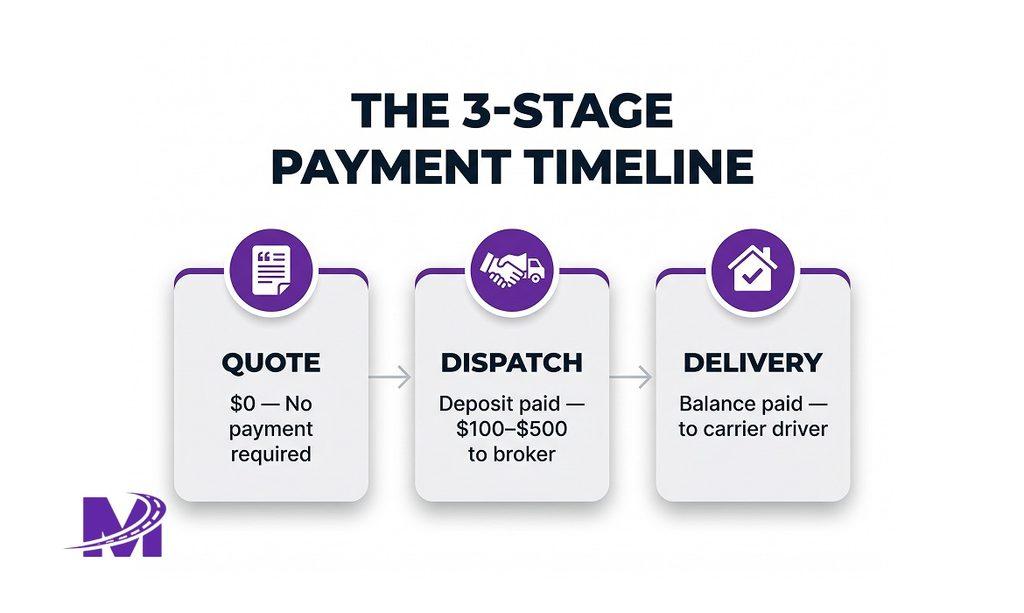
The Standard Three-Stage Payment Timeline
| Stage | When It Happens | What You Pay |
| Quote | Before booking | Nothing. No legitimate broker charges for a quote. |
| Dispatch / Booking | When a carrier is assigned | Broker deposit: typically $100–$500, paid to the broker. |
| Delivery | When your car arrives | Remaining balance paid directly to the carrier driver, usually in cash or certified funds. |
This structure is intentional and protects both parties. You pay the carrier only after your vehicle is in your hands and you have inspected it. The broker collects their fee at dispatch because that is when their work – finding and vetting a carrier – is complete. Learn what to check at delivery in our guide on state-to-state car transport.
What the Car Shipping Deposit Actually Pays For
The deposit is not a hold or a security payment in the traditional sense. It is the broker’s commission – the fee they charge for sourcing a licensed, insured carrier, negotiating the rate, handling dispatch, and managing communication through delivery. This is why the deposit amount closely tracks the broker’s margin on the deal. On a $900 shipment where the broker earns $200–$250, the deposit is typically in that range. See the complete guide to car shipping in 2026 for full context on how pricing is structured.
Why Brokers Collect It at Dispatch, Not at Booking
Collecting at dispatch rather than at booking serves a specific purpose: it proves a carrier has actually been secured before any money changes hands. Before dispatch, a broker has only searched the load board. The deposit triggering at the moment of carrier assignment means you are paying for a confirmed result, not a promise. Reputable brokers operating the car transport service model will not charge you until that carrier is assigned.
Why the Carrier Gets Paid at Delivery
The carrier receives the bulk of the payment – typically 75–90% of the total shipping cost – upon delivery. This is the structural protection that gives you leverage as the customer. If the vehicle arrives with new damage, you have not yet paid the person responsible for it. You can document the damage on the Bill of Lading before handing over payment. This delivery-payment model is standard across the industry and enforced by FMCSA regulations governing auto transport carriers.
How Much Should a Car Shipping Deposit Be?
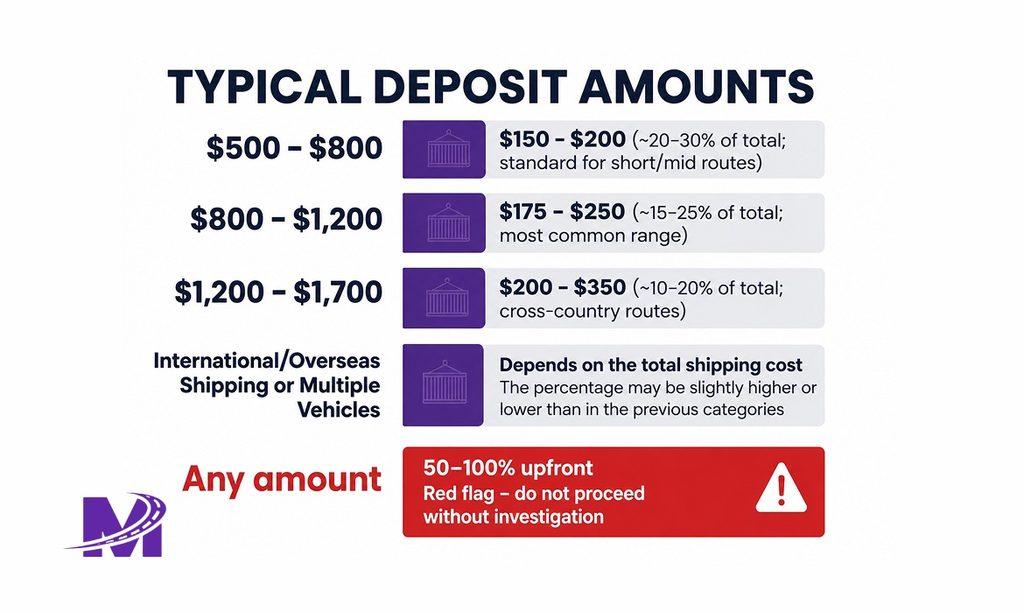
The deposit amount varies by broker, route, and total shipment cost. There is no universal fixed rate, but there are industry norms. Knowing them helps you identify when a deposit request is out of range. Use the Monarch quote calculator to see what total costs look like on your route before evaluating deposit amounts.
| Total Shipping Cost | Typical Deposit | What This Represents |
| $500 – $800 | $150 – $200 | ~20–30% of total; standard for short/mid routes |
| $800 – $1,200 | $175 – $250 | ~15–25% of total; most common range |
| $1,200 – $1,700 | $200 – $350 | ~10–20% of total; cross-country routes |
| International/Overseas Shipping or Multiple Vehicles | Depends on the total shipping cost | The percentage may be slightly higher or lower than in the previous categories |
| Any amount | 50–100% upfront | Red flag – do not proceed without investigation |
A deposit that exceeds 50% of the total quoted price is worth questioning. A deposit required before a carrier has been assigned is a structural red flag. A deposit paid by wire transfer, Zelle, or cryptocurrency with no written contract is a scam pattern. For the full list of warning signs, see: How to Spot and Avoid Car Shipping Scams in 2026.
Broker Deposit vs. Carrier Deposit: Key Differences
Most guides treat all deposits as equivalent. They are not. The deposit structure and refund terms differ significantly depending on whether you are booking through a broker or directly with a carrier. This distinction matters more than most customers realize. Before booking, always confirm the car transport service structure in writing.
Booking Through a Broker
Booking Directly With a Carrier
Most customers book through brokers because carriers rarely work with individual customers directly – they lack customer service infrastructure, do not accept credit cards, and prioritize commercial clients. For a detailed comparison, see: Door-to-Door vs. Terminal-to-Terminal: Which Logistics Model Fits You?
What Happens If the Carrier Drops Your Shipment After You’ve Paid a Deposit?
This scenario – a carrier accepting your load and then canceling before pickup – happens more often than the industry publicly acknowledges. It usually occurs because the carrier found a higher-paying load on the same route, had an equipment issue, or the broker underpriced the shipment and no carrier would actually run it at that rate. Understanding your rights in this situation is critical. Learn how to choose a reliable company in our guide on how to choose the right auto transport company.
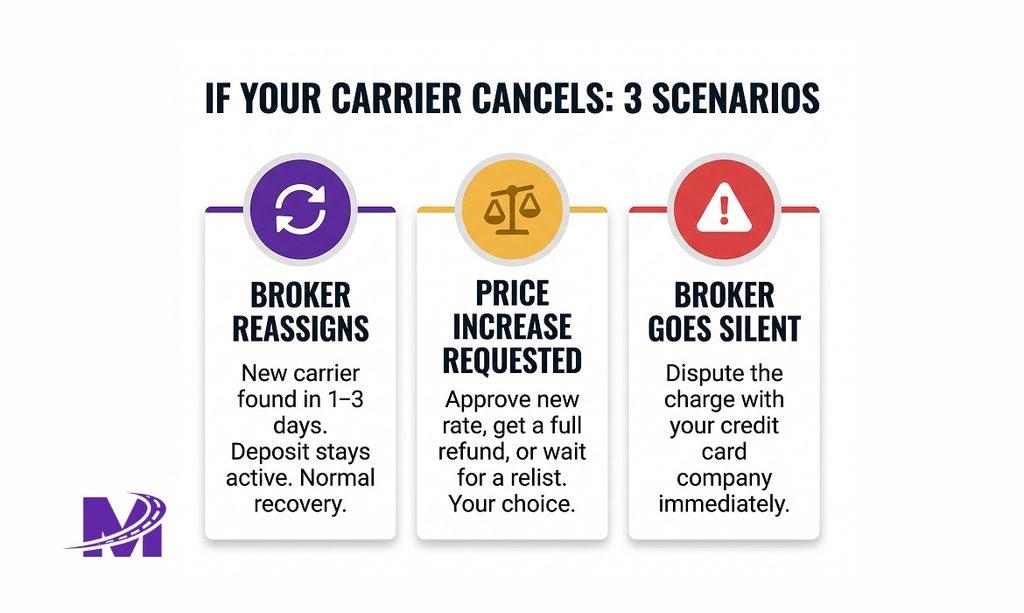
Scenario 1: Carrier Cancels, Broker Reassigns
If a carrier drops the load, a reputable broker immediately re-posts it to the load board and finds a replacement. Your deposit remains active with the broker. You may experience a delay of one to three days while a new carrier is sourced. This is the normal recovery path and requires no action from you beyond confirming the new pickup window.
Scenario 2: Broker Cannot Find a Replacement
If the broker quoted a rate that no carrier will accept – a common problem with brokers who use lowball pricing to win customers – you may receive a call asking you to authorize a higher total price to attract a carrier. You have three options: approve the price increase, decline and request a full refund of your deposit, or accept a delay while the broker reworks the listing. A full refund is your right if the broker cannot deliver the service at the agreed price. Confirm this in writing before booking. See what makes pricing realistic in our cost to ship a car between states guide.
Scenario 3: Broker Becomes Unresponsive
If the broker stops communicating and has collected a deposit, this is a scam pattern. Immediately dispute the charge with your credit card company. This is the primary reason to always pay your broker deposit by credit card rather than wire transfer, Zelle, Venmo, or cash. Credit card disputes are governed by the Fair Credit Billing Act and typically result in a full chargeback within 30–60 days. Wire transfers have no equivalent protection. For the full red-flag checklist, see: How to Spot and Avoid Car Shipping Scams in 2026.
Hidden Fees That Appear After the Deposit: What to Watch For
The deposit is the most visible payment in car shipping, but it is not always the only unexpected charge. Several fees regularly surface after a customer books – sometimes legitimately, sometimes as bad-faith add-ons. Knowing the difference protects you. If you encounter pricing disputes, it helps to understand how car transport service pricing should work.
| Fee Type | Typical Amount | Legitimate? | What to Do |
| Fuel surcharge added post-booking | $50–$150 | Only if disclosed upfront | Refuse if not in original quote; request written justification |
| Carrier price increase (bait-and-switch) | $100–$400 | No – red flag | Request full refund of deposit; walk away |
| Remote or rural area fee | $50–$200 | Yes, if disclosed | Ask before booking if your location is rural or gated |
| Inoperable vehicle surcharge | $100–$300 | Yes | Disclose vehicle condition upfront to avoid surprise |
| Expedited service fee | $150–$500 | Yes | Opt in explicitly; do not assume it is included |
| Gate or condo access fee | $50–$100 | Sometimes | Tell broker upfront if delivery address has access restrictions |
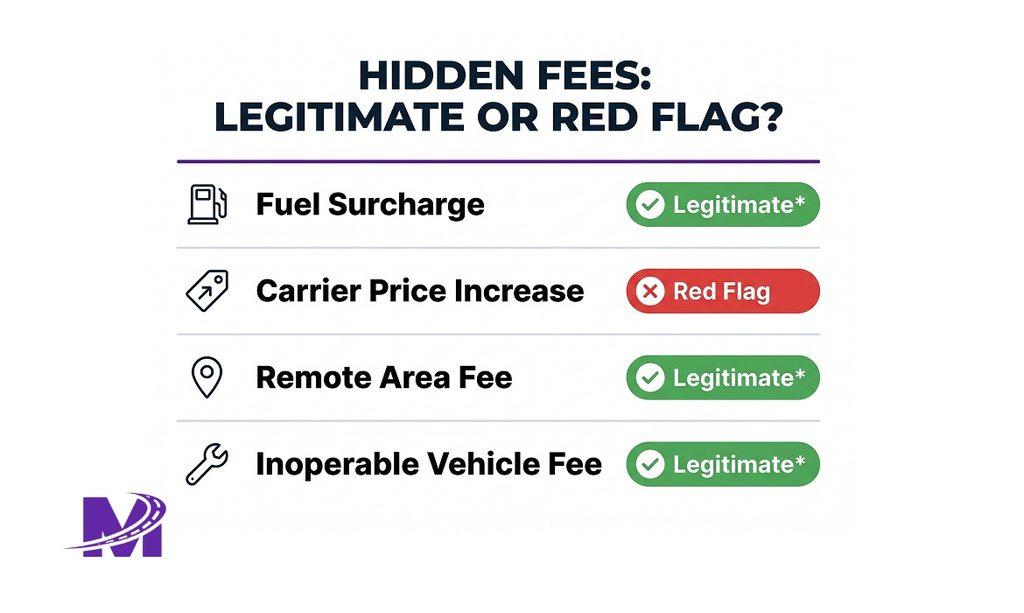
The most common post-booking problem in the industry is the carrier price increase after lowball quoting. A broker quotes $750 to win the business, then calls three days later to say no carrier will accept the load at that rate and the customer needs to authorize $950. If this happens to you, you are entitled to a full deposit refund. Do not feel pressured to approve the increase under a time deadline.
How to Protect Your Deposit When Shipping a Car
Five rules that eliminate the majority of deposit-related problems. Before booking any car transport service, confirm each one applies to your broker.
For the complete guide to evaluating brokers, see: How to Choose the Right Auto Transport Company: Red Flags and Green Flags.
What ‘Fully Refundable Deposit’ Actually Means in Auto Transport
The phrase ‘fully refundable deposit’ appears in the marketing of almost every auto transport broker. The real-world application varies significantly. Understanding when refunds apply – and when they do not – prevents misunderstandings. If you are uncertain about the process, getting a car transport quote first gives you a transparent baseline for comparison.
When You Are Entitled to a Full Refund
When Partial or No Refund Typically Applies
The industry norm for reputable brokers: full refund if canceled before carrier assignment; partial or no refund if canceled after carrier assignment and within the pickup window. Any broker who claims all deposits are non-refundable under all circumstances is operating outside normal industry practice. For more on what the transport process looks like from start to finish, see: State-to-State Car Transport: From Pickup to Delivery.
Final Thoughts: The Deposit Is Not the Problem – Lack of Transparency Is
A deposit in auto transport is a normal and legitimate part of the payment structure. It represents the broker’s earned commission for the work of sourcing and assigning a licensed carrier to your shipment. When it is collected at the right time – after carrier assignment, not before – and at the right amount – 15–25% of the total, not 50–100% – it is a reasonable business practice that also protects you by ensuring your balance is paid only after delivery.
The problems occur when the deposit is collected before a carrier exists, when the total is unusually high, when refund terms are buried or nonexistent, and when payment methods that prevent chargebacks are required. Those are not deposit problems. Those are scam indicators. Knowing the difference is the whole game in auto transport.
Before booking any shipment: pay by credit card, confirm the carrier-assignment trigger, get the refund policy in writing, and verify FMCSA registration. Those four steps eliminate the vast majority of deposit-related problems. Ready to see what your route actually costs? Get an instant quote from Monarch Transport Group – transparent pricing, no deposit until a carrier is assigned.
FAQ: Car Shipping Deposit
Most reputable auto transport brokers charge a deposit of $100 to $500, which represents roughly 15 to 25 percent of the total shipping cost. The deposit covers the broker’s commission for finding and assigning a licensed carrier. The remaining balance – typically 75 to 85 percent of the total – is paid directly to the carrier driver at delivery.
A legitimate deposit should only be charged after a licensed, insured carrier has been specifically assigned to your shipment – not at the time of quoting, and not before the broker has confirmed a driver. Charging a deposit before carrier assignment means you are paying for a service that has not yet been performed. This is one of the clearest distinctions between reputable brokers and problematic ones.
In most cases, yes – if you cancel before a carrier is assigned, the deposit should be fully refundable. If you cancel after a carrier has been confirmed and is within the pickup window, partial or no refund may apply, since the carrier held a spot on their schedule. Always confirm the refund policy in writing before paying. Any broker who refuses to provide written refund terms is a red flag.
Always pay by credit card. Credit card payments are protected under the Fair Credit Billing Act, which allows you to dispute charges if the service is not delivered. Wire transfers, Zelle, Venmo, Cash App, and cryptocurrency have no equivalent chargeback protection. If a broker refuses to accept credit card payment or insists on wire transfer only, do not proceed. This is a consistent pattern in auto transport scams.
The deposit pays the broker’s commission – the fee they earn for sourcing a carrier from the national load board, vetting their credentials, negotiating the rate, and managing dispatch. Brokers do not own trucks. Their revenue comes from this margin between the total customer price and the rate paid to the carrier. The deposit amount typically corresponds closely to the broker’s margin on the shipment.
If a broker cannot find a carrier at the quoted price, they may ask you to authorize a higher rate or offer a full refund of your deposit. You are entitled to a full refund if the broker cannot fulfill the service at the agreed price. Do not accept pressure to approve a price increase under a deadline. Request the refund in writing. If the broker becomes unresponsive, dispute the charge with your credit card company immediately.
After – always. The deposit should be triggered by carrier assignment, not by the act of booking. Before carrier assignment, the broker has only searched a load board. After carrier assignment, a specific, licensed, insured driver has committed to your shipment and the broker’s work is complete. Any broker who charges before this point is collecting payment for a promise, not a result.
Some carriers who work directly with customers charge no deposit, collecting the full amount at delivery. However, most individual customers book through brokers, who always charge a deposit as their commission. A few brokers advertise zero deposit but build the fee into a higher total price. What matters is the total cost and the refund policy, not whether the fee is labeled as a deposit or included in a single delivery payment.

Related articles

Car Shipping by Train: Costs, Process & What to Expect in 2026
IN THIS ARTICLE: The Two Faces of Rail Transport: Consumer vs. Commercial Why Choose the Tracks? (The Human Perspective) Dimensions and Constraints: Will Your Car Fit? The “Hidden” Logic of

Car Shipping Insurance: What’s Actually Covered (And What’s Not)
IN THIS ARTICLE: The Most Important Distinction Nobody Tells You Upfront What Car Shipping Insurance Actually Covers What Is NOT Covered – The Real Exclusions Coverage Limits – What the

Complete Guide to Car Shipping in 2026
The landscape of American mobility has shifted, making vehicle logistics more accessible and seamless than ever before. Understanding this new norm is the first step toward a stress-free relocation that

How Long Does It Take to Ship a Car? Realistic Timelines by Route & Season
IN THIS ARTICLE: The Two Timelines Nobody Separates (But Should) Realistic Transit Times by Route Distance Dispatch Time by Season: The Variable Nobody Controls How Route Type Affects Your Timeline

How Much Does It Cost to Ship a Car Between States?
IN THIS ARTICLE: Average Cost Breakdown by Distance Primary Factors Influencing Your Shipping Quote Geographic Influence on Pricing Understanding the Quote Structure The Impact of Seasonality on Auto Transport Rates

How to Choose the Right Auto Transport Company: Red Flags and Green Flags
IN THIS ARTICLE: First, Understand How the Industry Actually Works 🚩 Red Flags – Walk Away Immediately ✅ Green Flags – Signs You Found a Reliable Company Broker vs. Carrier

How to Ship a Car to Another State for a Job Relocation
IN THIS ARTICLE: Why Shipping a Car Makes More Sense Than Driving During a Job Move How Much Does Car Shipping Cost for a Job Relocation? Does Your Employer Cover

What Documents Do You Need to Ship a Car Across State Lines?
IN THIS ARTICLE: Key Takeaways Quick Reference: Documents by Situation Document 1: Government-Issued Photo ID Document 2: Bill of Lading – The Most Important Document in Car Shipping Documents for