

IN THIS ARTICLE:
- What Is Snowbird Car Shipping and How Does It Work?
- When to Book Snowbird Auto Transport to Florida
- How Much Does Snowbird Car Shipping to Florida Cost?
- Open vs. Enclosed Transport: Which One Do Snowbirds Actually Need?
- Most Popular Snowbird Car Shipping Routes to Florida
- How to Prepare Your Car for Snowbird Shipping
- What to Expect at Pickup and Delivery
- Car Shipping Insurance: What Is Actually Covered?
- How Snowbirds Handle the Car Situation: Shipping vs. Other Options
- 5 Mistakes Snowbirds Make When Shipping a Car to Florida
- Final Thoughts: Planning Your Snowbird Car Shipping the Right Way
- FAQ: Snowbird Car Shipping to Florida
Every fall, roughly a million seasonal residents make the trip south – from New York, Ohio, Michigan, and the rest of the northern states down to Florida’s sun. Most of them have figured out that driving that distance twice a year isn’t worth it anymore. A round-trip New York–to–Miami drive adds nearly 3,000 miles to your odometer, two hotel nights each way, fuel, and the kind of fatigue that takes days to shake.
Snowbird car shipping solves all of that. You fly south, your car arrives a few days later, and you spend the winter exactly where you planned to be – without the highway grind.
This guide covers everything you need to get your vehicle to Florida safely and efficiently: when to book, how much it costs, which transport type fits your car, what to do at pickup and delivery, and the questions every snowbird eventually asks. If you are also planning the return trip, see our companion guide: Snowbird Return – How to Ship Your Car Back North.
What Is Snowbird Car Shipping and How Does It Work?
Snowbird car shipping is the seasonal transport of a vehicle from a northern home state to Florida, typically in October or November, ahead of the winter stay. A licensed auto transport broker matches your shipment with a vetted carrier, your vehicle is loaded onto a hauler at or near your door, and it arrives at your Florida address in three to seven days – usually without you needing to be present for any part of the process.
The full sequence is straightforward:
Door-to-door service is the standard for most snowbird routes. The driver comes to your home in the North and delivers to your Florida address. In dense urban areas or gated communities, a driver may arrange a nearby meet point if the truck cannot maneuver on residential streets.
For a full overview of how the auto transport process works from start to finish, see: State-to-State Car Transport: From Pickup to Delivery.
When to Book Snowbird Auto Transport to Florida
Timing is the single biggest factor that determines whether your snowbird car shipping experience is smooth or frustrating. The fall southbound rush runs from October through November. During those eight weeks, carrier demand on Florida routes spikes sharply, rates climb, and available pickup windows shrink.

The Southbound Peak Calendar
| Timeframe | Demand Level | What to Expect |
| Early September | Low | Best rates, most carrier flexibility, 1–2 week lead time sufficient |
| Late September – early October | Building | Book 3–4 weeks out; rates beginning to rise |
| Mid-October – November | Peak | Book 4–6 weeks in advance; carrier slots fill fast on FL routes |
| December – January | Moderate | Late-season travelers; rates ease slightly after Thanksgiving rush |
Rule of thumb: book 4 to 6 weeks before your desired pickup date during October and November. If your schedule is flexible by a few days, say so when you request quotes. A 3-to-5-day pickup window instead of a single hard date makes it significantly easier for the broker to match you with available capacity – and often lowers the price.
The customers who wait until two weeks before they want to leave consistently pay more and have fewer choices. Carriers on high-demand corridors are already committed. Brokers have to raise the incentive on the load board to attract remaining drivers, and that cost passes directly to the shipper.
How Much Does Snowbird Car Shipping to Florida Cost?
Cost depends on four variables: distance, vehicle size, transport type, and timing. There is no fixed rate – every shipment is priced based on current carrier availability on that specific corridor. That said, realistic ballparks are useful for planning.
Estimated Cost Ranges by Route (Open Transport, Standard Sedan)
| Route | Distance | Estimated Cost Range |
| New York → Miami, FL | ~1,280 mi | $900 – $1,300 |
| Chicago, IL → Orlando, FL | ~1,100 mi | $850 – $1,200 |
| Detroit, MI → Tampa, FL | ~1,150 mi | $850 – $1,200 |
| Boston, MA → Fort Lauderdale, FL | ~1,500 mi | $950 – $1,400 |
| Columbus, OH → Naples, FL | ~1,200 mi | $900 – $1,250 |
These ranges reflect open transport during normal booking windows. Peak-season surcharges in October–November can push rates 15–25% higher. SUVs, trucks, and large vehicles cost more than sedans because they take up more deck space on the hauler.
For an exact quote on your route, use the Monarch shipping cost calculator – enter your origin, destination, and vehicle type to get a real-time estimate.
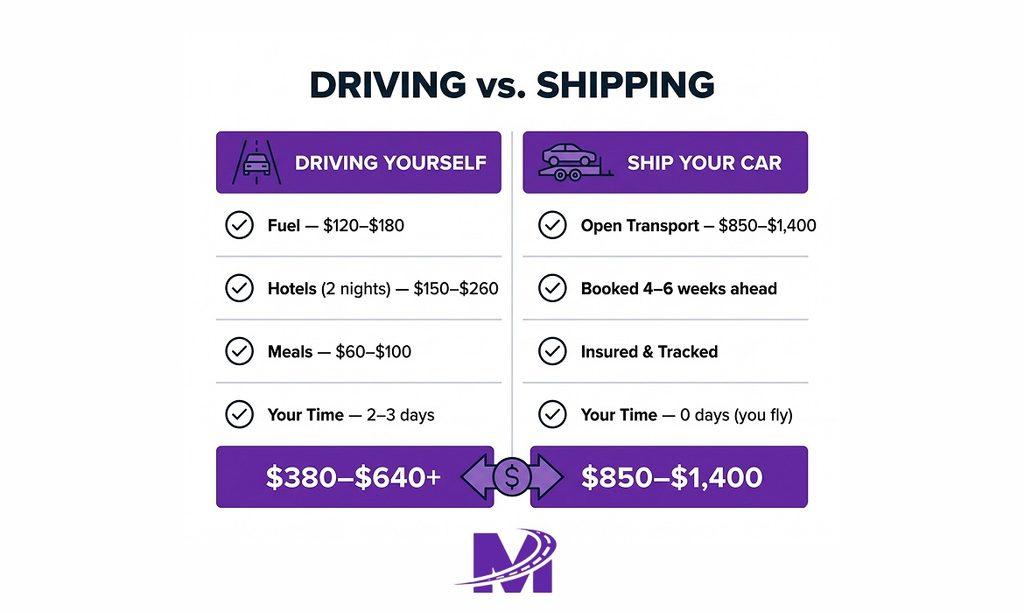
What Drives the Price Up or Down
For a detailed breakdown of all the factors that affect pricing, see: How Much Does It Cost to Ship a Car Between States?
Open vs. Enclosed Transport: Which One Do Snowbirds Actually Need?
Open transport is the right choice for the vast majority of snowbird shipments. It is the industry standard – the same type of hauler you see on the highway loaded with new vehicles from the factory. Your car is exposed to weather and road debris, but it is secured, loaded by a professional, and delivered in the same condition it left.
Enclosed transport makes sense in specific situations:
For a standard sedan, crossover, or even a newer SUV, open transport is the practical choice. The cost savings are real – typically $300–$600 on a Florida route – and the actual risk difference for a modern, undamaged vehicle is minimal.
See our full comparison: Open vs. Enclosed Auto Transport: Which Should You Choose?.
Most Popular Snowbird Car Shipping Routes to Florida
Florida draws seasonal residents from across the Northeast and Midwest, and carrier infrastructure reflects that. The high-volume corridors are serviced daily, which means better availability and more competitive pricing. Less-traveled routes require more lead time.
| Route | Transit | Carrier Availability | Notes |
| Northeast → Miami / Fort Lauderdale | 3–5 days | Very high (I-95 daily) | Most competitive rates in the country |
| Midwest (OH, IL, MI) → Orlando / Tampa | 4–6 days | High (I-75 corridor) | Stable pricing; strong carrier pool |
| Mid-Atlantic (PA, NJ, MD) → SW Florida | 4–6 days | High | Naples, Sarasota routes well-serviced |
| New England (MA, CT) → Palm Beach / Boca | 4–6 days | Moderate-High | Book slightly earlier for NH/VT pickups |
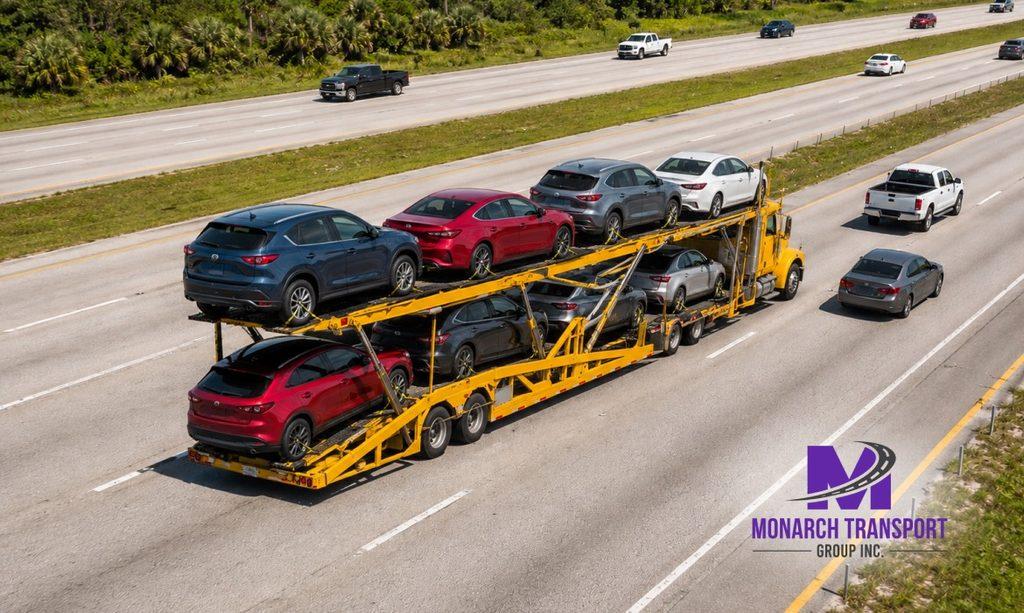
The I-95 corridor connecting the Northeast to South Florida is the single most active snowbird transport route in the country. If you are in the New York metro area, carriers are running this corridor daily from September through December. Availability is high, rates are competitive, and transit times are reliable.
Southwest Florida destinations – Naples, Fort Myers, Sarasota – are well-serviced due to the high concentration of seasonal residents in those markets, but they are slightly off the main I-95 trunk. Budget an extra day for delivery and book a week earlier than you would for Miami or Fort Lauderdale. See all available car transport options for your route.
How to Prepare Your Car for Snowbird Shipping
A few practical steps before pickup protect you legally and make the whole process go more smoothly.
Vehicle Prep Checklist
For a complete preparation checklist, see: How to Prepare Your Car for Shipping: Step-by-Step Checklist.

What to Expect at Pickup and Delivery
At Pickup
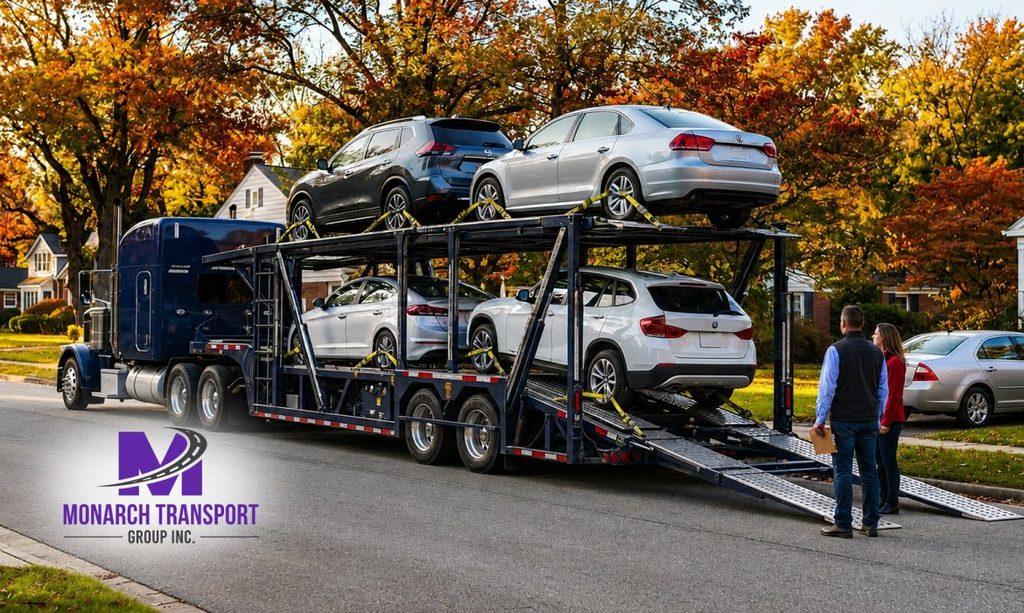
The driver arrives within the agreed pickup window – typically a range of one to two days rather than a specific hour. Before loading, they walk around the vehicle and complete the Bill of Lading: a condition report that records every existing scratch, dent, chip, or scuff. Review this document carefully. If you see damage that is not noted, add it yourself before you sign. Once you sign the Bill of Lading, anything not on it is presumed to have happened in transit.
After the condition inspection, you hand over the keys, collect a copy of the Bill of Lading, and the driver loads the vehicle onto the trailer. For open transport, your car is typically secured with wheel straps and positioned on one of two levels of the hauler.
During Transit
Most brokers provide a tracking update or estimated delivery window once the carrier is dispatched. Transit times on Florida routes run three to five days from the Northeast and four to six days from the Midwest. Actual timing depends on the carrier’s route, co-loaded stops, and any weather delays on the I-95 or I-75 corridors.
Do not plan around a specific delivery hour. A delivery estimate is a range, not an appointment. Coordinate with someone at your Florida address who can receive the vehicle if you are arriving separately.
At Delivery
Do a complete walk-around of the vehicle with the driver present before signing anything. Compare the current condition to your Bill of Lading from pickup. Look at all four panels, the roof, the bumpers, and the undercarriage. If you notice any new damage, note it on the delivery Bill of Lading and photograph it immediately, with the driver and the trailer visible in the frame.
Any damage claim must be documented at delivery. Do not sign a clean delivery receipt if there is damage you have not resolved with the driver on the spot. Once you sign, the delivery is considered accepted as described.
Car Shipping Insurance: What Is Actually Covered?
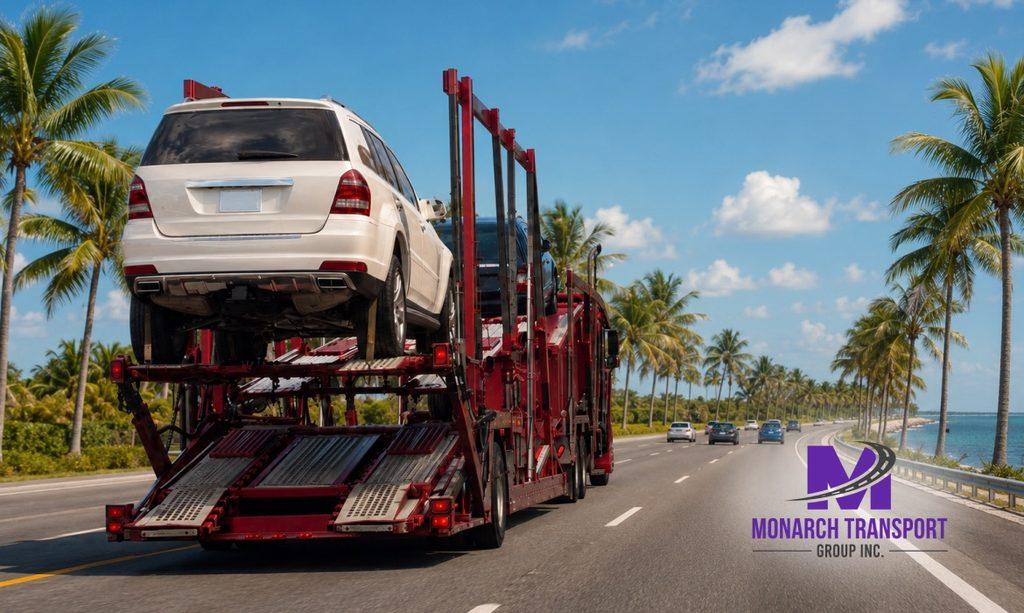
Every FMCSA-licensed carrier is required by federal law to carry cargo insurance. This coverage applies to physical damage caused during transport – not to pre-existing conditions, not to personal items inside the vehicle, and not to mechanical or electrical problems that surface after delivery.
The minimum cargo insurance requirements set by the FMCSA are $5,000 per vehicle for open transport and $20,000 per vehicle for household goods carriers. Many carriers carry higher limits. Ask your broker to confirm the carrier’s insurance before you book.
If you have a high-value vehicle – a luxury car, a classic, or anything with significant modifications – consider supplemental insurance through your own auto policy or a third-party transport insurance provider. Standard carrier cargo coverage may have deductibles or exclusions that leave gaps.
Keep in mind: personal items left in the vehicle are not covered by carrier cargo insurance under any circumstances. Learn more about what car shipping insurance actually covers.
How Snowbirds Handle the Car Situation: Shipping vs. Other Options
Not every snowbird ships a car south. The options each have real trade-offs, and the right choice depends on how long you stay, how much you drive in Florida, and what your budget looks like over a three-to-five year horizon.
Option 1: Seasonal Shipping (Most Common)
Ship one vehicle south in the fall, back north in the spring. This is the most practical setup for most snowbirds: your car is always with you, you avoid the wear and tear of the drive, and the annual shipping cost is predictable. Total annual shipping cost for a standard sedan on a New York–Florida route runs approximately $1,800 to $2,600 per year round-trip. Get an instant quote for your specific route.
Option 2: Keep a Dedicated Car in Florida
Some snowbirds buy or keep a second vehicle permanently in Florida. This eliminates shipping costs but adds insurance, registration, storage, and maintenance for a car that sits idle half the year. In practice, the carrying costs of a second vehicle often exceed annual shipping costs within two to three years – especially given Florida’s insurance rates, which have increased significantly in recent years.
Option 3: Long-Term Vehicle Storage
If you prefer to fly and use rideshare or rentals in Florida, some snowbirds store their northern car at a covered or climate-controlled facility while they’re away. Monthly storage rates at quality facilities in the Northeast run $100–$300 per month depending on the market and amenity level. For a five-month stay, that’s $500–$1,500 – often cheaper than shipping, but leaves you without your own vehicle in Florida.
Most snowbirds who run the full numbers over several years find seasonal auto transport to be the most cost-efficient and least complicated solution, especially on high-volume I-95 corridor routes where carrier availability is strong and pricing is competitive. Request a quote for your snowbird route and lock in your rate before peak season.
5 Mistakes Snowbirds Make When Shipping a Car to Florida
For more on avoiding industry pitfalls, see: How to Spot and Avoid Car Shipping Scams in 2026.
Final Thoughts: Planning Your Snowbird Car Shipping the Right Way
Snowbird car shipping to Florida is one of the most predictable and well-serviced segments of the entire auto transport industry. The routes are established, the carrier networks are robust, and the seasonal pattern is the same every year. That predictability works in your favor – if you use it.
Book early. Give a flexible pickup window. Confirm your carrier’s insurance. Do the walk-around at both ends. Those four steps resolve the vast majority of issues that snowbirds encounter.
The I-95 and I-75 corridors run with heavy carrier traffic from September through December. Competition keeps pricing fair and availability strong for customers who plan ahead. The snowbirds who struggle are the ones who wait too long and then accept whatever is left.
Ready to get started? Get an instant quote for your route and see current rates for your specific origin and destination. Or explore the full range of car transport services at Monarch Transport Group.
FAQ: Snowbird Car Shipping to Florida
Book 4 to 6 weeks before your desired pickup date during the October–November southbound rush. Outside of peak season, 2 to 3 weeks is usually sufficient. Earlier booking gives you more carrier options, better pricing leverage, and a wider choice of pickup windows. Waiting until one to two weeks before departure during peak season typically results in higher rates and limited availability.
On common snowbird routes – New York to Miami, Chicago to Orlando, Detroit to Tampa – open transport for a standard sedan typically runs $850 to $1,400 depending on the exact route, time of booking, and current carrier availability. Enclosed transport adds 30 to 50 percent to those figures. SUVs and trucks cost more than sedans due to their larger footprint on the hauler. Peak-season rates in October–November run 15 to 25 percent higher than off-peak.
You can leave a limited number of small, secured items in the trunk, but carriers are not legally insured to transport personal belongings. Federal regulations restrict what can be in the vehicle. Electronics, luggage, valuables, and any loose items should travel with you. Anything left in the car is transported at your risk and is not covered by the carrier’s cargo insurance policy.
Transit time on the New York to Florida corridor is typically 3 to 5 days for open transport under normal conditions. Transit begins once the carrier physically picks up your vehicle – not when you book. Add 1 to 3 days for dispatch time between booking and actual pickup, depending on carrier availability at your location. Midwestern routes (Chicago, Detroit) to Florida generally run 4 to 6 days in transit.
Open transport is the standard option: your car rides on an open multi-car hauler, exposed to weather and road debris. It is safe, affordable, and appropriate for most vehicles. Enclosed transport uses a fully covered trailer and costs roughly 30 to 50 percent more. Enclosed is recommended for luxury vehicles, classic cars, exotics, and vehicles with custom bodywork. For a standard sedan, crossover, or newer SUV, open transport is the practical choice.
No. For pickup, you can designate another adult to hand over the keys and sign the Bill of Lading, provided they have the authority to release the vehicle. For delivery, someone must be present at the destination to inspect the vehicle and sign for receipt. If you are flying into Florida before the car arrives, a trusted neighbor or property manager at your Florida address can accept the delivery.
Note any new damage on the delivery Bill of Lading before you sign, and photograph everything immediately with the driver and trailer visible. Do not sign a clean delivery receipt if there is unresolved damage. Contact your broker within 24 hours to initiate a damage claim. The carrier’s cargo insurance covers transport-related physical damage, but only if it is documented at the point of delivery.
Yes, September rates are typically lower than October and November. The peak demand surge for southbound Florida routes begins in mid-October as the bulk of snowbirds begin their annual migration. Shipping in early to mid-September, before demand spikes, can save 15 to 25 percent compared to peak-season pricing on the same route.
Related articles

Auto Transport Broker vs. Carrier: Which One Should You Use?
IN THIS ARTICLE: What Is an Auto Transport Broker? What Is an Auto Transport Carrier? The Key Differences Side by Side Does Using a Broker Cost More? What Is “Dual

Buying a Motorcycle at Auction or Out of State? Here’s How to Get It Home
IN THIS ARTICLE: The Three Ways to Get a Motorcycle Home Buying at a Salvage Auction (Copart, IAA) – What’s Different Buying from a Private Seller Out of State –

Can You Ship a Financed or Leased Car? Lender Rules Explained
IN THIS ARTICLE: Do I Need My Lender’s Permission to Ship a Car? Financed vs. Leased – Why the Difference Matters What a Standard Domestic Move Actually Requires When You

Cross-Country Car Shipping: How to Save Money Safely
IN THIS ARTICLE: Why “Cheap” Doesn’t Have to Mean “Dangerous” 1. Open Transport: The Industry Gold Standard for Savings 2. The Power of “Terminal-to-Terminal” Shipping 3. Timing the Market: The

How Long Does It Take to Ship a Car? Realistic Timelines by Route & Season
IN THIS ARTICLE: The Two Timelines Nobody Separates (But Should) Realistic Transit Times by Route Distance Dispatch Time by Season: The Variable Nobody Controls How Route Type Affects Your Timeline

How State-to-State Car Transport Works: From Pickup to Delivery
IN THIS ARTICLE: Understanding the Auto Transport Ecosystem Choose Your Transport Type The Process of Shipping Calculating the Cost and Timeline of State-to-State Car Transport The 2026 EV Transport Protocol

How to Ship a Car You Just Bought Online
IN THIS ARTICLE: Step 1: Get Quotes Before the Deal Closes Step 2: Choose Open or Enclosed Transport Step 3: Coordinate Pickup with the Seller Step 4: Inspect and Sign

How to Ship Your Electric Vehicle (EV) Safely in 2026
IN THIS ARTICLE: The Reality of EV Logistics in 2026 Why EVs Change the Math: The Weight Factor The “50% Rule”: Battery Safety and State of Charge (SoC) Vetting the