
Popular State-to-State Car Shipping Routes: Costs & Transit Times Compared (2026)
Calculate Shipping Cost
IN THIS ARTICLE:
- State-to-State Car Shipping Routes: Cost & Transit Time
- What factors influence the cost of shipping cars from one state to another?
- How long does transport between states actually take?
- Which State-to-State Routes Are Cheapest Per Mile?
- Open vs. Enclosed Transport for State-to-State Shipping
- Broker vs. Carrier: Who Actually Moves Your Car?
- How to Get an Accurate Quote for Your Route
- How to Prepare for a Multi-State Move
- Mistakes That Quietly Raise Your Bill
- Is Car Shipping Insurance Included?
- Conclusion
- FAQ About State-to-State Car Shipping Routes
Typical prices for moving a car from one state to another in 2026 are $500 to $1,950 for open transport, and transit time is 9 to 10 days for coast-to-coast shipping or about one day for short regional journeys. For the most popularly searched routes, prices vary based on the number of carriers that regularly run that route, the time of year, and the vehicle size, including Florida to New York, California to Texas, Texas to Florida, Illinois to California, and New York to California.
It discusses the common state-to-state courier and mail routes for 2026, offers realistic estimates of cost and time based on distance, and offers an explanation of why there is a difference of hundreds of dollars between two quotes for the same route.
Key Takeaways

State-to-State Car Shipping Routes: Cost & Transit Time
The list below shows the routes people most frequently search for and book, including short regional journeys, medium-distance moves, and full cross-country transfers. For a broader overview of state-to-state car shipping and what to expect when moving a vehicle between states, see our dedicated service guide. This is a general guide only, not a firm figure; since carrier availability changes week to week, the only way to get the exact price for your chosen dates is to request a real-time quote.
| Florida → New York | ~1,100 mi | $800 – $1,200 | 3 – 5 days |
| New York → Florida | ~1,100 mi | $750 – $1,150 | 3 – 5 days |
| California → Texas | ~1,400 mi | $950 – $1,400 | 3 – 6 days |
| Texas → Florida | ~1,150 mi | $800 – $1,250 | 3 – 5 days |
| Michigan → Florida | ~1,150 mi | $850 – $1,300 | 3 – 5 days |
| Illinois → California | ~2,000 mi | $1,150 – $1,650 | 5 – 8 days |
| New York → California | ~2,800 mi | $1,400 – $1,900 | 7 – 10 days |
| North Carolina → California | ~2,600 mi | $1,350 – $1,850 | 7 – 9 days |
| Florida → Washington | ~3,100 mi | $1,550 – $1,950 | 8 – 10 days |
| Georgia → Florida | ~350 mi | $450 – $650 | 1 – 2 days |
| Illinois → Michigan | ~300 mi | $400 – $600 | 1 – 2 days |
The price for shipping a car from Florida to New York isn’t necessarily the same as that for shipping from New York to Florida, even when the routes are the same, because of carrier availability, seasonal demand, and the difference between the number of outbound and return shipments – something to bear in mind if you’re comparing quotes for a route that you’ve seen priced differently elsewhere.
Some of these lanes are worth looking at more closely since the pricing pattern in each case gives you some useful information about the wider market.
Florida ↔ Northeast: the busiest seasonal corridor in the country
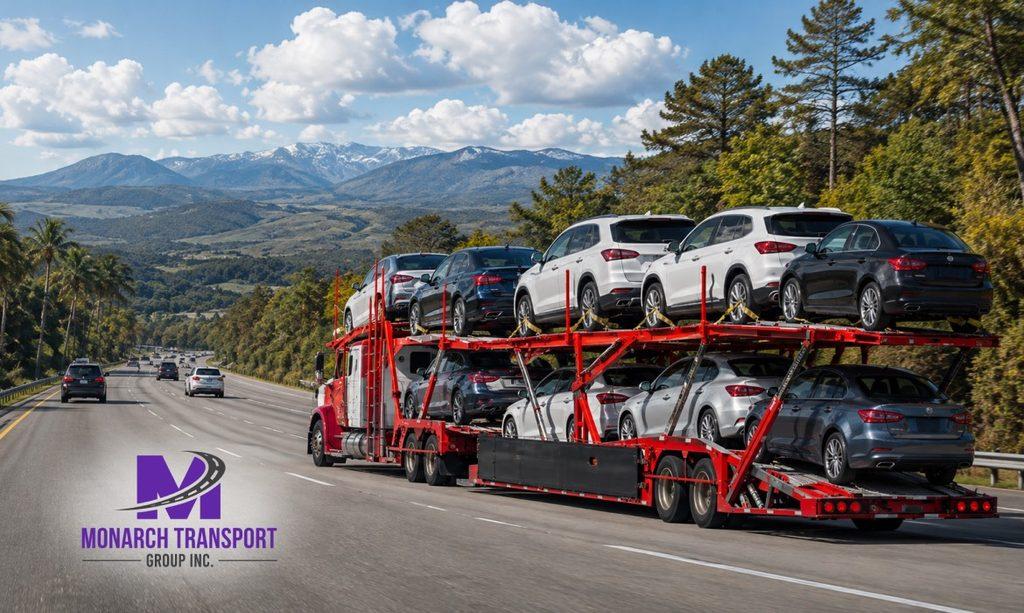
The routes from Florida to New York and vice versa are among the busiest in the United States, largely because of snowbirds, retirees, and people who have moved there permanently. Demand heading south increases each fall as seasonal residents move south, and demand heading north rises each spring as they return. This high traffic ensures a large supply of carriers, which is why this route charges competitive rates for the distance, even though it is popular and in high demand. Our guide on how to ship a car back north and our Florida snowbird car shipping guide explain exactly when to book on this route to avoid paying the seasonal premium.
California ↔ Texas: a dense, year-round lane
This route enjoys steady two-way traffic due to relocation, online vehicle purchases, and business travel between two of the country’s largest state economies. Because carriers rarely run this route empty in either direction, rates stay near the lower end of the scale for the distance, compared with other routes of the same length with less steady demand.
Coast-to-coast lanes: New York, North Carolina, and Florida to California or Washington
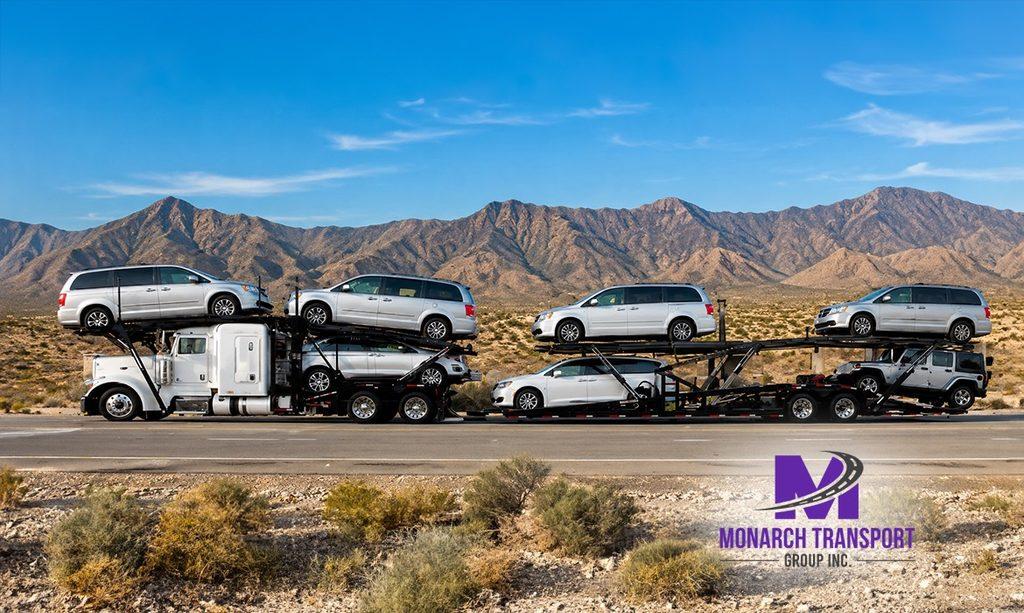
Although cross-country journeys have the lowest per-mile rate in this guide, they cost the most in total dollars. When your car is loaded, the driver usually covers about 400 to 500 miles each day, meaning a 2,800-mile trip will realistically take seven to ten days of traveling – though it could be longer if delays occur due to weather, mountain roads, or holiday traffic. Since California is one of the busiest destinations for these routes, carrier availability varies by direction and season.
How Much Does It Cost to Ship a Car From One State to Another in 2026?
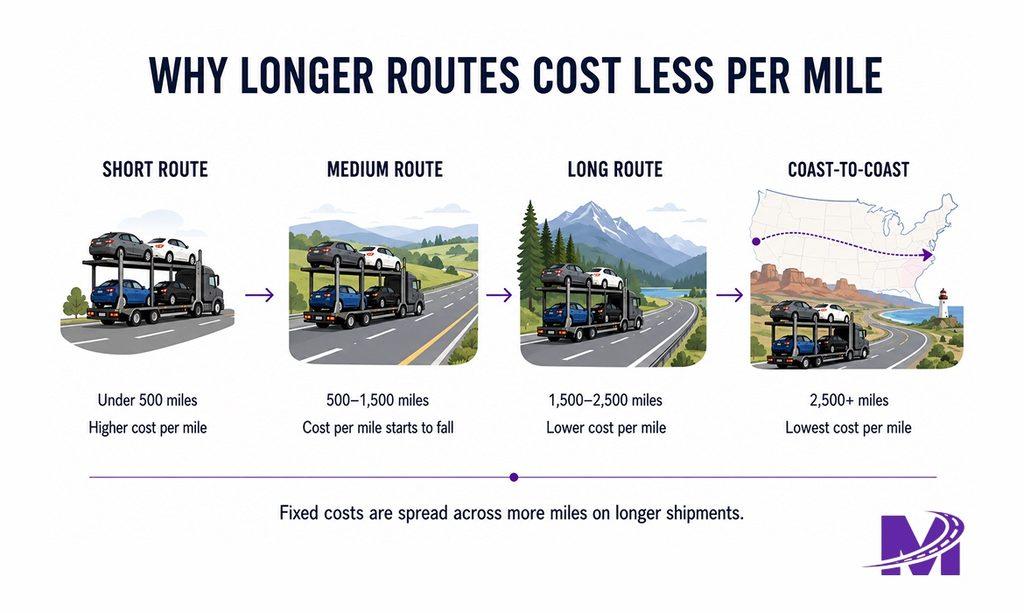
Distance forms the basis of the price, but the relationship is not linear. For short distances, the per-mile rate is higher because the carrier’s fixed costs – such as fuel, time, insurance, and loading – are spread over very few miles. However, when a route exceeds 1,500 miles, the per-mile rate drops markedly because the same fixed costs are now spread over a much longer journey.
| Under 500 miles | $400 – $750 | $1.30 – $2.20 |
| 500 – 1,000 miles | $650 – $1,050 | $0.90 – $1.20 |
| 1,000 – 1,500 miles | $850 – $1,300 | $0.75 – $1.00 |
| 1,500 – 2,500 miles | $1,100 – $1,700 | $0.55 – $0.80 |
| 2,500+ miles (coast-to-coast) | $1,400 – $1,950 | $0.45 – $0.65 |
These cost ranges apply to a typical sedan or SUV traveling on a standard corridor. For a complete breakdown of all the factors that affect the figure for a particular lane, see our guide on the cost of shipping a car between states.
What factors influence the cost of shipping cars from one state to another?
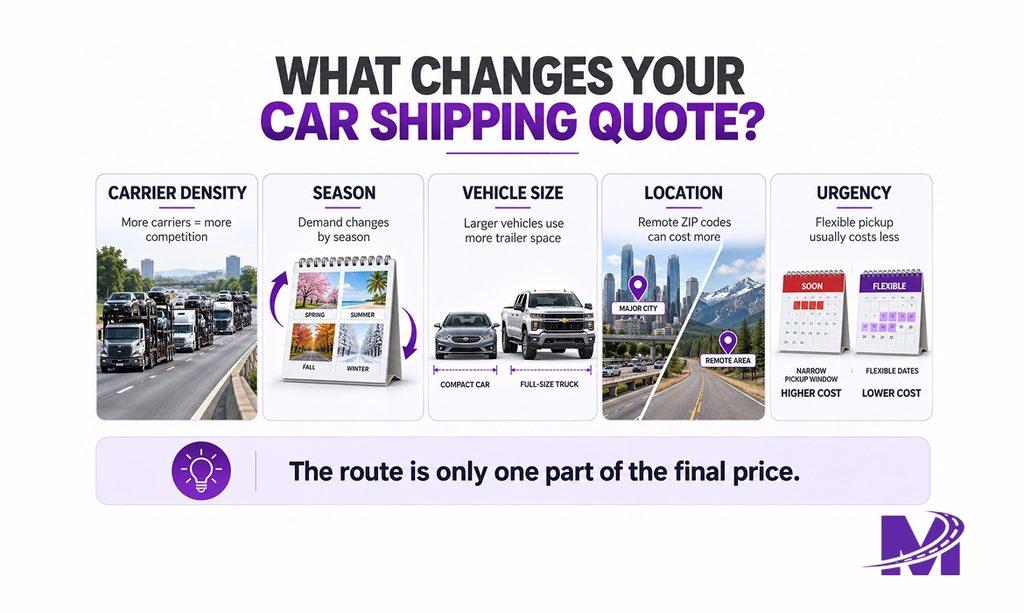
Two shipments using the same route can differ by hundreds of dollars. When you are moving a car to another state for a move, a purchase, or a relocation, the route itself is only one element of the price – the difference is usually due to one of these factors.
To get a more specific estimate for your route, use the car shipping calculator and enter your pickup, delivery, and vehicle details.
How long does transport between states actually take?
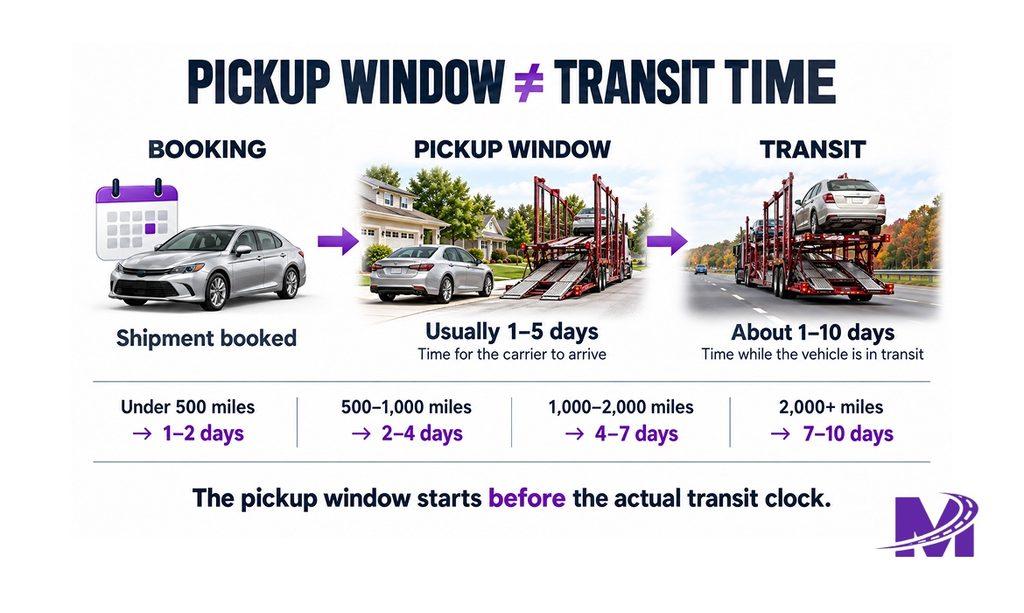
Allow about 1 to 10 days of transit time, depending on distance, plus a separate 1 to 5 day pickup window before the truck even picks up your car. Once your vehicle is on the truck, carriers usually cover about 400 to 500 miles each day, mainly because federal hours-of-service regulations limit how long a driver can legally remain on the road each day. For a complete explanation of how to interpret a pickup window as compared to an actual delivery date, refer to our guide on how long car shipping takes.
| Under 500 miles | 1 – 2 days | Single-day driving range for most carriers |
| 500 – 1,000 miles | 2 – 4 days | One to two overnight stops on route |
| 1,000 – 2,000 miles | 4 – 7 days | Multiple stops for other customers on the same load |
| 2,000+ miles (coast-to-coast) | 7 – 10 days | Full cross-country haul under daily driving limits |
The pickup window refers to the period – usually one to three days – when the driver assigned to you is expected to arrive. This is necessary because a single truck generally serves multiple customers on the same route and must account for traffic conditions, weather, and the time required to load at each stop. Although a lead time of at least 5 to 7 days helps, booking 1 to 3 weeks in advance gives your broker more flexibility to match your car with a suitable carrier, rather than paying a premium for immediate availability.
Which State-to-State Routes Are Cheapest Per Mile?
The cheapest routes per mile are typically those with high carrier demand and steady traffic, where trucks can fill multiple loads along the same corridor. Higher carrier density can also mean faster pickup, although it does not guarantee the lowest rate.
Sun Belt and coastal routes often benefit from strong year-round demand. Corridors connecting California, Texas, Florida, and the Northeast see consistent relocation and seasonal traffic, giving carriers more opportunities to combine shipments.
Low-density routes tend to cost more, especially when a pickup or delivery point is in a remote rural area or mountain town. If your exact address is far from major carrier corridors, using a nearby metropolitan area for pickup or delivery can sometimes reduce the cost and shorten the wait.
Open vs. Enclosed Transport for State-to-State Shipping
For state-to-state moves, open transport is the standard choice and the cheapest option on all the routes covered in this guide; enclosed transport generally costs 40 to 70 percent more, and this difference increases as the distance grows. Open carriers carry the vast majority of ordinary vehicles – such as sedans, SUVs, and trucks – using the same types of trailers that you see on the interstate. When it comes to a classic car, an exotic vehicle, or any other one that cannot be replaced, an enclosed transport trailer protects it from road debris and weather throughout the journey, a benefit that makes the extra cost worthwhile for a long haul where the vehicle is exposed for the longest time. Our complete comparison of open versus enclosed auto transport helps you decide what’s right for your vehicle.
Broker vs. Carrier: Who Actually Moves Your Car?
The owner of a truck both owns the truck and physically transports vehicles, while a broker such as Monarch Transport Group arranges your shipment by using a network of independently owned and insured carriers that have been checked and approved, rather than by operating its own fleet. National bookings are generally made via a broker because it is unlikely that a single carrier will cover all the routes across the country. On the other hand, a broker can match your route to the appropriate vetted carrier that is already operating on it, having first confirmed that the carrier has the necessary insurance. The guide we provide on brokers versus carriers explains who is responsible for what at each stage of the shipping process.
How to Get an Accurate Quote for Your Route
To get an accurate quote from state to state, you need four things: the exact ZIP codes for pickup and delivery, the year, make, and model of the vehicle, information as to whether it is powered by its own energy, and the earliest date on which you are available to pick up the vehicle. If the information given is vague, the price returned will also be vague and is likely to change after a carrier has actually examined the route. The quickest method of obtaining a real figure for your route is to use our shipping cost calculator – it only takes under a minute and shows the current carrier prices for your selected dates, not a general distance formula.
How to Prepare for a Multi-State Move
Preparation will safeguard you in terms of cost and also in the event that anything goes wrong regarding a claim for damage. Make sure that the fuel tank is left about one-quarter full, remove the toll tags and any loose objects, and take photographs of each panel in daylight before the carrier comes to collect the vehicle. We provide a full pre-shipping checklist which goes over the entire procedure.
Mistakes That Quietly Raise Your Bill
The majority of individuals who end up paying too much when moving from one state to another can usually identify the reason as being one of three mistakes that could have been avoided.
For a deeper look at trimming cost without cutting corners on safety, see our guide to saving money on cross-country shipping.
Is Car Shipping Insurance Included?
Yes – the assigned carrier’s cargo insurance covers your shipment according to the terms and limits of that policy, not a separate policy you have to buy, and not your personal auto insurance, which typically doesn’t extend to a vehicle in a carrier’s possession. Coverage details vary by carrier, so verify the policy and ask what exclusions or limits could apply to your vehicle before booking. Our guide to car shipping insurance coverage breaks down what’s typically covered, what’s excluded, and how to file a claim.
Conclusion
The minimum cost for a move between two states is set by distance, but carrier density, season, vehicle size, pickup location, and timing can all change the final quote. The routes and price ranges in this guide provide a useful starting point, but your actual cost depends on the details of your shipment.
If you’re not sure which type of transport fits your vehicle or situation, explore our full selection of car shipping services to compare your options. If you already know what you need and want to see what your route may cost, use our shipping calculator to enter your vehicle and route details and get an estimate.
FAQ About State-to-State Car Shipping Routes
In 2026, shipping a car to another state typically costs 500-1,950 with open transport, depending on the distance and route. Many standard state-to-state shipments fall in the 700-1,400 range, while shorter regional moves can cost less and long cross-country routes can reach the upper end of the range. The final price depends on factors such as route demand, vehicle size and condition, pickup and delivery locations, and how far in advance you book.
Open transport on a high-volume corridor, booked 1 to 2 weeks ahead with a flexible multi-day pickup window, is consistently the least expensive option.
Busy corridors between major metros – Florida to the Northeast, California to Texas, and routes along I-10, I-75, and I-95 – tend to be the cheapest per mile because carriers run them constantly and rarely drive empty in either direction.
Transit runs about 1 to 2 days under 500 miles, 2 to 4 days near 1,000 miles, and 7 to 10 days coast to coast, on top of a separate 1 to 5 day pickup window. Carriers average roughly 400 to 500 miles per day under federal hours-of-service limits.
It can. Migration patterns aren’t symmetrical – California is a top outbound state, so eastbound loads out of California are often easier to fill than the same route run westbound, and Florida’s snowbird corridor flips seasonally, with southbound rates rising in fall and northbound rates rising in spring.
Open transport is suitable for most standard vehicles and represents the more economical option on all the routes covered in this guide; enclosed transport, on the other hand, costs about 40 to 70 percent more and is a worthwhile choice when dealing with classic, luxury, or low-clearance vehicles that require complete protection from weather and road debris during a long journey.
You get an estimated window rather than a fixed time, since one truck typically serves several customers along the same route and has to adjust for traffic, weather, and federal hours-of-service rules. Booking further ahead generally produces the most reliable schedule.
Exact pickup and delivery ZIP codes, the vehicle’s year, make, and model, whether it runs under its own power, and your earliest available pickup date. Precise inputs prevent a revised price once a carrier actually reviews the route.
Licensed brokers and carriers have registration information you can verify for free through the FMCSA’s SAFER company database before you book – depending on the type of operation, this includes a USDOT number and, where applicable, an MC number. A company that won’t share this information, or that pressures you for a large deposit before assigning a carrier, is a red flag worth walking away from.
One to three weeks ahead is the sweet spot for most routes – enough lead time for your broker to match the car with a well-suited carrier instead of paying a premium for an immediate slot. Peak seasonal windows, like the fall and spring snowbird rush, benefit from booking closer to the three-week end of that range.
Related articles

Car Shipping by Train: Costs, Process & What to Expect in 2026
IN THIS ARTICLE: The Two Faces of Rail Transport: Consumer vs. Commercial Why Choose the Tracks? (The Human Perspective) Dimensions and Constraints: Will Your Car Fit? The “Hidden” Logic of

Cross-Country Car Shipping: How to Save Money Safely
IN THIS ARTICLE: Why “Cheap” Doesn’t Have to Mean “Dangerous” 1. Open Transport: The Industry Gold Standard for Savings 2. The Power of “Terminal-to-Terminal” Shipping 3. Timing the Market: The

Complete Guide to Car Shipping in 2026
The landscape of American mobility has shifted, making vehicle logistics more accessible and seamless than ever before. Understanding this new norm is the first step toward a stress-free relocation that

Door-to-Door vs. Terminal-to-Terminal: Which Logistics Model Fits You?
IN THIS ARTICLE: Understanding the Two Primary Logistics Models Comparative Analysis: Door-to-Door vs. Terminal-to-Terminal The Financial and Temporal Mechanics of Shipping Models Geographical Impact: Urban vs. Rural Accessibility The Final

Enclosed Car Shipping: The Gold Standard for Luxury and Exotic Vehicle Transport
IN THIS ARTICLE: Why “Standard” Transport Doesn’t Cut It for Masterpieces The Anatomy of Protection: Hard-Sided vs. Soft-Sided Trailers The Low-Clearance Nightmare: Why Hydraulic Lifts Matter Beyond the Walls: The

How Long Does It Take to Ship a Car? Realistic Timelines by Route & Season
IN THIS ARTICLE: The Two Timelines Nobody Separates (But Should) Realistic Transit Times by Route Distance Dispatch Time by Season: The Variable Nobody Controls How Route Type Affects Your Timeline

How State-to-State Car Transport Works: From Pickup to Delivery
IN THIS ARTICLE: Understanding the Auto Transport Ecosystem Choose Your Transport Type The Process of Shipping Calculating the Cost and Timeline of State-to-State Car Transport The 2026 EV Transport Protocol

Snowbird Car Shipping – How to Send Your Car to Florida for Winter
IN THIS ARTICLE: What Is Snowbird Car Shipping and How Does It Work? When to Book Snowbird Auto Transport to Florida How Much Does Snowbird Car Shipping to Florida Cost?