
IN THIS ARTICLE:
- Key Takeaways
- What Qualifies as a Non-Running or Inoperable Car?
- Can You Ship a Car That Doesn’t Start, Roll, Brake, or Steer?
- What Equipment Is Used to Ship a Non-Running Car?
- How Does Non-Running Car Shipping Work?
- Can You Ship a Non-Running Car From a Driveway or Auction?
- How Much Does It Cost to Ship a Non-Running Car?
- How to Ship a Non-Running Car: Step-by-Step
- What Documents and Access Details Do You Need?
- What to Tell the Car Shipping Company Before Booking
- How to Prepare a Non-Running Car for Pickup
- Common Mistakes That Lead to Extra Fees
- FAQs About Non-Running Car Shipping
Yes, you can ship a car that doesn’t start. Carriers move non-running vehicles every day using winches and other specialized loading equipment. What matters more than the engine is whether the car still rolls, steers, and releases its brakes, because that’s what decides how it gets onto the trailer, what equipment the driver needs, and what the shipment costs. In practice, shipping a non-running car comes down to describing its condition accurately before anyone is dispatched.
Get a free estimate once you know what you’re working with.
Key Takeaways
Need it moved now? Monarch arranges state-to-state car shipping with winch-equipped and specialized carriers nationwide. Call 855-983-5929 and describe the vehicle’s condition to get an accurate quote.
What Qualifies as a Non-Running or Inoperable Car?
It helps to separate two things: why the car doesn’t run, and what it can still do on the ground. The first affects almost nothing about shipping; the second affects everything.
The cause might be a dead battery, a failed engine or transmission, accident damage, or an unfinished restoration. A dealership and a project-car owner can describe their vehicles the same way for very different reasons.
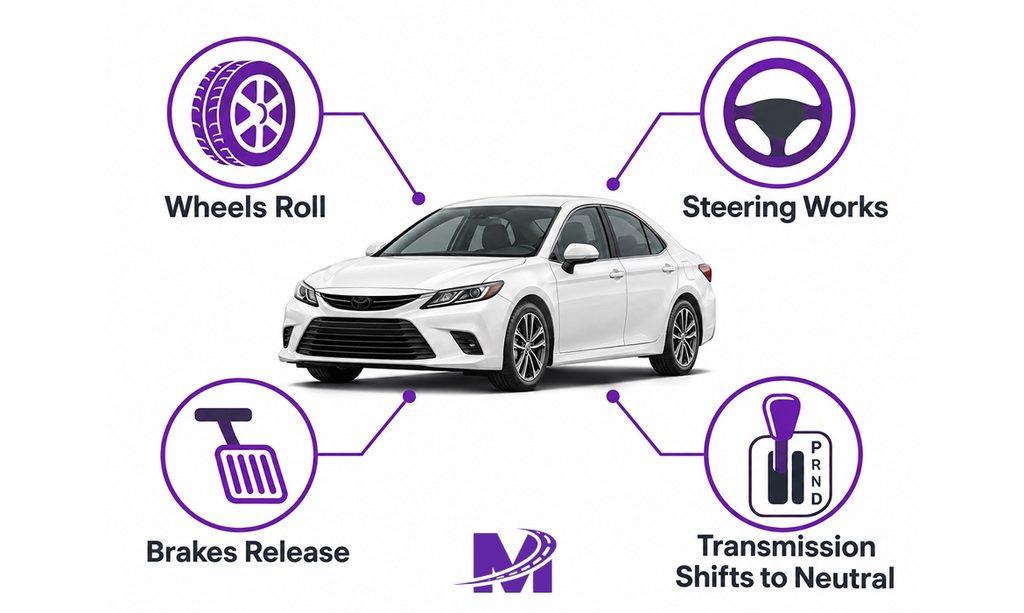
What matters for loading is a short list:
A car that won’t start but rolls and steers is a straightforward load. A running car with seized brakes is a much harder one. That’s why “inoperable” on its own never gives a dispatcher enough to work with.
Can You Ship a Car That Doesn’t Start, Roll, Brake, or Steer?
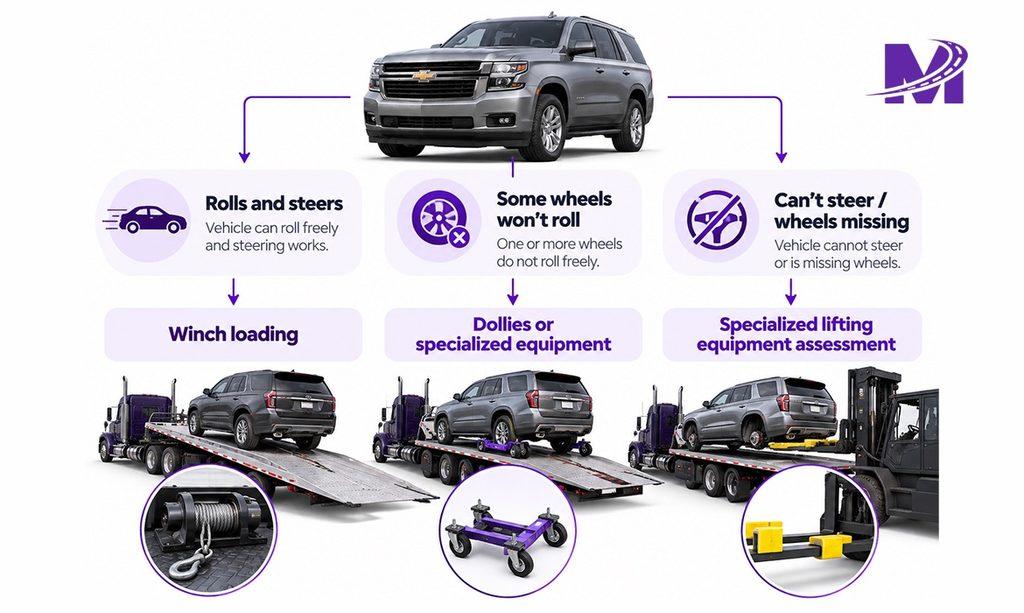
Carriers handle inoperable vehicles differently depending on whether the car can roll, brake, and steer. These three functions determine whether a standard car hauler with a winch is suitable or whether the vehicle needs a flatbed and specialized loading equipment.
Doesn’t start, but rolls, brakes, and steers. This is the simplest type of inoperable vehicle to transport. A standard car hauler equipped with a winch can load the vehicle while the driver guides it. Dead batteries and failed engines often fall into this category, provided the wheels turn freely and the brakes work. A surcharge typically applies because loading takes additional time and equipment.
Doesn’t roll or has locked or missing wheels. A standard winch-equipped car hauler may not be suitable if the wheels cannot turn freely. Dragging the vehicle can damage its tires, suspension, or other components. These vehicles generally require a flatbed and a forklift arranged for loading and unloading at both ends of the shipment.
Doesn’t brake or steer, or has significant damage. A vehicle that cannot brake or steer safely should not be treated as a routine winch load. If it cannot be safely positioned and secured on a standard car hauler, it will need a flatbed and specialized loading equipment, including a forklift when required. The exact arrangement depends on the vehicle’s condition and the equipment available at pickup and delivery.
Two additional issues should be disclosed when booking. If the transmission cannot be shifted into neutral, the wheels may remain locked even when the vehicle is otherwise intact. An electronic parking brake that won’t release can cause a similar problem. External power may resolve some electrical issues, but don’t assume it will work; tell the dispatcher in advance so the appropriate equipment can be arranged.
The final transport method depends on the vehicle’s condition, whether its wheels can roll freely, whether it can brake and steer, its weight and dimensions, and the loading conditions at both locations. Describe all known problems when requesting a quote so the carrier can plan the correct equipment and loading arrangements.
What Equipment Is Used to Ship a Non-Running Car?
| Vehicle condition | Typical transport setup | Loading requirements | Vehicle condition |
| Doesn’t start, but rolls, brakes, and steers | Standard car hauler with a winch | Winch loading; typically a 150–300 surcharge | Doesn’t start, but rolls, brakes, and steers |
| Doesn’t roll; locked or missing wheels | Flatbed | Forklift arranged for loading and unloading at both ends | Doesn’t roll; locked or missing wheels |
| Doesn’t brake or steer safely | Flatbed when a standard hauler cannot safely load the vehicle | Specialized loading; forklift when required | Doesn’t brake or steer safely |
A flatbed and a forklift aren’t interchangeable. A flatbed describes the trailer; a forklift describes how the car gets onto it. Many flatbeds have a winch but no lifting equipment, so a flatbed booking doesn’t automatically solve a non-running vehicle. For more on the trailers themselves, see our guide to auto transport trailer types.
How Does Non-Running Car Shipping Work?
The booking process looks the same as standard transport, but one step is added: matching the vehicle to a carrier that has the right loading gear and the space to use it.
With a running car, the driver drives it up the ramp. With an inoperable vehicle, the driver has to position the truck, run a cable or bring in equipment, and move the car under control, which takes longer and needs more clear space around the trailer. That’s why not every carrier on your route can take the job, and why assignment can take longer than a standard shipment.
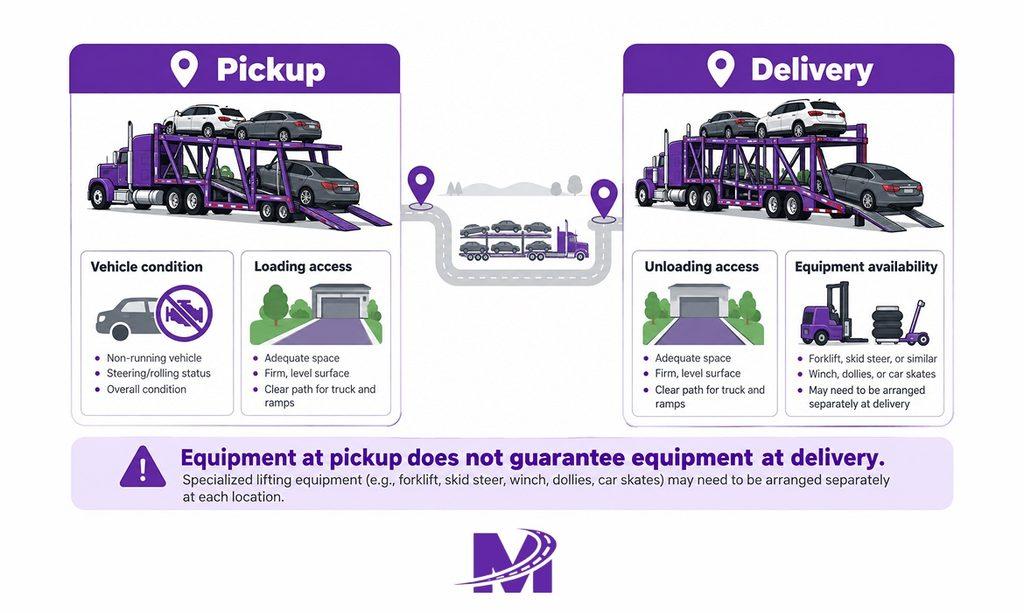
It also means both ends have to be checked separately. A winch on the truck travels with the driver, so it’s available at pickup and delivery alike. A forklift usually doesn’t, which means the equipment has to exist at each location or be arranged there. A car that loads easily at an auction with its own forklift can still be a problem at a residential delivery address with none.
Can You Ship a Non-Running Car From a Driveway or Auction?
Both work, but they present opposite challenges.
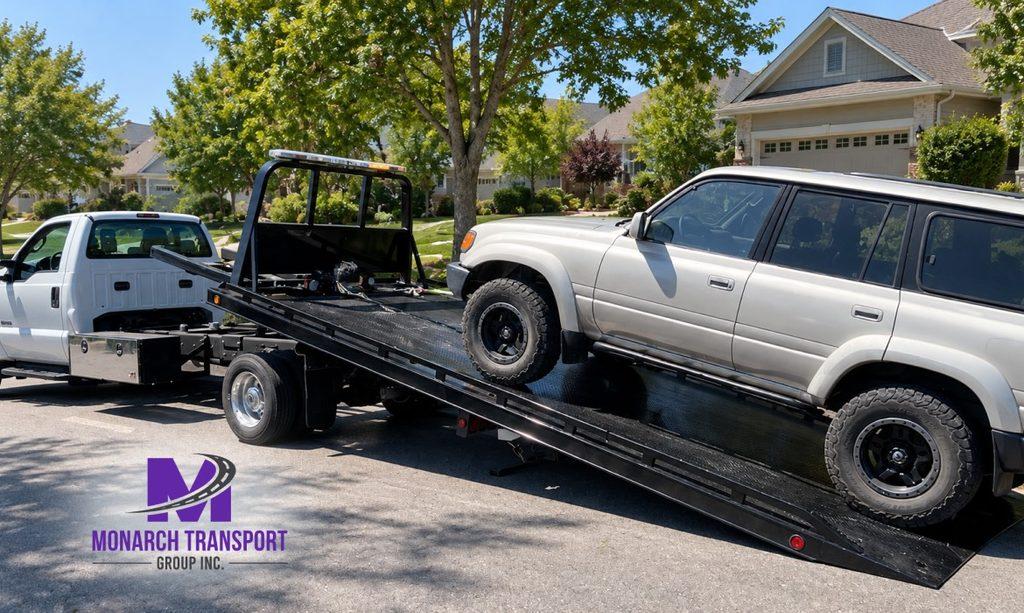
From a private address, the limiting factor is space and equipment. There’s no forklift in a driveway, so loading depends on what the carrier brings. The truck also needs room to park, extend ramps, and pull the vehicle on, which a narrow street, a steep driveway, or overhanging trees can rule out. Often the solution is to agree on a nearby open area such as a large parking lot.
From an auction lot or repair shop, equipment is usually easier, since many facilities have their own loaders. The complication is access: gate hours, release procedures, and whoever is authorized to hand the vehicle over. Lot staff will not release a car to a driver without the right paperwork, so that needs settling before dispatch. For the auction side specifically, see our guide on how dealerships ship cars from auto auctions.
How Much Does It Cost to Ship a Non-Running Car?
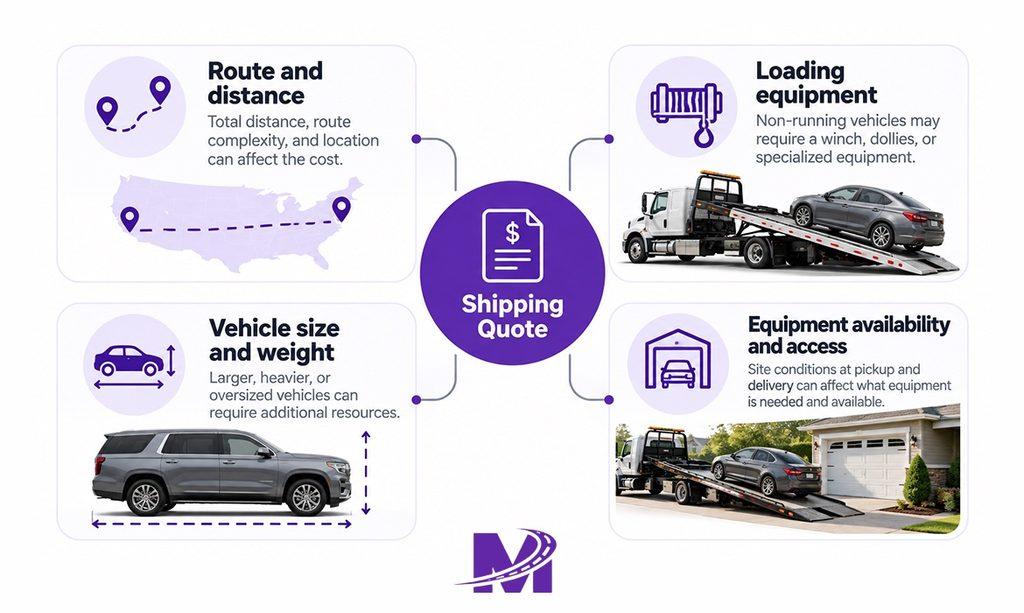
Inoperable car shipping costs more than standard transport because it takes longer to load, requires specific equipment, and limits which carriers can take the job. Your quote is built from:
What Affects the Extra Cost?
The surcharge depends on how difficult the vehicle is to load and transport:
Route matters, too. On a busy corridor, more carriers may have the necessary equipment available. In a rural area, you may have to wait for a suitably equipped carrier, and that limited availability can affect the price. Calculate your car shipping cost with the vehicle’s actual condition described up front so your quote reflects the equipment and handling it needs.
How to Ship a Non-Running Car: Step-by-Step
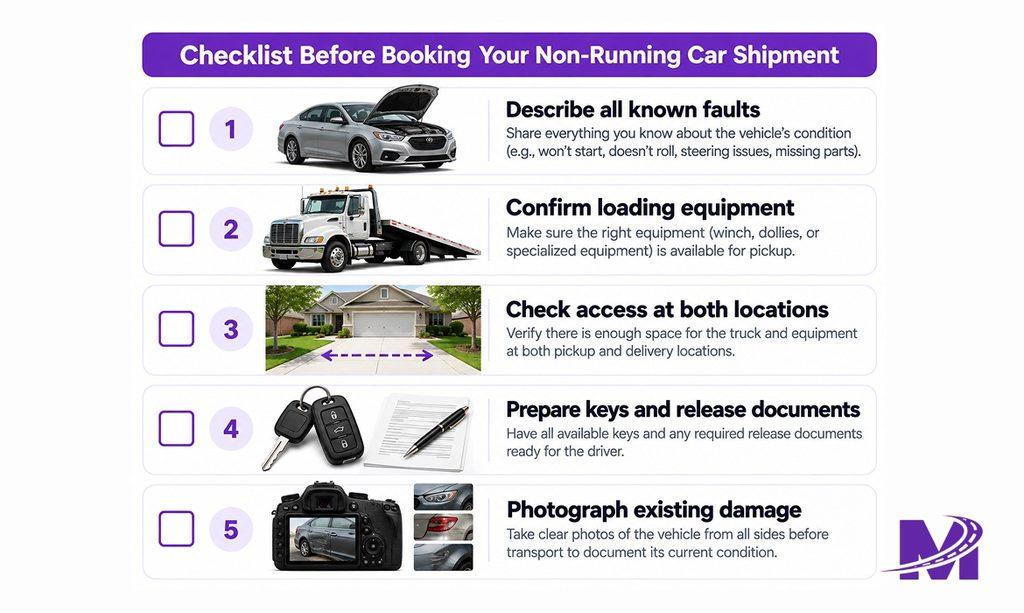
Shipping a non-running car requires more preparation than transporting a vehicle in working condition. Before booking, you need to confirm the car’s exact condition, arrange suitable loading equipment, and make sure both pickup and delivery locations can accommodate the transport truck. Follow these steps to prepare the vehicle and avoid unexpected delays or additional charges.
What Documents and Access Details Do You Need?
Beyond the vehicle itself, a few organizational details decide whether pickup actually happens:
Sorting these out before dispatch helps ensure a smooth pickup and avoid a wasted trip.
What to Tell the Car Shipping Company Before Booking
Be specific about:
How to Prepare a Non-Running Car for Pickup
For an inoperable vehicle, preparation focuses on a few specifics:
The standard steps – cleaning, fuel level, disabling the alarm, removing personal items – are covered in our car shipping preparation checklist.
Common Mistakes That Lead to Extra Fees
If you’re moving a project or collector vehicle that doesn’t currently run, our guide on how to ship a classic car covers that scenario in more detail.
Ready to Move Your Non-Running Car?
Describe the vehicle’s actual condition and get a realistic quote the first time, rather than a price that changes when the driver arrives. Monarch arranges state-to-state car shipping with licensed, vetted carriers nationwide, including winch-equipped and specialized loading.
Get a Free Car Shipping Quote or call 855-983-5929 to talk through what your vehicle needs.
FAQs About Non-Running Car Shipping
Yes. If the car doesn’t start but still rolls, brakes, and steers, it can generally be loaded onto a standard car hauler using a winch. A typical surcharge for this type of loading is 150–300. If the vehicle cannot roll, brake, or steer safely, or has locked or missing wheels or significant damage, it may require a flatbed and a forklift for loading and unloading at both ends, which can cost considerably more.
No. A car that won’t start but rolls, brakes, and steers can generally travel on a standard car hauler equipped with a winch. A flatbed and specialized loading equipment may be necessary when the vehicle cannot roll, brake, or steer safely, has locked or missing wheels, or has substantial damage. The carrier must assess the vehicle’s condition before confirming the setup.
surcharge is $150-$300 on top of the base shipping price. Vehicles that require a flatbed and a forklift for loading and unloading at both ends can cost significantly more. The final price depends on the vehicle’s condition, route, and specialized equipment needs.
More than a standard shipment, because of the extra equipment and loading time. The exact amount depends on your route, the vehicle, and the equipment required.
Often yes, but it needs an assessment first. Locked or seized wheels rule out a straightforward winch load and may call for specialized equipment.
Yes, with the right equipment. Tell the carrier before booking so the correct truck is dispatched.
Usually, but it depends on the vehicle. Without keys, the steering or transmission may be locked, which changes the loading method, so mention it when you request a quote.
Transit time is similar to a standard shipment, but assignment can take longer, since fewer carriers on your route have the right equipment. Build in extra time if the date matters.
Usually, though the loading method depends on the vehicle’s condition and whether it can roll, brake, and steer.
Tell the company right away. A change in condition can mean different equipment, and an unreported change often results in a failed pickup.
Related articles
Amtrak Auto Train vs. Car Shipping: Cost and Speed
IN THIS ARTICLE: Key Takeaways Amtrak Auto Train vs. Car Shipping: What’s the Difference? Amtrak Auto Train vs. Car Shipping Cost Which Is Faster: Amtrak Auto Train or Car Shipping?
Auto Transport Trailer Types – Which One Carries Your Car?
IN THIS ARTICLE: Auto Transport Trailer Types at a Glance Open Auto Transport Carriers Enclosed Auto Transport Trailers Specialized Transport Trailers Top Load vs. Bottom Load – What’s the Difference?
Car Shipping by Train: Costs, Process & What to Expect in 2026
IN THIS ARTICLE: The Two Faces of Rail Transport: Consumer vs. Commercial Why Choose the Tracks? (The Human Perspective) Dimensions and Constraints: Will Your Car Fit? The “Hidden” Logic of
Car Shipping Deposit Explained – Why Brokers Ask for It and When You Pay
IN THIS ARTICLE: How the Auto Transport Payment Structure Works What the Car Shipping Deposit Actually Pays For How Much Should a Car Shipping Deposit Be? Broker Deposit vs. Carrier
Car Shipping Near Me: How Local Pickup Works With Nationwide Carriers
IN THIS ARTICLE: Key Takeaways What Does “Car Shipping Near Me” Actually Mean? How Local Pickup Works With a Nationwide Car Carrier Will a Car Carrier Pick Up My Vehicle

Complete Guide to Car Shipping in 2026
The landscape of American mobility has shifted, making vehicle logistics more accessible and seamless than ever before. Understanding this new norm is the first step toward a stress-free relocation that
Cross-Country Car Shipping: How to Save Money Safely
IN THIS ARTICLE: Why “Cheap” Doesn’t Have to Mean “Dangerous” 1. Open Transport: The Industry Gold Standard for Savings 2. The Power of “Terminal-to-Terminal” Shipping 3. Timing the Market: The

Door-to-Door vs. Terminal-to-Terminal: Which Logistics Model Fits You?
IN THIS ARTICLE: Understanding the Two Primary Logistics Models Comparative Analysis: Door-to-Door vs. Terminal-to-Terminal The Financial and Temporal Mechanics of Shipping Models Geographical Impact: Urban vs. Rural Accessibility The Final
