
IN THIS ARTICLE:
- Auto Transport Trailer Types at a Glance
- Open Auto Transport Carriers
- Enclosed Auto Transport Trailers
- Specialized Transport Trailers
- Top Load vs. Bottom Load – What’s the Difference?
- Why Carrier Licensing Is Worth Checking
- How Trailer Type Affects Your Shipping Quote
- Which Trailer Type Is Right for Your Car?
- Auto Transport Trailer Types FAQs
When you book a car shipment, you might picture a single tow truck showing up with your sedan on the back. In reality, the vehicle that pulls into your driveway could be anything from a two-level open carrier hauling nine other cars to a fully enclosed trailer built for a single classic. The trailer type your carrier uses affects your price, your pickup window, and how much protection your vehicle gets along the way.
This guide walks through the trailer types you’ll actually run into when shipping a car with Monarch – what each one carries, why a carrier picks one over another, and how to know which one fits your vehicle. If you’re weighing open against enclosed specifically, our open vs. enclosed auto transport guide goes deeper on that one decision. This article covers the full lineup.
Before diving in, it helps to know that “trailer type” actually covers a few different things at once: whether the trailer is open or enclosed, how many vehicles it carries, and – for a smaller number of specialized jobs – its structural design (flatbed, lowboy, gooseneck). This guide is organized around those three questions in that order.
Key Takeaways
Auto Transport Trailer Types at a Glance
The right trailer depends on your vehicle, how much protection it needs, and how quickly you need it moved. The table below compares the most common auto transport trailer types, their typical capacity, ideal use cases, and relative cost.
| Open multi-car carrier | Commonly 7–10 cars | Everyday shipments, most vehicle types | $ |
| Enclosed multi-car carrier | Commonly 2–6 cars | Luxury, exotic, or auction vehicles | $$$ |
| Single-car / dedicated hauler | 1 car | Tight timelines, one-off moves | $$–$$$ |
| Enclosed single-car trailer | 1 car | Classics, high-value cars needing full protection | $$$$ |
| Flatbed / lowboy trailer | Usually 1–2 vehicles | Non-running, oversized, or low-clearance vehicles | $$$ |
The exact vehicle count on any of these depends on the specific rig, the vehicles’ size and weight, and the carrier’s equipment – treat this as a general reference, not a guarantee for every truck on the road. The rest of this guide breaks down each category.
Open Auto Transport Carriers
Open carriers are the ones you see most often on the highway – no walls, no roof, vehicles strapped in across an exposed steel frame. They’re the default for most shipments because they’re the most widely available and the least expensive option, and most cars don’t need something more.
Multi-Level Open Carriers
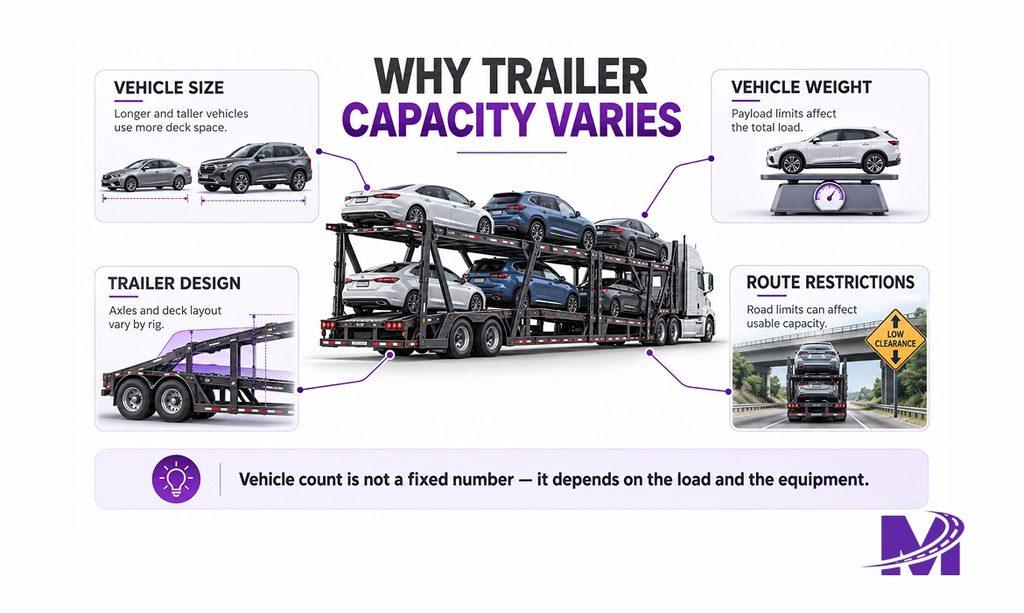
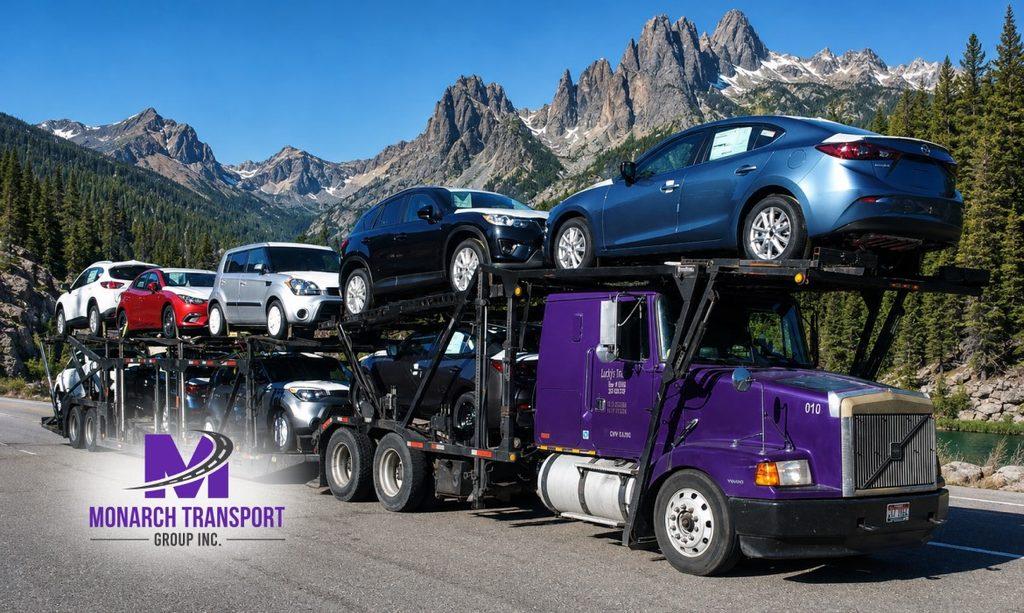
This is the classic two-level rig, commonly holding 7–10 vehicles depending on vehicle size. Actual capacity on any given trip depends on more than just a weight cap – it’s determined by the specific vehicles’ dimensions and weight, the trailer’s axle configuration, and route restrictions, all layered on top of the federal gross weight limit of 80,000 lbs for a loaded truck-and-trailer combination on the Interstate System, per 23 CFR 658.17. None of those factors work in isolation, which is why capacity varies rig to rig even within the same general trailer class.
What it’s good for: Everyday sedans, SUVs, trucks, and most passenger vehicles. If your car is running, has normal ground clearance, and isn’t a collector’s item, an open carrier will move it safely and affordably.
The trade-off: Your vehicle rides exposed to weather, road debris, and dust for the length of the trip. For a daily driver, that’s rarely a real concern. For a freshly painted or delicate vehicle, it’s worth thinking through.
Open carriers are generally the most widely available option in the industry, which is also part of why they’re usually the easiest trailer type to book on short notice. More of them run routes at any given time than any other equipment type.
Single-Level and Dedicated Open Trailers
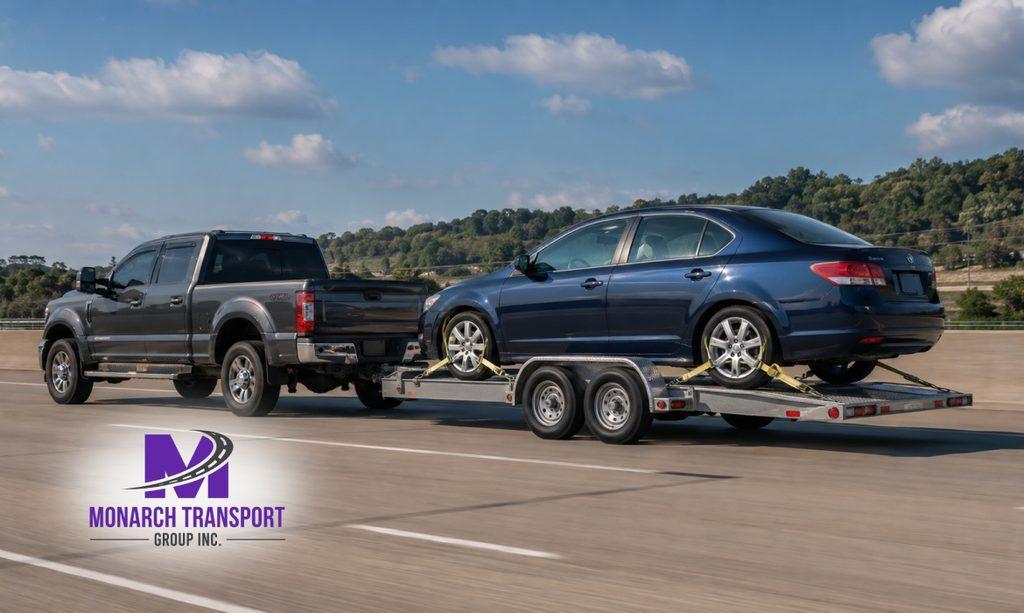
Not every open trailer is a two-level rig. A single-level open trailer, or a smaller open trailer pulled by a pickup or medium-duty truck rather than a full semi, is usually reserved for a single vehicle or a small handful. This is where the term “hotshot” sometimes gets used – but it’s worth being precise about what that means. Hotshot trucking constitutes a broader freight segment built around pickup-and-trailer rigs handling smaller, often expedited loads, not a synonym for “one car.” A single-car open hauler may or may not be run by an operator who identifies as a hotshot carrier; either way, what matters for your shipment is that the trailer is dedicated to your vehicle alone.
What it’s good for: Tight timelines, shorter or regional moves, and any situation where your car needs to be the only thing on the trailer.
The trade-off: Because the carrier isn’t spreading trip costs across multiple vehicles, dedicated single-car service usually costs more per mile than standard multi-car open transport. It’s a speed-and-priority premium, not a markup for no reason – you’re paying for a truck that exists to move your car and nothing else.
Enclosed Auto Transport Trailers
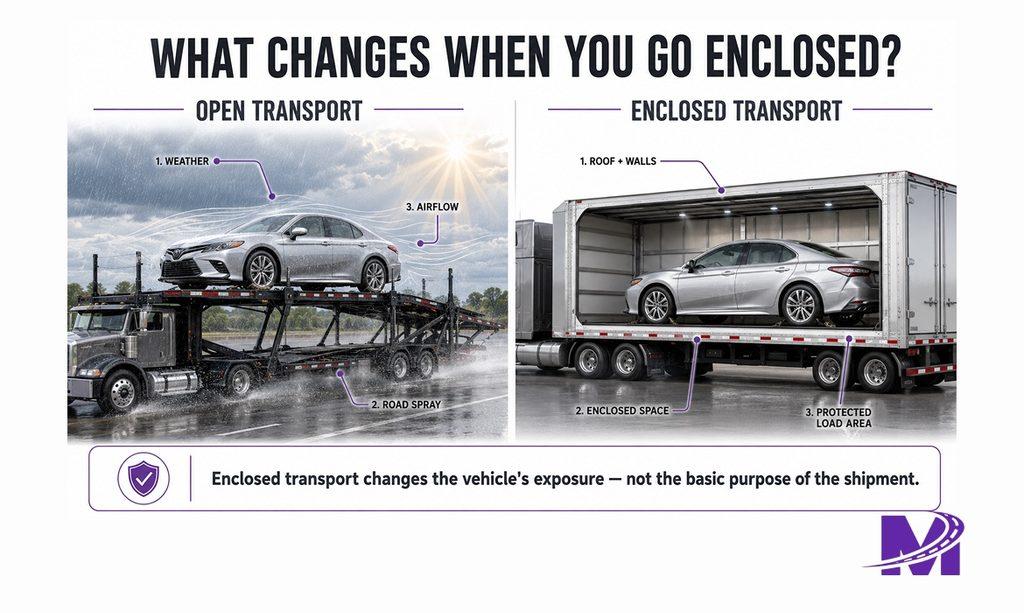
Enclosed trailers add walls and a roof to the same basic idea, trading some capacity and cost for full protection from weather, road spray, and debris.
| Weather protection | None | Full |
| Road debris protection | Limited | High |
| Typical capacity | Higher | Lower |
| Availability | Higher | Lower |
| Relative cost | Lower | Higher |
Enclosed Multi-Car Carriers
These share the multi-level deck layout of an open carrier, but fully walled and roofed. They typically move fewer vehicles per trip – commonly in the 2–6 range – since the enclosure itself adds weight that eats into the available payload. You’ll see these used most for dealer inventory moves, auction lots, and any batch of vehicles valuable enough to justify the extra equipment.
Enclosed Single-Car Trailers
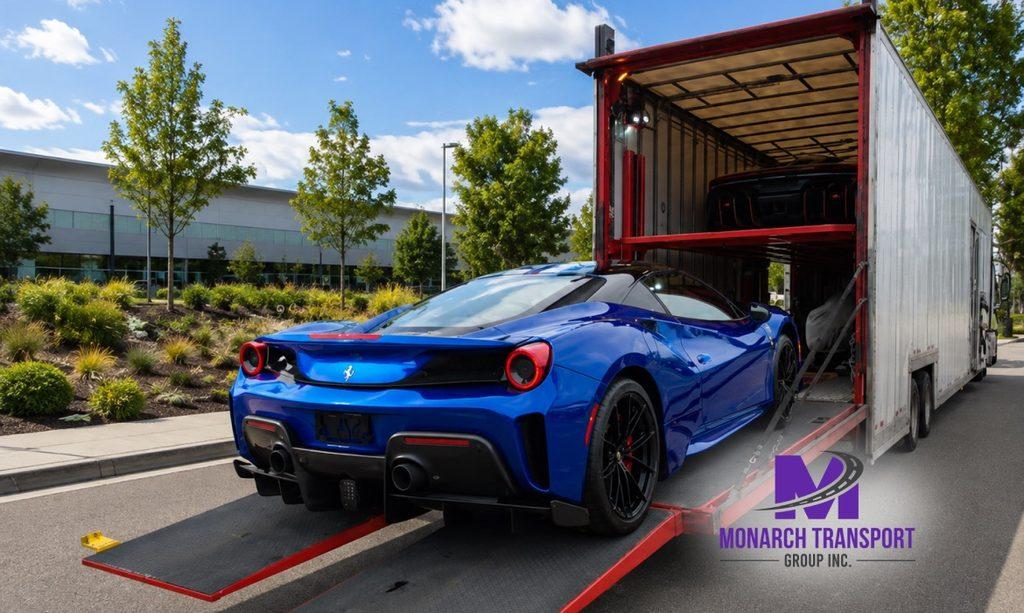
This is the option most owners mean when they say they want “full enclosed protection” – a single vehicle, fully walled and roofed, often secured with soft, wheel-strap-based tie-downs rather than standard straps to avoid marking custom wheels or paint. Some enclosed single-car trailers also offer a lower loading angle than a standard multi-car carrier, which can matter for vehicles with limited ground clearance. However, this varies by trailer rather than being a universal feature of the category.
What it’s good for: Classic cars, exotics, show cars, and anything where a scratch or a few miles of road grime would be a real financial or sentimental loss. Our guides on shipping a classic car and enclosed transport for luxury vehicles go into the details of prepping a car for this kind of move.
The trade-off: This is the most expensive way to ship a car, by a wide margin. For most daily drivers, it’s overkill. For a genuinely irreplaceable car, it’s the option built for exactly that.
Specialized Transport Trailers
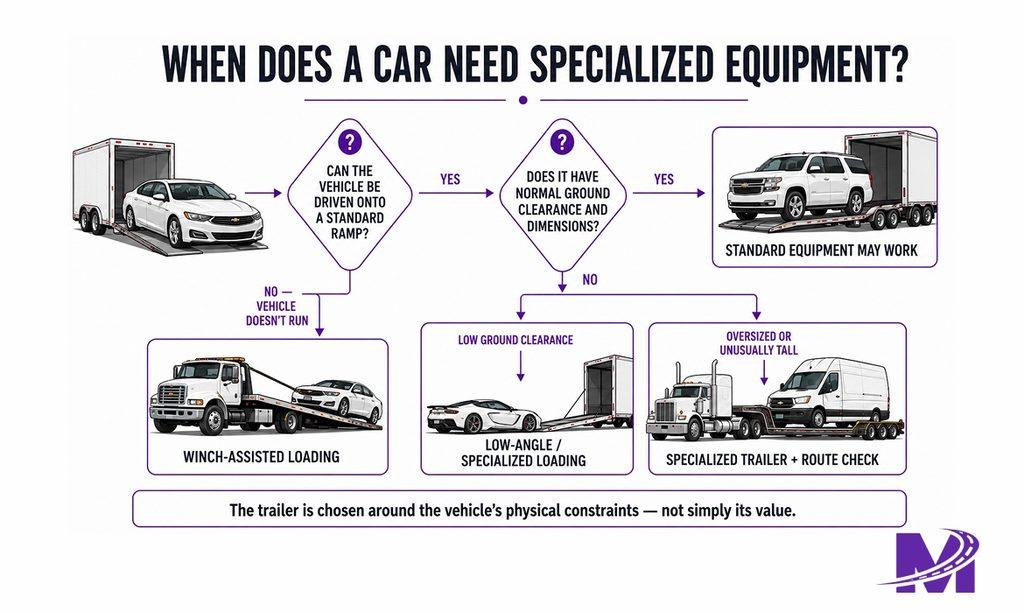
A smaller share of shipments need equipment built for a specific physical problem – a vehicle that can’t be driven, can’t clear a standard ramp angle, or is too large for standard car-carrier equipment.
Flatbed trailers are a single, level deck. Depending on the specific trailer and the vehicle’s condition, loading may involve ramps, a winch, or a forklift – it isn’t limited to one method, and the right approach depends on whether the car can be driven and how it’s positioned for pickup.
Lowboy trailers are a type of flatbed with a dropped deck section between the axles, which lowers the vehicle’s overall height once loaded. That can provide meaningful extra clearance for taller loads. However, whether a specific load can legally travel a given route still depends on that route’s actual bridge and tunnel clearances, along with any required permits – a lowboy reduces height; it doesn’t override route-specific restrictions on its own.
What specialized trailers are good for: Non-running vehicles that can’t be safely driven onto a standard ramp, oversized vehicles, and anything with ground clearance so low that even an enclosed single-car trailer’s ramp angle would cause it to scrape. This category also covers vehicles that are technically “cars” in name only – heavily modified builds, off-road rigs with lift kits that push overall height past normal limits, and similar edge cases.
The trade-off: Specialized equipment means fewer carriers can take the job, which generally means a higher price and a longer wait for the right truck to become available. Loading also tends to take longer than a standard drive-on process, so factor extra time into your pickup window if your vehicle falls into this category.
Gooseneck and wedge trailers come up most often around dealer and auction transport rather than individual shipments. A gooseneck hitches to the bed of a pickup rather than a standard hitch, providing better weight distribution when a carrier hauls two vehicles in tandem. A wedge trailer is a smaller, slanted open trailer built to carry 3 or 4 cars, often pulled by a heavy-duty pickup instead of a full semi-tractor. You likely won’t request one by name, but it helps to recognize the terms if a carrier mentions them.
Top Load vs. Bottom Load – What’s the Difference?
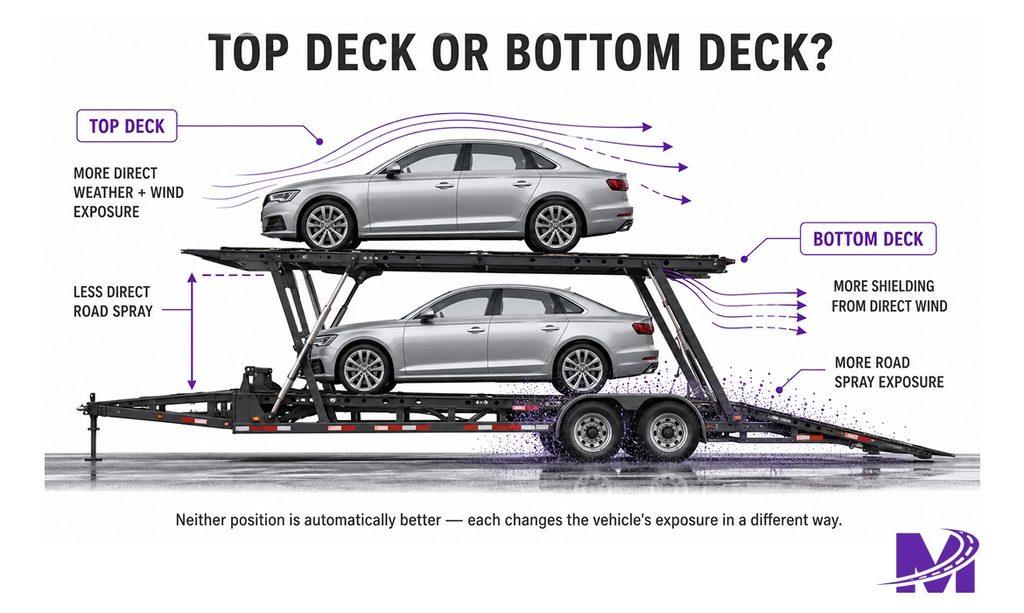
On a multi-level open carrier, vehicles get assigned to either the top or bottom deck, and it’s worth knowing what that means for your car. The upper deck typically loads first – many carriers lower it to the ground on hydraulics, drive vehicles up, then raise it back into position before loading the lower deck. That sequence, and the exact mechanism, varies by carrier and equipment, but the general logic holds across most rigs. Whichever deck is loaded first also tends to be secured first, since repeatedly lowering an already-loaded deck to load the other one adds time and risk.
Top-deck placement is generally considered gentler on a vehicle, since it’s less exposed to debris kicked up from the road directly beneath the trailer. However, it also means more exposure to wind and weather. Bottom-deck placement shields a vehicle from some of that exposure but sits closer to road spray. Neither position is inherently better for every vehicle – if you have a preference, it’s worth asking your carrier rather than assuming you don’t have any say in it.
Why Carrier Licensing Is Worth Checking
Trailer type also affects what licensing a carrier’s driver needs, which is a fair thing to ask about when vetting a company rather than a purely technical detail. A truck-and-trailer combination with a gross combination weight of 26,001 lbs or more, towing a trailer rated above 10,000 lbs, generally requires the driver to hold a Class A Commercial Driver’s License. Most multi-car open and enclosed carriers fall into that category well before hitting the federal weight cap discussed above. If a company can’t clearly explain their driver’s licensing and insurance, that’s worth treating as a signal to keep looking – you can check a carrier’s registration and safety record directly through FMCSA’s SAFER Company Snapshot before booking, and our guide to choosing an auto transport company covers more of what to check.
How Trailer Type Affects Your Shipping Quote
Trailer type is one of the biggest levers in your final price. Still, it’s one factor among several – distance, vehicle size and weight, whether the car runs, pickup and delivery access, and seasonal demand all shape the number too. Within trailer type specifically:
If you want to see how these differences play out for your specific vehicle and route, our shipping calculator breaks down a real estimate rather than a generic range.
Which Trailer Type Is Right for Your Car?
The sections above cover what each trailer type does well. Here’s the shortcut version – match your vehicle or situation to the row that fits, and start there when asking for quotes.
| Your vehicle or situation | Recommended trailer |
| Standard running sedan, SUV, or truck | Open multi-car carrier |
| Classic, exotic, or recently restored car | Enclosed multi-car or enclosed single-car trailer |
| Low-clearance or modified vehicle | Enclosed single-car or specialized trailer, depending on clearance |
| Non-running vehicle | Carrier with a winch, or a flatbed/specialized trailer if it can’t be safely driven at all |
| Oversized or heavily modified vehicle | Flatbed or lowboy trailer |
| Urgent or dedicated single-vehicle move | Single-car or dedicated open hauler |
Not sure which row fits your vehicle? Our car transport service page walks through how we match a shipment to the right trailer type and carrier, and our complete guide to car shipping covers the rest of the process end to end – from getting a quote to the day your car actually gets picked up.
Ready to see what trailer type fits your vehicle? Get a free auto transport quote and compare your options.
Auto Transport Trailer Types FAQs
The open multi-car carrier – the two-level, no-walls trailer you see on the highway carrying multiple vehicles. It’s the standard for most everyday shipments because it’s the most widely available and least expensive option.
For a daily driver, usually not – the added protection doesn’t matter much for a car that already deals with weather every day. For a classic, exotic, or recently restored vehicle, the protection from road debris and weather is often worth the premium.
It depends on the carrier and their equipment. Many open carriers use a winch to load non-running vehicles. Still, severely disabled cars, or ones with mechanical issues that prevent safe steering and braking during loading, may need a flatbed with forklift loading instead. Mark this when you request a quote.
Commonly 7 to 10, depending on vehicle size and the specific rig. Capacity depends as much on vehicle dimensions and weight as on the trailer itself, plus the federal weight cap for loaded combinations on the Interstate System.
Yes. Dedicated single-car service tends to move faster since there’s no wait for other vehicles to fill the trailer. Multi-car carriers, open or enclosed, may take longer to schedule because the carrier coordinates pickups and drop-offs for several vehicles along one route.
In most cases, yes – multi-car open and enclosed carriers are heavy enough to require a Class A CDL. It’s reasonable to confirm with any company before booking, along with their insurance coverage.
Yes – tell your broker upfront if you want enclosed transport, need a flatbed for a non-running vehicle, or have a tight timeline that calls for dedicated single-car service. Trailer type shapes your quote from the start, not something you negotiate after the fact.
It can, slightly. Top-deck placement generally means less exposure to road debris but more to wind and weather; bottom-deck is the reverse. If you have a preference, ask – it’s not usually something carriers volunteer unless you raise it.
Related articles

How State-to-State Car Transport Works: From Pickup to Delivery
IN THIS ARTICLE: Understanding the Auto Transport Ecosystem Choose Your Transport Type The Process of Shipping Calculating the Cost and Timeline of State-to-State Car Transport The 2026 EV Transport Protocol
How Much Does It Cost to Ship a Car Between States?
IN THIS ARTICLE: Average Cost Breakdown by Distance Primary Factors Influencing Your Shipping Quote Geographic Influence on Pricing Understanding the Quote Structure The Impact of Seasonality on Auto Transport Rates
How Long Does It Take to Ship a Car? Realistic Timelines by Route & Season
IN THIS ARTICLE: The Two Timelines Nobody Separates (But Should) Realistic Transit Times by Route Distance Dispatch Time by Season: The Variable Nobody Controls How Route Type Affects Your Timeline
Enclosed Car Shipping: The Gold Standard for Luxury and Exotic Vehicle Transport
IN THIS ARTICLE: Why “Standard” Transport Doesn’t Cut It for Masterpieces The Anatomy of Protection: Hard-Sided vs. Soft-Sided Trailers The Low-Clearance Nightmare: Why Hydraulic Lifts Matter Beyond the Walls: The
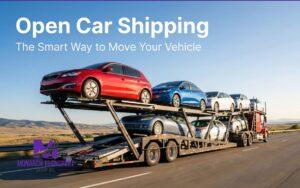
Cross-Country Car Shipping: How to Save Money Safely
IN THIS ARTICLE: Why “Cheap” Doesn’t Have to Mean “Dangerous” 1. Open Transport: The Industry Gold Standard for Savings 2. The Power of “Terminal-to-Terminal” Shipping 3. Timing the Market: The
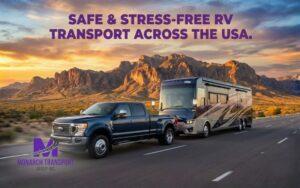
Complete Guide to RV Shipping in 2026
IN THIS ARTICLE: Introduction: The Freedom of the Road, Delivered by Professionals Understanding the Fleet: Classes and Types of RVs Methods of Transport: How We Get Your RV Home Measuring
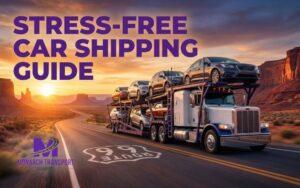
Complete Guide to Car Shipping in 2026
The landscape of American mobility has shifted, making vehicle logistics more accessible and seamless than ever before. Understanding this new norm is the first step toward a stress-free relocation that
Car Shipping Deposit Explained – Why Brokers Ask for It and When You Pay
IN THIS ARTICLE: How the Auto Transport Payment Structure Works What the Car Shipping Deposit Actually Pays For How Much Should a Car Shipping Deposit Be? Broker Deposit vs. Carrier