
Motorcycle Shipping Costs in 2026 – Full Price Breakdown by Route, Method & Bike Type
Calculate Shipping Cost
IN THIS ARTICLE:
- Why Motorcycle Shipping Prices Vary So Wildly
- Cost Breakdown by Distance – What Every Route Costs in 2026
- Cost Breakdown by Transport Method – Open vs. Enclosed vs. Crating
- Cost Breakdown by Bike Type – Why Your Specific Motorcycle Matters
- The Hidden Fees That Turn a $600 Quote Into a $900 Invoice
- Seasonal Pricing – When You Book Changes What You Pay
- How to Get a Competitive Quote – The Process Explained
- The Bill of Lading – Your Protection If Something Goes Wrong
- Electric Motorcycles – Special Pricing to Know
- Quick Reference – What Your Specific Scenario Will Cost
- 7 Ways to Pay Less Without Compromising Your Bike
- Final Word – What Motorcycle Shipping Actually Costs
- FAQ About Motorcycle Shipping Costs
Shipping a motorcycle generally costs between $200 and $1,500+, though most owners shipping a standard bike domestically land in the $400–$800 range. But that range is almost useless when you’re standing in your driveway wondering what it will actually cost to move your specific bike from Denver to Atlanta, or whether shipping your touring Harley enclosed is worth the extra $400 over open transport.
This guide gives you a full, honest breakdown by distance, transport method, and exact bike type – plus the hidden fees that turn a $600 quote into a $900 invoice, and the real-world negotiating tactics that bring it back down. Ready to skip straight to pricing? Use our motorcycle shipping cost calculator to get a quote for your specific route.
Why Motorcycle Shipping Prices Vary So Wildly
Before we get to the numbers, you need to understand why two people shipping motorcycles the same distance can receive quotes that differ by $300 or more.
Auto transport – and motorcycle transport specifically – is a dynamic pricing market. Carriers set rates based on how full their trailers are, what fuel currently costs, how many other bikes are heading in the same direction, and what time of year you’re booking. A quote that’s accurate in February may be $150 higher in July.
The five core variables that determine your final price are: distance, transport method, bike type and weight, geography (urban vs. rural), and timing. Let’s go through each one with actual numbers.
Cost Breakdown by Distance – What Every Route Costs in 2026
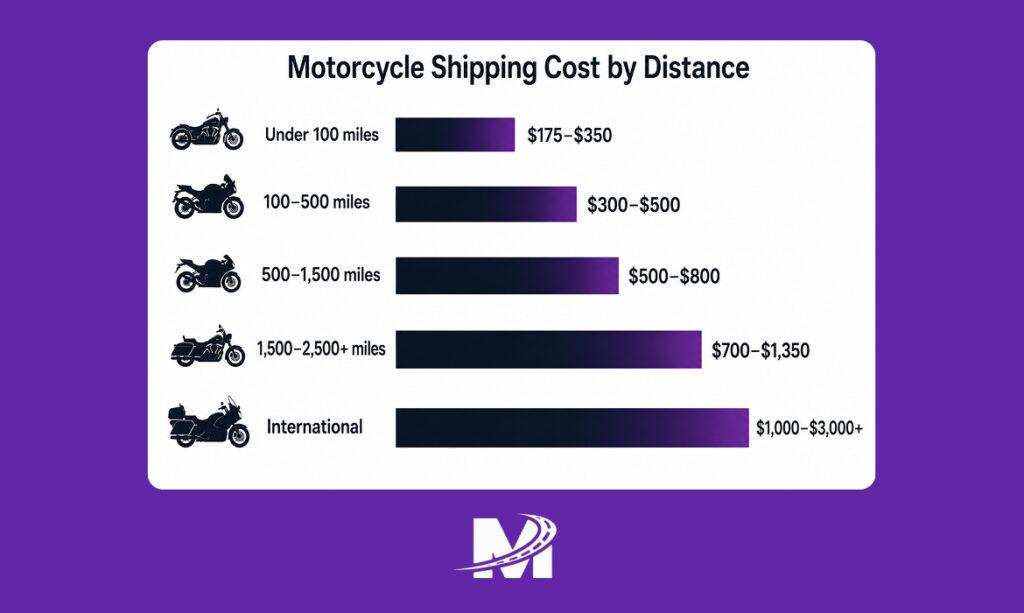
Distance is the primary driver of your base rate, but the relationship is not linear. You pay a high per-mile rate for short hauls and a much lower per-mile rate once you cross the 1,000-mile threshold. Here’s why: a carrier driving 200 miles still has to factor in driver time, fuel to reposition the truck, and loading/unloading labor – most of which doesn’t scale with distance.
| Distance | Typical Price Range | Notes |
| Under 100 miles (local) | $175 – $350 | High per-mile cost; most practical for intrastate moves |
| 100 – 500 miles (short haul) | $300 – $500 | Common for regional moves, state-to-state nearby |
| 500 – 1,500 miles (mid-range) | $500 – $800 | Best price-per-mile sweet spot for most owners |
| 1,500 – 2,500+ miles (cross-country) | $700 – $1,350 | LA to New York, Florida to Washington, etc. |
| International shipments | $1,000 – $3,000+ | Depends heavily on destination country and crating requirements |
A note on the cross-country range: That $700–$1,350 window is wide for a reason. A lightweight 400cc dual-sport going open-transport from Phoenix to Dallas on a flexible timeline will land near the bottom. A fully-loaded touring bike going enclosed, door-to-door, in July, from a rural area will hit the top. The sections below tell you exactly which factors push you toward which end.
Cost Breakdown by Transport Method – Open vs. Enclosed vs. Crating
This is the most impactful single decision you’ll make after choosing your route. The method you choose can swing the price by 50% or more. If you’re still deciding between methods, our open vs. enclosed auto transport guide walks through the full trade-offs for every vehicle type.
Open Transport – $200 – $600
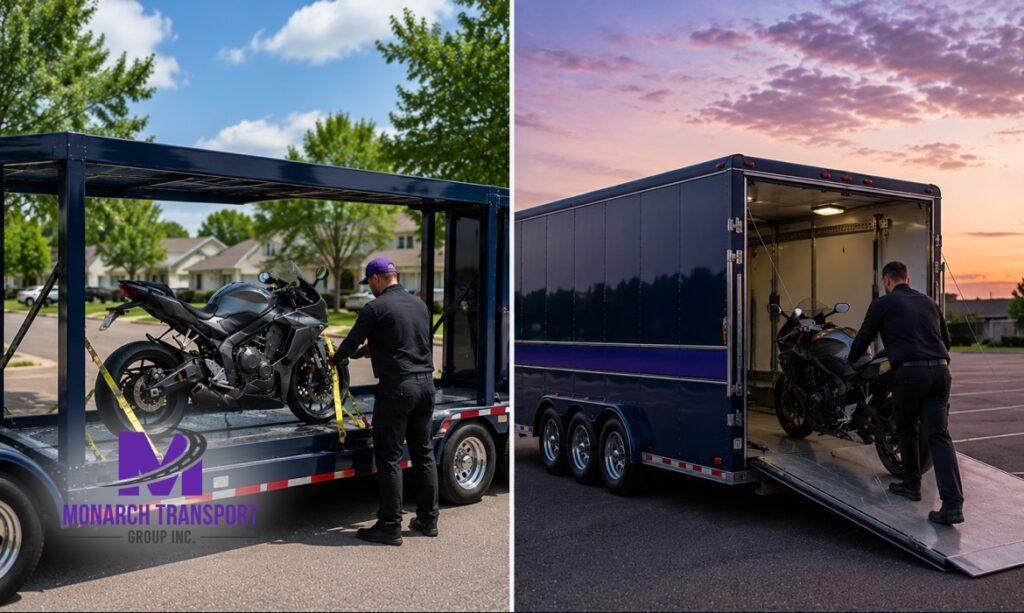
Open transport is the industry standard for most bikes. Your motorcycle is loaded onto a multi-vehicle trailer – sometimes alongside cars – and is exposed to road air, light dust, and weather. “Exposed” sounds alarming, but in practice it means the same conditions as a 3,000-mile road trip you’d take yourself.
Who it’s right for: Daily riders, standard sportbikes, modern cruisers, and any motorcycle whose resale value doesn’t depend on mint showroom condition. If your bike has 20,000 miles on it and you ride it in the rain, open transport is the correct choice. Anything else is paying for peace of mind you don’t need.
Who should think twice: Owners of low-production custom builds, concours-condition classics, or bikes with exposed painted surfaces that could be damaged by a stone chip. For these, keep reading.
Enclosed Transport – $500 – $1,200
Enclosed carriers use a hard-sided trailer that fully protects the motorcycle from road debris, weather, and UV exposure. The bike is also typically secured on a dedicated pallet rather than shared with cars, which means gentler handling and a more controlled loading process.
The real cost difference: On a 1,500-mile cross-country move, enclosed will typically cost $400–$600 more than open. On a shorter 600-mile haul, the gap narrows to $200–$350.
Who actually needs it: Motorcycles with documented collector value, custom paint jobs that took three months to complete, pre-1980 vintage bikes, and any bike you’d refuse to ride through a rainstorm. If your insurance covers the bike for an agreed value (not actual cash value), enclosed transport is worth the premium – a claim avoided is better than a claim filed. For cars in the same situation, see how enclosed transport works for luxury and exotic vehicles.
Who doesn’t: Anyone whose bike is insured for standard ACV and would clean up with a wash after delivery. The enclosed premium is genuine, but so is the fact that the vast majority of bikes shipped open arrive without a scratch.
Crating – Adds $150 – $300 to Base Price
Crating means your motorcycle is disassembled to a defined degree (mirrors folded, handlebars removed if necessary), placed in a custom wooden crate, and shipped as freight rather than on a vehicle hauler. It is standard practice for international shipments and sometimes required for particularly delicate custom bikes or vintage restorations.
When it’s required vs. optional: For international shipping, crating is almost always mandatory – both for customs compliance and because the bike will be handled by freight equipment, not motorcycle-specific carriers. Domestically, crating is optional and rarely necessary unless a carrier specifically requests it for a non-standard vehicle.
The hidden cost nobody mentions: Crating isn’t just the $150–$300 materials fee. You also need to factor in the cost of disassembly at origin (if you’re not doing it yourself) and reassembly at destination. If you’re using a dealer or shop for that, add $100–$300 in labor on each end. For a truly fragile vintage build, it may still be worth it. For everything else, enclosed transport accomplishes the same protection goal at lower total cost.
Cost Breakdown by Bike Type – Why Your Specific Motorcycle Matters
Not all motorcycles ship at the same rate, even on the same route. Carriers price based on weight and footprint – a heavier bike consumes more of their legal weight allowance, and a wider bike may affect how many other motorcycles or vehicles they can fit on the trailer.
Lightweight Bikes – Scooters, Dirt Bikes, 250cc–500cc
These are the easiest and cheapest motorcycles to ship. A 150cc scooter or a 300-pound dirt bike sits at the absolute low end of every distance bracket. Expect to pay 10–20% below the midrange price for any given route.
Practical examples:
Standard Bikes – Naked Bikes, Mid-Size Sportbikes, Standard Cruisers
This is where most owner quotes land. A Honda CB650, a Kawasaki Z900, a mid-size Sportster – these are average-weight, average-footprint bikes that fit cleanly into standard carrier specs. Quotes will fall at or slightly below the midpoints of every distance bracket listed above.
Heavyweight Bikes – Touring, Baggers, Large Cruisers
This is where the price surprises start. A fully-dressed Harley-Davidson Road Glide Ultra weighs nearly 900 pounds wet. An Indian Roadmaster Dark Horse is over 800 pounds. These bikes are not just heavier – they’re also wider, with hard saddlebags and top cases that extend past the standard footprint.
The real-world impact: Carriers typically add $50–$150 to their quote for heavyweight touring bikes and large-displacement choppers. On a competitive route like Miami to Houston, this might be the difference between a $580 and a $720 quote. For a true coast-to-coast move, the premium can reach $200.
What owners often miss: It’s not just the weight. Fixed saddlebags on a bagger can create loading complications that some carriers charge a “special handling” fee for – typically $50–$100. Ask about this explicitly when you get your quote. If you can remove the saddlebags and ship them separately in a box, you may save the fee entirely and get a lower base quote.
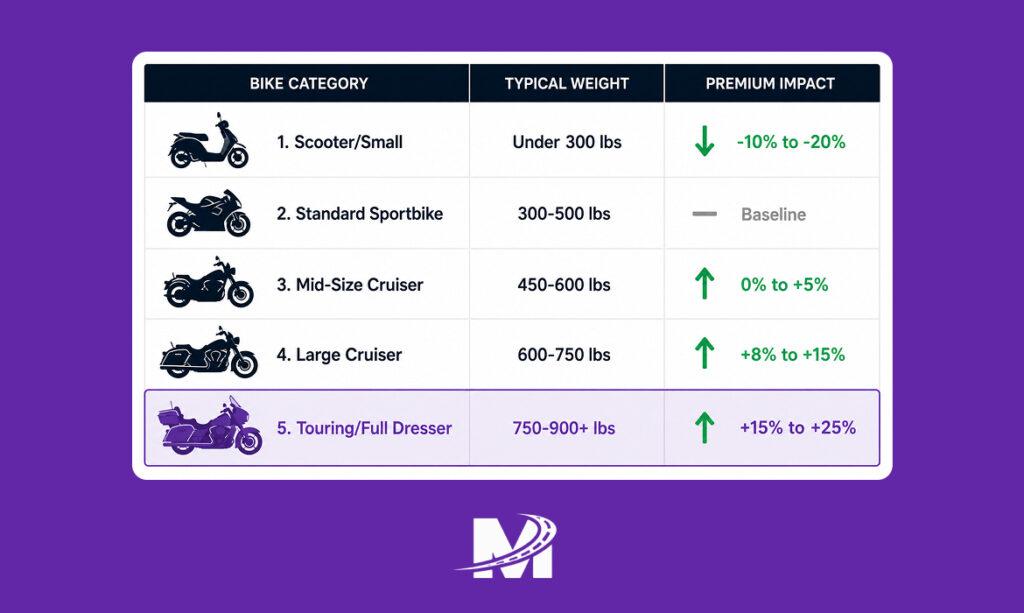
| Bike Category | Weight Range | Shipping Premium vs. Standard |
| Scooter / Small Dirt Bike | Under 300 lbs | -10% to -20% |
| Standard / Mid-Size Sportbike | 300–500 lbs | Baseline |
| Mid-Size Cruiser / Naked Bike | 450–600 lbs | 0% to +5% |
| Large Cruiser / Heavy Chopper | 600–750 lbs | +8% to +15% |
| Touring / Full Dresser / Bagger | 750–900+ lbs | +15% to +25% |
The Hidden Fees That Turn a 0 Quote Into a 0 Invoice
Rural Pickup/Delivery Surcharge: $50 – $150
If your home or destination is more than 30–50 miles from a major interstate corridor, expect a surcharge. Carriers optimize their routes around highways. Deviating into rural territory costs them time and fuel.
How to avoid it: Ask the broker, “If I meet the driver at a truck stop near [major highway], how much does the quote drop?” Driving 45 minutes to a Pilot Travel Center on I-40 can save you $75–$150. For lightweight bikes, you can often do this in a pickup truck yourself.
Non-Operational Vehicle Fee – $150 – $300
If your motorcycle doesn’t start reliably, doesn’t roll, or can’t be ridden under its own power onto the trailer, it’s classified as “non-op.” This requires the driver to use a winch or ramp extension, which takes extra time and equipment.
The underreported scenario: A bike that starts fine at home but won’t start after 2,000 miles on a cold trailer – because the battery was already marginal – gets classified as non-op at delivery. The carrier then charges the receiving party (you) for the extra labor. Replace the battery before shipping if it’s more than three years old. A $100 battery is much cheaper than a $250 non-op fee.
Oversize/Overweight Fee – $75 – $200
This applies to bikes that fall outside standard dimensions. Full-dresser tourers with extended fairings, very tall adventure bikes, and sidecar rigs all fall into this category. Ask about this before booking if your bike has any non-stock modifications that affect width or height.
Insurance Upgrade Fees – $50 – $200
Every legitimate carrier includes base cargo insurance – typically $10,000 to $15,000 in coverage. For most bikes, this is adequate. For high-value machines (a well-preserved vintage bike, a custom build with significant invested labor), you may want supplemental coverage.
Before you pay for it: Call your own motorcycle insurer. Many policies cover your bike while it’s in transit on a licensed carrier. If yours does, you may not need the supplemental insurance at all, saving $50–$200 on the booking.
Fuel Level
Carriers want bikes shipped with a quarter tank or less – enough to load and unload, not enough to add significant weight or create a fuel vapor hazard in an enclosed trailer. If you show up with a full tank, the driver may ask you to drain it. Keep it at 1/4 tank.
Between rural surcharges, non-op fees, and insurance add-ons, the difference between a clean quote and a final invoice can easily reach $300. With Monarch’s motorcycle transport service, all applicable fees are disclosed upfront – before you commit to anything.
Seasonal Pricing – When You Book Changes What You Pay
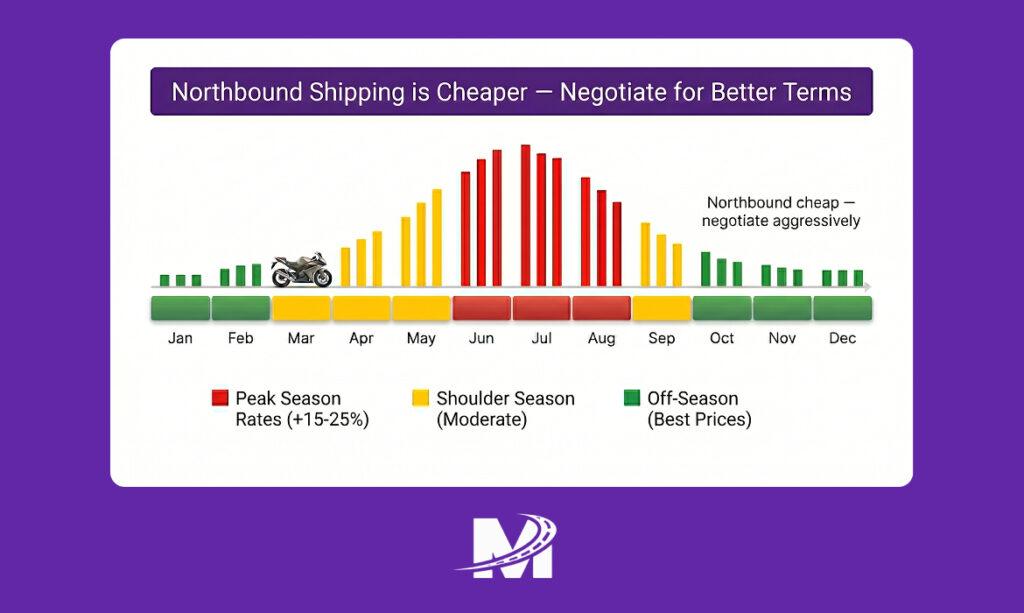
Motorcycle shipping follows a predictable seasonal pattern, and understanding it can save you $100–$250 on the same route.
Peak Season – May through August
Demand is highest in summer. Families are relocating. Snowbirds who shipped south in fall are now shipping back north. Riders who bought bikes online are having them delivered before summer ends. This is when carriers have full trailers and no incentive to negotiate.
Budget impact: Expect to pay 15–25% above baseline during June, July, and August. On a $700 cross-country quote, that’s an additional $105–$175.
Shoulder Season – April and September
These months offer a reasonable middle ground – prices are rising or falling but haven’t hit their extreme. If you have any flexibility in your move date, late September into early October is often a sweet spot: summer pricing has deflated, but winter weather hasn’t started creating delays.
Off-Season – November through February
This is when motorcycle shipping is genuinely cheap. Demand drops significantly because fewer people are buying, selling, or relocating bikes in winter. Carriers are filling trucks that would otherwise run partially empty.
The snowbird reverse: When retirees ship their bikes south (Florida, Arizona) in October and November, southbound routes get expensive. But northbound routes in the same period are cheap – carriers are desperate to fill the return trip. If you happen to need a northbound move in November, you may be able to negotiate aggressively.
Winter caveat: Lower prices come with longer lead times. A carrier that might confirm pickup within 5 days in July may need 10–14 days in January. If your schedule is flexible, this is a great trade-off. If you have a hard deadline, book earlier than you think you need to.
How to Get a Competitive Quote – The Process Explained
Step 1: Use a Broker, Not Just a Carrier
A reputable broker has relationships with dozens of carriers and knows which ones are running your route in a given week. They can often get your bike on a truck faster and at a lower price than you’d find on your own. For a full breakdown of how this works, read our auto transport broker vs. carrier guide before you start calling around.
Step 2: Give a 5-to-7-Day Pickup Window
If you tell a broker “I need pickup on Thursday the 12th,” you’ve eliminated every carrier that doesn’t have a truck in your area that specific day. A 5–7 day window allows the broker to match you with a carrier who is already running a route near you, which means the carrier will often accept a lower rate to fill their last open spot.
Step 3: Book 2–3 Weeks Out
The sweet spot for motorcycle shipping is 14–21 days before your target pickup date. Earlier than that and fuel price fluctuations make quotes unreliable. Later than that and you’re paying “expedited” rates because the carrier has already filled their route.
Step 4: Ignore the Lowest Quote
There is a well-documented tactic in this industry called the “lowball and hold.” A broker gives you a price $200–$300 lower than everyone else to secure your deposit, posts your bike on the load board at that rate, and no carrier takes the job because the pay is too low. Days pass. Your pickup window comes and goes. Then the broker calls to say a driver “finally became available” – at a price $300 higher than the original quote.
The tell: if a quote is more than 20% below the average of your other quotes, it’s almost certainly a lowball. The middle range of quotes you receive is where the real market is. Our car shipping scams guide covers this and other red-flag tactics in detail – the same patterns apply to motorcycle shipping.
Step 5: Verify FMCSA Registration
Before paying any deposit, verify that the carrier your broker has assigned is registered with the Federal Motor Carrier Safety Administration. You can do this free at safer.fmcsa.dot.gov using the carrier’s MC number or DOT number. A legitimate carrier will provide this without hesitation. A carrier that deflects or can’t provide these numbers is a red flag.
The Bill of Lading – Your Protection If Something Goes Wrong
The BOL is your official condition record – the document that determines whether you can successfully file a damage claim if something goes wrong in transit. For a broader look at how this document works across all vehicle types, see our complete guide to car shipping.
At Pickup
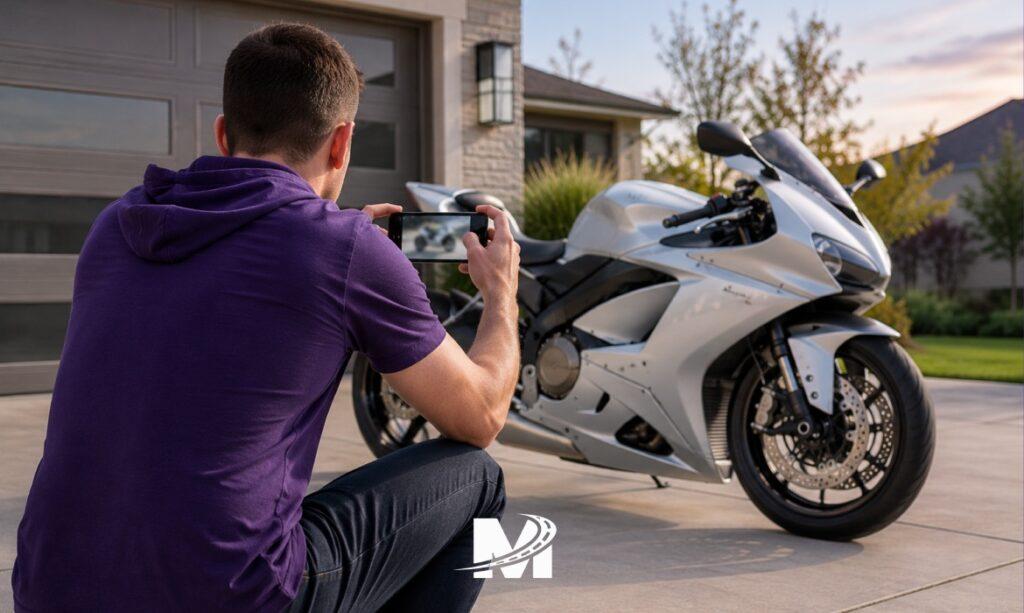
Walk around the motorcycle with the driver and confirm every existing scratch, scuff, chip, and blemish is noted on the BOL. Be specific. “Minor scratches on left lower fairing” is better than “some wear.” Take photographs of every noted item, and take photos of areas that are undamaged so you have documentation of their pre-transit condition.
If you have aftermarket parts – a custom exhaust, upgraded mirrors, a GPS mount – note these on the BOL as well. Stock components are what the carrier’s insurance knows about. A $400 custom exhaust that gets damaged isn’t automatically covered if it wasn’t documented.
At Delivery
Do not sign the BOL until you have physically inspected the motorcycle. If the bike is delivered at night, move it to a well-lit area or use a high-powered flashlight before signing. Check the areas most commonly missed: the underside of the fairings, the top of the fuel tank (stone chips fall here on open transport), the axle sliders, and the mirrors.
If you notice new damage, note it on the delivery BOL before signing, photograph it immediately, and contact the carrier’s insurance within 24 hours. Once you sign a clean BOL, you have legally accepted the motorcycle in the condition it arrived. You can monitor your shipment status at any point using our order tracking page.
Electric Motorcycles – Special Pricing to Know
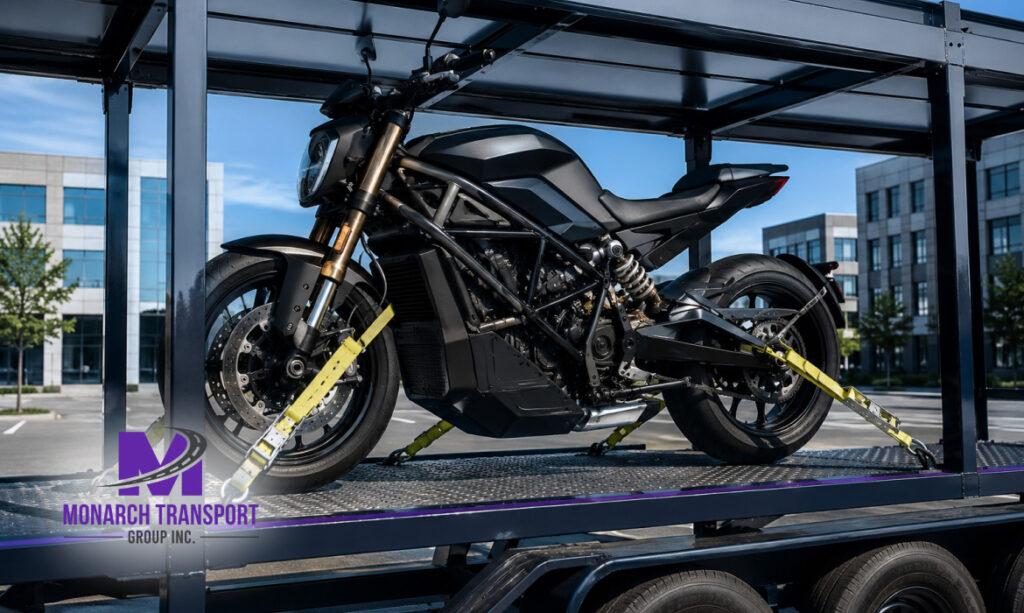
Electric motorcycles – the Zero SR/F, Energica Ego, and similar bikes – are increasingly common in shipping networks. The main consideration is battery classification: large lithium-ion packs are classified as hazardous materials for transport, and some carriers add a handling surcharge of $50–$150. Not all carriers charge this, but enough do that it’s worth asking specifically when you request a quote.
EV motorcycles also tend to be heavier than their ICE equivalents due to battery weight, which pushes them into higher price brackets. If you want a deeper look at EV-specific shipping considerations, our guide on shipping your electric vehicle safely covers the full process including battery prep and carrier selection.
If you’re shipping an electric motorcycle, explicitly mention it when requesting quotes. Some brokers have carrier networks that specialize in EV transport and can match you with a carrier who handles these regularly without the surcharge.
Quick Reference – What Your Specific Scenario Will Cost
Rates vary widely depending on your bike’s size, the distance, and whether you choose open or enclosed transport. The table below breaks down real-world pricing across common scenarios – from short intrastate hauls to cross-country enclosed shipments – so you can quickly find the range closest to your own situation.
| Scenario | Estimated Cost |
| 250cc dirt bike, intrastate move under 200 miles, open | $200 – $320 |
| Standard sportbike, Chicago to Nashville (~470 mi), open, flexible dates | $300 – $420 |
| Mid-size cruiser, New York to Miami (~1,280 mi), open, door-to-door | $550 – $750 |
| Harley Road Glide (full dresser), Texas to California (~1,400 mi), open | $700 – $950 |
| Harley Road Glide, same route, enclosed | $1,000 – $1,300 |
| Vintage cafe racer, Seattle to Chicago (~2,100 mi), enclosed | $1,000 – $1,350 |
| Custom chopper, rural origin, cross-country, enclosed, July | $1,200 – $1,500+ |
| Electric motorcycle, LA to NYC (~2,800 mi), open | $800 – $1,100 |
For a precise quote on your route and bike, use the Monarch motorcycle shipping calculator.
7 Ways to Pay Less Without Compromising Your Bike
1. Be flexible on dates. A 7-day pickup window instead of a specific day can reduce your quote by $75–$150 on competitive routes.
2. Choose terminal-to-terminal if your region has a terminal. Dropping off and picking up at a shipping hub eliminates the “last mile” navigation premium. Savings: $75–$200. See how door-to-door vs. terminal-to-terminal compares across different situations.
3. Book in the off-season. January and February are cheapest. If you’re buying a bike online and there’s no urgency on delivery timing, winter shipping saves real money. Not sure where to buy? Check our list of best places to buy a motorcycle online in the USA.
4. Remove fixed saddlebags if possible. On full-dresser baggers, removable hard cases reduce the “oversize” surcharge and sometimes get you into a lower price tier entirely.
5. Have your battery tested before shipping. Avoiding a non-op classification at delivery is worth the $20 cost of a battery test at any auto parts store.
6. Verify your existing motorcycle insurance covers transit. If it does, skip the supplemental insurance the broker offers.
7. Book 2–3 weeks out, not months ahead. Fuel prices change. A quote from six weeks out may not reflect what you actually pay. The 14–21 day window is where quotes are accurate and competitive.
Final Word – What Motorcycle Shipping Actually Costs
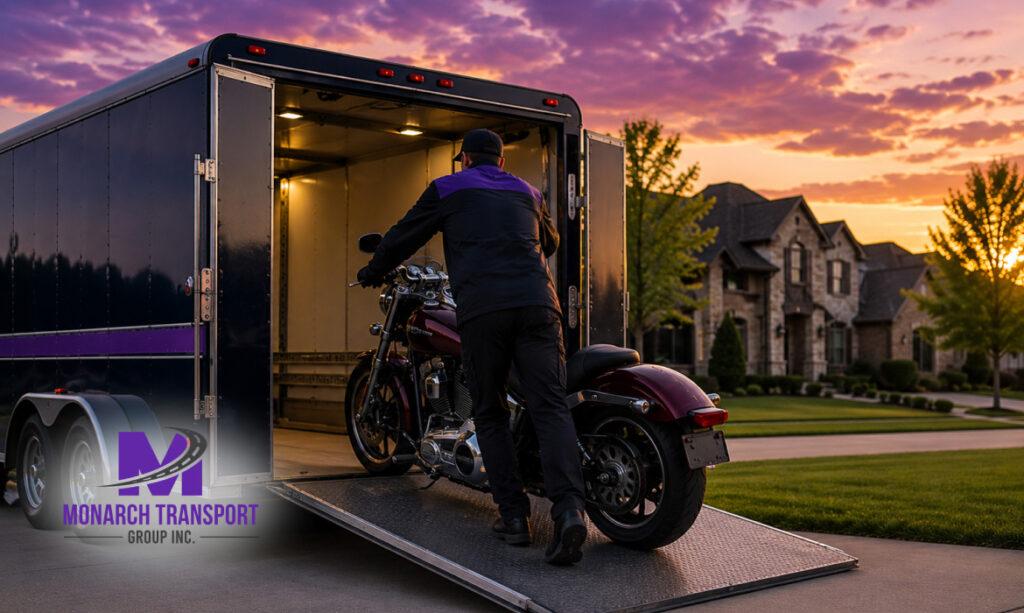
For most owners shipping a standard or mid-size bike domestically on open transport with some date flexibility, the realistic budget is $400–$800. For cross-country moves on full-dresser touring bikes in peak season with enclosed transport, budget $1,000–$1,350.
Ready to book? Our motorcycle transport service covers all bike types and routes, or get an instant quote with the shipping calculator.
FAQ About Motorcycle Shipping Costs
Cross-country shipping (1,500–2,500+ miles) typically costs $700–$1,350. The lower end applies to lightweight bikes on open transport with flexible timing. The upper end applies to heavyweight touring bikes on enclosed carriers during peak summer months.
For moves over 1,000 miles, shipping is often comparable or cheaper when you account for your own fuel, hotel nights, meals, wear on the bike, and the time cost of a multi-day ride. For cross-country moves, the math usually favors shipping.
Typical domestic transit times: 3–5 days for 500–1,000 miles, 5–8 days for 1,000–1,500 miles, 7–14 days for cross-country moves. These are transit times after pickup, not the full process including booking and scheduling.
Open transport with terminal-to-terminal pickup and delivery, booked during January or February, with a 7-day pickup window. This combination can reduce costs by 30–40% compared to enclosed, door-to-door shipping in peak summer.
Most carriers allow small items in saddlebags, but weight matters. Anything that brings the bike over the carrier’s weight parameters can result in an overweight surcharge or refusal. Keep it minimal – gloves, a light jacket, documents. Never pack valuables.
Yes, significantly. Heavyweight touring bikes and baggers can cost $100–$200 more than lightweight bikes on the same route due to weight and footprint differences. Always provide the exact year, make, and model when requesting a quote.
Carriers are required to carry cargo insurance, typically $10,000–$15,000 in base coverage. Before purchasing supplemental insurance from the broker, check whether your own motorcycle insurance policy covers the bike during transport – many do, which makes the supplemental policy unnecessary.
Related articles

ATV vs UTV Shipping: Costs, Methods & What to Expect in 2026
IN THIS ARTICLE: The Fundamental Difference: Dimensional Weight and Trailer Space Average Shipping Costs in 2026: What to Budget Best Time to Ship Your ATV or UTV – Seasonal Price

Best Places to Buy a Motorcycle Online in the USA
IN THIS ARTICLE: The Digital Shift: Geography No Longer Constrains the Ride Where to Buy: Top 2026 Platforms Analysis Comparison Table: Platform Overview The Facet of Finance: Not Just the

Car Shipping Insurance: What’s Actually Covered (And What’s Not)
IN THIS ARTICLE: The Most Important Distinction Nobody Tells You Upfront What Car Shipping Insurance Actually Covers What Is NOT Covered – The Real Exclusions Coverage Limits – What the

Complete Guide to Car Shipping in 2026
The landscape of American mobility has shifted, making vehicle logistics more accessible and seamless than ever before. Understanding this new norm is the first step toward a stress-free relocation that

Car Shipping by Train: Costs, Process & What to Expect in 2026
IN THIS ARTICLE: The Two Faces of Rail Transport: Consumer vs. Commercial Why Choose the Tracks? (The Human Perspective) Dimensions and Constraints: Will Your Car Fit? The “Hidden” Logic of

How State-to-State Car Transport Works: From Pickup to Delivery
IN THIS ARTICLE: Understanding the Auto Transport Ecosystem Choose Your Transport Type The Process of Shipping Calculating the Cost and Timeline of State-to-State Car Transport The 2026 EV Transport Protocol
How to Ship a Motorcycle Safely: The 2026 Guide
IN THIS ARTICLE: The “Why” Behind the Shipping Method Option 1: The DIY Route (Towing it Yourself) Option 2: Open vs. Enclosed Transport Option 3: Specialized Motorcycle Shippers vs. General

Seasonal Car Shipping Tips: What to Know Before Shipping in Summer
IN THIS ARTICLE: Why Summer Is the Most Demanding Season for Auto Transport The Price Reality: How Much More Does Summer Shipping Cost? The Heat Problem – What Open Trailers