
How to Ship a Car You Won at Auction: Pickup Deadlines, Storage Fees and Transport Options
Calculate Shipping Cost
IN THIS ARTICLE:
- Key Takeaways
- What to Do Immediately After Winning a Car Auction
- Auction Pickup Deadlines and Storage Fees
- How to Arrange Transport From Copart, IAA, or Manheim
- How to Ship a Non-Running or Salvage Auction Car
- Open vs. Enclosed Transport for Auction Cars
- How Much Does It Cost to Ship a Car Won at Auction?
- What to Check at Pickup and Delivery
- Get a Quote for Auction Car Transport
- FAQs
Winning the bid is the easy part. What follows is a clock: most auctions give you a short window to pay, and a second, separate window to physically remove the vehicle before storage charges start accumulating. Miss either one and the savings from a good buy disappear into daily fees. On top of that, a paid car isn’t automatically a released car, carriers aren’t always available on short notice, and a vehicle that doesn’t run needs equipment arranged in advance.
This guide walks through what to do from the moment you win, how to avoid storage and gate fees, and how to arrange transport that actually arrives on time.
Key Takeaways
Already know the lot location and destination? Get a free transport quote and start the clock on booking, not on storage fees.
What to Do Immediately After Winning a Car Auction
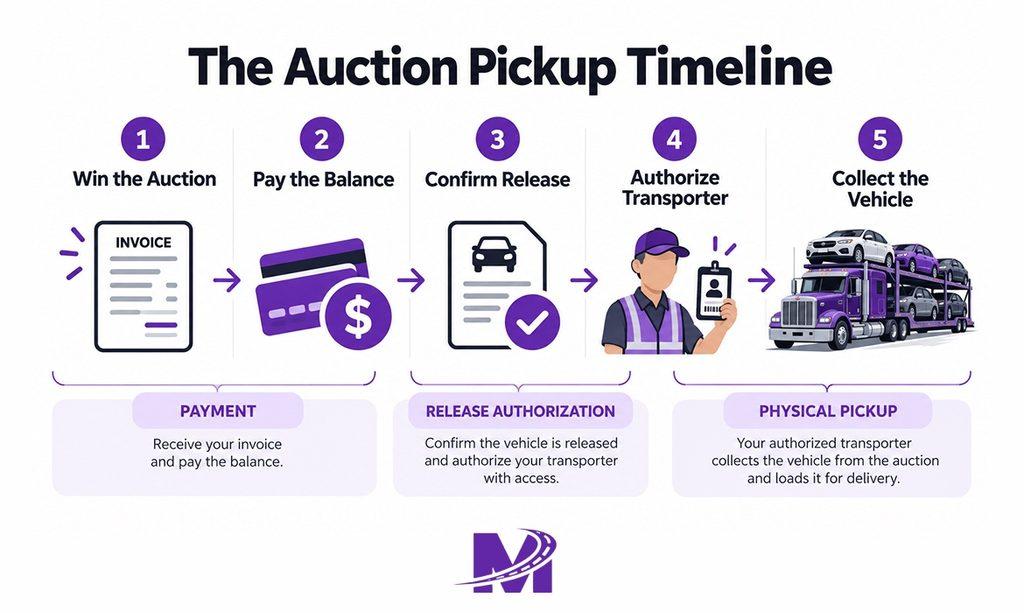
The first 24 hours set up everything else. Work through these in order.
Confirm the Winning Bid and Total Amount Due
Your invoice is more than the hammer price. Buyer fees, gate fees, internet fees, and applicable taxes are added on, and the total is what has to clear before release. Pull the full invoice from your account rather than working from the bid amount.
Check the Payment Deadline and Release Status
Payment windows are short – Copart, for example, specifies a three-day payment period, with the exact terms set out in your account and member terms. Note that paying and being cleared for pickup are not the same thing. Payments can take time to post, and some methods clear faster than others, so check the vehicle’s status in your account rather than assuming release follows payment instantly.
Find the Vehicle’s Pickup Location and Yard Hours
The yard holding your car may not be the one you expected, and yards have their own operating hours and access rules. A carrier can only collect during those hours, which narrows the scheduling window more than most buyers anticipate.
Collect the Lot Number, VIN, and Buyer Information
Your transporter will need the lot number, VIN, yard address, your buyer details, and whatever release credential the auction uses. Having these ready means a carrier can be dispatched the moment the vehicle clears. Keep in mind that the auction’s vehicle release process is separate from the paperwork you may need to register or title the vehicle later – confirm the pickup requirements with the yard before dispatching a carrier.
Auction Pickup Deadlines and Storage Fees
This is where most money gets lost unnecessarily.
How Long Can You Leave a Car at an Auction?
Free storage periods are short and vary by auction company, location, and sometimes the type of sale and buyer. Some auctions count calendar days, including weekends; others use business days. Never assume the pickup window at one yard applies to another. Check the terms for the specific lot holding your vehicle.
At Copart, storage charges apply when a vehicle remains at the yard longer than three business days. The daily rate varies by location and is listed on the yard’s location page. The auction day counts toward the pickup window, so check the current schedule for your specific lot before arranging transport.
Auction Fees With Published Figures
Some charges are set out in the auctions’ published terms, so you can budget for them more precisely. Copart’s member fee schedule lists a $50 per-vehicle late payment fee if payment isn’t made within three business days, including the day of sale, and a $79 gate fee per vehicle. A relist fee of 10% of the final sale price, with a $600 minimum, applies if a vehicle goes unpaid for eight calendar days, including the day of sale. Storage fees vary by location, so check the page for your yard.
Manheim is a dealer-only wholesale auction, with buyers generally required to be licensed dealers or other eligible commercial buyers registered with AuctionACCESS or approved by Manheim. If you’re a private buyer, your vehicle most likely came from Copart or IAA.
Manheim’s terms state that a vehicle on its premises must be collected by the sixth day after it’s reported ready for release. After that, storage fees of up to $25 per day may apply. Vehicles at off-site locations fall under separate terms.
These figures come from each auction’s published information and apply under specific conditions. Verify that the fees and deadlines are current and applicable to your purchase before arranging pickup.
When Do Copart, IAA and Manheim Charge Storage Fees?
Each auction publishes its own schedule, and daily rates differ between locations. Verify these for your lot before booking anything:
| What to confirm | Where to check |
| Payment deadline | Your account invoice and the auction’s member terms |
| Free storage period | The terms for the specific yard holding your vehicle |
| Daily storage rate | The location page for that yard |
| How release is confirmed | Copart: Gate PIN · IAA: release instructions · Manheim: Vehicle Release |
| Options if you’re running late | Contact the auction directly for your lot |
Storage terms differ by auction company, by location, and sometimes by sale type, so the window at one yard never carries over to another.
What Happens If You Miss the Pickup Deadline?
Storage charges accrue daily, and extended delays can escalate further depending on the auction’s terms. If you’re already past the window, work through it in order:
Extensions aren’t guaranteed, so treat this as damage control rather than a plan.
How to Avoid Extra Storage, Gate and Loading Fees
How to Arrange Transport From Copart, IAA, or Manheim
You generally have three routes, and they’re worth comparing on the same terms. If you bought the vehicle through an online marketplace rather than a physical auction, our guide on shipping a car you bought online covers that process.
Auction-Arranged Delivery vs. Independent Auto Transport
Auction-arranged transport is the simplest to book, since the auction handles the yard side. An independent broker matches your vehicle to carriers across a wider network, which usually means more flexibility on timing and vehicle condition. Booking a carrier directly can work if you find one already running your route – Monarch’s car transport service covers auction pickups nationwide.
Don’t assume one is automatically cheaper. Compare actual quotes for the same pickup window, the same vehicle condition, and the same delivery address – a low quote that can’t handle a non-running car isn’t a comparable offer.
How to Book a Carrier for Auction Pickup
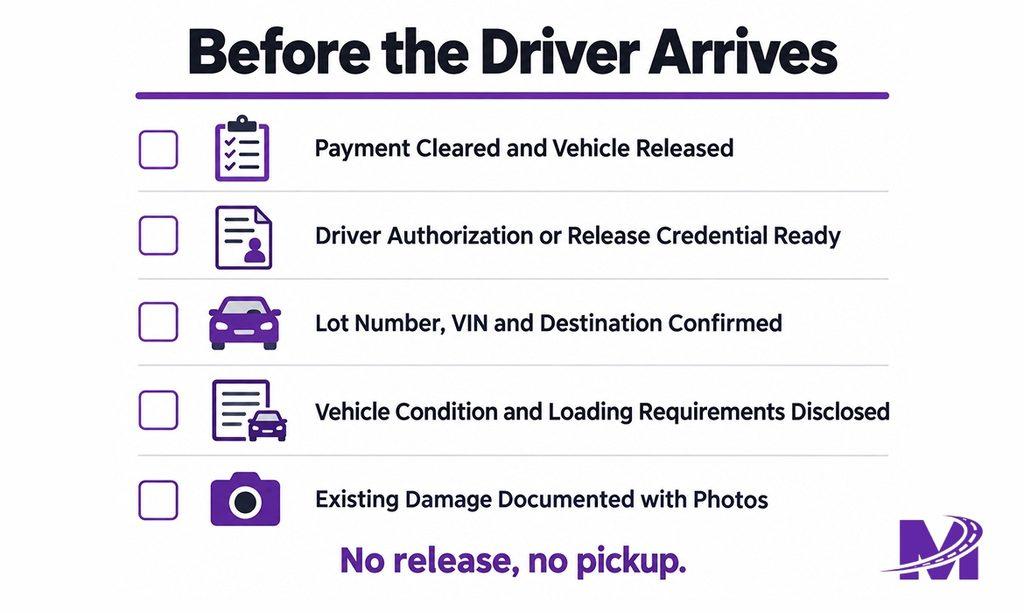
Auctions require transporters to be authorized before collection. Copart, for instance, has a process for inviting a third-party transporter through your account and issuing a Gate PIN; Manheim uses a Vehicle Release. Whatever the mechanism, the driver has to be on the list before arrival, and sorting that out on pickup day costs you a day.
What Information Does Your Transporter Need?
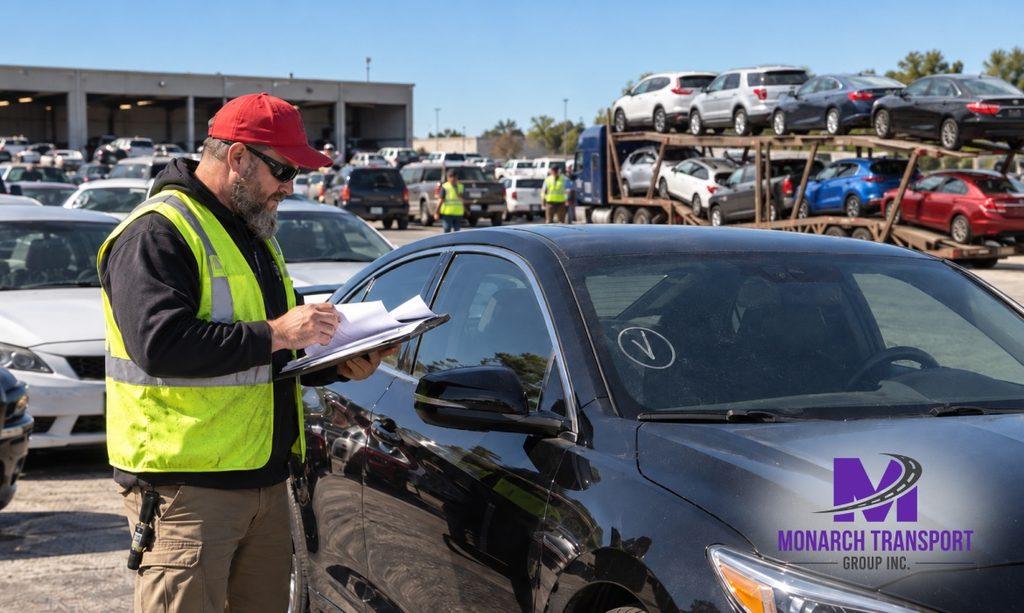
Lot number, VIN, year/make/model, the exact yard address, yard hours, the release credential, the destination address, and a complete description of the vehicle’s condition.
How to Confirm the Vehicle Is Ready for Release
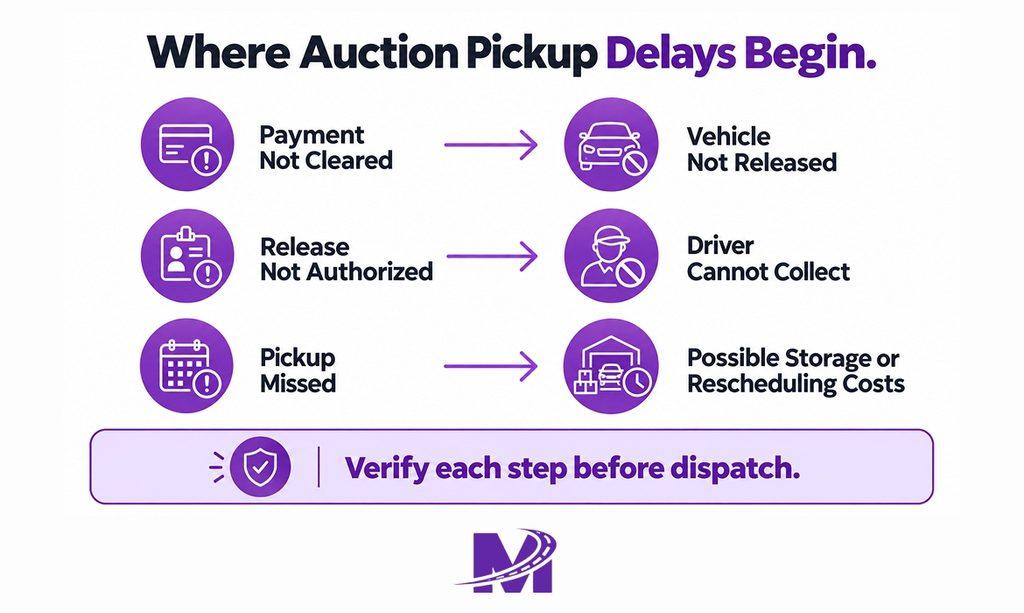
Before a driver is dispatched, verify that payment has cleared, the status shows the car is available for pickup, and the release credential has been issued. A driver arriving at a yard for a car that isn’t released is a failed pickup you’ll likely pay for.
How to Ship a Non-Running or Salvage Auction Car
Auction vehicles are frequently inoperable, and this is where pickups fail most often.
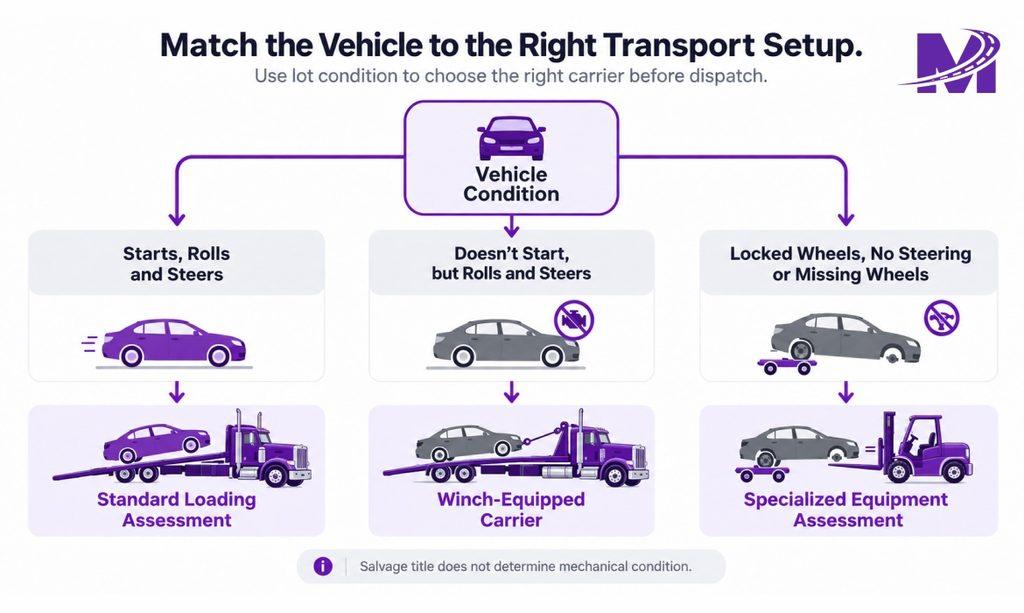
Does the Car Start, Roll, Steer, and Brake?
Four separate questions, and the answers determine the equipment. The auction listing may note run-and-drive status, but that’s a sale designation, not a loading assessment. Note also that a salvage title is a paperwork status, not a mechanical one – a salvage car can run perfectly, and a clean-title car can be immobile.
When Do You Need a Winch, Forklift or Special Equipment?
Our guide on shipping a non-running car covers the equipment side in detail.
Can a Salvage Car Be Loaded at the Auction Yard?
Usually yes – yards often have loading equipment, which can make the pickup end easier than a residential one. The harder end is delivery, where no forklift may be available. Confirm equipment at both locations before booking.
What to Tell Your Transporter Before Pickup
Describe the condition precisely: whether it starts, whether all four wheels roll, whether it steers, whether the brakes release, any missing wheels, and the extent of visible damage. “Non-running” alone gives a dispatcher nothing to work with and is the most common cause of the wrong truck showing up.
Open vs. Enclosed Transport for Auction Cars
| Open transport | Enclosed transport | |
| Cost | Lower | Higher |
| Protection | Exposed to weather and road debris | Fully shielded |
| Best for | Daily drivers, salvage, repairable vehicles | High-value, collector, pristine vehicles |
| Availability | Widely available | Fewer carriers, more lead time |
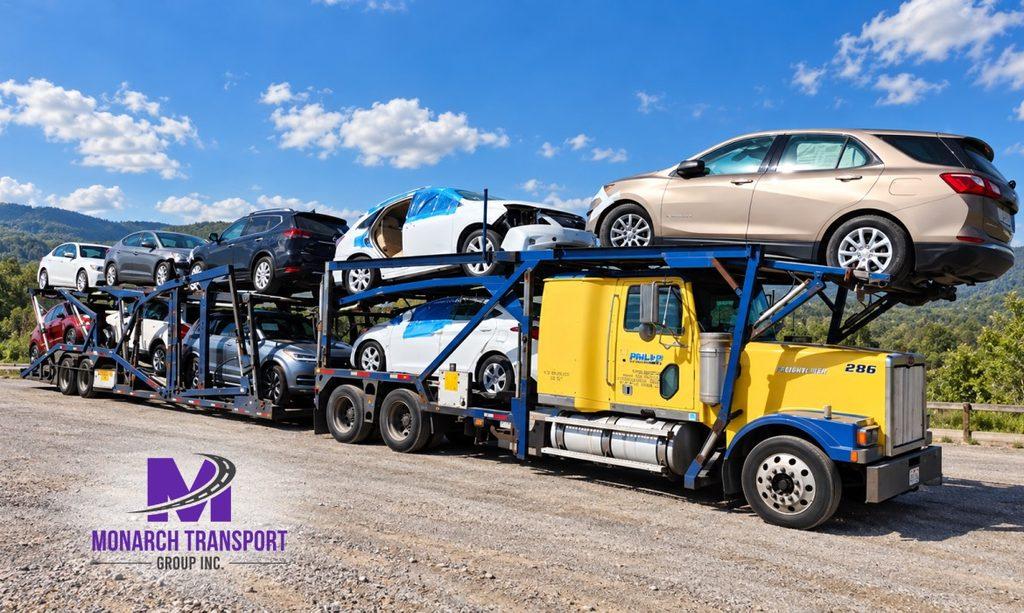
Open transport is the default for most auction buys, especially a car already damaged or heading to a repair shop – there’s little point paying a premium to protect a vehicle you’re about to rebuild. Enclosed makes sense for a high-value or collector purchase, or a vehicle whose finish you intend to preserve. For a damaged high-value car, enclosed is often worth it, but check that your chosen carrier can also handle the loading equipment the vehicle needs.
How Much Does It Cost to Ship a Car Won at Auction?
What Does Auction Car Transport Typically Cost?
Monarch Transport Group’s published rates for standard vehicle transport vary by distance and transport type. The table below shows estimated costs for open and enclosed transport. If an auction vehicle doesn’t start but still rolls, brakes, and steers, winch loading typically adds about 150-300 to the base transport price. Vehicles in poor condition that require a flatbed and forklift assistance at both pickup and delivery are quoted individually.
| Distance | Open transport | Enclosed transport | If the car doesn’t run |
| 0-500 miles | $450-$750 | $700-$1,050 | Add $150-$300 for winch loading if the vehicle rolls, brakes, and steers; otherwise, quoted individually |
| 500-1,000 miles | $700-$1,050 | $1,000-$1,450 | Add $150-$300 for winch loading if the vehicle rolls, brakes, and steers; otherwise, quoted individually |
| 1,000-1,500 miles | $950-$1,350 | $1,300-$1,850 | Add $150-$300 for winch loading if the vehicle rolls, brakes, and steers; otherwise, quoted individually |
| 1,500-2,000 miles | $1,150-$1,650 | $1,600-$2,200 | Add $150-$300 for winch loading if the vehicle rolls, brakes, and steers; otherwise, quoted individually |
| 2,000+ miles | $1,350-$1,950 | $1,900-$2,700 | Add $150-$300 for winch loading if the vehicle rolls, brakes, and steers; otherwise, quoted individually |
These are estimated rates, not guaranteed quotes. [NOTE FROM SERGE FOR ANASTASIA: two typos in the table above: “$1,150-$1.650” should be “$1,150-$1,650” and “$1,600-$2.200” should be “$1,600-$2,200” (comma, not dot). Please fix before publishing.] SUVs, pickups, rural auction yards, special loading requirements, and urgent pickup requests can increase the final price. Enclosed transport costs more than open transport, with the difference depending on the route, vehicle, and carrier availability.
Example: budgeting for a 700-mile auction car shipment. For a standard, operable sedan, Monarch’s published open-transport range is $700-$1,050. If the car doesn’t start but still rolls, brakes, and steers, budget an additional $150-$300 for winch loading, bringing the illustrative total to $850-$1,350. If the vehicle cannot be loaded using a standard winch setup and needs a flatbed and forklift assistance at both ends, request an individual quote.
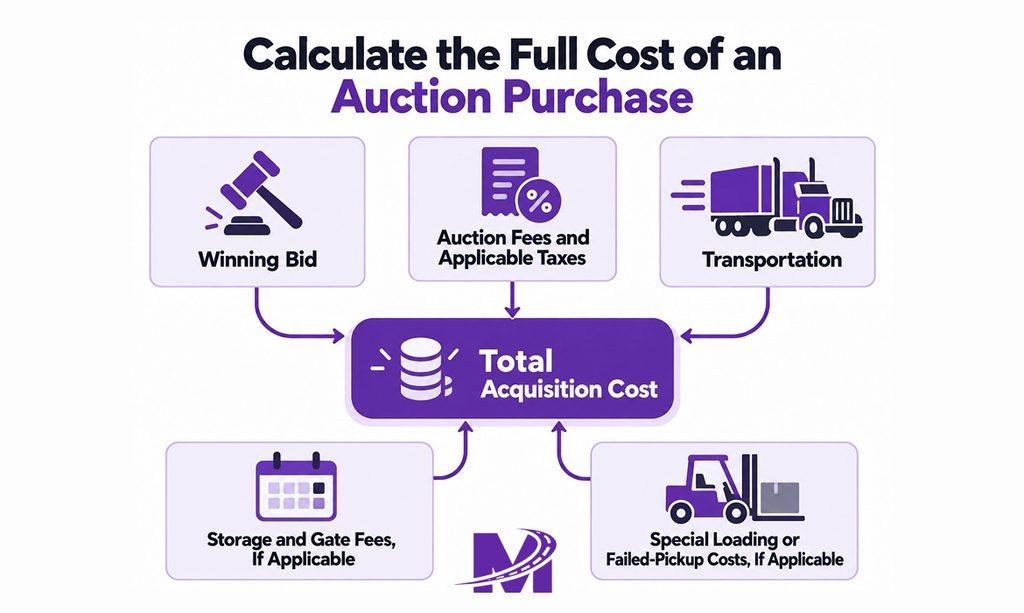
Transportation is only one part of your auction budget. Your total costs may also include the vehicle’s purchase price, buyer fees, the gate fee, storage accrued before collection, and special-loading or failed-pickup charges.
Factors That Affect Auction Car Shipping Costs
How to Compare Transport Quotes
Quote the same thing across providers: same pickup window, same stated vehicle condition, same delivery address, same transport type. Then ask what isn’t included. Calculate your shipping cost with the vehicle’s real condition entered, since a quote based on “runs and drives” won’t survive contact with a non-rolling car.
What to Check at Pickup and Delivery
Photograph the Vehicle Before Loading
Save the auction listing photos, and have the driver photograph the car at the yard. With auction vehicles, pre-existing damage is the norm, so the only way to tell old damage from new is a clear record of its condition at loading.
Review the Bill of Lading
Existing damage must be noted on the BOL at pickup. Keep your copy.
Inspect the Car Again at Delivery
Compare it against the loading photos and the BOL before signing. If you find new damage, record it on the paperwork before you complete the handover and follow the carrier’s claims process.
Get a Quote for Auction Car Transport
Have the lot location, destination, and vehicle condition ready, and you can book before storage fees start. Monarch arranges state-to-state car shipping from auction yards nationwide, including winch-equipped and specialized loading.
Get a Free Car Shipping Quote or call 855-983-5929.
FAQs
Copart’s pickup window depends on the yard and sale terms. Its location pages state that storage charges apply when a vehicle remains at the yard longer than three business days, with the daily rate set by location. Count the auction day toward the deadline and check the current storage schedule on your vehicle’s yard page before arranging pickup.
Copart storage fees vary by location. Storage charges apply when a vehicle remains at the yard beyond the free pickup period, and the daily rate is listed on the specific yard’s location page. Copart’s published member fee schedule lists a $79 gate fee per vehicle at pickup. Check your yard’s current terms for the exact storage rate and any other applicable fees.
Usually, but the person or transporter must be authorized in advance through the auction’s release process. An unauthorized driver will be turned away at the gate.
Yes, with the right equipment. Tell your transporter whether the car rolls, steers, and brakes so the correct truck is dispatched.
Each auction uses its own release mechanism, such as a Gate PIN or a vehicle release form. Have it issued before the driver arrives.
Neither is automatically cheaper. Compare quotes for the same pickup window, vehicle condition, and destination, then check what each one excludes.
Storage charges accrue daily and can escalate under the auction’s terms. Contact the auction as soon as you know you’ll be late and confirm any extra charges before authorizing them.
Transit time depends on distance, but the bigger variable is how quickly a carrier is assigned and the vehicle is released. Non-running vehicles can take longer to match.
Related articles

10 Best Platforms to Buy or Sell Used Cars Online in 2026
IN THIS ARTICLE: Platform Comparison at a Glance Safety: How to Protect Yourself on Any Platform The Bottom Line: Choosing Your 2026 Auto Platform FAQ Buying or selling a used
Auto Transport Broker vs. Carrier: Which One Should You Use?
IN THIS ARTICLE: What Is an Auto Transport Broker? What Is an Auto Transport Carrier? The Key Differences Side by Side Does Using a Broker Cost More? What Is “Dual

Can You Ship a Financed or Leased Car? Lender Rules Explained
IN THIS ARTICLE: Do I Need My Lender’s Permission to Ship a Car? Financed vs. Leased – Why the Difference Matters What a Standard Domestic Move Actually Requires When You

Car Shipping by Train: Costs, Process & What to Expect in 2026
IN THIS ARTICLE: The Two Faces of Rail Transport: Consumer vs. Commercial Why Choose the Tracks? (The Human Perspective) Dimensions and Constraints: Will Your Car Fit? The “Hidden” Logic of

Car Shipping Deposit Explained – Why Brokers Ask for It and When You Pay
IN THIS ARTICLE: How the Auto Transport Payment Structure Works What the Car Shipping Deposit Actually Pays For How Much Should a Car Shipping Deposit Be? Broker Deposit vs. Carrier

Car Shipping Routes: How Cost and Transit Time Work by Route Type
IN THIS ARTICLE: Key Takeaways Types of Car Shipping Routes Virginia to Ohio Car Shipping Virginia to Florida Car Shipping California to North Carolina Car Shipping How Much Does It

Complete Guide to Car Shipping in 2026
The landscape of American mobility has shifted, making vehicle logistics more accessible and seamless than ever before. Understanding this new norm is the first step toward a stress-free relocation that

Cross-Country Car Shipping: How to Save Money Safely
IN THIS ARTICLE: Why “Cheap” Doesn’t Have to Mean “Dangerous” 1. Open Transport: The Industry Gold Standard for Savings 2. The Power of “Terminal-to-Terminal” Shipping 3. Timing the Market: The
