
IN THIS ARTICLE:
- Key Takeaways
- What Paperwork Do You Need to Ship an ATV or UTV?
- How to Prepare an ATV or UTV for Transport
- ATV and UTV Pre-Pickup Checklist
- What Should You Do at ATV or UTV Pickup?
- What If the ATV or UTV Does Not Run?
- Does an ATV or UTV Need Special Preparation for Enclosed Transport?
- What Can You Leave on an ATV or UTV During Transport?
- Common ATV and UTV Shipping Preparation Mistakes
- Get an ATV or UTV Shipping Quote
- ATV vs. UTV: Does the Preparation Process Differ?
- FAQs About ATV and UTV Shipping
Before an ATV or UTV is picked up for transport, gather the ownership documents your carrier asks for, such as a title or bill of sale when applicable, and have pickup and delivery contact information ready. Prepare the vehicle by removing loose items and accessories, checking for leaks, confirming the carrier’s fuel requirement, and photographing the vehicle’s existing condition before the driver arrives. Disclose a non-running vehicle before booking so the carrier can plan the right equipment.
To prepare an ATV or UTV for shipping, gather the documents your carrier requires, remove loose items and accessories, examine for leaks, confirm the required fuel level, and photograph the vehicle before pickup. Keep proof of ownership or purchase documents available when applicable, and provide pickup and delivery contact information. If the ATV or UTV does not run, disclose that before booking so the carrier can determine the equipment needed for loading.
ATV and UTV transport is one of several shipping services Monarch offers, and the same paperwork and preparation basics apply whether you’re booking open or enclosed pickup. Use this checklist as a starting point, then read the sections below for the details for each item.
Key Takeaways
What Paperwork Do You Need to Ship an ATV or UTV?
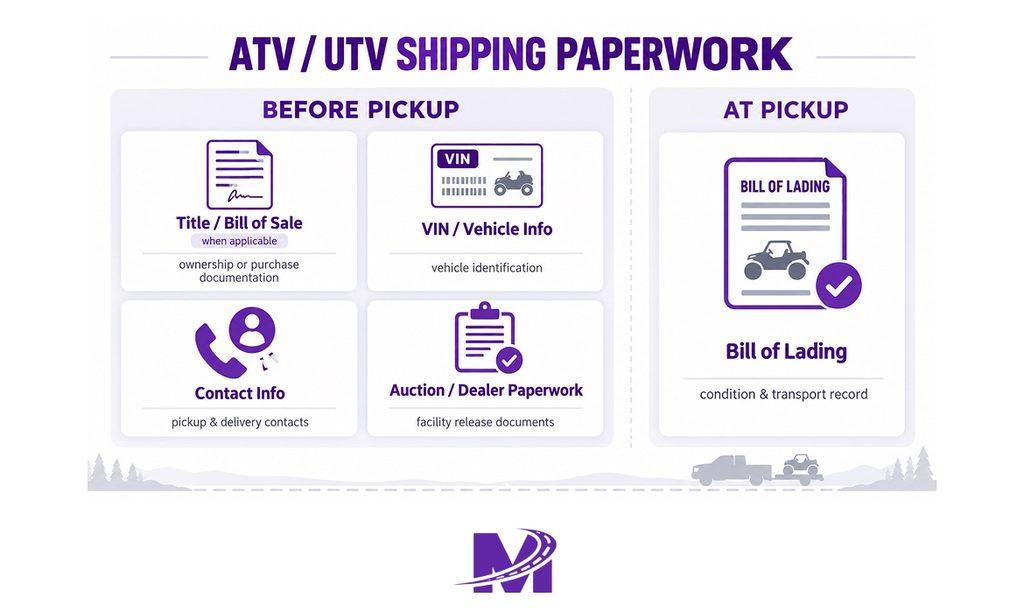
The documents needed to ship an ATV or UTV depend on the shipment, the carrier, and whether you’re shipping domestically or across a border. Common items include proof of ownership when applicable, pickup and delivery contact information, and the Bill of Lading completed at pickup.
| Document / information | Why you may need it | When to have it ready |
| Title or bill of sale | Helps establish purchase or ownership documentation when applicable | Before pickup |
| VIN or vehicle information | Identifies the ATV or UTV | When booking |
| Contact information | Gives the carrier pickup and delivery contacts | Before pickup |
| Bill of Lading | Records shipment details and vehicle condition | At pickup |
| Auction or dealer paperwork | Confirms release at a facility that requires it | Before pickup |
Proof of Ownership: Title or Bill of Sale
If you recently purchased the ATV or UTV and the title hasn’t transferred yet, keep the bill of sale or purchase agreement available and confirm with the carrier what documentation it accepts. For comparison, our guide to documents needed to ship a car across state lines explains the paperwork commonly used in auto transport. For questions about title and odometer records, NHTSA’s odometer fraud resources explain how title histories are used and where to start.
Pickup and Delivery Contact Information
Give the carrier a direct phone number for both ends of the shipment, plus any details that affect access: gate or facility instructions, operating hours, or a backup contact if you will not be there yourself. This is what lets the driver reach you when they are close, instead of guessing at a delivery window.
Bill of Lading: What to Check Before Signing
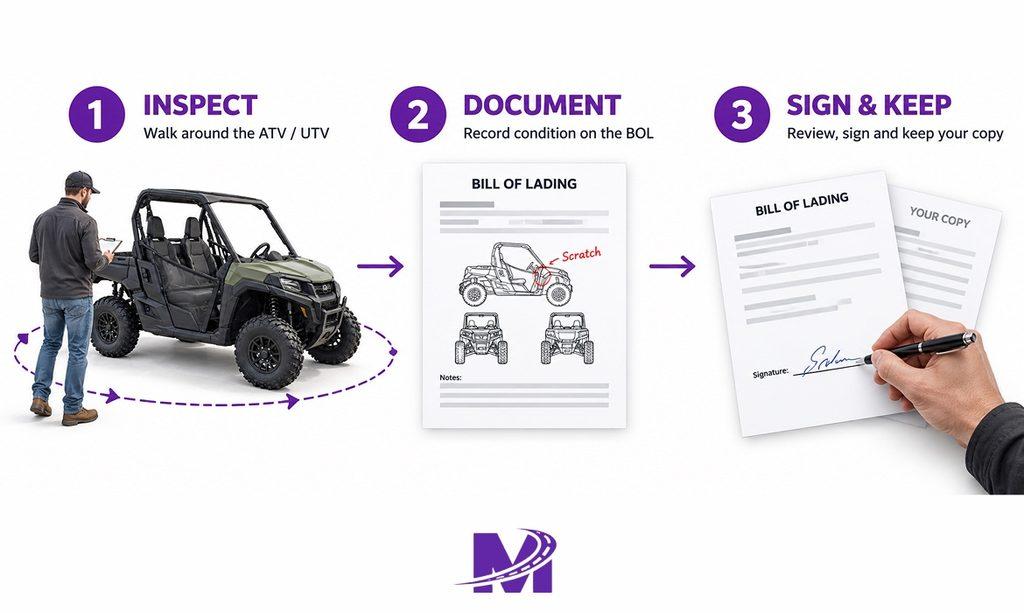
A Bill of Lading (BOL) is the shipping document that records the vehicle’s condition and transport details at pickup. For Monarch shipments, the driver prepares the BOL on-site, you examine and sign it, and you use it again to check the vehicle’s condition at delivery. Review it carefully before signing: confirm the vehicle is correctly identified, its condition matches what you documented, and any existing damage is noted. Keep your copy for your records.
How to Prepare an ATV or UTV for Transport
A little preparation before pickup day makes the handoff faster and the inspection more accurate. Monarch’s pickup guidelines ask that you remove personal items from the vehicle before the driver arrives; the steps below build on that.
1. Remove Loose Items and Accessories
Remove loose or easily damaged accessories that the carrier does not secure as part of the shipment: personal belongings, GPS units, phone mounts, coolers, storage boxes, and other unbolted gear. Also remove any plates, tags, and passes before pickup. This is worth doing for a practical reason: road and toll cameras read plates and transponders while the vehicle is on the truck, and a machine that is not being driven can still generate fines that end up with you. If you are unsure whether something should come off, confirm with the carrier.
2. Clean the ATV or UTV Before Pickup
Washing the vehicle beforehand makes it easier for you and the driver to inspect and document its condition before loading. Mud and dust can hide an existing scratch or a leak that would otherwise be visible.
3. Inspect for Fluid Leaks and Mechanical Problems
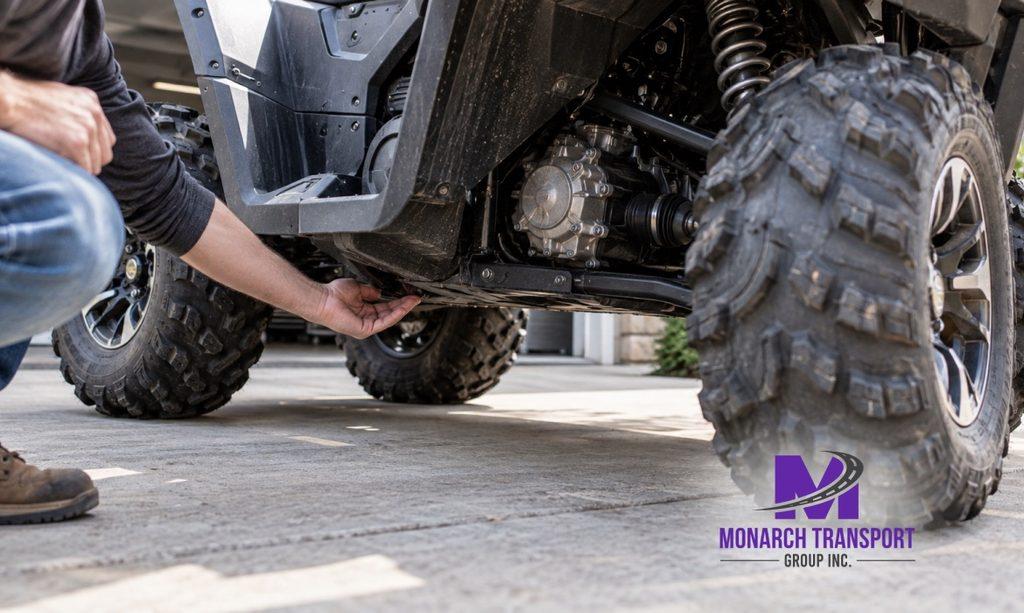
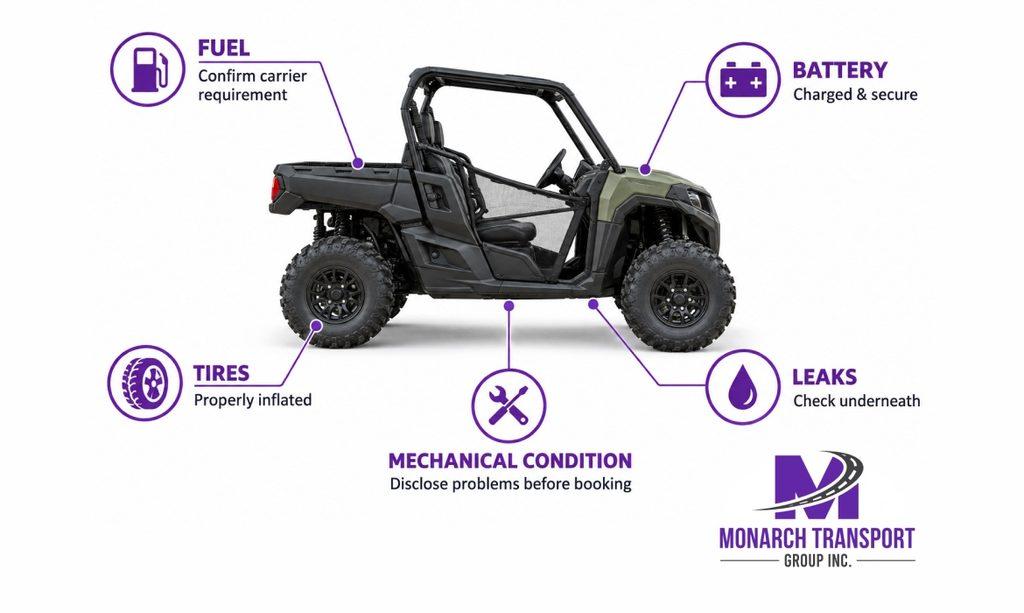
An ATV or UTV should be free of active fluid leaks before pickup. Look for oil, coolant, fuel, or brake fluid on the ground or around the engine. If the vehicle has a mechanical problem or does not run, tell the carrier before booking so it can plan the right loading equipment; the section on non-running vehicles below covers this in more detail.
4. Check the Fuel Level
Confirm the carrier’s fuel requirement before pickup. Some carriers specify around 1/4 tank or less rather than a full tank, but requirements vary, so validate the exact limit before pickup instead of assuming.
5. Check the Battery and Tires
If the ATV or UTV is operational, make sure the battery is charged and the terminals are secure, and ask the carrier whether it needs the battery disconnected for transport. Check that the tires are properly inflated and free of obvious damage, since flat or damaged tires can complicate loading and unloading.
6. Photograph the ATV or UTV Before Pickup
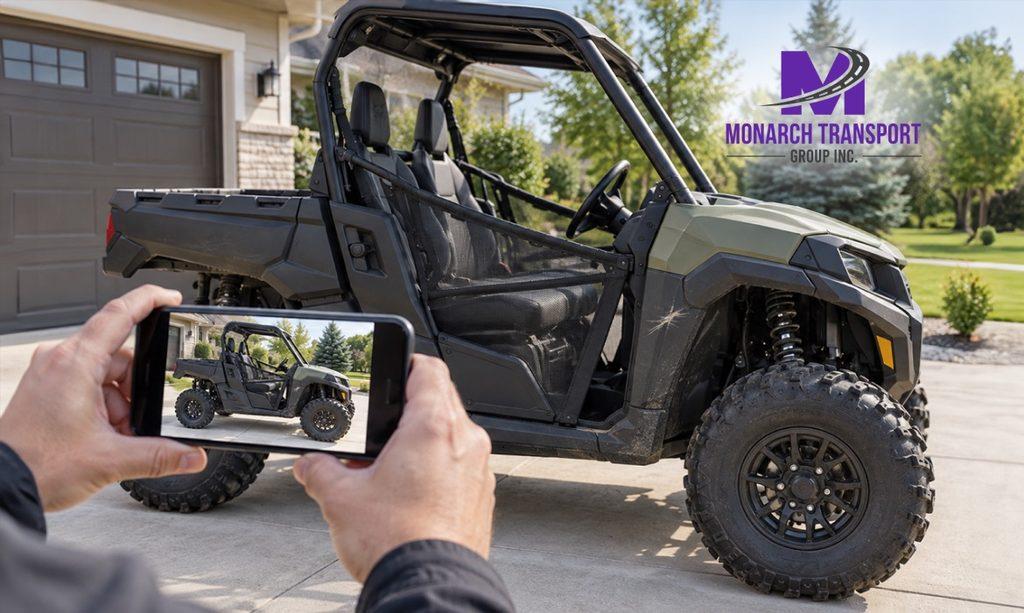
Photograph the front, rear, both sides, and top, along with close-ups of any scratches, dents, cracked plastic, or damaged accessories. Take photos before the carrier arrives, not after loading. These photos, together with the Bill of Lading, are your record if you need to document a change in condition at delivery.
ATV and UTV Pre-Pickup Checklist
Use this checklist to make sure your ATV or UTV is ready before the carrier arrives. Requirements can vary by carrier and shipment, so confirm any paperwork, fuel limits, and special loading needs in advance. Completing these steps helps document the vehicle’s condition and avoid preventable pickup delays.
| Before pickup | Check |
| Confirm required paperwork | ☐ |
| Keep title or bill of sale accessible, if applicable | ☐ |
| Confirm pickup and delivery contacts | ☐ |
| Remove loose personal items | ☐ |
| Remove or secure removable accessories, passes, tags and plates | ☐ |
| Wash the ATV or UTV | ☐ |
| Check for leaks | ☐ |
| Confirm fuel level with the carrier | ☐ |
| Check the tires | ☐ |
| Check the battery | ☐ |
| Photograph all sides | ☐ |
| Photograph existing damage | ☐ |
| Disclose a non-running condition | ☐ |
| Review the Bill of Lading at pickup | ☐ |
What Should You Do at ATV or UTV Pickup?
Inspect the Vehicle With the Driver
Walk around the vehicle with the driver before it loads. Compare what you see against your pre-shipping photos, and point out anything that should be recorded, so the condition on file matches what is actually there.
Review the Bill of Lading
Check that the vehicle is correctly identified and that its condition, including any existing damage, is described accurately before you sign. This is the document you will compare against at delivery, so read it carefully rather than signing quickly.
Keep Your Shipping Records
Hold on to the Bill of Lading, your pickup photos, the quote, the booking confirmation, and the carrier’s contact information until the shipment is complete. If you have questions about the vehicle’s condition, see what to do if it’s damaged during shipping.
What If the ATV or UTV Does Not Run?
A non-running ATV or UTV can often still be shipped, but you must disclose it before booking so the carrier can plan the right equipment. The basic requirement is the same as for cars: to go on a standard car hauler trailer, the vehicle must be able to roll, brake, and steer.
What Equipment May Be Needed?
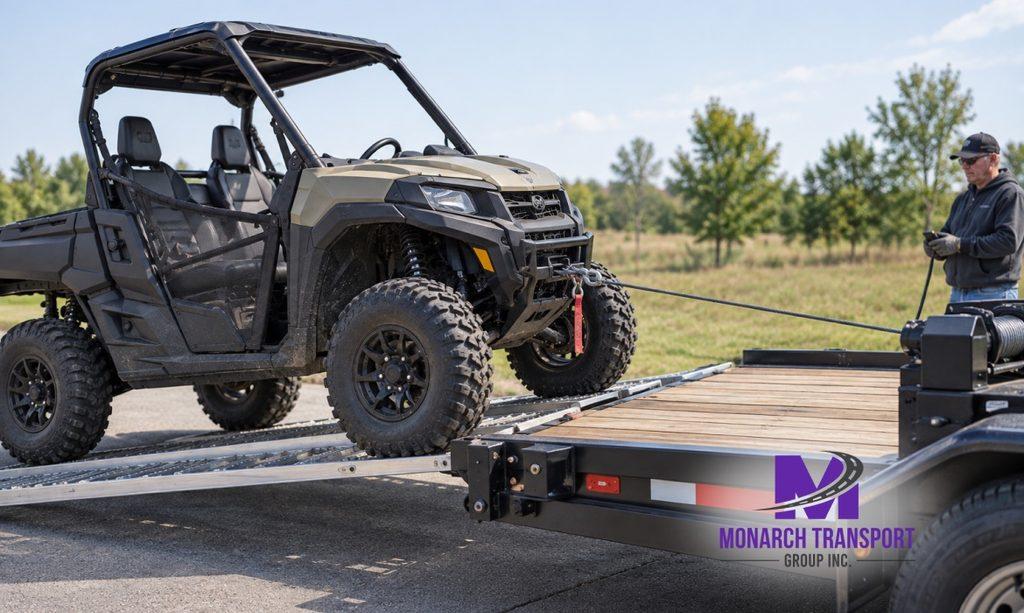
Depending on the vehicle’s condition, the driver may need a winch to pull the ATV or UTV onto a standard trailer, or a flatbed with a loader service if the vehicle can’t roll, brake, and steer. Not every truck carries this equipment, which is why disclosure matters.
Tell the transport company that the vehicle is inoperable before pickup so the carrier can determine whether additional equipment is required. A driver who arrives without the right gear may not be able to load the ATV or UTV.
Does an ATV or UTV Need Special Preparation for Enclosed Transport?
The basic preparation stays the same for enclosed ATV shipping: paperwork, photos, loose items removed, no active leaks, the right fuel level, and the battery and tires checked.
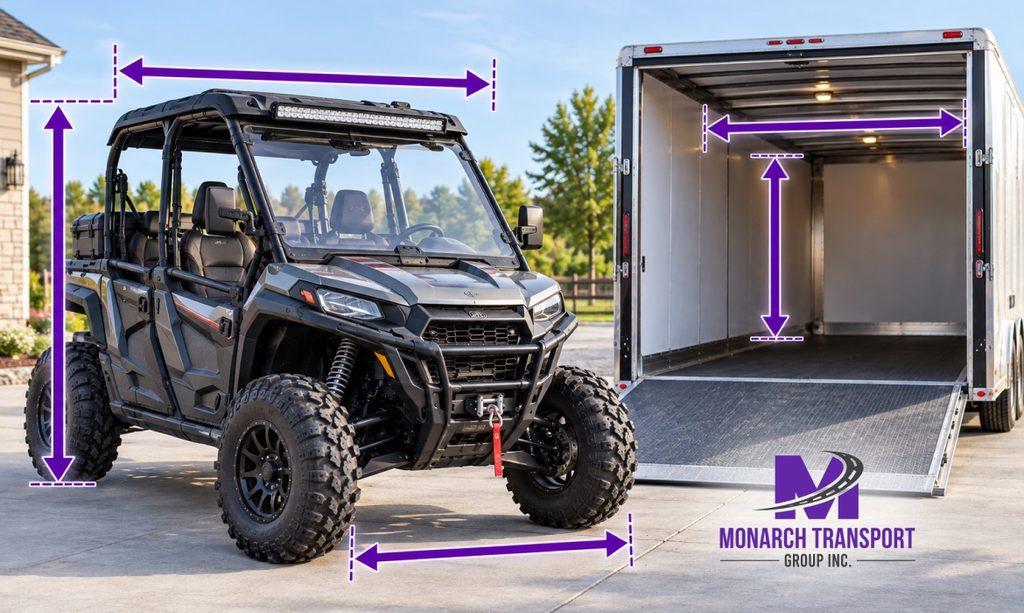
Enclosed transport offers extra protection from weather and road debris and may be worth considering for valuable or custom ATVs and UTVs. The carrier may also ask about dimensions, tall accessories, or anything that affects loading clearance inside a covered trailer, since enclosed trailers generally have less interior room than an open carrier. Confirm these details when you book so we can assign the right trailer.
What Can You Leave on an ATV or UTV During Transport?
Items to Remove
Confirm With the Carrier
If an item isn’t permanently secured or specifically covered by the carrier’s terms, don’t assume it can stay on the vehicle. When in doubt, ask before pickup day rather than finding out from the driver at the curb.
Common ATV and UTV Shipping Preparation Mistakes
Most ATV and UTV shipping problems before pickup come from overlooked details that are easy to address in advance. Avoid these common mistakes to help the carrier prepare the right equipment, complete the vehicle inspection, and reduce the risk of pickup delays or disputes about pre-existing damage.
Get an ATV or UTV Shipping Quote
Once your paperwork and vehicle are ready, request a quote for Monarch’s ATV and UTV transport service, which covers open and enclosed shipping for quads, side-by-sides, and other off-road vehicles nationwide. You can also use the shipping calculator to see pricing for your route before you book.
ATV vs. UTV: Does the Preparation Process Differ?
The core preparation steps are the same for both, but dimensions and accessories tend to matter more for a UTV.
| Preparation item | ATV | UTV |
| Remove loose items | Yes | Yes |
| Document condition with photos | Yes | Yes |
| Check for leaks | Yes | Yes |
| Confirm fuel requirements | Yes | Yes |
| Check tires and battery | Yes | Yes |
| Verify dimensions | Helpful | Especially important |
| Disclose a non-running condition | Yes | Yes |
| Check removable accessories | Yes | Especially important |
A UTV, or side-by-side, is often larger than an ATV and may have a roof, windshield, doors, a cargo bed, or aftermarket equipment. Those features take up more trailer space and can affect loading, so accurate dimensions and a clear list of removable accessories matter more for a UTV shipment. Monarch’s guide to ATV and UTV shipping costs and methods covers how these differences determine pricing.
FAQs About ATV and UTV Shipping
It depends on the shipment and the carrier. Common items include proof of ownership when applicable and pickup and delivery contact information; the Bill of Lading is completed at pickup.
Not always. Confirm with your carrier, since requirements vary by shipment. If the title has not transferred to your name yet, keep the bill of sale or purchase agreement available and confirm what documentation the carrier accepts.
A bill of sale may be useful, especially for a recently purchased ATV or UTV when the title has not yet transferred. Requirements vary, so confirm with the carrier what documentation it accepts before pickup.
Remove loose items and accessories, clean the vehicle, examine for leaks, confirm the fuel level with the carrier, check the tires and battery, and photograph the vehicle from all sides before pickup.
Check the carrier’s fuel requirement before pickup. Many providers ask for a low fuel level rather than a full tank, so validate the exact amount instead of assuming.
Often, yes, as long as you disclose the condition before booking. A non-running vehicle that still rolls, brakes, and steers can go on a standard trailer and is typically loaded with a winch, depending on the carrier’s equipment. If it can’t roll, brake, and steer, it usually ships on a flatbed and needs a loader service to load and unload it.
In most cases, no. Remove personal belongings and unsecured accessories, and confirm with the carrier about anything you are unsure of, such as racks or storage boxes.
Photograph the front, rear, both sides, and top, along with close-ups of any existing scratches, dents, or damage, before the carrier arrives.
It is the shipping document that records the vehicle’s condition and transport details at pickup. Examine it thoroughly and keep your copy, since you will compare it against the vehicle’s condition at delivery.
Related articles

Snowbird Car Shipping – How to Send Your Car to Florida for Winter
IN THIS ARTICLE: What Is Snowbird Car Shipping and How Does It Work? When to Book Snowbird Auto Transport to Florida How Much Does Snowbird Car Shipping to Florida Cost?
Popular State-to-State Car Shipping Routes: Costs & Transit Times Compared (2026)
IN THIS ARTICLE: State-to-State Car Shipping Routes: Cost & Transit Time What factors influence the cost of shipping cars from one state to another? How long does transport between states
Car Shipping Near Me: How Local Pickup Works With Nationwide Carriers
IN THIS ARTICLE: Key Takeaways What Does “Car Shipping Near Me” Actually Mean? How Local Pickup Works With a Nationwide Car Carrier Will a Car Carrier Pick Up My Vehicle

Cross-Country Car Shipping: How to Save Money Safely
IN THIS ARTICLE: Why “Cheap” Doesn’t Have to Mean “Dangerous” 1. Open Transport: The Industry Gold Standard for Savings 2. The Power of “Terminal-to-Terminal” Shipping 3. Timing the Market: The

Enclosed Car Shipping: The Gold Standard for Luxury and Exotic Vehicle Transport
IN THIS ARTICLE: Why “Standard” Transport Doesn’t Cut It for Masterpieces The Anatomy of Protection: Hard-Sided vs. Soft-Sided Trailers The Low-Clearance Nightmare: Why Hydraulic Lifts Matter Beyond the Walls: The

How Long Does It Take to Ship a Car? Realistic Timelines by Route & Season
IN THIS ARTICLE: The Two Timelines Nobody Separates (But Should) Realistic Transit Times by Route Distance Dispatch Time by Season: The Variable Nobody Controls How Route Type Affects Your Timeline

How Much Does Expedited Car Shipping Cost? 2026 Guide
IN THIS ARTICLE: Key Takeaways Ready to Ship Your Car? How Much Does Expedited Car Shipping Cost in 2026? What Determines the Price of Expedited Car Shipping? Expedited vs. Standard

Car Shipping by Train: Costs, Process & What to Expect in 2026
IN THIS ARTICLE: The Two Faces of Rail Transport: Consumer vs. Commercial Why Choose the Tracks? (The Human Perspective) Dimensions and Constraints: Will Your Car Fit? The “Hidden” Logic of
