
IN THIS ARTICLE:
- Key Takeaways
- Ready to Ship Your Car?
- How Much Does Expedited Car Shipping Cost in 2026?
- What Determines the Price of Expedited Car Shipping?
- Expedited vs. Standard Car Shipping: How Much Extra Will You Pay?
- How Fast Is Expedited Car Shipping, and Is Delivery Guaranteed?
- When Does Expedited Car Shipping Make Sense?
- How to Lower the Cost of Expedited Car Shipping
- How to Get an Expedited Car Shipping Quote
- FAQs About Expedited Car Shipping Costs
In 2026, expedited car shipping typically costs between $600 and $2,200 for open transport, and $850 to $2,950 for enclosed transport. Expedited pricing works as the standard rate for your route plus a priority surcharge of roughly $150–$250. Prices depend on factors like distance, your vehicle, the route, and how soon you need pickup. A shorter pickup window usually means a higher price for priority service. These are Monarch’s estimates for 2026, not guaranteed quotes.
Key Takeaways
Ready to Ship Your Car?
Need to arrange expedited car shipping for a tight deadline? Learn more about Monarch Transport Group’s priority service, or use the shipping calculator to get an estimate for your specific route and vehicle.
How Much Does Expedited Car Shipping Cost in 2026?
If you need to move a car on a tight schedule, the first question is usually simple: how much more will expedited shipping cost?
There is no single expedited car shipping price because every shipment is different. A sedan traveling 400 miles between two major cities is a very different job from a large SUV traveling more than 2,000 miles across the country. Your pickup deadline also changes the price, because the carrier has less time to find an available truck.
For 2026, Monarch’s estimated expedited rates range from $600 to $2,200 for open transport and $850 to $2,950 for enclosed transport, depending primarily on distance. Expedited pricing is the standard rate for your route plus a priority surcharge of roughly $150–$250.
| Distance | Open — Standard | Open — Expedited | Enclosed — Standard | Enclosed — Expedited |
| 0–500 mi | $450 – $750 | $600 – $1,000 | $700 – $1,050 | $850 – $1,300 |
| 500–1,000 mi | $700 – $1,050 | $850 – $1,300 | $1,000 – $1,450 | $1,150 – $1,700 |
| 1,000–1,500 mi | $950 – $1,350 | $1,100 – $1,600 | $1,300 – $1,850 | $1,450 – $2,100 |
| 1,500–2,000 mi | $1,150 – $1,650 | $1,300 – $1,900 | $1,600 – $2,200 | $1,750 – $2,450 |
| 2,000+ mi | $1,350 – $1,950 | $1,500 – $2,200 | $1,900 – $2,700 | $2,050 – $2,950 |
Rates shown are estimates and may vary by market conditions. Expedited pricing adds a priority surcharge of roughly $150–$250 over the standard rate for the same route.
Paying for expedited service does not mean paying a driver to drive faster. In most cases the premium buys priority pickup: expedited shipments usually get picked up within 1 to 3 days, compared with 3 to 7 days for standard transport, because the carrier search starts sooner and your vehicle goes to the front of the queue. Both timeframes depend on carrier availability on your specific route, so treat them as typical pickup windows rather than guarantees.
Transit can also be shorter on some expedited shipments. Certain expedited trucks run with a team of two drivers who take turns behind the wheel, which lets them cover roughly twice the distance in the same time without exceeding legally required hours-of-service limits. This is not available on every route, so ask whether team drivers are an option for your shipment. Learn more about how expedited car shipping works.
Why Doesn’t Car Shipping Cost Scale Directly With Mileage?
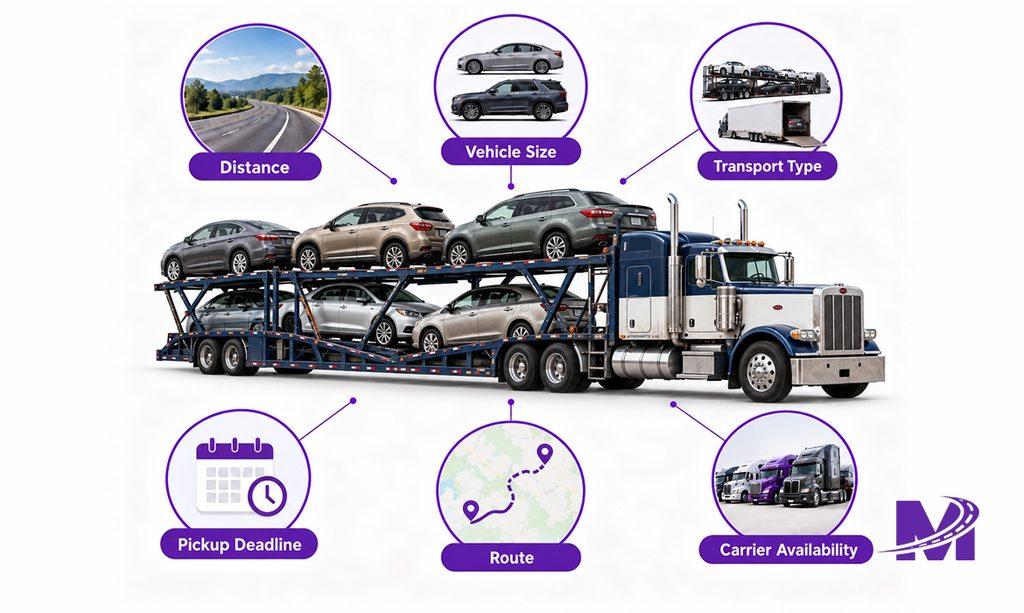
It might seem easy to estimate your cost by multiplying the miles by a per-mile rate, but in reality, it doesn’t work that way.
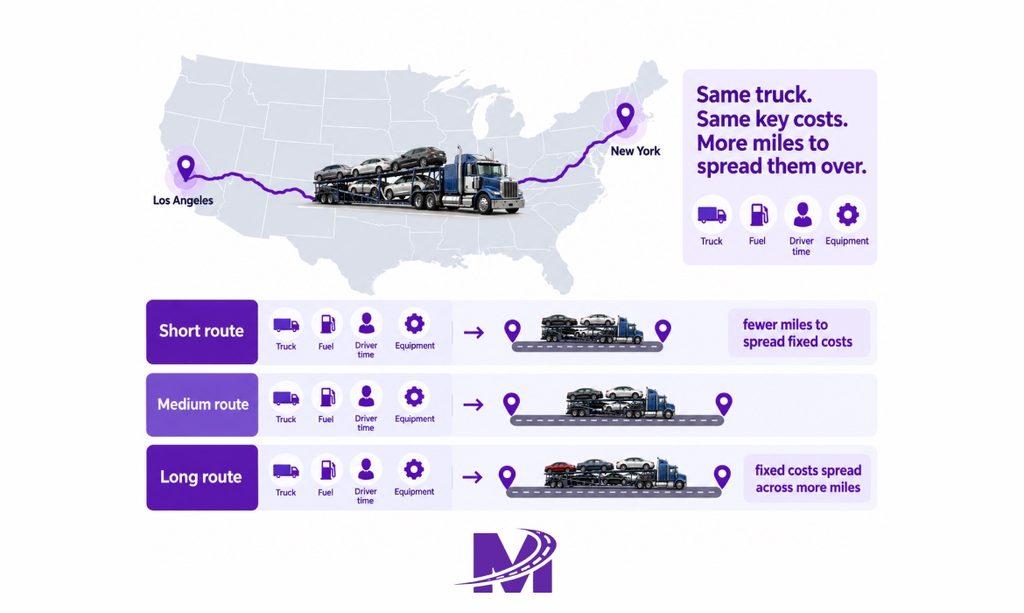
A carrier already running a major interstate corridor may be able to add another vehicle without doubling its operating costs, and long shipments spread fixed expenses such as driver time and equipment over more miles. As a result, the total price increases with distance, but the price per mile often decreases.
The effective per-mile cost can fall on longer routes because the total transportation cost is spread across more miles. Kelley Blue Book’s 2026 car shipping cost survey, based on quotes from eight transport companies for a standard sedan on open transport, found the per-mile rate dropping from about $1.50 on a short regional route to roughly $0.56 on a cross-country one. That is why a 2,000-mile shipment is not necessarily four times the price of a 500-mile one. Route demand, available carriers, and the direction a truck is already traveling all affect the final number.
What Have Monarch Customers Recently Paid?
Published customer examples make a price range easier to understand because they show what real shipments looked like, not simply theoretical numbers.
The shipments below moved on standard service, so they show the base a route starts from before any priority surcharge is added. On an expedited booking, expect roughly $150–$250 on top of figures like these. They also show how much routes of similar length can differ: an enclosed shipment from Phoenix to Portland came to $2,450 over 1,420 miles, while an open shipment from Dallas to Seattle came to $1,350 over 2,100 miles.
| Vehicle | Route | Distance | Transport | Transit | Total price |
| 2023 Tesla Model Y | San Francisco, CA → Denver, CO | 1,255 mi | Not specified | 4 days | $1,050 |
| 2024 BMW X5 | New York, NY → Miami, FL | 1,280 mi | Enclosed | 3 days | $1,890 |
| 2022 Ford F-150 | Dallas, TX → Seattle, WA | 2,100 mi | Open | 6 days | $1,350 |
| 2023 Mercedes GLE | Chicago, IL → Los Angeles, CA | 2,015 mi | Enclosed | 5 days | $2,100 |
| 2024 Porsche 911 | Phoenix, AZ → Portland, OR | 1,420 mi | Enclosed | 4 days | $2,450 |
These examples are for illustration only and should not be treated as current quotes for similar routes, expedited or standard. Carrier availability, pickup urgency, and market conditions can change from one shipment to the next.
What Determines the Price of Expedited Car Shipping?
Two people can request expedited transport on the same day and receive very different quotes. The price is not based on distance alone: your vehicle takes up a certain amount of carrier space, your pickup location may be easy or difficult to reach, and your deadline determines how many available trucks can realistically take the shipment.
Many factors combine to set the final price. The biggest ones are distance, your vehicle’s size, the type of transport, your pickup deadline, the route, the season, fuel prices, and how many carriers are available.
1. Distance and Route
Distance is the starting point for almost every auto transport quote, but mileage alone does not determine the price.
A 1,000-mile route between big cities might have lots of carriers traveling it every week. A shorter route to a rural area can be harder to cover because fewer trucks go there.
This matters most for expedited shipping. With standard transport, dispatchers may have several days to find a carrier. With an expedited order, there is less time to wait for the right truck, so if your route has limited carrier capacity, the premium for a tight pickup deadline can increase.
For more route-specific examples, see Monarch’s guide to state-to-state car shipping costs and transit times.
2. Vehicle Size and Weight
Your car will not be traveling alone. An open carrier shares trailer space with other vehicles, so your car’s size and weight affect the remaining space available for other loads.
A compact sedan usually takes up less space than a large SUV or pickup truck. If a vehicle is oversized, modified, or very heavy, it needs more room. Bigger vehicles also weigh more, which means higher fuel use.
That’s why you should give the year, make, and model when you ask for a quote. If your car is bigger or has been changed, the price may need to be adjusted.
3. Open vs. Enclosed Transport
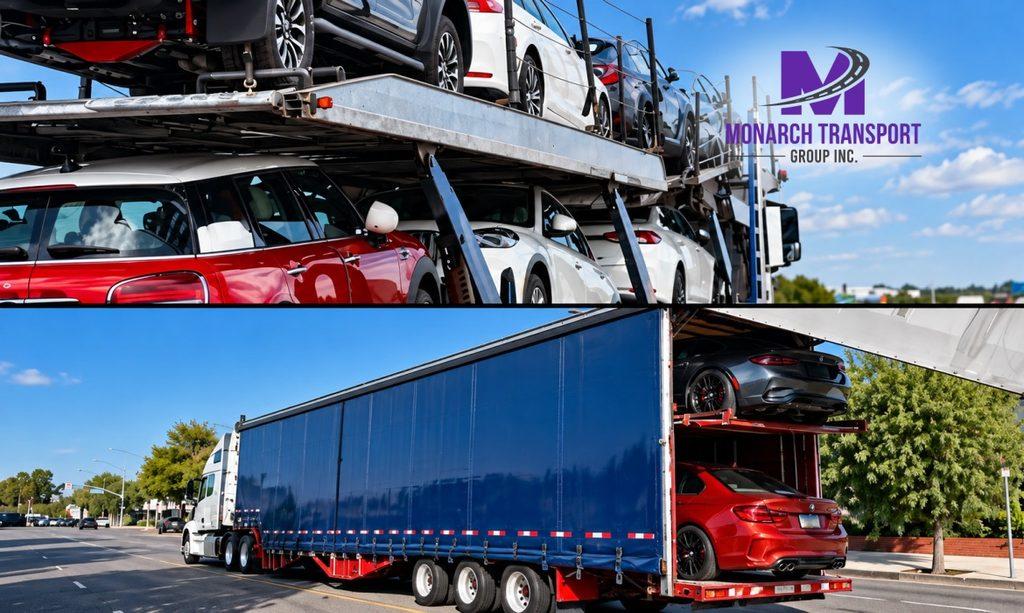
For most everyday vehicles, open transport is the more economical choice: the vehicle rides on an open trailer alongside others. Enclosed car shipping places it inside a covered trailer, which protects it from weather and road debris.
Enclosed transport costs more because enclosed carriers typically haul fewer vehicles and provide that extra protection. People frequently choose it for luxury, classic, exotic, or otherwise high-value vehicles.
In Monarch’s expedited estimates, enclosed transport is roughly $250–$750 more than open transport within the same distance band. If you are deciding between the two, compare open vs. enclosed auto transport based on the vehicle and the level of protection you actually need.
4. Pickup Deadline and Carrier Availability
This is the factor that most clearly separates expedited shipping from ordinary transport.
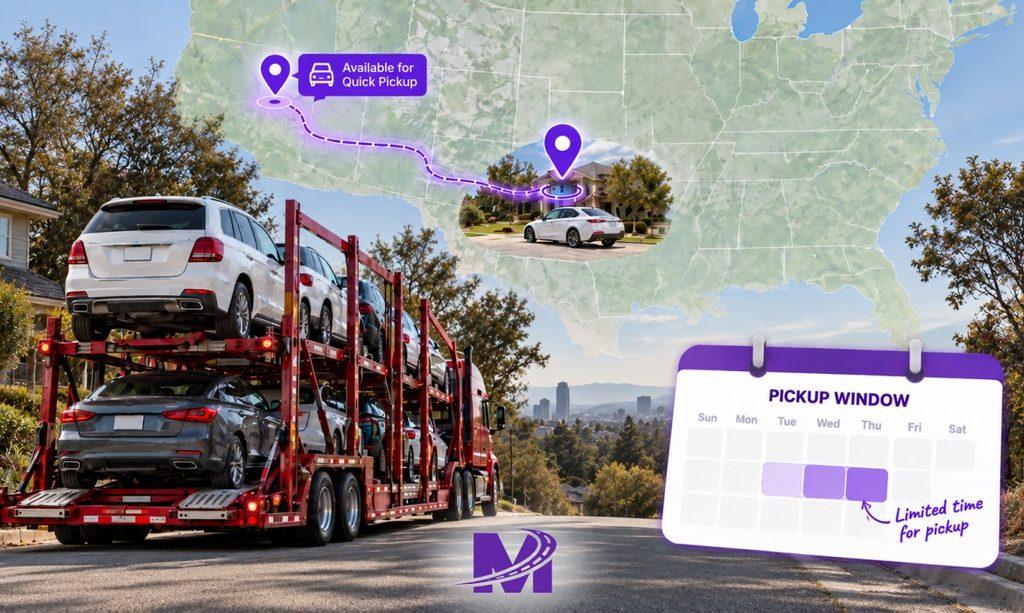
Imagine you need your car picked up within two days. The dispatcher cannot simply wait until a carrier happens to have an empty space. The search has to focus on trucks that can reach your pickup location within that narrow window, and that smaller pool of carriers is one reason expedited transport carries a priority surcharge.
In short, you’re paying for priority in scheduling, not for a faster trip on the road.
5. Pickup and Delivery Locations
Door-to-door shipping doesn’t always mean a big carrier can pull up to your driveway. If your street has low branches, tight turns, weight limits, or limited access, the driver may need to meet you at a nearby spot where loading and unloading is safe.
Carriers have more options on major highways and in big cities. Remote locations might need extra miles or special planning, which can affect your quote.
6. Season and Demand
Car shipping demand changes throughout the year and typically increases in spring and summer, when relocations and seasonal moves tighten carrier capacity on popular routes.
For someone with a flexible schedule, that may simply mean waiting for a better rate. For an expedited shipment, there is less room to wait, which is why the same route can produce different quotes at different times of the year.
7. Fuel Costs
Fuel is one of the basic operating expenses behind every vehicle transport shipment. When diesel prices rise, carriers have to cover higher costs to run the same routes.
The U.S. Energy Information Administration’s weekly diesel data shows a national on-highway diesel average of $6.382 per gallon for the week of September 28, 2026.
That does not mean quotes move one-for-one with fuel prices. It simply illustrates why auto transport pricing can change as operating costs change, and why published ranges are estimates rather than permanent prices.
Expedited vs. Standard Car Shipping: How Much Extra Will You Pay?
Expedited shipping typically adds about $150 to $250 on top of the standard price for the same route. That is an estimate rather than a guaranteed quote, the exact surcharge depends on your route, vehicle, and how soon you need the vehicle picked up. What you are paying for is speed at the start of the process: priority pickup and a shorter wait before your vehicle is on its way.
| Factor | Standard shipping | Expedited shipping |
| Pickup time | Typically 3–7 days | Typically 1–3 days |
| Pickup flexibility | Flexible window | Short window, so be ready to hand over the keys |
| Price | Standard rate for the route | Standard price + about $150–$250 priority surcharge |
| Carrier pool | Broad | Limited to carriers with immediate capacity |
| Best for | Flexible schedules | Time-sensitive moves |
The biggest difference between the two services is not what happens once the car is on the trailer. Both shipments still follow the same roads, traffic, and driver-hour restrictions. The difference comes before loading: standard transport gives the dispatcher more time to find a suitable carrier, while expedited transport puts your shipment higher on the priority list when the pickup window is tight.
The premium is roughly $150–$250, but the exact figure depends on your route, so the most reliable way to see it is to price both options side by side. Monarch’s shipping calculator shows standard and expedited pricing for the same route. Kelley Blue Book’s cost survey reaches the same general conclusion: faster delivery costs more than a flexible schedule.
How Fast Is Expedited Car Shipping, and Is Delivery Guaranteed?
Expedited car shipping is faster mainly at the front end: pickup can happen as fast as 1 to 3 days, compared with typically 3 to 7 days for standard transport, depending on carrier availability on your route. Transit is a second, separate clock, and expedited service usually shortens the first far more than the second.
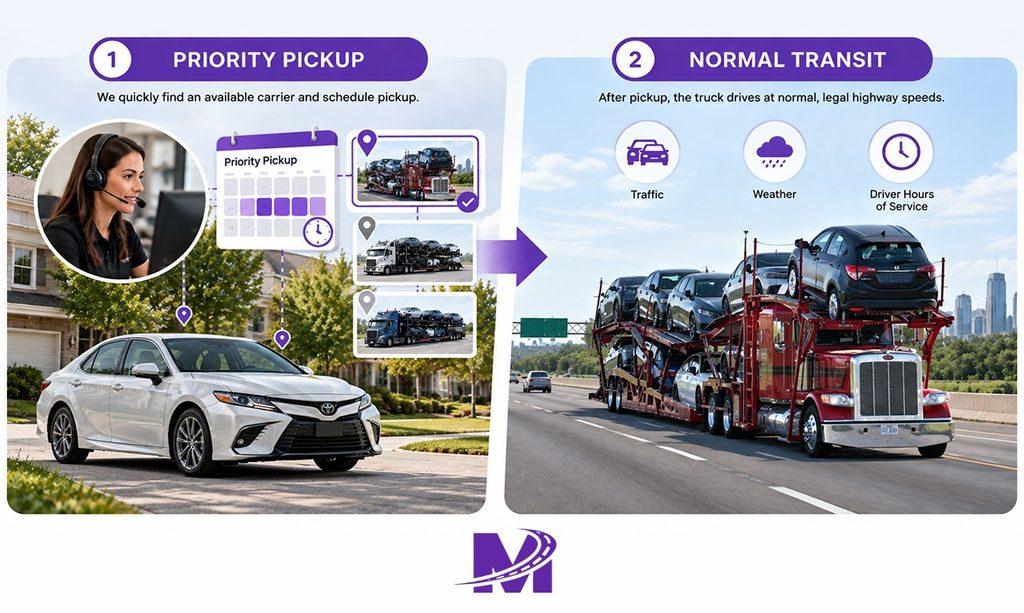
A common misunderstanding is that “expedited” always means your car will arrive in half the normal driving time. In most cases the real gain is at pickup: your vehicle gets on a truck days sooner, which matters when you cannot wait for a standard pickup window. Once it is loaded, the carrier still has to cover the same miles and comply with traffic conditions and federal hours-of-service rules.
There is one exception worth asking about. Some expedited shipments run with a team of two drivers who alternate behind the wheel, so the truck can cover roughly twice the distance in the same time while each driver stays within hours-of-service limits. This shortens transit noticeably on long routes, but it is not available on every lane.
Neither pickup nor delivery is guaranteed to a specific day. The timeframes below are estimates that depend on the route, the season, and carrier availability.
| Distance | Expedited transit (single driver) | Expedited transit (team drivers) |
| 0–500 miles | 1–2 days | 1 day |
| 500–1,000 miles | 2–4 days | 1–2 days |
| 1,000–1,500 miles | 3–5 days | 2–3 days |
| 1,500–2,000 miles | 4–6 days | 2–4 days |
| 2,000+ miles | 5–8 days | 3–5 days |
Does expedited shipping mean the truck drives faster?
No – the truck itself does not go faster. Federal hours-of-service regulations set how long a commercial driver may be on duty and driving and require rest periods, so a priority load cannot run nonstop, and transit still depends on distance, route, weather, and traffic. What can shorten transit is a second driver: on shipments that run with a two-person team, the drivers alternate, so the truck keeps moving while one of them rests. Ask whether team drivers are available on your route.
For a longer explanation of what affects shipping time, see Monarch’s guide on how long car shipping takes.
When Does Expedited Car Shipping Make Sense?
The easiest way to decide whether expedited shipping is worthwhile is to consider what happens if your car isn’t picked up on time. If a delay means paying for a rental car, missing a vehicle handoff, paying additional storage, or disrupting a move, the extra shipping cost may be easier to justify. If you have another week of flexibility, standard transport gives the carrier more time to find a suitable load and can reduce the price.
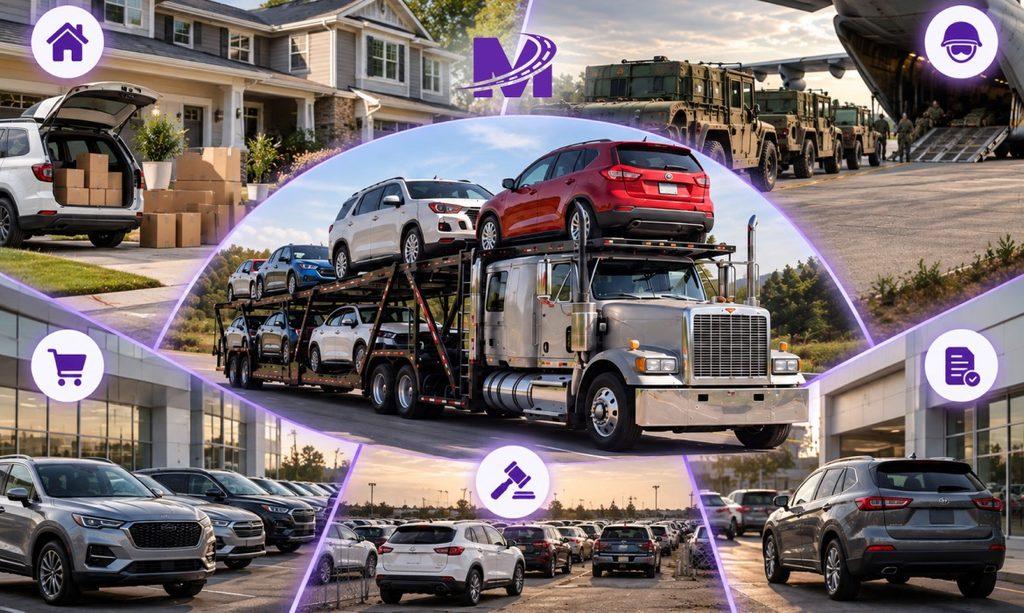
Expedited shipping can be useful when a missed pickup date creates additional costs or logistical-related problems. Common examples include:
How to Lower the Cost of Expedited Car Shipping
You cannot remove the priority fee, but you can reduce what surrounds it. The most effective moves are choosing open transport, keeping pickup and delivery points accessible, and booking as soon as you know your deadline.
Don’t choose on price alone.
The lowest expedited quote is not always the best value. Before you book, check the company’s federal record. The Federal Motor Carrier Safety Administration provides a free lookup, FMCSA’s SAFER Company Snapshot, where you can search by company name, USDOT number, or MC number and see its inspection, out-of-service, and crash summary and safety rating, if any.
How to Get an Expedited Car Shipping Quote
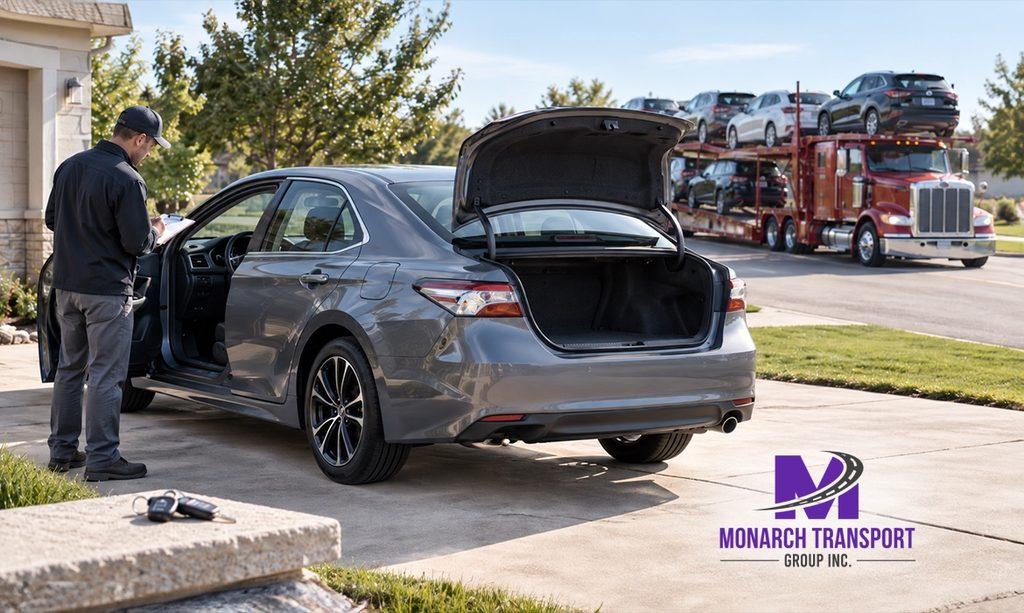
To get an expedited car shipping estimate for your vehicle, provide your pickup location, destination, vehicle type, and preferred timeline. Monarch’s quote flow takes about 60 seconds and shows standard and expedited pricing side by side, so you can see exactly what speed adds to your route.
Have these details ready:
Get an instant car shipping quote for your route, or read more about Monarch’s expedited car shipping service and how priority dispatch works.
FAQs About Expedited Car Shipping Costs
Monarch’s 2026 estimates run from $600–$1,000 for expedited open transport under 500 miles to $1,500–$2,200 on routes over 2,000 miles, and from $850–$1,300 to $2,050–$2,950 for expedited enclosed transport. Expedited pricing is the standard rate for your route plus a priority surcharge of roughly $150–$250. Your final price also depends on the vehicle, route, and pickup timeline.
Expedited typically adds about $150 to $250 over the standard price for the same route. That is an estimate rather than a guaranteed quote, since the exact surcharge depends on your route, vehicle, and pickup deadline. The quickest way to see the difference for your shipment is to compare standard and expedited pricing for the same route in Monarch’s quote flow.
Expedited pickup can be done as fast as 1 to 3 days, compared with typically 3 to 7 days for standard transport. Exact timing depends on carrier availability on your route.
No. Expedited service speeds up pickup, not road conditions or weather. Treat both pickup and transit times as estimates, and ask your dispatcher for the expected window on your route.
Same-day shipping, where pickup and delivery both happen on the same day, is a separate and much more limited option. It is typically available only on select short-haul routes with high carrier availability. If you mainly need the earliest possible pickup, expedited shipping is usually the closer fit.
Yes. Enclosed transport costs more than open transport at every distance in Monarch’s table, in exchange for protection from weather and road debris.
Availability and price depend on the route. A vehicle that still rolls, brakes, and steers can go on a standard trailer and is typically loaded with a winch. If it cannot roll, brake, and steer, it ships on a flatbed and needs a loader service. Either way the pool of available trucks narrows, so tell the quote team about the vehicle’s condition up front.
Related articles

Popular State-to-State Car Shipping Routes: Costs & Transit Times Compared (2026)
IN THIS ARTICLE: State-to-State Car Shipping Routes: Cost & Transit Time What factors influence the cost of shipping cars from one state to another? How long does transport between states

How to Prepare Your Car for Shipping: Step-by-Step Checklist
IN THIS ARTICLE: Why Preparation is not just a Chore Step 1: Selecting Your Logistics Partner Step 2: The Evidence Phase – Cleaning and Documentation Step 3: Protecting the Extravagant

How State-to-State Car Transport Works: From Pickup to Delivery
IN THIS ARTICLE: Understanding the Auto Transport Ecosystem Choose Your Transport Type The Process of Shipping Calculating the Cost and Timeline of State-to-State Car Transport The 2026 EV Transport Protocol

Cross-Country Car Shipping: How to Save Money Safely
IN THIS ARTICLE: Why “Cheap” Doesn’t Have to Mean “Dangerous” 1. Open Transport: The Industry Gold Standard for Savings 2. The Power of “Terminal-to-Terminal” Shipping 3. Timing the Market: The

Car Shipping by Train: Costs, Process & What to Expect in 2026
IN THIS ARTICLE: The Two Faces of Rail Transport: Consumer vs. Commercial Why Choose the Tracks? (The Human Perspective) Dimensions and Constraints: Will Your Car Fit? The “Hidden” Logic of
Auto Transport Broker vs. Carrier: Which One Should You Use?
IN THIS ARTICLE: What Is an Auto Transport Broker? What Is an Auto Transport Carrier? The Key Differences Side by Side Does Using a Broker Cost More? What Is “Dual

What Documents Do You Need to Ship a Car Across State Lines?
IN THIS ARTICLE: Key Takeaways Quick Reference: Documents by Situation Document 1: Government-Issued Photo ID Document 2: Bill of Lading – The Most Important Document in Car Shipping Documents for

Snowbird Car Shipping – How to Send Your Car to Florida for Winter
IN THIS ARTICLE: What Is Snowbird Car Shipping and How Does It Work? When to Book Snowbird Auto Transport to Florida How Much Does Snowbird Car Shipping to Florida Cost?