
IN THIS ARTICLE:
- Key Takeaways
- How Military Car Shipping Works for a PCS Move
- Does the Military Pay to Ship Your Car?
- Military Car Shipping Cost
- How Military Auto Transport Discounts Work
- CONUS vs. OCONUS Military Car Shipping
- When Should You Book PCS Car Shipping?
- Documents You’ll Need
- How to Prepare Your Vehicle for Transport
- Open vs. Enclosed Transport for a PCS Move
- What If Your PCS Orders Change?
- Coordinating Pickup and Base Access
- How to Choose a Military Car Shipping Company
- Military Auto Transport With Monarch Transport Group
- Military Car Shipping FAQs
PCS entitlement details in this guide are checked against current Military OneSource guidance – policies can change, so always confirm specifics with your Transportation Office.
Getting orders is the easy part. Figuring out what happens to your car is where most military families start making phone calls. If you’re staring down a PCS and wondering whether to drive, ship, or store the vehicle, here’s what actually matters before you book anything.
Military car shipping isn’t complicated once you know the rules – what the government covers, what it doesn’t, and where a private carrier fits into the picture. This guide walks through entitlements, current auto transport discounts, realistic costs by distance, the paperwork, and the questions that come up most often from service members moving a vehicle for the first (or fifth) time.
Key Takeaways
How Military Car Shipping Works for a PCS Move
Whether you’re shipping through a private carrier or the government process, the general flow looks similar:
The rest of this guide breaks each of these steps down in more detail, starting with the question everyone asks first: who actually pays.
Does the Military Pay to Ship Your Car?
The honest answer is: it depends heavily on whether your PCS is domestic or overseas, and what your specific orders authorize. Procedures can also vary somewhat between branches, so treat the following as general guidance and confirm the details with your Transportation Office.
CONUS PCS Moves
For a move within the continental United States, private car shipping is generally an out-of-pocket expense. The government doesn’t typically pay a private carrier’s invoice directly. Instead, you’re eligible for the Monetary Allowance in Lieu of Transportation (MALT), which reimburses mileage if you drive the vehicle yourself – it doesn’t cover a shipping bill.
That said, CONUS-to-CONUS shipping isn’t a flat “never covered” situation. There are limited circumstances under the Joint Travel Regulations where a POV may be authorized for government-funded shipment during a CONUS move – including situations where a service member can’t reasonably drive the vehicle themselves, or where the available travel time doesn’t allow driving and still reporting by the required date. A second vehicle in the household can also factor into what’s authorized. Eligibility, reimbursement limits, and required documentation depend entirely on the specific circumstances and orders, so don’t assume a vehicle is either automatically covered or automatically excluded – confirm directly with your Transportation Office.
OCONUS PCS Moves
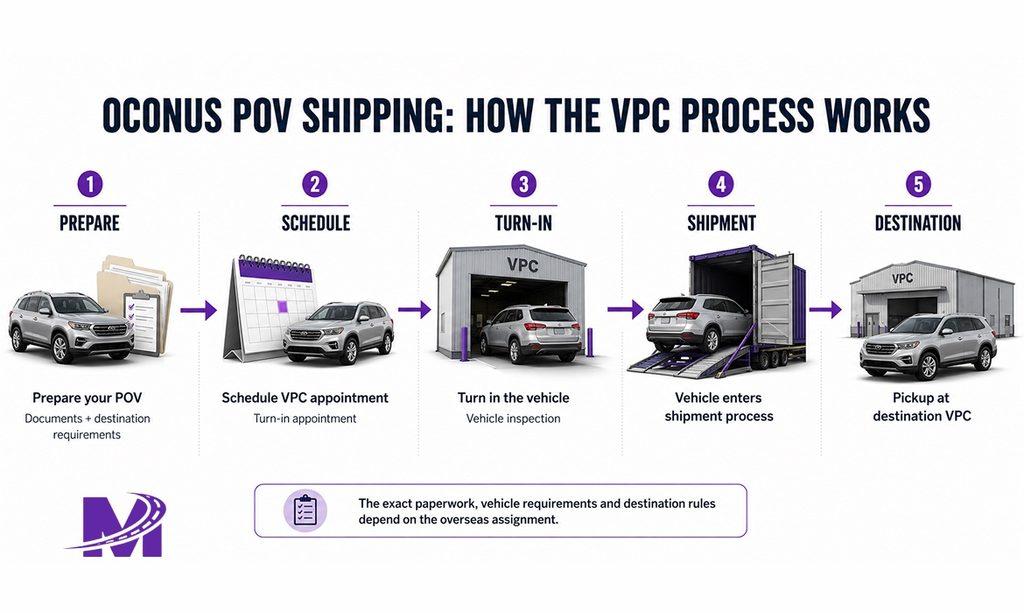
For overseas assignments, the Department of Defense generally arranges and pays for one POV shipment when authorized, but the process looks different from booking a private carrier yourself. Overseas shipments typically move through a government-arranged vehicle-processing system rather than a commercial quote form. Military OneSource directs service members to PCSmyPOV to locate a Vehicle Processing Center (VPC), schedule turn-in and pickup appointments, and review documentation requirements for their destination.
A few things worth knowing about OCONUS shipping specifically:
Can You Ship a Second Vehicle?
For most households, a second vehicle is where private auto transport comes in – whether you’re moving within CONUS, moving OCONUS and shipping a spare car stateside, or just don’t want to put the miles on it yourself. This is also where the military discount and flexible-scheduling savings from private carriers make the most financial difference, since the government isn’t picking up the tab.
Military Car Shipping Cost
Pricing depends on distance, vehicle size, transport type, time of year, and how flexible your pickup window is. These are general market ranges for open transport on a standard sedan or similar vehicle – treat them as planning estimates, not a quoted rate.
| Distance | Typical Open Transport | Typical Transit Time |
|---|---|---|
| 0–500 miles | $400–$700 | 2–4 days |
| 500–1,000 miles | $600–$1,000 | 3–5 days |
| 1,000–2,000 miles | $800–$1,300 | 5–7 days |
| 2,000+ miles | $1,000–$1,700+ | 7–10 days |
What moves these numbers up or down:
Actual rates vary significantly by origin, destination, vehicle, season, carrier availability, and pickup flexibility, so treat the ranges above as a starting point for budgeting rather than a firm quote.
If you want an exact number for your specific route, shipping calculator gives you a real quote based on your pickup and delivery locations, vehicle, and timeline.
How Military Auto Transport Discounts Work
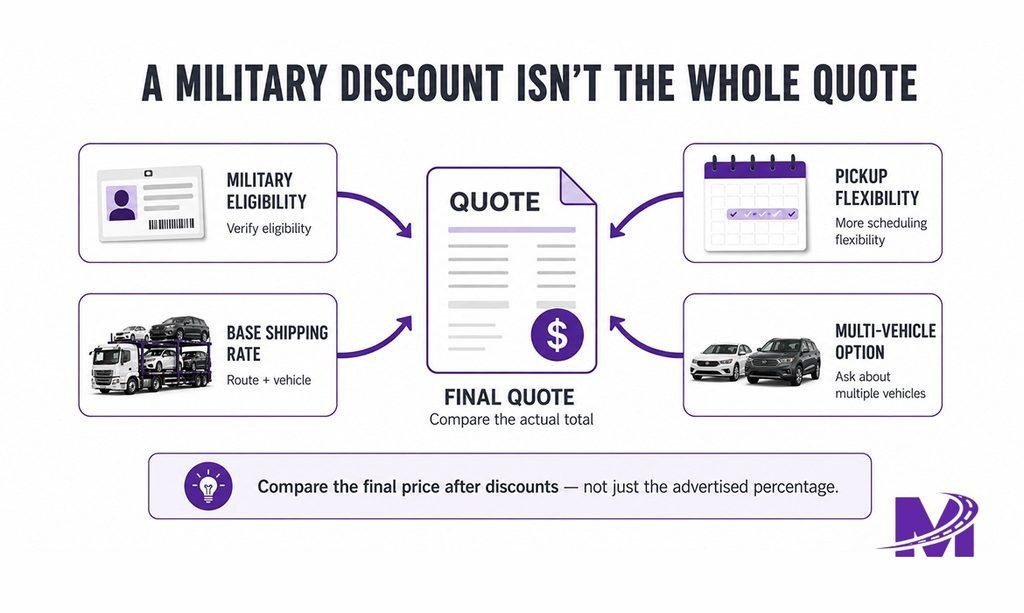
Many private carriers offer a military discount for active duty, veterans, Reserves, National Guard members, and military dependents, commonly somewhere in the 5–15% range. On a $900–$1,300 shipment, even a modest discount can reduce the final cost by dozens or hundreds of dollars.
A few things worth knowing about how these discounts get applied in practice:
Verification happens at booking, not after. Have a military ID or a copy of your orders on hand when you call or fill out a quote form. Carriers verify eligibility up front, which also means your reserved rate gets locked in faster.
Flexible pickup can also lower the quote. A wider pickup window gives the broker or carrier more options when matching your shipment with available truck capacity, which can bring the price down on its own. Any military discount is then applied on top, according to that company’s specific policy.
Multi-vehicle households should ask. If you’re shipping two cars, some carriers knock a bit more off the second vehicle. It’s not always advertised, so ask directly.
Discount percentages vary by carrier. Don’t assume the highest advertised percentage automatically means the lowest final price – compare the actual dollar total after the discount, not just the headline number.
CONUS vs. OCONUS Military Car Shipping
The process for shipping a vehicle during a PCS move depends largely on whether you’re relocating within the continental U.S. (CONUS) or overseas (OCONUS). The biggest differences involve who arranges the shipment, whether the government covers the cost, and where your vehicle is handed over. Here’s how the two options compare:
| Factor | CONUS PCS | OCONUS PCS |
|---|---|---|
| Government-funded shipping | Usually not covered directly | Generally one POV, when authorized |
| Private shipping | Common and typically self-funded | Usually for a second or additional vehicle |
| How it’s arranged | You book a commercial carrier or broker | Government-arranged through a VPC / PCSmyPOV |
| Military discount | Often available on private shipments | Mainly relevant to any privately shipped vehicle |
| Pickup location | Your home, office, or base-adjacent point | Designated Vehicle Processing Center |
| Key restrictions | Carrier and DOT requirements | Country-specific import rules, weight/size limits |
When Should You Book PCS Car Shipping?
Timing affects price more than almost anything else in car shipping. As a general guide:
If your orders landed late and you’re working with two weeks or less, don’t panic – last-minute PCS shipments happen regularly. Availability and pricing tend to be less predictable on short notice, so call and explain your timeline; a good transport coordinator will tell you honestly what’s realistic rather than promising something that isn’t.
Documents You’ll Need
The paperwork differs depending on whether you’re booking a private carrier or going through a government-arranged OCONUS shipment.
Documents for Private Military Car Shipping
Documents for Government OCONUS POV Shipping
Government-arranged shipments through a VPC typically involve their own checklist, separate from a private carrier’s paperwork. This commonly includes proof of ownership, valid registration, current insurance, and confirmation that the vehicle has no unresolved safety recalls. Requirements can vary by destination and by branch, so confirm the current list with your Transportation Office or through PCSmyPOV before your scheduled turn-in appointment.
How to Prepare Your Vehicle for Transport
Before pickup, regardless of which shipping route you’re using:
For a full walkthrough, Monarch’s vehicle prep checklist covers every step in more detail, and the documents needed to ship a car across state lines guide is worth a read if you want the full paperwork picture beyond what’s covered here.
Open vs. Enclosed Transport for a PCS Move
Open transport is what most families choose for a PCS. It’s the same method dealerships use to move new inventory, it’s widely available, and it’s noticeably cheaper than the enclosed alternative. For most daily drivers, minivans, and standard SUVs, open transport offers the best balance of price and availability.
Enclosed transport costs more – usually a few hundred dollars over open rates – but it makes sense for classic cars, high-value vehicles, or anything you’d rather not expose to weather and road debris on a cross-country trip. If your vehicle falls into that category, the extra cost buys real peace of mind.
For a deeper side-by-side comparison, see open vs. enclosed auto transport: which should you choose. For most PCS orders, open transport gets the job done without cutting corners on safety.
What If Your PCS Orders Change?
Orders shift. Report dates move. It happens often enough that it’s worth planning for rather than being surprised by.
Booking with a carrier that offers a rate guarantee once your shipment is scheduled – locking in the quoted price rather than adding fees later – removes one more variable from a timeline that already has enough of them.
Coordinating Pickup and Base Access
One detail that catches families off guard: transport drivers can’t always get onto the installation itself. Gate restrictions at many bases mean pickup or delivery happens at a nearby parking lot or off-base meeting point instead. Confirm this with your carrier ahead of time, and have your gate instructions and ID ready so nothing gets held up at the last minute. If the driver can’t access the installation, agree on the exact off-base meeting point before pickup day rather than sorting it out over the phone that morning.
How to Choose a Military Car Shipping Company
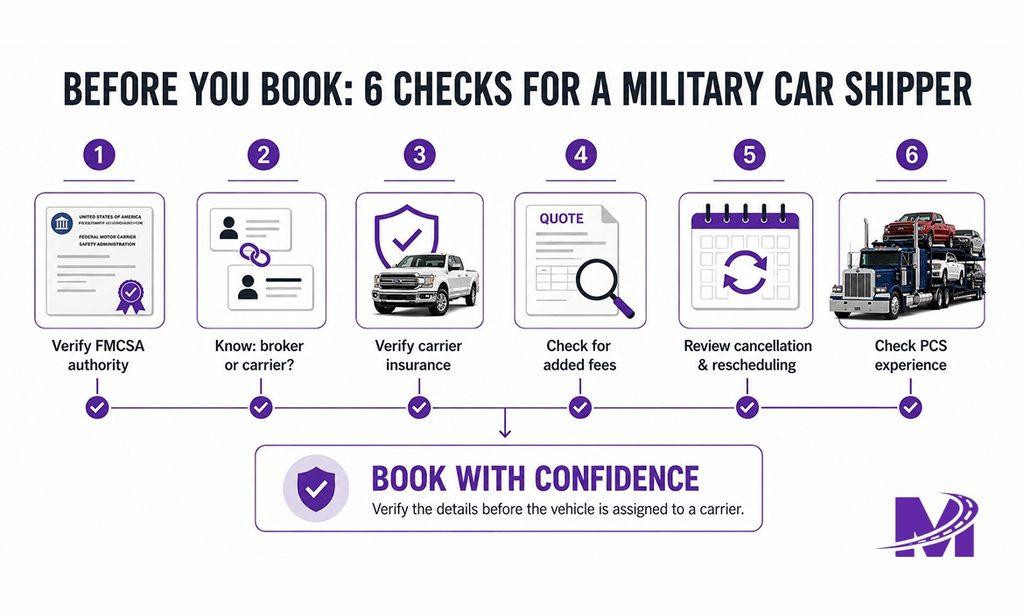
A few criteria worth checking before you book, beyond just the quoted price:
For more on realistic timelines once you’re booked, see how long does car shipping take, and if you’re weighing shipping against driving the route yourself, cross-country car shipping: how to save money safely breaks down that comparison in more depth.
Military Auto Transport With Monarch Transport Group
Once you know what to look for, here’s what that looks like with military car shipping service:
Exclusive military discounts. Available to active duty members, veterans, Reserves, National Guard members, and military dependents. Call or request a quote and mention your orders to have the discount verified and applied.
Effortless pickup and delivery. Drivers work to your specified pickup and delivery instructions through a straightforward three-step process, built around PCS timelines rather than a generic shipping schedule.
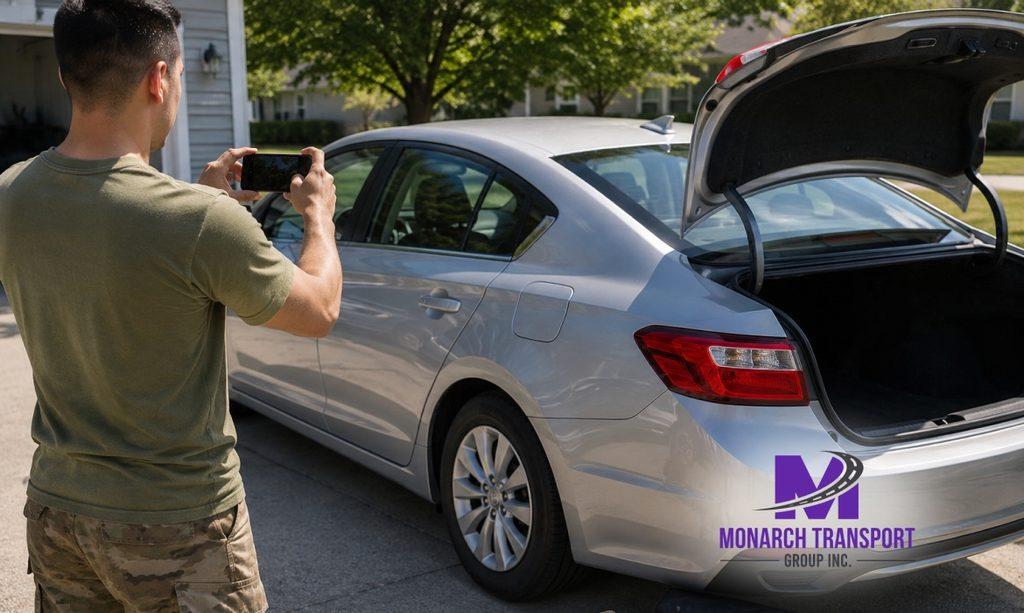
Extra baggage welcome. You can pack up to one suitcase or box of personal items, under 100 lbs., in the trunk at no extra cost, as long as it doesn’t compromise safe transport of the vehicle. The assigned driver retains the right to inspect the trunk for prohibited items.
Price Lock Guarantee. Schedule your shipment weeks or months ahead and the quoted price is the price you pay – no surprise fees added later.
Vetted carrier network. Monarch coordinates with a network of licensed, insured carriers rather than running its own fleet, which means your vehicle moves with a driver matched to your specific route. Insurance coverage is documented for the carrier assigned to your shipment, and coverage details are available to review before booking – ask your coordinator for the specifics that apply to your vehicle and route.
Our team has handled enough PCS timelines to know they rarely go exactly as planned. Orders shift, reporting dates move, and pickup windows sometimes need to flex on short notice. Quotes are built around that reality instead of pretending every move is a straight line from A to B.
See what your route costs with the shipping calculator, or check the military car shipping discount for the full rundown of eligibility and how to verify it.
Have questions about your specific route or reporting date? Get a free military car shipping quote or explore vehicle shipping services to see what options are available for your move.
Military Car Shipping FAQs
One POV may be shipped at government expense for an authorized OCONUS PCS, arranged through a government Vehicle Processing Center. For CONUS moves, private shipping is normally an out-of-pocket cost, with limited exceptions depending on your specific orders.
Typically not directly. You’re eligible for MALT mileage reimbursement if you drive the vehicle, but that doesn’t cover a private shipping invoice. Some CONUS situations involving a second vehicle have specific authorization rules – confirm with your Transportation Office.
Private auto transport commonly runs $400-$1,700+ depending on distance, vehicle size, season, and whether you choose open or enclosed transport. Shorter routes and off-peak timing land at the lower end.
Many private auto transport companies offer military discounts, often around 5-15%, although eligibility and savings vary by company. Monarch offers a military discount for eligible customers; ask for the current discount when requesting a quote.
3-4 weeks for a standard move, 4-6 weeks during peak season (late spring through summer), and more lead time for long-distance or cross-country routes if you want the best pricing and carrier availability.
The government generally covers only one POV, and mainly for OCONUS orders. A second vehicle is usually shipped privately, though some CONUS situations have specific exceptions worth checking with your Transportation Office.
For private shipping: your PCS orders, a government ID, vehicle title or registration, proof of insurance, and the Bill of Lading provided at pickup. Government OCONUS shipments through a VPC involve additional paperwork specific to that process.
For an authorized OCONUS move, one POV may be shipped through a government-arranged process via a Vehicle Processing Center rather than a private carrier’s quote form. A second or additional vehicle for an overseas move is usually a private arrangement.
Notify your carrier as soon as your report date or destination changes. Many companies can adjust the pickup window or requote the route, but fees or repricing may apply depending on the shipment status and the company’s cancellation and rescheduling policy.
A verified military discount, transparent flat-rate pricing with no fees added after the quote, carrier insurance you can actually review, FMCSA registration, and reviews from other service members who’ve shipped on a similar route.
Related articles

How to Choose the Right Auto Transport Company: Red Flags and Green Flags
IN THIS ARTICLE: First, Understand How the Industry Actually Works 🚩 Red Flags – Walk Away Immediately ✅ Green Flags – Signs You Found a Reliable Company Broker vs. Carrier

How State-to-State Car Transport Works: From Pickup to Delivery
IN THIS ARTICLE: Understanding the Auto Transport Ecosystem Choose Your Transport Type The Process of Shipping Calculating the Cost and Timeline of State-to-State Car Transport The 2026 EV Transport Protocol

How Much Does It Cost to Ship a Car Between States?
IN THIS ARTICLE: Average Cost Breakdown by Distance Primary Factors Influencing Your Shipping Quote Geographic Influence on Pricing Understanding the Quote Structure The Impact of Seasonality on Auto Transport Rates

How Long Does It Take to Ship a Car? Realistic Timelines by Route & Season
IN THIS ARTICLE: The Two Timelines Nobody Separates (But Should) Realistic Transit Times by Route Distance Dispatch Time by Season: The Variable Nobody Controls How Route Type Affects Your Timeline

Door-to-Door vs. Terminal-to-Terminal: Which Logistics Model Fits You?
IN THIS ARTICLE: Understanding the Two Primary Logistics Models Comparative Analysis: Door-to-Door vs. Terminal-to-Terminal The Financial and Temporal Mechanics of Shipping Models Geographical Impact: Urban vs. Rural Accessibility The Final

Cross-Country Car Shipping: How to Save Money Safely
IN THIS ARTICLE: Why “Cheap” Doesn’t Have to Mean “Dangerous” 1. Open Transport: The Industry Gold Standard for Savings 2. The Power of “Terminal-to-Terminal” Shipping 3. Timing the Market: The

Complete Guide to Car Shipping in 2026
The landscape of American mobility has shifted, making vehicle logistics more accessible and seamless than ever before. Understanding this new norm is the first step toward a stress-free relocation that

Car Shipping by Train: Costs, Process & What to Expect in 2026
IN THIS ARTICLE: The Two Faces of Rail Transport: Consumer vs. Commercial Why Choose the Tracks? (The Human Perspective) Dimensions and Constraints: Will Your Car Fit? The “Hidden” Logic of