
IN THIS ARTICLE:
- Key Takeaways
- Types of Car Shipping Routes
- Virginia to Ohio Car Shipping
- Virginia to Florida Car Shipping
- California to North Carolina Car Shipping
- How Much Does It Cost to Ship a Car?
- How Long Does Car Shipping Take?
- Open vs. Enclosed Transport on Popular Routes
- How Seasonality Affects Popular Routes
- Why the Same Route Can Have Different Shipping Prices
- How to Ship a Car on Any Route
- Pricing Note
- Car Shipping Routes FAQ
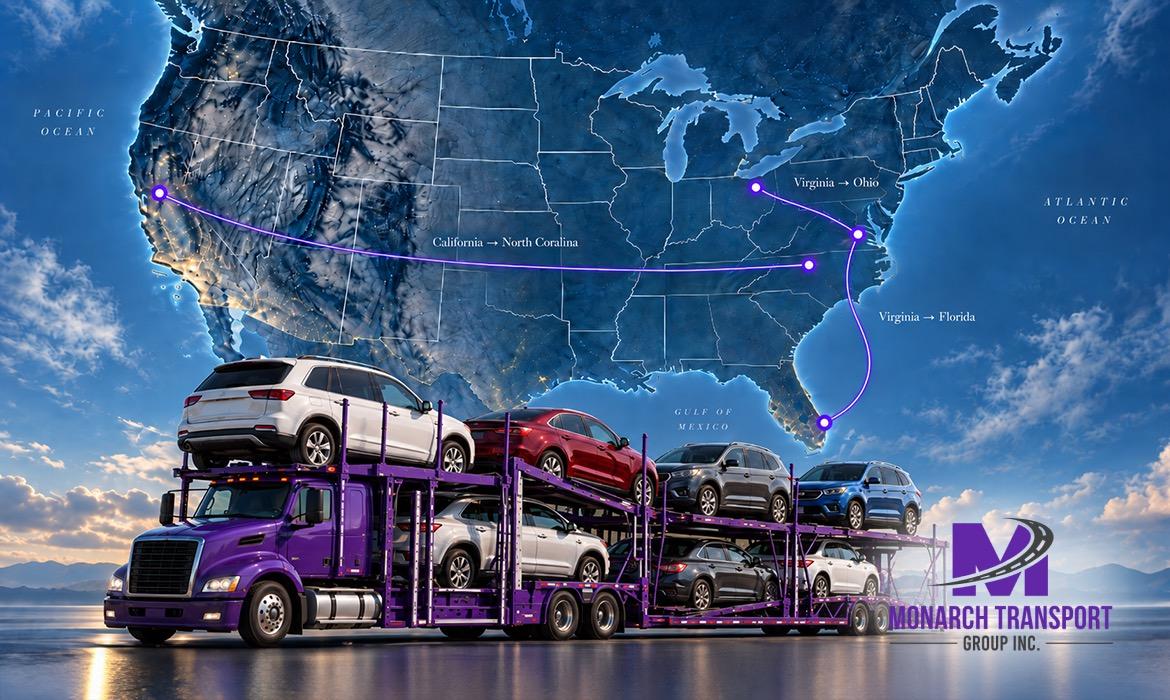
Car shipping routes can generally be grouped into three common patterns – regional, snowbird and cross-country – and each has its own typical cost, transit time and seasonal considerations. Distance is the main factor in total price, but vehicle size, transport type, season, pickup and delivery locations, and carrier availability also affect the final quote.
This guide is about how the three patterns behave, not a directory of lanes: what sets the price on each, how long transit realistically takes, and which seasonal effects apply. Virginia to Ohio, Virginia to Florida and California to North Carolina appear as worked examples of each pattern. If you want pricing for one specific lane rather than the pattern behind it, see Monarch’s popular state-to-state car shipping routes guide.
| Route | Type | Approx. distance | Typical transit | General cost position |
| Virginia → Ohio | Regional | ~450–560 miles | 1–3 days | Lower end |
| Virginia → Florida | Snowbird | ~700–950 miles | 3–5 days, longer in peak season | Mid-range, higher in fall |
| California → North Carolina | Cross-country | ~2,400–2,600 miles | 7–10 days | Upper end |
These positions are relative to Monarch’s published $500–$1,950 open-transport range for state-to-state shipping, not guaranteed quotes. Your price depends on the exact pickup and delivery ZIP codes, vehicle size and condition, transport type, season and carrier availability on your specific route. Get a shipping calculator estimate for your exact addresses rather than relying on a state-level average.
Key Takeaways
Shipping a Car Between States?
Whether you’re moving across neighboring states or planning a cross-country relocation, Monarch Transport Group coordinates door-to-door car shipping with vetted, licensed carriers across all 50 states.
Get a quote for your route and compare transport options based on your vehicle, schedule, and budget.
Explore State-to-State Car Shipping
Types of Car Shipping Routes
Most car shipping routes fall into one of three patterns, and knowing which one your move fits helps set realistic expectations for cost and timing before you request a quote.
| Route type | Typical distance | What mainly drives cost and timing | Example in this guide |
| Regional | Under ~500–600 miles | Short distance keeps transit and pickup windows short | Virginia to Ohio |
| Snowbird corridor | Roughly 700–1,200 miles | Seasonal direction: southbound in fall, northbound in spring | Virginia to Florida |
| Cross-country | 2,000+ miles | Total distance and driver hours-of-service limits | California to North Carolina |
The sections below work through one example of each pattern in detail, so you can see what actually moves the number on a route like yours.
Virginia to Ohio Car Shipping
Virginia to Ohio is a short regional lane, roughly 450 to 560 miles depending on the exact pickup and delivery cities. Its shorter distance generally means less transit time than longer state-to-state routes.
How Much Does It Cost to Ship a Car from Virginia to Ohio?
As a short, in-region route, this lane typically falls toward the lower end of Monarch’s $500–$1,950 open-transport range for state-to-state shipping. Enclosed transport generally adds about 30–40% over the open-transport price, so it is worth considering mainly for a classic, luxury or low-clearance vehicle rather than a daily driver.
How Long Does It Take?
At roughly 450–560 miles, this route generally takes about 1–3 days in transit once the vehicle is loaded, plus a separate pickup window before the driver arrives. Get an exact estimate for your addresses with the shipping calculator.
Virginia to Florida Car Shipping
Virginia to Florida runs roughly 700 to 950 miles depending on the exact cities, and it sits on the eastern snowbird corridor along Interstate 95, which runs the length of the East Coast from Florida to Maine. This is one of the routes covered in Monarch’s snowbird car shipping to Florida guide.
How Much Does It Cost to Ship a Car from Virginia to Florida?
At this distance, the route generally falls in the middle of Monarch’s overall $500–$1,950 open-transport range, closer to the $700–$1,400 band Monarch cites for many continental routes. Pricing shifts with the season: southbound demand on Florida-bound lanes rises each fall as seasonal residents head south, which can push rates toward the higher end of that range.
How Long Does It Take?
Expect roughly 3–5 days of transit once the vehicle is loaded, though peak snowbird season can extend that window as carriers fill up on this corridor. If your move is time-sensitive, Monarch’s expedited car shipping service can get the vehicle picked up in as little as 1–3 days, compared with 3–7 days on standard service. For the return trip the following spring, see the guide to shipping a car back north.
California to North Carolina Car Shipping
California to North Carolina is a long cross-country domestic lane, running roughly 2,400 to 2,600 miles depending on the exact cities. Interstate 40 is one of the major east-west highways connecting California and North Carolina and can form part of the route depending on the pickup and delivery locations. The Federal Highway Administration’s Interstate route log lists I-40 at 2,556.61 miles between Barstow, California, and Wilmington, North Carolina.
How Much Does It Cost to Ship a Car from California to North Carolina?
As a cross-country lane, this route tends to fall toward the upper end of Monarch’s $500–$1,950 open-transport range. Longer routes generally have a lower cost per mile than short ones, but the total price is still higher because of the distance. Monarch’s guide to cross-country car shipping covers more ways to manage the cost on a haul this long. Enclosed transport adds roughly 30–40% on top of the open-transport price, which is worth weighing for a high-value vehicle on a trip this long.
How Long Does It Take?
On a true cross-country lane like this, expect around 7–10 days of transit once the vehicle is loaded, on top of a separate pickup window. Federal hours-of-service rules limit how long commercial drivers can drive and remain on duty each day, so a multi-day cross-country trip is normal even after pickup rather than a sign of delay.
How Much Does It Cost to Ship a Car?
Monarch’s published state-to-state pricing runs roughly $500 to $1,950 for open transport, and many continental U.S. shipments fall in the $700–$1,400 range. Actual quotes vary by route, vehicle, season and exact ZIP codes, and distance is only one of several factors.
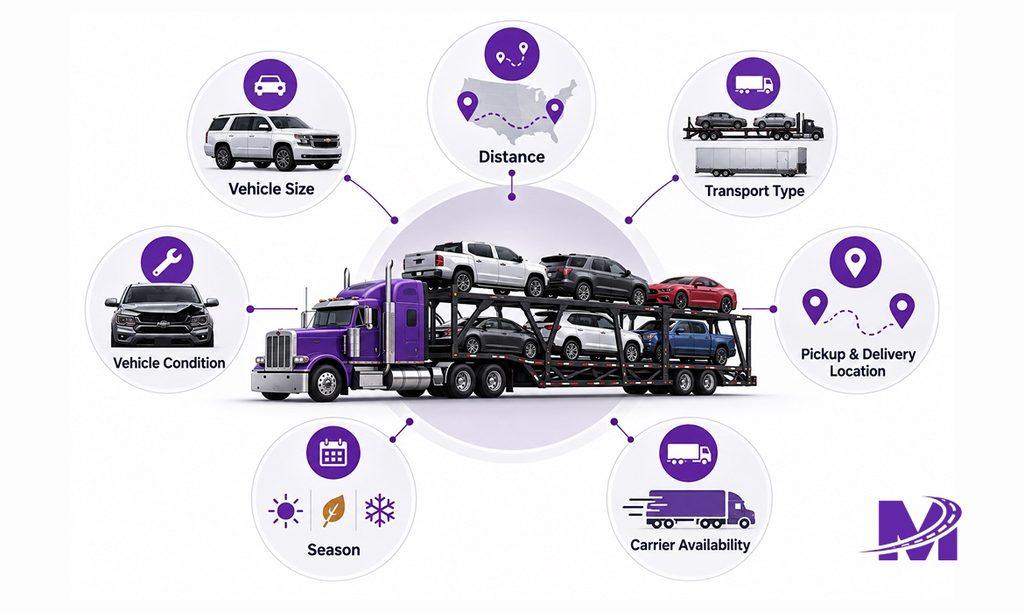
What Affects the Price on Any Route
For a fuller breakdown of these factors, see Monarch’s guide to the cost to ship a car between states. To see current pricing for your own route and vehicle, use the shipping calculator.
How Long Does Car Shipping Take?
Transit time depends mainly on distance, and it is separate from the pickup window, which is the time between booking and the driver arriving to load the vehicle. Confusing the two is the most common reason people expect their car sooner than it arrives.
Transit Time by Distance
| Distance | Typical transit |
| Under 500 miles | 1–3 days |
| 500–1,500 miles | roughly 3–5 days |
| Cross-country (1,500+ miles) | 7–10 days |
This is on top of a separate pickup window before the driver arrives. With standard service, pickup usually happens within 3 to 7 days; with expedited service it can be as fast as 1 to 3 days. Both depend on carrier availability on your specific route, so treat them as typical windows rather than guarantees.
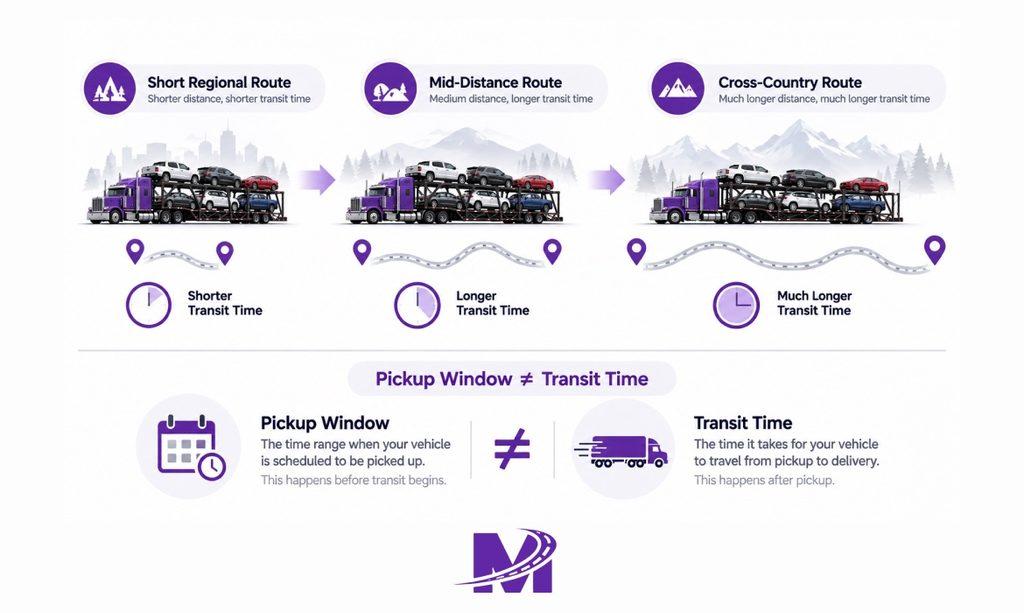
Why Transit Can’t Be Rushed Past a Certain Point
Once a vehicle is loaded, the driver is still bound by federal hours-of-service regulations, which limit how many hours a commercial driver may be on duty and driving each day. That is why a 2,500-mile cross-country shipment normally takes multiple days rather than only two or three, no matter how the shipment is booked. Faster carrier assignment shortens the pickup window, not the transit time itself. For more on how timing varies by route and season, see how long car shipping takes.
Open vs. Enclosed Transport on Popular Routes
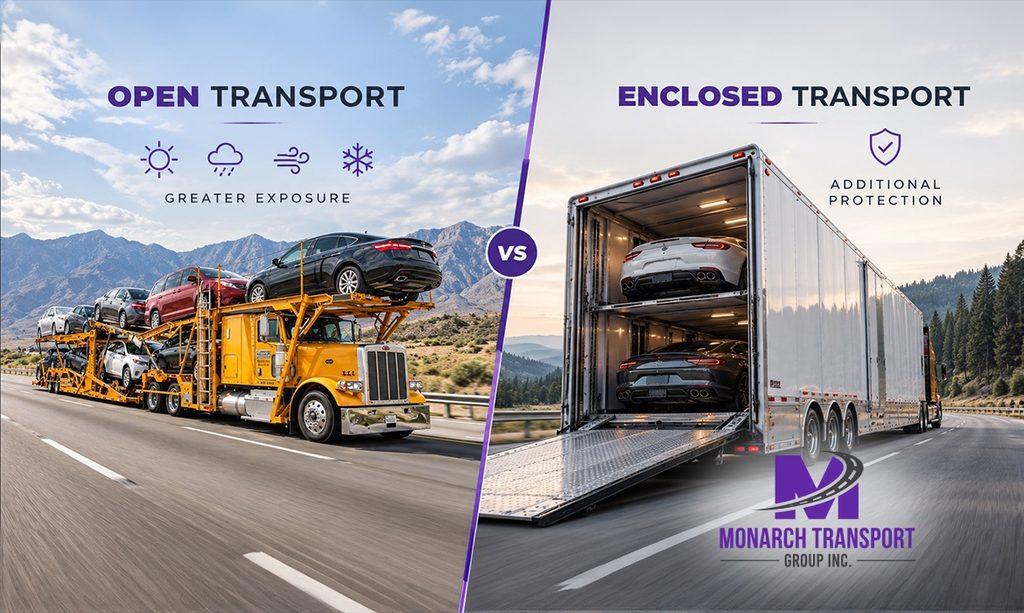
| Factor | Open Transport | Enclosed Transport |
| Cost | Lower | About 30–40% higher |
| Availability | Broader | More limited |
| Protection | Standard | Greater protection from weather and road debris |
| Best for | Everyday vehicles | Classic, luxury or exotic vehicles |
Open transport is the standard choice on nearly every route in this guide, and it is what most carriers run. Enclosed transport costs more on any given lane, but the premium is usually worth it for a high-value or low-clearance vehicle rather than a daily driver. See the full comparison in open vs. enclosed auto transport.
How Seasonality Affects Popular Routes
Car shipping demand shifts by season, and it does not move the same way on every route.
Snowbird Routes
Routes connecting the Northeast and Midwest to Florida, Arizona and Texas see the sharpest seasonal swings: southbound demand rises each fall as seasonal residents head south, and northbound demand rises each spring on the return trip. Virginia to Florida, covered above, is one of these routes, and its guides on booking windows are linked in that section.
Summer Relocation Demand
June through August can bring increased demand as family relocations timed around the school year, college students shipping cars to and from campus, and general summer moving activity add to normal shipping volume. Pickup availability and pricing can change during busier periods as demand increases.
Fuel Costs and Route Pricing
Fuel is a major operating cost for carriers, and it moves with the broader market. The U.S. Energy Information Administration’s weekly diesel data tracks the national on-highway diesel average, and shifts in that price are one more reason a quote for the same route can change from month to month.
Why the Same Route Can Have Different Shipping Prices
Two people shipping the same type of car on the same state pair can get very different quotes. The state names describe a corridor, not one fixed price. A few things account for the gap:
This is also why a state-level range, like the ones in this guide, is a planning estimate rather than a quote. For example, Virginia to Florida is not one price: a Richmond pickup and a Miami delivery can price differently from a rural Virginia pickup to a smaller Florida city, even though both are “Virginia to Florida.” A shipping calculator estimate using your exact ZIP codes accounts for these differences in a way a general route guide cannot.
How to Ship a Car on Any Route
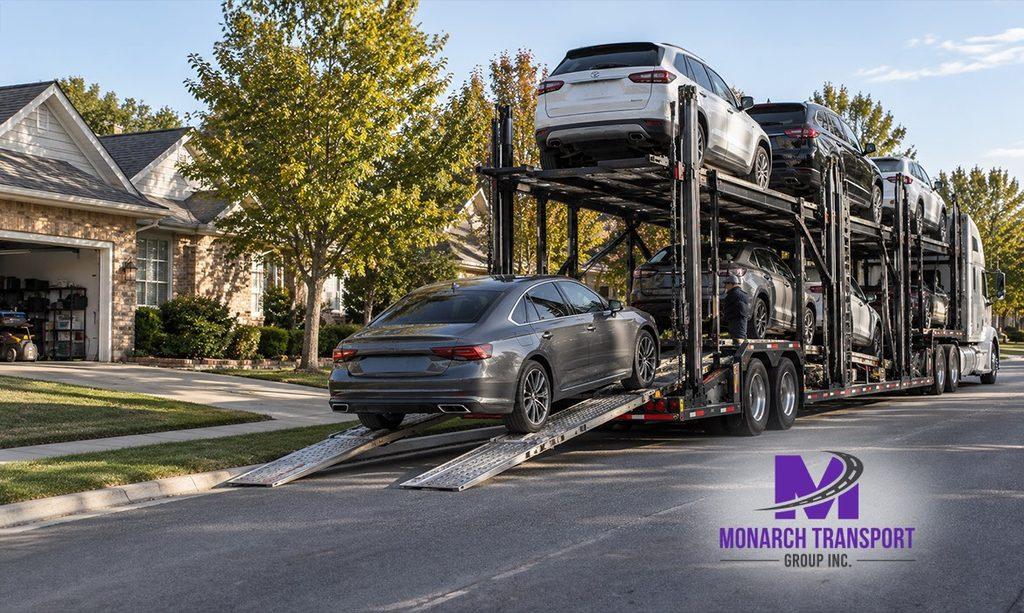
Booking works the same way whether your route is a short regional lane or a full cross-country haul.
Monarch’s car transport service covers standard door-to-door shipping for routes like these, and the shipping services page lists the full range of vehicle types Monarch ships, from cars and motorcycles to ATVs, boats and RVs. If your move needs to happen on a tighter schedule, expedited service is available for time-sensitive shipments.
Pricing Note
The ranges in this guide are planning estimates based on Monarch’s published state-to-state pricing. They are not fixed rates or guaranteed quotes. Actual pricing can change based on pickup and delivery ZIP codes, vehicle size and condition, transport type, season and carrier availability. Get a shipping calculator estimate for your exact route before booking.
Car Shipping Routes FAQ
There is no single published list of the most popular car shipping routes, because demand varies by season, origin, destination and shipment type. Common patterns include short regional moves, snowbird corridors between the Northeast or Midwest and Florida, and long cross-country shipments. Virginia to Ohio, Virginia to Florida and California to North Carolina, covered above, are examples of each pattern.
Open transport is generally the lower-cost option on any route, and shorter, high-traffic corridors tend to have a lower total price than longer or less-traveled lanes. Booking with a flexible pickup window and avoiding peak seasonal demand also help.
At roughly 1,000 miles, a route often falls within the $700–$1,400 range Monarch cites for many continental routes, though the exact price depends on the vehicle, season and specific ZIP codes.
Cross-country routes of 2,000+ miles tend to fall toward the upper end of Monarch’s $500–$1,950 open-transport range, generally $1,400–$1,950, with enclosed transport costing roughly 30–40% more.
There is no single fastest car shipping route. Shorter routes generally have shorter transit times, while pickup speed depends on carrier availability, route density and your pickup date.
Yes, on seasonal corridors. Snowbird routes to Florida, for example, see higher southbound demand in fall and higher northbound demand in spring, which can shift pricing by direction at different times of year.
High-traffic routes can have more regular carrier activity, which may make pricing more competitive than on less frequently served routes of similar length. However, route traffic alone does not determine the final price.
Booking a few weeks ahead generally gives more flexibility on pickup timing and pricing, especially during peak seasons like summer relocations or the fall and spring snowbird windows.
Neither is better in general. Open transport is the standard, lower-cost choice for everyday vehicles on any distance, while enclosed transport is worth the added cost for a high-value or low-clearance vehicle on a long haul.
Related articles

Cross-Country Car Shipping: How to Save Money Safely
IN THIS ARTICLE: Why “Cheap” Doesn’t Have to Mean “Dangerous” 1. Open Transport: The Industry Gold Standard for Savings 2. The Power of “Terminal-to-Terminal” Shipping 3. Timing the Market: The

Open vs. Enclosed Auto Transport: Which Should You Choose?
IN THIS ARTICLE: The Reality of the Road: What is Open Car Shipping? Where Open Transport Makes Perfect Sense Comparison Table: Open Transport Quick Glance The Practitioner Tip: The Myth

Snowbird Car Shipping – How to Send Your Car to Florida for Winter
IN THIS ARTICLE: What Is Snowbird Car Shipping and How Does It Work? When to Book Snowbird Auto Transport to Florida How Much Does Snowbird Car Shipping to Florida Cost?

Seasonal Car Shipping Tips: What to Know Before Shipping in Summer
IN THIS ARTICLE: Why Summer Is the Most Demanding Season for Auto Transport The Price Reality: How Much More Does Summer Shipping Cost? The Heat Problem – What Open Trailers

What to Do If Your Car Is Damaged During Shipping
IN THIS ARTICLE: Key Takeaways What to Do If Your Car Arrives Damaged How Common Is Car Damage During Transport? What Causes Damage During Car Shipping? What Types of Car

Car Shipping by Train: Costs, Process & What to Expect in 2026
IN THIS ARTICLE: The Two Faces of Rail Transport: Consumer vs. Commercial Why Choose the Tracks? (The Human Perspective) Dimensions and Constraints: Will Your Car Fit? The “Hidden” Logic of
