
IN THIS ARTICLE:
- Key Takeaways
- What Does “Car Shipping Near Me” Actually Mean?
- How Local Pickup Works With a Nationwide Car Carrier
- Will a Car Carrier Pick Up My Vehicle at My Home?
- Where Can I Meet a Car Carrier for Pickup?
- Why Do Carriers Sometimes Use Nearby Pickup Locations?
- What Happens on Pickup Day?
- How Long Does Local Car Pickup Take?
- How Much Does Car Shipping Near Me Cost?
- Open vs. Enclosed Transport for Local Pickup
- Can I Ship an Inoperable Vehicle From a Local Pickup Location?
- How to Prepare Your Car for Local Pickup
- What If the Carrier Cannot Reach My Address?
- Local Pickup vs. Local Delivery
- How to Book Car Shipping Near You
- FAQs About Car Shipping Near Me
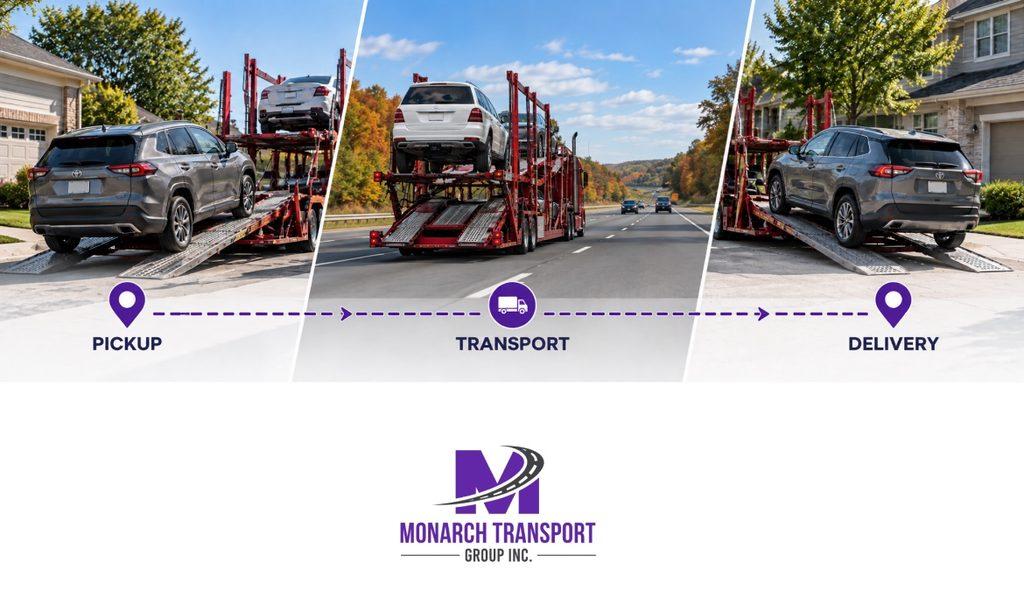
Car shipping near me does not necessarily mean a carrier will pick up your vehicle directly from your driveway, or that the company is based in your city. Nationwide auto transport companies arrange your shipment with a carrier serving the pickup area and traveling toward your destination, and the driver collects the car from your address or, when a large car hauler cannot safely reach it, from a nearby accessible location. That local pickup is the first stage of a longer interstate trip.
This guide explains what “near me” actually means in auto transport, how local pickup works step by step, when a nearby meeting point is used, what happens on pickup day, and how to prepare your vehicle.
Key Takeaways
Need help arranging local pickup for your vehicle? Explore Monarch’s car transport service or call 855-527-5769 to discuss your shipment.
What Does “Car Shipping Near Me” Actually Mean?
“Car shipping near me” refers to where your vehicle is picked up, not to where the carrier is headquartered. People who search for it usually want one of a few things: a company that can collect their car in their area, an estimate for shipping it from their address, or door-to-door service. Related searches include car transport near me, auto transport near me, vehicle pickup near me, and car shipping company near me, and they all point to the same practical question: how does the car get from my location onto a truck?
Does “Near Me” Mean the Carrier Is Based Locally?
No. A nationwide auto transport company can arrange pickup in a local area as part of a longer interstate route, so the carrier does not need to be based near you.
Local pickup and a local carrier are two different things. A truck that collects your car in your city may have started its route in another state and may be heading to a third. In some shipments, the company you book with and the carrier that physically transports your vehicle are separate businesses. This is common when an auto transport broker arranges a shipment with a licensed carrier, as explained in the difference between an auto transport broker and a carrier.
Can a Nationwide Carrier Pick Up My Car Locally?
Yes, in most cases. Monarch transports vehicles throughout the 48 contiguous states, arranges pickup in the customer’s area, and works with carriers serving the route. Shipping to and from Hawaii and Alaska is also available on request. The pickup itself happens locally, at your address or a nearby location, and the long-distance trip starts from there. To see how the service works from booking to delivery, visit Monarch’s car transport service page.
How Local Pickup Works With a Nationwide Car Carrier
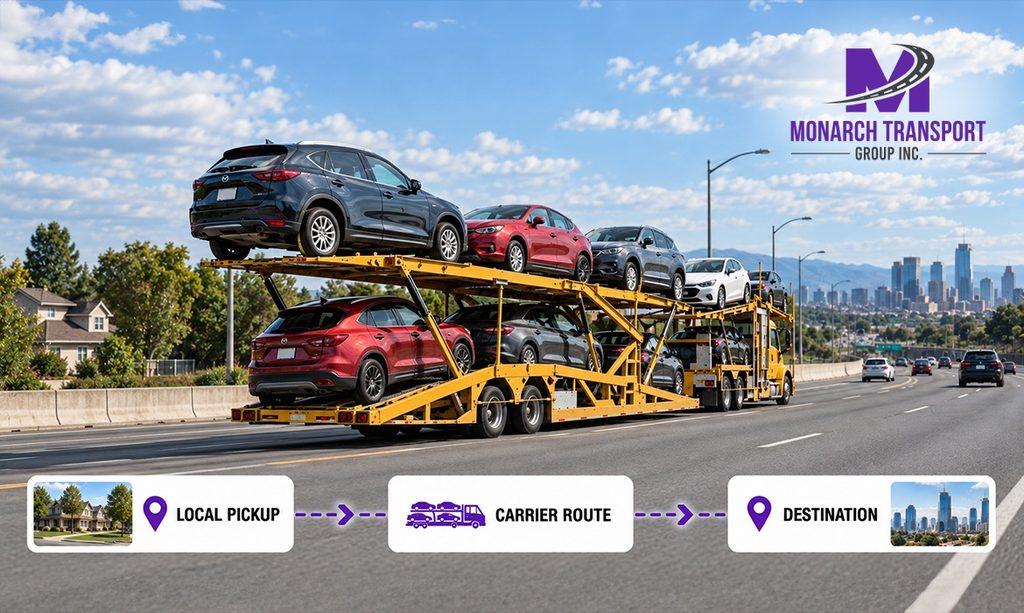
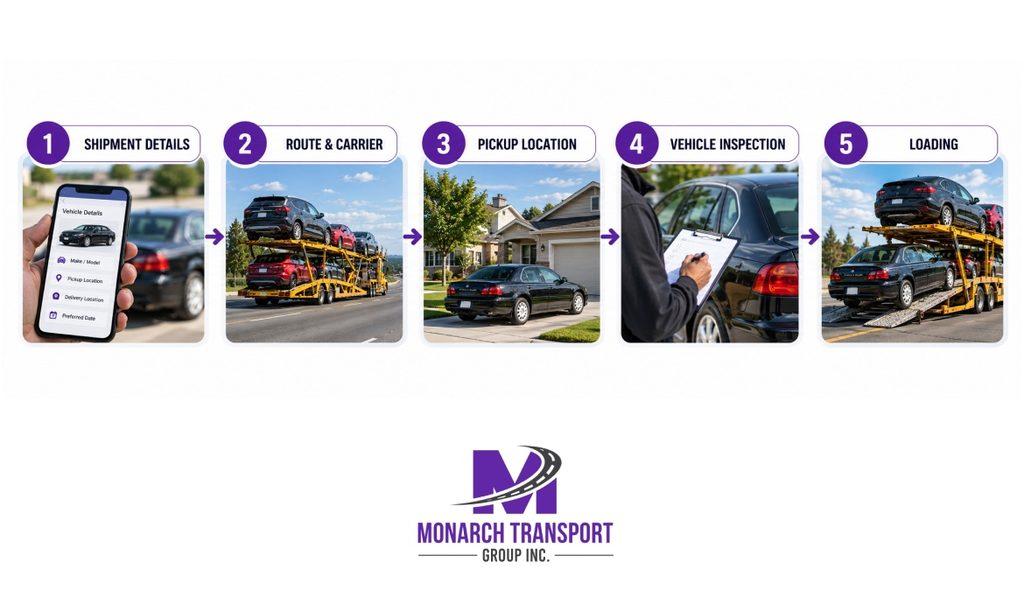
Local pickup is the first stage of an auto transport shipment, when a carrier collects a vehicle from the customer’s address or an agreed nearby location and loads it onto equipment for transport to the destination. The process has five steps.
1. You Provide Your Pickup Address and Vehicle Details
Everything starts with the information the company needs to price the shipment and plan the pickup:
The shipping calculator uses these details to generate an estimate for your shipment.
2. Your Shipment Is Matched to a Carrier Serving the Route
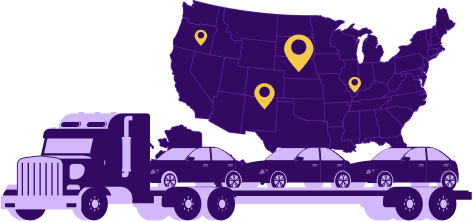
Nobody keeps a truck parked in every neighborhood. Auto carriers run along established routes, and your shipment is arranged with a carrier serving your pickup area and traveling toward your destination. A transport corridor is a commonly traveled route between geographic areas where auto carriers regularly pick up and deliver vehicles. Monarch arranges pickup in the customer’s area and works with carriers serving the route.
Door-to-door service does not necessarily mean your vehicle is stored at a local terminal before pickup. In many shipments, the carrier coordinates pickup directly along its route.
3. The Pickup Location Is Confirmed
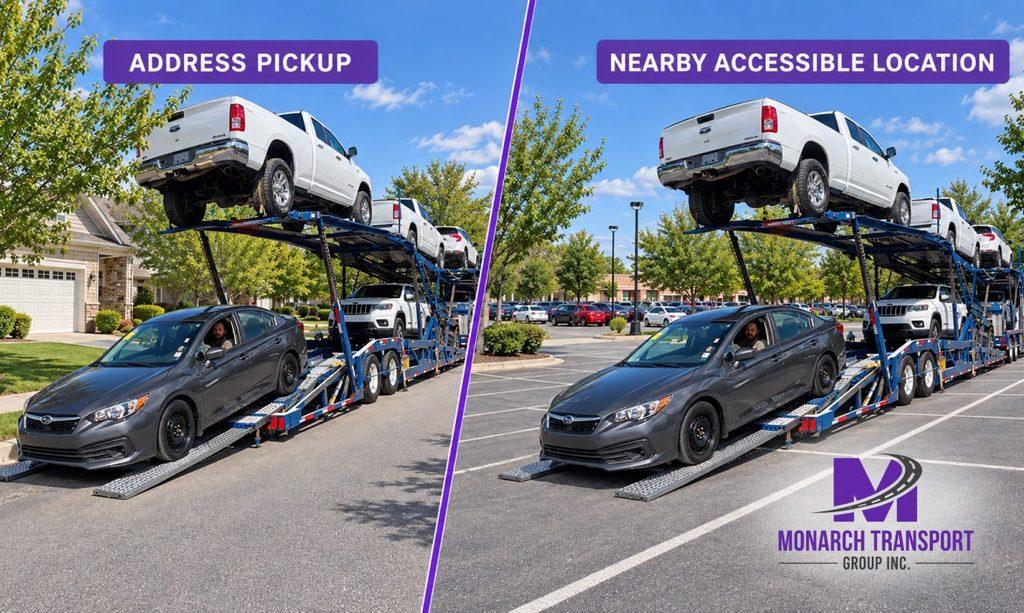
The pickup is either completed at your address or at a nearby accessible location if the truck cannot safely reach the exact address. Drivers generally aim to pick up as close to the requested address as safety, road access, and local restrictions allow, and the carrier works with you to arrange a nearby accessible location when the truck cannot reach it.
4. The Driver Arrives and Inspects the Vehicle
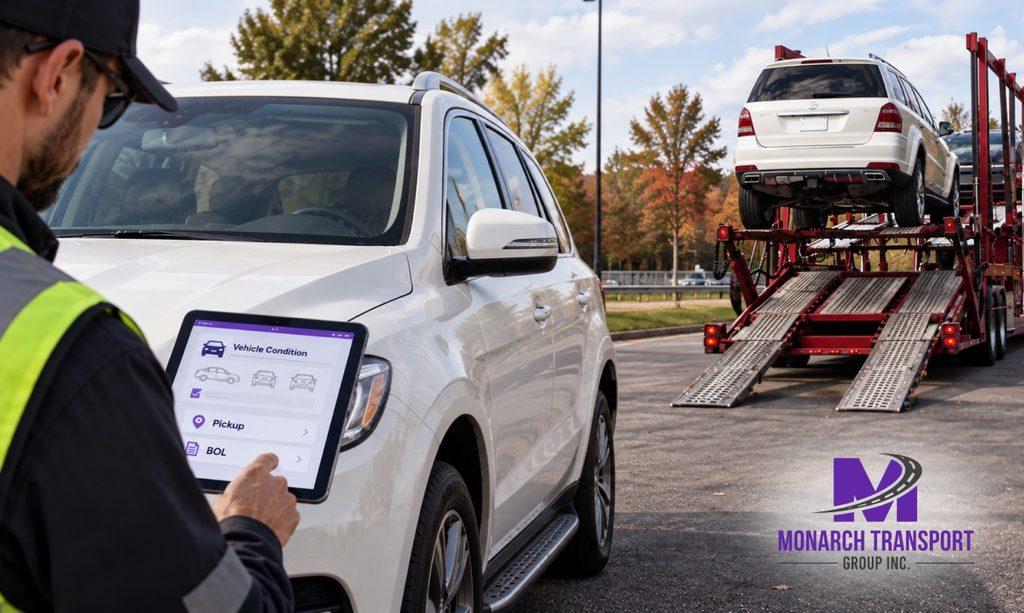
The driver usually contacts you before arriving to confirm timing. At the pickup, you and the driver inspect the vehicle together and record its existing condition, including any scratches or dents. The Bill of Lading documents the shipment and the vehicle’s condition at pickup, and you receive a copy for your records.
5. The Vehicle Is Loaded and Enters the Nationwide Transport Route
Once the inspection is signed, the driver loads and secures the vehicle. From there, the vehicle continues along the carrier’s route to the destination. For a look at route-specific pricing and timing, see Monarch’s state-to-state car shipping service.
Will a Car Carrier Pick Up My Vehicle at My Home?
Often, yes, if the carrier can safely access the address with the equipment being used. If the street is too narrow, restricted, congested, or otherwise unsuitable for a large carrier, pickup may be moved to a nearby accessible location. Monarch’s door-to-door auto transport service is built around your specified address, with the driver working to get as close as safety and legality allow.
When Door-to-Door Pickup Works
Home pickup tends to work when:
When You May Need a Nearby Pickup Location
A nearby location may be needed when the address has:
Where Can I Meet a Car Carrier for Pickup?
A nearby pickup location is an accessible meeting point used when a large car carrier cannot safely or legally reach the customer’s exact address. The location is coordinated with the shipping company and confirmed with the driver before pickup, and it should be somewhere the truck can enter, stop, and leave without blocking traffic.
Common examples include:
Common examples include large parking lots, shopping centers, commercial areas with truck access, and dealerships. If you’re arranging vehicle transport for a dealership rather than an individual shipment, learn more about dealership auto transport.
How Far From My Address Can the Pickup Location Be?
There is no fixed distance. It depends on road access, the size of the truck, local restrictions, the availability of suitable staging areas, and the driver’s route. A location that suits one driver on one route may not suit another, which is why the exact spot is confirmed for each shipment instead of being set by a general rule.
Why Do Carriers Sometimes Use Nearby Pickup Locations?
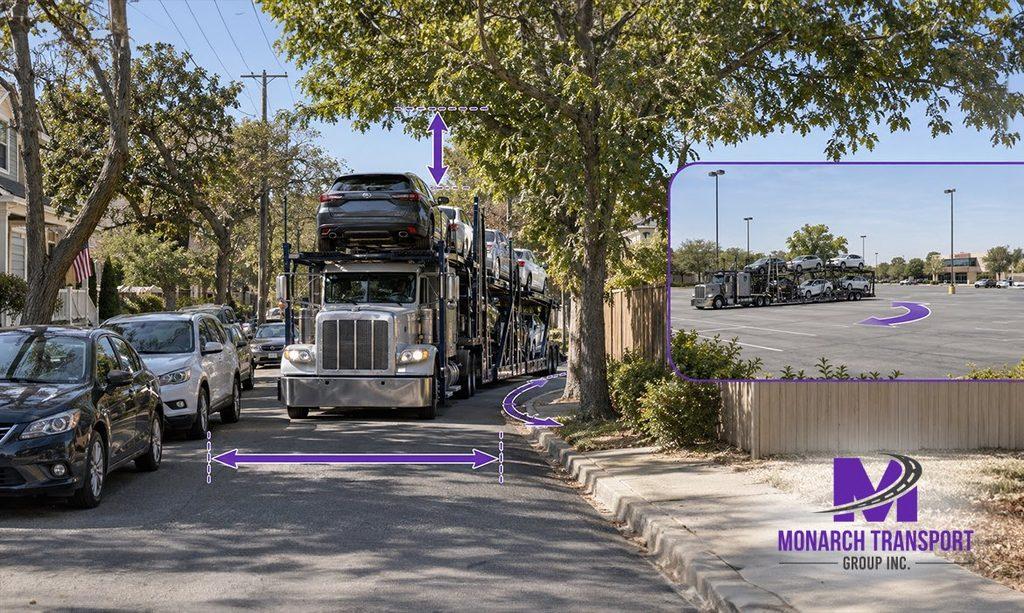
Large auto transport equipment may require adequate road width, turning space, clearance, and legal access. When an address does not meet those conditions, the carrier may arrange pickup at a nearby accessible location. It is a practical decision based on the truck and the street.
Large Auto Transport Trucks Need More Road Space
Large automobile transporters can demand considerable road space. Federal rules also set requirements related to the size of certain automobile transporters, which is one reason narrow streets, tight turns, and restricted access can make direct pickup impractical. A rig of that kind needs room to enter a street, stop, lower its loading ramps, and pull out again.
A Nearby Pickup Can Make Loading Easier
Moving the handoff to an accessible location can make loading and departure easier when the stated address is difficult to access.
Local Pickup Locations Can Improve Safety and Accessibility
Loading a car requires lowering ramps and moving vehicles, which is easier to manage when there is sufficient space around the truck and less interference from through traffic. A wide parking lot gives the driver room to do that, and it gives you room to walk around the vehicle during the inspection.
What Happens on Pickup Day?
On pickup day, the driver meets you at the confirmed location, inspects the vehicle with you, records its condition on the Bill of Lading, loads the car and continues along the transport route. In order:
Monarch asks that you or a trusted adult be present at both pickup and delivery. That person documents the vehicle’s condition and signs the Bill of Lading, which serves as a receipt confirming the condition of the car at each stage. Keep your copy, because it is the record you will compare against at delivery. If something looks different when the car arrives, the guide on what to do if your car is damaged during shipping walks through the next steps.
How Long Does Local Car Pickup Take?
Local pickup timing has two parts that are easy to confuse, and mixing them up leads to wrong expectations about when a car will arrive.
Pickup Window vs. Transit Time
Pickup window is when the carrier arrives to collect your vehicle. Transit time is how long the vehicle is in transit after pickup. They are separate clocks: the pickup window depends on how quickly a driver is assigned and how close your route is to their schedule, while transit time depends on distance, route and conditions on the road.
Pickup timing is a separate question. With standard service, pickup usually happens within 3 to 7 days, while expedited car shipping can get your vehicle picked up in as little as 1 to 3 days. Both timeframes depend on carrier availability on your specific route, so treat them as typical pickup windows rather than guarantees, and ask for the expected pickup date when you book. For the transit side, see how long car shipping takes.
What Can Delay a Local Pickup?
Several things can move a pickup window:
Driver hours are another limit. Federal hours-of-service regulations restrict how long commercial drivers may be on duty and driving, so a delay earlier on the route can shift the pickup time later in the day.
How Much Does Car Shipping Near Me Cost?
There is no single price for “car shipping near me” because “near me” describes the pickup area, not the complete shipping route. The price depends on the whole shipment, from the pickup location to the destination, not on the distance between your house and a meeting point.
What Determines the Cost of Local Car Shipping?
For a longer look at how these factors add up, see Monarch’s guide to the cost to ship a car between states.
Does Using a Nearby Pickup Location Lower the Price?
Not necessarily. The price is built around the whole shipment route and the transport conditions, not around how far the meeting point is from your door. A nearby pickup location can make the pickup possible, and in some cases easier for the driver, but it should not be treated as a way to reduce the quote. If you are unsure, ask the company whether a change in pickup location affects your price before you agree to it.
Open vs. Enclosed Transport for Local Pickup
Both transport types start with the same local pickup, but the trailer changes what the shipment offers. Open transport uses an open carrier, and enclosed transport uses a covered trailer.
| Factor | Open Transport | Enclosed Transport |
| Trailer type | Open carrier | Enclosed trailer |
| Typical use | Everyday vehicles | Luxury, classic and specialty vehicles |
| Weather exposure | Exposed | Reduced |
| Capacity | Higher | Lower |
| Cost | Generally lower | Generally higher |
The pickup process itself can look very similar for both. The difference is that accessibility requirements can vary with the equipment, since a given trailer may need more or less room to maneuver. Neither option is better in general. To weigh them for your own vehicle, see the comparison of open vs. enclosed auto transport.
Can I Ship an Inoperable Vehicle From a Local Pickup Location?
Often, yes, but a vehicle that does not run needs extra planning. Monarch can ship inoperable vehicles and should be told about the condition in advance. To be loaded onto a standard car hauler trailer, a vehicle needs to be able to roll, brake, and steer. A vehicle that can’t do those things can usually still be shipped, but on a flatbed, with a loader service to load and unload it. The exact answer depends on what is wrong with the vehicle:
What Equipment May Be Needed?
Depending on the vehicle’s condition, the driver may need a winch, specialized loading equipment or a trailer configuration built for non-running vehicles. Not every truck has this equipment, which is why disclosure matters.
Tell the transport company that the vehicle is inoperable before pickup so the carrier can determine whether additional equipment is required. A driver who arrives without the right gear may not be able to load the car. Monarch’s preparation checklist covers what a non-running vehicle still needs.
How to Prepare Your Car for Local Pickup
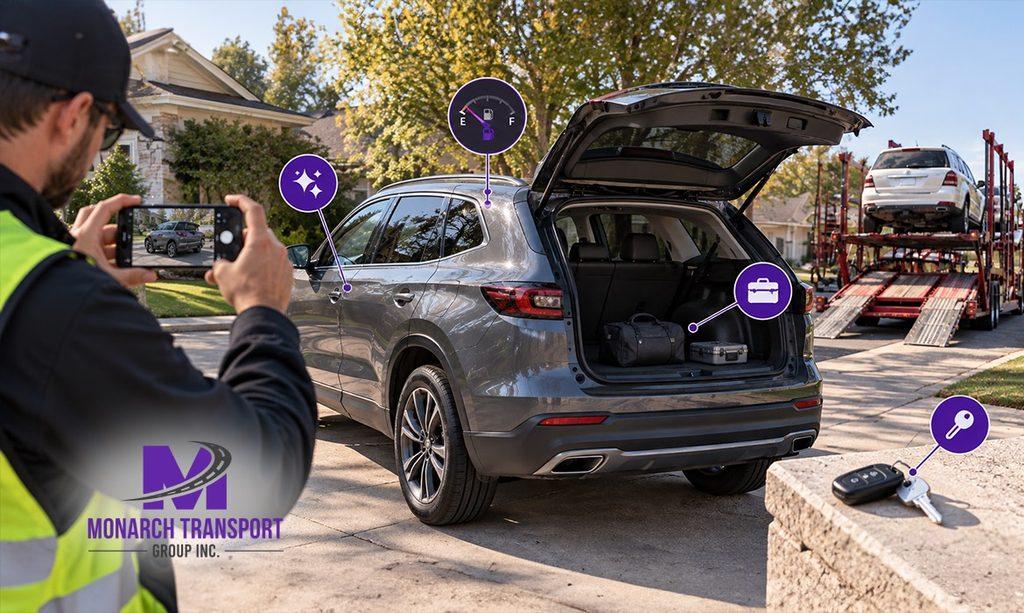
A little preparation before the driver arrives keeps the handoff short and the inspection accurate. Monarch’s checklist and its full step-by-step guide to preparing your car for shipping cover the details.
Before the Driver Arrives
What to Remove From the Car
Monarch’s checklist recommends removing all personal belongings and valuables from the cabin. Policies on personal items vary between companies and carriers, so if you are thinking of leaving anything in the vehicle, ask the transport company what, if anything, is permitted before pickup day, and do not assume a general weight limit.
What If the Carrier Cannot Reach My Address?
When a large truck cannot reach your address, the shipment can still go ahead. The driver and the company agree on a nearby accessible location, the vehicle is inspected and loaded there, and the rest of the shipment follows the usual steps.
The best time to raise access concerns is when you book. If you know your street is narrow, has low trees, or sits in a restricted community, say so up front so the company can plan a meeting point ahead of pickup day.
Will I Need to Drive My Car to the Pickup Location?
If the vehicle is operational, you may be able to bring it to the agreed meeting point, depending on the pickup arrangement. If the car does not run, tell the company as early as possible, because moving it may need different equipment or a different pickup arrangement. Either way, the person handing over the vehicle needs to be there for the inspection.
Local Pickup vs. Local Delivery
Local pickup is where the vehicle enters the transport network, and local delivery is where it leaves it. The same access rules apply at both ends.
| Local Pickup | Local Delivery |
| Vehicle enters the transport network | Vehicle leaves the transport network |
| Origin location | Destination location |
| Initial inspection | Final inspection |
| Loading | Unloading |
At delivery, the driver brings the car as close to the address as safety and legality allow, or meets you at a nearby accessible location, and you compare the vehicle with the pickup inspection report before signing.
How to Book Car Shipping Near You
Booking takes four steps, and most of the work is in the details you give at the start.
1. Get a Quote
Use the shipping calculator to get an estimate for your route and vehicle.
2. Provide Pickup and Delivery Details
Give exact ZIP codes, the vehicle’s details and condition, your preferred transport type, and your pickup date.
3. Confirm the Pickup Arrangement
Check whether the truck can reach your address, agree on a nearby meeting point if it cannot, and confirm the pickup window.
4. Prepare for Pickup
Clean and photograph the vehicle, remove personal items, have the keys ready, and make sure you or a trusted adult will be there for the inspection.
To get started, request a quote for Monarch’s car transport service. If you are booking directly with a carrier, you can verify its federal registration through FMCSA’s SAFER Company Snapshot.
FAQs About Car Shipping Near Me
Often, yes. If the truck can safely reach your street and stop near the address, the driver loads the car there. If it cannot, the pickup moves to a nearby accessible location.
You do not need a company based in your city, because nationwide companies arrange local pickups along their routes. What matters is that the company clearly explains whether it is a broker or a carrier, serves your area, provides the terms of the shipment, and can be verified through the appropriate federal registration records. If you are booking with a carrier, you can verify its federal registration through FMCSA’s SAFER Company Snapshot.
No. The phrase describes where the vehicle is picked up, and the carrier can be based anywhere along the route.
Sometimes. It depends on the street’s width, clearance, and local restrictions, and on the size of the truck. A wide, open street is usually workable, while a narrow street with overhanging trees may not be.
The driver and the company arrange a nearby accessible location, such as a large parking lot, where the car can be inspected and loaded safely.
There is no fixed distance. It depends on road access, the truck, and the staging areas available near your address, and it is confirmed for each shipment.
Monarch asks that you or a trusted adult be present at both pickup and delivery to document the car’s condition and sign the Bill of Lading.
Possibly. Non-running vehicles need special equipment, so tell the company about the condition before pickup and confirm that the driver can load the car.
Neither is better in general. Open transport is the more common and generally lower-priced choice, while enclosed transport offers more protection from weather and road debris and generally costs more.
The price depends on the full route, the vehicle, the trailer type and the timing, not on the distance to the meeting point. Use the shipping calculator for an estimate on your route.
Related articles
Auto Transport Broker vs. Carrier: Which One Should You Use?
IN THIS ARTICLE: What Is an Auto Transport Broker? What Is an Auto Transport Carrier? The Key Differences Side by Side Does Using a Broker Cost More? What Is “Dual

Car Shipping by Train: Costs, Process & What to Expect in 2026
IN THIS ARTICLE: The Two Faces of Rail Transport: Consumer vs. Commercial Why Choose the Tracks? (The Human Perspective) Dimensions and Constraints: Will Your Car Fit? The “Hidden” Logic of
Car Shipping Deposit Explained – Why Brokers Ask for It and When You Pay
IN THIS ARTICLE: How the Auto Transport Payment Structure Works What the Car Shipping Deposit Actually Pays For How Much Should a Car Shipping Deposit Be? Broker Deposit vs. Carrier

Car Shipping Insurance: What’s Actually Covered (And What’s Not)
IN THIS ARTICLE: The Most Important Distinction Nobody Tells You Upfront What Car Shipping Insurance Actually Covers What Is NOT Covered – The Real Exclusions Coverage Limits – What the
Cross-Country Car Shipping: How to Save Money Safely
IN THIS ARTICLE: Why “Cheap” Doesn’t Have to Mean “Dangerous” 1. Open Transport: The Industry Gold Standard for Savings 2. The Power of “Terminal-to-Terminal” Shipping 3. Timing the Market: The

Enclosed Car Shipping: The Gold Standard for Luxury and Exotic Vehicle Transport
IN THIS ARTICLE: Why “Standard” Transport Doesn’t Cut It for Masterpieces The Anatomy of Protection: Hard-Sided vs. Soft-Sided Trailers The Low-Clearance Nightmare: Why Hydraulic Lifts Matter Beyond the Walls: The
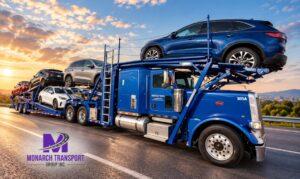
How Car Carrier Trucks Work: Single-Car vs Multi-Car Transport Explained
IN THIS ARTICLE: Key Takeaways What Is a Car Carrier Truck? How Does a Car Carrier Truck Work? Single-Car vs. Multi-Car Carrier: What Is the Difference? How Multi-Car Carriers Work

How Long Does It Take to Ship a Car? Realistic Timelines by Route & Season
IN THIS ARTICLE: The Two Timelines Nobody Separates (But Should) Realistic Transit Times by Route Distance Dispatch Time by Season: The Variable Nobody Controls How Route Type Affects Your Timeline
